

The capacity of hard drives continues to increase, but the growth rate has been steadily declining in recent years. For example, it took the industry only two years to release the first 4 TB drive after 2 TB HDDs became available, three years to reach the 8 TB mark, and it took five years to double the capacity of a 3.5-inch hard drive again.
The latest leap has been made possible by a whole list of innovative solutions. Today, even conservatives like Toshiba, which until recently refused to use helium, are forced to produce hard drives in sealed enclosures, and the number of platters on the spindle has increased to nine — although, for a long time, five platters were considered a reasonable limit. In specific niches, the technology known as Shingled Magnetic Recording (SMR) is used, where the tracks of sectors on the platter partially overlap. Finally, to shift the hard drive capacity limit from 14 to 16 TB without employing SMR, manufacturers had to implement one of the promising technologies, the gradually shrinking list of which we reproduce in our annual , — reading the track with multiple heads simultaneously (TDMR, Two-Dimensional Magnetic Recording). Further advances will inevitably require more significant changes in the fundamental operation of HDDs — such as heating the platter with lasers or microwaves (HAMR/MAMR, Heat/Microwave-Assisted Magnetic Recording) while the writing head passes over.
However, it is easy to notice that all the described techniques primarily aim at increasing recording density and expanding capacity on a single spindle, although many of them have a beneficial side effect of increased linear reading and writing speeds. In this regard, modern HDDs have surpassed the limit of 250 MB/s and are already comparable to early consumer solid-state drives. However, the access speed to random sectors of magnetic disks has hardly progressed, and in terms of volume, the number of operations per second only decreases. At the same time, there are increasing demands for fault tolerance, as the more data is stored on a single spindle, the more crucial it is to avoid data loss and the longer it takes to recover.
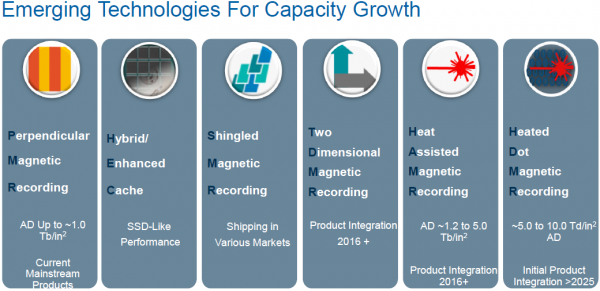
But the creators of magnetic storage found a response to this challenge. We took three hard drives with capacities ranging from 14 to 16 TB to see how the technologies of 64 years ago adapt to the realities of 2019, and noticed several trends. The champion samples of modern 3.5-inch hard drives, made for rack servers and storage systems, have something in common with solid-state drives — from the principles of sector addressing to the direct integration of flash chips into the local memory stack. Consumer models, in turn, have become closer in their characteristics to server counterparts, and even the description "desktop HDD" no longer says much about the performance and reliability of the device. However, the purpose of this review is not limited to general statements. We aim to determine how the new trends in hard drive design are reflected in solid performance measurement figures.
Technical specifications of the test participants
Before we begin analyzing the test results, it's important to closely examine the specifications of the devices we will be dealing with. This time, there aren't as many as usual in our group tests, but we have met the main criteria without which the comparison of hard drives could not claim completeness. The review featured products from all three manufacturers — Seagate, Toshiba, and Western Digital, and they belong to various categories: consumer and server. The main specifications that unite them are a capacity of either 14 or 16 TB, a sealed helium-filled casing, and a spindle speed of 7200 RPM. Additionally, for comparison with heavier models, three familiar smaller capacity devices (10 and 12 TB) designed for operation in servers, home or office NAS devices are included in the testing.
| Manufacturer | Seagate | Toshiba | Western Digital | |||
|---|---|---|---|---|---|---|
| Series | BarraCuda Pro | Exos X10 | IronWolf | MG08 | S300 | Ultrastar DC HC530 |
| Model Number | ST14000DM001 | ST10000NM0016 | ST12000VN0008 | MG08ACA16TE | HDWT31AUZSVA | WUH721414ALE6L4 |
| Form Factor | 3.5 inches | 3.5 inches | 3.5 inches | 3.5 inches | 3.5 inches | 3.5 inches |
| The PerformanceResourceTiming | SATA 6 Gb/s | SATA 6 Gb/s | SATA 6 Gb/s | SATA 6 Gb/s | SATA 6 Gb/s | SATA 6 Gb/s |
| Capacity, GB | 14 000 | 10 000 | 12 000 | 16 000 | 10 000 | 14 000 |
| Configuration | ||||||
| Spindle Speed, RPM | 7 200 | 7 200 | 7 200 | 7 200 | 7 200 | 7 200 |
| Data Density, GB/Platter | 1 750 | 1 429 | 1 500 | 1 778 | 1 429 | 1 750 |
| Number of Platters/Heads | 8/16 | 7/14 | 8/16 | 9/18 | 7/14 | 8/16 |
| Sector Size, Bytes | 4096 (512-byte emulation) | 4096 (512-byte emulation) | 4096 (512-byte emulation) | 4096 (512-byte emulation) | 4096 (512-byte emulation) | 4096 (512-byte emulation) |
| Buffer Size, MB | 256 | 256 | 256 | 512 | 256 | 512 |
| Performance | ||||||
| Max. Sustained Sequential Read Speed, MB/s | 250 | 249 | 210 | N/A | 248 | 267 |
| Max. Sustained Sequential Write Speed, MB/s | 250 | 249 | 210 | N/A | 248 | 267 |
| Average Seek Time: Read/Write, ms | N/A | N/A | N/A | N/A | N/A | 7.5/N/A |
| Fault tolerance | ||||||
| Workload Rate, TB/week | 300 | N/A | 180 | 550 | 180 | 550 |
| Unrecoverable Read Errors, number of occurrences per volume of data (bits) | 1/10^15 | 1/10^15 | 1/10^15 | 10/10^16 | 10/10^14 | 1/10^15 |
| MTBF (Mean Time Between Failures), hours | N/A | 2 500 000 | 1 000 000 | 2 500 000 | 1 000 000 | 2 500 000 |
| AFR (Annualized Failure Rate), % | N/A | 0,35 | N/A | N/A | N/A | 0,35 |
| Number of Head Parking Cycles | 300 000 | 600 000 | 600 000 | 600 000 | 600 000 | 600 000 |
| Physical Specifications | ||||||
| Power Consumption: Idle/Read-Write, Watts | 4,9/6,9 | 4,5/8,4 | 5,0/7,8 | N/A | 7,15/9,48 | 5,5/6,0 |
| Noise Level: Idle/Seek, dB | N/A | N/A | 1,8/2,8 | 2.0/N/A | 3.4/N/A | 2,0/3,6 |
| Maximum Temperature, °C: Drive On/Drive Off | 60/70 | 60/N/A | 70/70 | 55/70 | 70/70 | 60/70 |
| Shock Resistance: Drive On/Drive Off | N/A | 40 g (2 ms) / 250 g (2 ms) | 70 g (2 ms) / 250 g (2 ms) | 70 g (2 ms) / 250 g (2 ms) | 70 g (2 ms) / 250 g (2 ms) | 70 g (2 ms) / 300 g (2 ms) |
| Dimensions: L × H × W, mm | 147 × 101,9 × 26,1 | 147 × 101,9 × 26,1 | 147 × 101,9 × 26,1 | 147 × 101,9 × 26,1 | 147 × 101,9 × 26,1 | 147 × 101,6 × 26,1 |
| Weight, g | 690 | 650 | 690 | 720 | 770 | 690 |
| Warranty period, years | 5 | 5 | 3 | 5 | 3 | 5 |
| Retail Price (USA, excluding tax), $ | From 549 (newegg.com) | From 289 (newegg.com) | From 351 (newegg.com) | N/A | From 301 (newegg.com) | From 439 (amazon.com) |
| Retail price (Russia), rub. | From 34,348 (market.yandex.ru) | From 17,498 (market.yandex.ru) | From 26,320 (market.yandex.ru) | N/A | From 19,784 (market.yandex.ru) | From 27,495 (market.yandex.ru) |
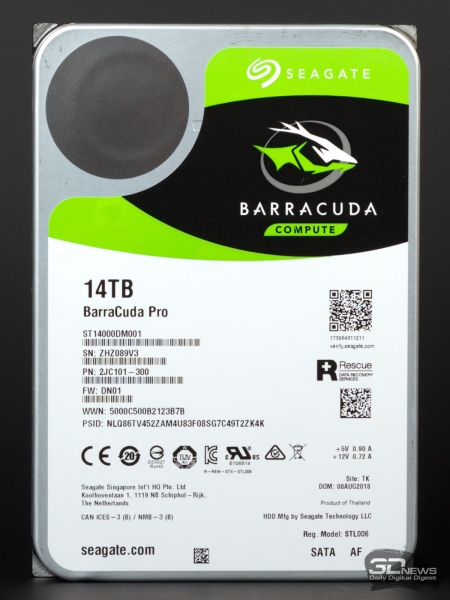
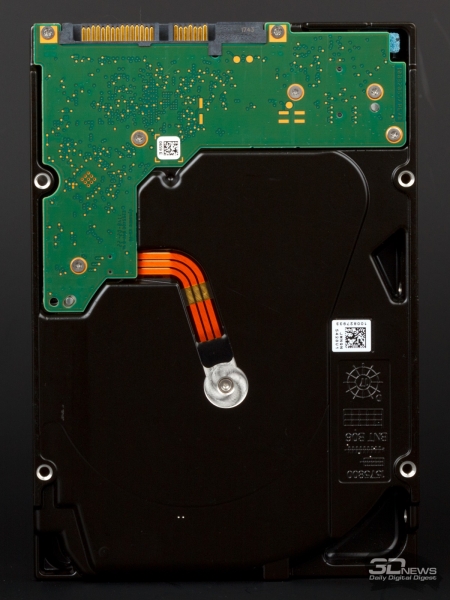
The first model in our modest collection of hard drives with impressive capacity — the BarraCuda Pro 14TB — is meant for desktop PCs and DAS, but it is not just any drive; it is a 'professional' model. This means that the BarraCuda Pro is subject to the usual limitations of desktop hard drives. For instance, it is not designed for RAID configurations, as having TLER (Time-Limited Error Recovery) is desirable to prevent HDDs from dropping out of the array due to prolonged attempts by the microcontroller to read a problematic sector. Additionally, the BarraCuda Pro chassis is poorly suited for use in shelves or NAS setups with multiple trays, as it lacks rotational vibration compensation.
On the other hand, unlike most other desktop HDDs, drives of this brand have an increased annual workload limit — up to 300TB of rewrites, are ready to operate 24/7, and come with a five-year warranty. Performance certainly won't be a complaint (at least for tasks with predominantly linear data access): thanks to eight platters of 1.75TB, the device achieves a sustained throughput of 250MB/s. Furthermore, the manufacturer promises that random access speed in the BarraCuda Pro should be higher compared to regular desktop drives, while power consumption is lower than that of most 3.5-inch models. However, we'll still verify all of Seagate's claims.
To achieve such a high data density within the standard perpendicular recording without using the niche SMR (Shingled Magnetic Recording) technology, Seagate had to implement one of the advanced methods that we write about year after year in our... , known as Two-Dimensional Magnetic Recording (TDMR). However, despite its name, TDMR is not associated with the actual data recording process, but is intended to increase the signal-to-noise ratio under high track density conditions on the magnetic plate by simultaneously reading the track with two read heads: these are spaced in such a way that their field captures adjacent tracks, making it easier to compensate for interference. In the future, hard drives with TDMR will have even more heads, and with data reading reliability, its speed may also increase, but that is still a matter for the future.
The BarraCuda Pro drives significantly differ from the related devices in the lower series without the Pro suffix — starting with the fact that all manufacturers' standard desktop HDD models are stuck at 6–8 TB capacity. The BarraCuda Pro disk can be described as a descendant of the Seagate server line, lacking the features associated with working in arrays. Consequently, the price of the device has soared to the level of enterprise models, or even higher: in Russia, a 14-terabyte model is not found for less than 34,348 rubles, and on retail platforms in the USA — $549. Even nearline models from Seagate of the same capacity cost less — starting at $375 or 28,936 rubles.
 |  | |
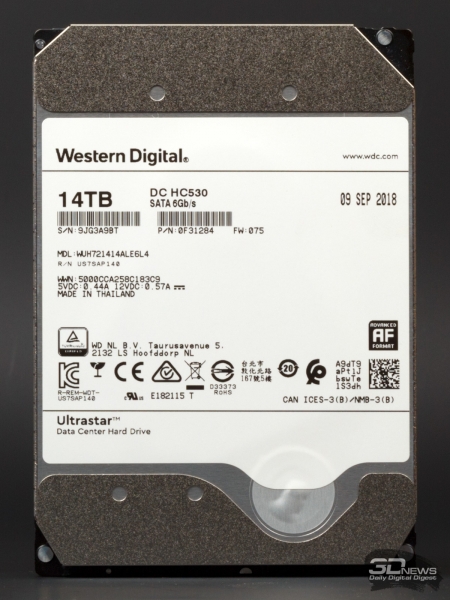
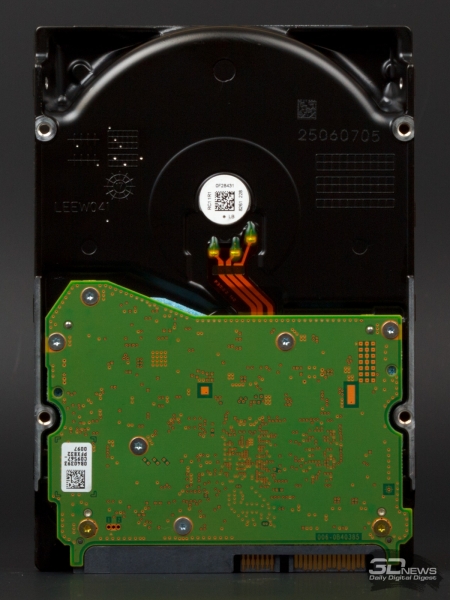
The next subject, the 14-terabyte Ultrastar DC HC530 disk, is a nearline-class drive that represented the best that Western Digital engineers could offer until the release of the new 16 TB model. In 3DNews' experience, it became the first Ultrastar hard drive lacking the familiar HGST letters in its name: the company transitioned all server models to its own brand after HGST's assets were fully absorbed into the merged corporation. In its key specifications, this device is similar to the BarraCuda Pro of the same capacity: inside the sealed casing, the Ultrastar DC HC530 also has eight magnetic plates with a usable capacity of 1,750 GB, and data reading from closely spaced tracks is facilitated by TDMR technology. However, in terms of other parameters and the variety of additional features characteristic of enterprise HDDs, the Ultrastar DC HC530 cannot be placed on the same level with desktop models, although the BarraCuda Pro is not a typical representative of its category.
Thus, the useful recording density on the BarraCuda Pro and Ultrastar DC HC530 platters is the same as the spindle speed, but WD's product guarantees a higher sustained linear read and write speed—up to 267 MB/s (it's unclear where the difference comes from, but tests will show if it actually exists). Random access latency is reduced by the new second-generation two-stage actuator and a large 512 MB buffer, with the main feature being Media Cache—reserved zones for quick block writes scattered across the platter surface. This last feature links modern nearline drives to solid-state drives, where there is also a variable relationship between physical sectors and logical blocks. Starting with the 10-terabyte models of Ultrastar DC HC330, WD utilizes a small amount of flash memory for write caching operations. It should be noted that alongside the (potentially) extremely high speed by magnetic drive standards, WD's product boasts a moderate power consumption, in fact being the device with the lowest energy consumption among all test participants, judging by its specifications.
Drives of this class are designed for continuous operation in server rack environments: the spindle's bi-directional mounting, rotational vibration compensation—these and other structural features of the Ultrastar DC HC530 have allowed the drive's workload rating to reach 550 TB/year, while the mean time between failures is typical for nearline models at 2.5 million hours. In case of an unlikely failure during firmware updates, a spare chip is soldered onto the controller board. The drive is available in configurations with native 4 KB sector access or emulating 512-byte sectors, with either a SATA or SAS interface. In the latter case, an option for end-to-end data encryption is also available.
Retail prices for the WD Ultrastar DC HC530 in the configuration with a SATA port and emulation of legacy 512-byte sectors match the cutting-edge specifications and technologies of this device: from 27,495 rubles in Russian online stores to $439 on Amazon.
 |  | |
Assembling a collection of 14 TB hard drives for comparative testing was quite challenging, and we couldn't obtain a suitable third-party device from Toshiba. Instead, we got a model from the next generation, with 16 TB. Currently, all three companies that produce hard drives offer storage devices of this capacity, but Toshiba's MG08 series product was the first among them. The Japanese company's record is based on platters with approximately, if not exactly, the same recording density as the 14 TB BarraCuda Pro and Ultrastar hard drives, but Toshiba was able to fit nine 'disks' into a standard 3.5-inch casing for the first time. The TDMR technology was also essential in breaking new capacity barriers. The throughput of the Toshiba MG08 in sequential read/write operations is expected to be on par with the WD Ultrastar DC HC530, but curiously, the manufacturer does not disclose any performance details about the device.
It is known that Toshiba has also taken measures to increase reliability while simultaneously reducing write operation latency: the flash memory chip on board the MG08 allows data sent by the host controller for writing to be preserved in the event of a power failure. However, test results indicate that it also functions as a second-level cache after the DRAM buffer. This technology (Persistent Write Cache) is only mentioned in the specifications of drives emulating 512-byte formatting, which is an additional source of risk during a power failure (and to some extent, it steals performance) due to the need to perform read-modify-write operations for each logical block write that does not align with the boundaries of physical sectors. Notably, the MG08 series also includes models with native access to 4-kilobyte sectors. Whether this means that the latter are completely devoid of flash memory or simply lack the backup function is unknown. However, regardless of PWC, Toshiba MG08 and other drives from this company employ Dynamic Cache algorithms, which, according to the manufacturer, optimally allocate buffer space between read and write operations. We also do not have any detailed information on them.
Other sources of increased fault tolerance in the Toshiba MG08 design include spindle mounting on both sides and rotational vibration sensors. These drives are rated to write 550 TB of data per year, have a standard workload rating of 2.5 million hours for enterprise devices, and come with a five-year warranty. Several different disk configurations with SATA or SAS interfaces and an optional end-to-end encryption feature are available for order. However, we cannot provide price guidance: the 16-terabyte Toshiba drive was introduced back in January, but it is still a rare find in retail.
Toshiba MG08 16 TB
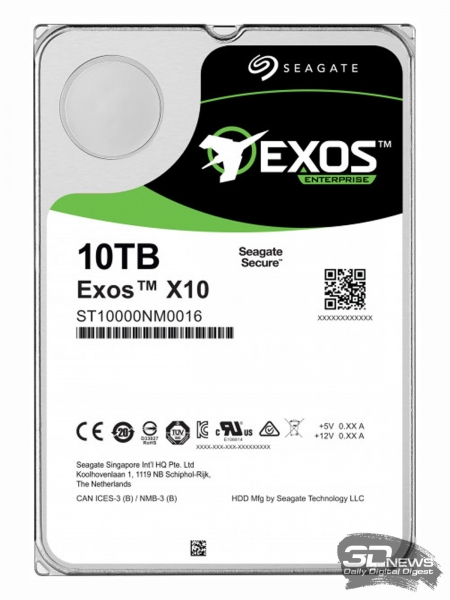
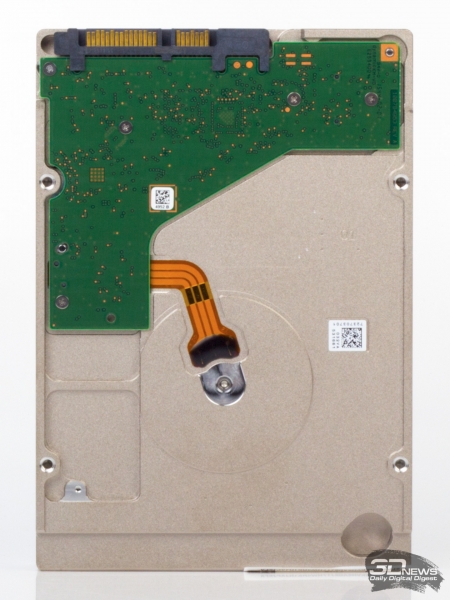
Now that we have gotten to know the three main participants in testing, let's take a look at smaller capacity hard drives with which we will compare the new 14-16 terabyte models. One of them, the Exos X10 with a capacity of 10 TB, is a nearline drive containing seven magnetic platters in a sealed casing. And although the usable capacity of the platter has increased from 1429 to 1750 GB and more, the sequential access speed of hard drives should also have increased. By this parameter, the Exos X10 practically matches the same 14 TB BarraCuda Pro according to the specifications of both drives. Something clearly doesn't add up in the specifications of Seagate hard drives, but we have the opportunity to find out everything in practice.
To increase access speed for random operations, the Exos series features an advanced write caching mechanism, AWC (Advanced Write Caching), which reduces response time. Within AWC, write operations are grouped in the DRAM buffer, as is the case with any other hard drive; however, the buffer retains a copy of the data after it has been written to the platter, and the contents of the mirror buffer can be immediately read by the host controller. In the 2.5-inch form factor, AWC includes the next speed tier — reserved areas on the platter surface, where data from DRAM is written in a sequential order (Media Cache), as well as a small amount of non-volatile memory to save data from the buffer during a power failure. But in the Exos X10, flash memory is absent, and possibly Media Cache along with it.
Consumer-grade hard drives for desktop computers and NAS differ in the Exos series with high metrics for mean time between failures (2.5 million hours) and a calculated workload (550 TB/year), the ability to operate in a server rack without restrictions on the number of bays, and a five-year warranty period. The hard drive with model number ST10000NM0016, which we received for testing, additionally belongs to the Hyperscale modifications, which feature reduced power consumption compared to other Exos family members, but are only available with SATA interface and 512-byte sector emulation. In SAS interface configurations among Exos models, there are also variants with native access to 4-kilobyte sectors and a full disk encryption function.
 |  | |
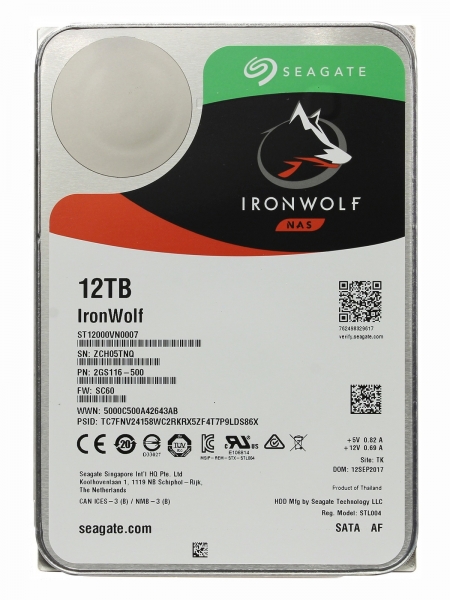
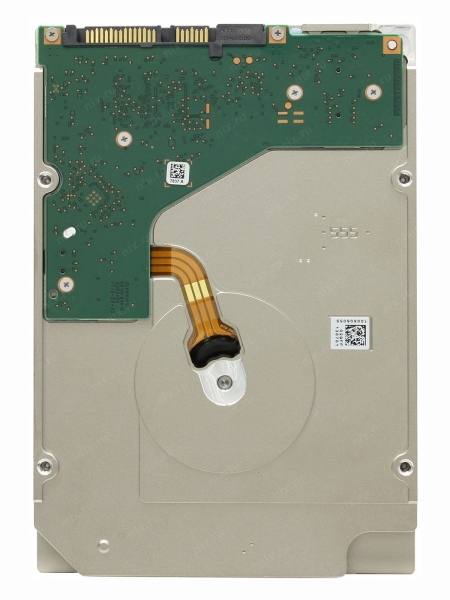
The Seagate IronWolf hard drive was recently featured in of new products from this brand along with the Seagate solid-state drive for network storage. The 12-terabyte IronWolf model appears to be equipped with platters that have the same physical recording density as the Exos X10, except here there is one more. However, Seagate rates the performance of its creation in sequential read and write operations much lower — only 210 MB/s. There are also no sophisticated technologies aimed at compensating for the high response latency inherent in magnetic drives.
However, all IronWolf hard drives, starting from a capacity of 4 TB, have borrowed several hardware features from the Exos series that contribute to increased fault tolerance. The magnetic platter assembly of each hard drive is balanced in two planes, and rotational vibration sensors ensure stable operation in rack-mounted storage systems or standalone NAS devices with up to eight drive bays. IronWolf is designed for moderate usage mode with a workload rating of 180 TB/year and features a mean time between failures of 1 million hours. As a result, the warranty period for IronWolf is not as long as that for more serious models in Seagate's catalog — three years.
 |  | |
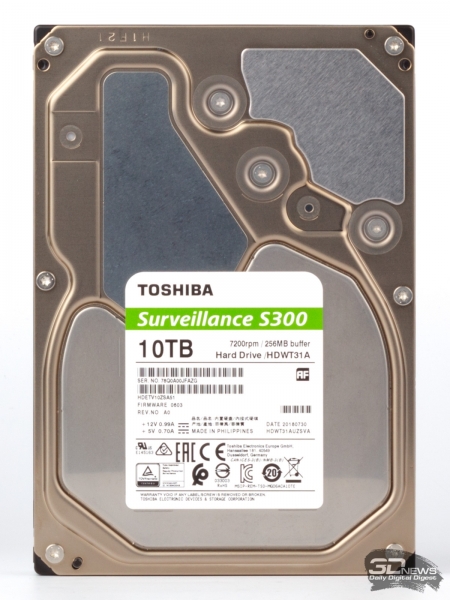
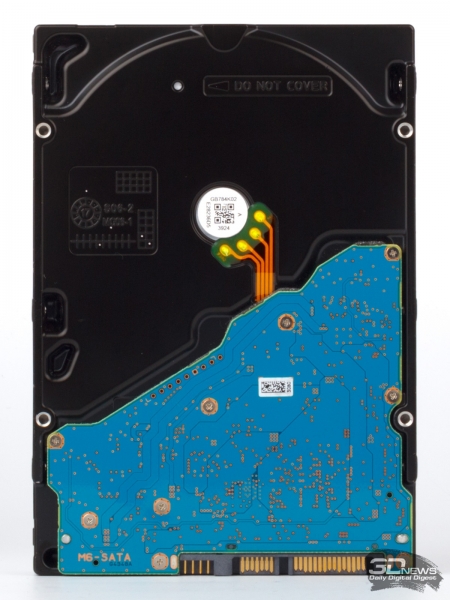
Under the S300 brand, the Japanese company Toshiba has released a series of drives for video surveillance systems — these hard drives also have their own dedicated On the pages of 3DNews. Thanks to the expansion of the ATA Streaming Command Set data transfer protocol, the higher-end Toshiba S300 models guarantee simultaneous video recording from 64 surveillance cameras. However, they remain typical storage drives for NAS and DAS, designed for 24/7 operation with a solid MTBF: like the IronWolf, it stands at 1 million hours, and the warranty period is the same three years. Due to the design advantages of the S300 chassis—spindle mounting on both sides and active rotational vibration compensation—it allows for the installation of more than eight such devices in a single rack or a standalone NAS.
The S300 model, chosen for comparison with newcomers of 14–16TB capacity, is based on the hardware chassis of server disks MD06ACA-V and contains seven magnetic platters. The device specifications indicate a typical random read/write speed of 248 MB/s, common for modern high-capacity HDDs. However, of the techniques used in Toshiba's server hard drives to reduce latency, the S300 retains only the Dynamic Cache feature.
Unlike all other participants in the testing, the S300, even with a dense stack of seven platters, operates without helium and is housed in a standard ventilated casing. It seems that this is precisely the reason the 10TB model has the highest power consumption in the summary specifications table of the test participants. Although this metric is only of significant concern to data center administrators, it directly impacts the HDD temperature. We will verify the actual power consumption of the S300 ourselves later, but for now, we will note this point.
 |  | |
Source: 3dnews.ru
