

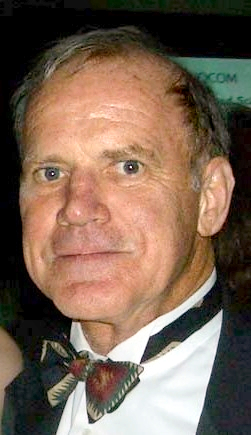
 In California, American Nobel laureate in chemistry Carey Mullis passed away at the age of 74. According to his wife, he died on August 7 due to heart and respiratory failure caused by pneumonia.
James Watson, the co-discoverer of the DNA molecule, will tell us about the contribution he made to biochemistry and why he received the Nobel Prize.
Excerpt from the book by James Watson, Andrew Berry, Kevin Davis
DNA. The Story of the Genetic Revolution
Chapter 7. The Human Genome. The Script of Life
…
The polymerase chain reaction (PCR) was invented in 1983 by biochemist Carey Mullis while working at Cetus. The discovery of this reaction was quite remarkable. Later, Mullis recalled, "One Friday evening in April 1983, I had an epiphany. I was driving, winding along a moonlit mountain road in Northern California, near the redwood forests." It's impressive that inspiration struck him in such a situation. It’s not that the roads in Northern California are particularly conducive to epiphanies; it’s just that a friend once saw Mullis recklessly speeding down an icy two-way road, and it didn’t bother him at all. The friend told the New York Times: "Mullis had a vision that he would die crashing into a redwood. So he fears nothing while driving, as long as there are no redwoods along the road." The presence of redwoods alongside the road forced Mullis to focus, and... there it was, the epiphany. For his invention, Mullis received the Nobel Prize in Chemistry in 1993 and since then has become even more eccentric in his actions. For example, he supports a revisionist theory that AIDS is not linked to HIV, significantly undermining his own reputation and hindering doctors.
PCR is a fairly simple reaction. To carry it out, we need two chemically synthesized primers that are complementary to the opposite ends of different strands of the DNA fragment we want to amplify. Primers are short segments of single-stranded DNA, each about 20 base pairs long. The unique feature of primers is that they match the sections of DNA that need to be amplified, that is, the DNA template.
(Image is clickable) Carey Mullis, inventor of PCR
The specificity of PCR is based on the formation of complementary complexes between the matrix and primers, which are short synthetic oligonucleotides. Each primer is complementary to one of the strands of the double-stranded matrix and defines the beginning and end of the amplified region. The resulting 'matrix' represents a complete genome, and our goal is to isolate the fragments of interest from it. To achieve this, the double-stranded DNA matrix is heated to 95 °C for several minutes to separate the DNA strands. This stage is called denaturation, as the hydrogen bonds between the two DNA strands are broken. Once the strands are separated, the temperature is lowered so that the primers can bind to the single-stranded matrix. DNA polymerase begins DNA replication by binding to a segment of nucleotide chain. The enzyme DNA polymerase replicates the template strand using the primer as a starting point or reference for copying. As a result of the first cycle, we achieve multiple sequential duplications of a specific DNA segment. We then repeat this procedure. After each cycle, we obtain the target segment in double the amount. After twenty-five cycles of PCR (that is, in less than two hours), we have the segment of DNA we are interested in, in an amount that exceeds the original by 225 times (that is, we amplified it approximately 34 million times). Essentially, we start with a mixture of primers, template DNA, DNA polymerase enzyme, and free bases A, C, G, and T, where the amount of the specific reaction product (limited by primers) increases exponentially, while the amount of 'long' DNA copies increases linearly, therefore the reaction products are dominated by the specific product.
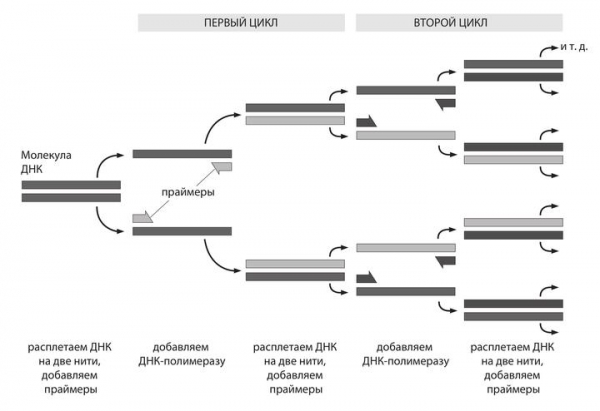
Amplification of the desired DNA segment: polymerase chain reaction
At the dawn of PCR use, the main problem was that after each heating-cooling cycle, it was necessary to add DNA polymerase to the reaction mixture because it was inactivated at 95 °C. Therefore, it had to be replenished for each of the 25 cycles. The reaction procedure was relatively inefficient, required a lot of time and the polymerase enzyme, which is quite expensive. Fortunately, nature came to the rescue. Many animals feel comfortable at temperatures much higher than 37 °C. But why has the figure of 37 °C become important for us? This is because this temperature is optimal for E. coli, from which the polymerase enzyme for PCR was originally derived. In nature, there are microorganisms whose proteins have become more stable to the effects of high temperatures over millions of years of natural selection. It was suggested to use DNA polymerases from thermophilic bacteria. These enzymes turned out to be thermostable and were able to withstand numerous reaction cycles. Their use simplified and automated the PCR process. One of the first thermostable DNA polymerases was isolated from the bacterium Thermus aquaticus, which lives in the hot springs of Yellowstone National Park, and was named Taq polymerase.
PCR quickly became the main workhorse of the Human Genome Project. Overall, the process does not differ from what was developed by Mullis; it has simply been automated. We were no longer dependent on a crowd of semi-blind graduate students painstakingly transferring drops of liquid into plastic tubes. In modern laboratories conducting molecular genetic research, this work is carried out on robotic conveyors. PCR robots, involved in such a large-scale sequencing project as the Human Genome Project, tirelessly work with huge volumes of heat-stable polymerase. Some scientists working on the Human Genome Project were outraged by the unjustifiably high royalties added to the cost of consumables by the patent owner for PCR, the European industrial-pharmaceutical giant Hoffmann-LaRoche.
Another "driving force" was the method of DNA sequencing itself. The chemical basis of this method was no longer a novelty at the time: the International Human Genome Project (HGP) adopted the same clever technique that Fred Sanger developed back in the mid-1970s. The innovation lay in the scale and level of automation achieved in sequencing.
Automatic sequencing was originally developed in Lee Hood's lab at the California Institute of Technology. He graduated from high school in Montana and played American football as a quarterback; under Hood's leadership, the team won the state championship multiple times. His teamwork skills also served him well in his scientific career. Hood's lab featured a diverse group of chemists, biologists, and engineers, and soon his lab emerged as a leader in technological innovations.
The method of automatic sequencing was actually invented by Lloyd Smith and Mike Hunziker. Mike Hunziker, who was then working in Hood's lab, approached Lloyd Smith with an improved sequencing method in which each type of nucleotide would be stained a different color. This idea could potentially increase the efficiency of the Sanger process by four times. In Sanger's method, a unique set of oligonucleotides of varying lengths is formed in each of the four test tubes (corresponding to the four bases) with the involvement of DNA polymerase, which includes the primer sequence. Next, formamide was added to the test tubes to denature the strands, and electrophoresis was conducted in a polyacrylamide gel across four lanes. In the Smith and Hunziker variant, ddNTPs are labeled with four different dyes, and PCR is carried out in a single tube. Then, during electrophoresis in the polyacrylamide gel, a laser beam at a specific gel location excites the dye activity, and the detector determines which nucleotide is currently migrating through the gel. Initially, Smith was pessimistic—he feared that the use of ultra-small amounts of dye would render the nucleotide fragments indistinguishable. However, being well-versed in laser technologies, he soon found a solution by using special fluorescent dyes that fluoresce under laser radiation.
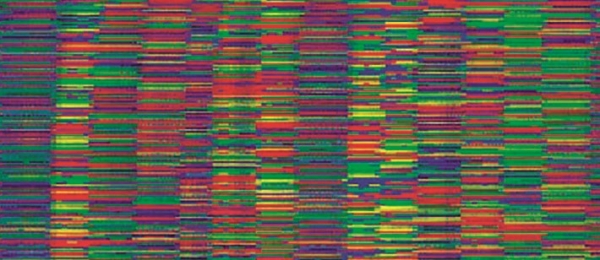
(Full version — 4.08 MB) In fine print: the DNA sequence decoded using an automatic sequencer obtained from the automatic sequencing machine. Each color corresponds to one of the four bases.
In the classical version of the Sanger method, one of the strands of the DNA being analyzed acts as a template for the synthesis of a complementary strand by the enzyme DNA polymerase, followed by sorting the DNA fragments by size in a gel. Each fragment included in the DNA during synthesis, which later allows visualization of the reaction products, is labeled with a fluorescent dye corresponding to the terminal base (as mentioned on p. 124); thus, the fluorescence of this fragment will serve as an identifier for that base. Then, only detection needs to be performed and the reaction products visualized. The results are analyzed using a computer and represented as a sequence of colored peaks corresponding to the four nucleotides. The information is then transmitted directly to the computer's information system, eliminating the time-consuming and sometimes painful data entry process that greatly complicated sequencing.
» Learn more about the book at
»
»
For Habr users, a 25% discount with the coupon — PCR
Source: habr.com
