

The Ryzen 5 six-core processors gained widespread recognition long before AMD transitioned to the Zen 2 microarchitecture. Both the first and second generations of Ryzen 5 six-cores became a popular choice in their price segment due to AMD's strategy: offering consumers enhanced multithreading capabilities than Intel processors at a similar or even lower price. AMD's models from 2017-2018 in the $200-250 price range not only featured six computing cores but also supported the SMT virtualization technology, allowing them to execute up to 12 streams simultaneously. This capability became a crucial advantage against the Core i5; in many computational tasks, the first-generation Ryzen 5 indeed outperformed the Intel options available at that time.
However, this was clearly not enough for unequivocal leadership in their weight class. Gaming tests revealed the same unpleasant scenario for AMD: neither the first nor the second generation of Ryzen 5 six-cores could pose a worthy competition to the Intel Core i5 series. In modern games, the performance of mid-range graphics cards, including the GeForce RTX 2060 and GeForce GTX 1660 Ti, severely limits even , not to mention that for faster GPUs, such processors are categorically unsuitable. In other words, AMD's past-generation processors were simply locked out of high-end gaming configurations.
But this review wouldn’t have appeared on our site if it weren't for a significant change, as AMD has now introduced the next, third generation of Ryzen processors. We have had the opportunity to be amazed once again at how successful the , released last month in AMD consumer processors: our site features reviews of both , and But today we will look at how this microarchitecture can fit into simpler processors – with six computing cores – namely the chips that users love for their combination of sufficient performance for most cases and relatively low prices.
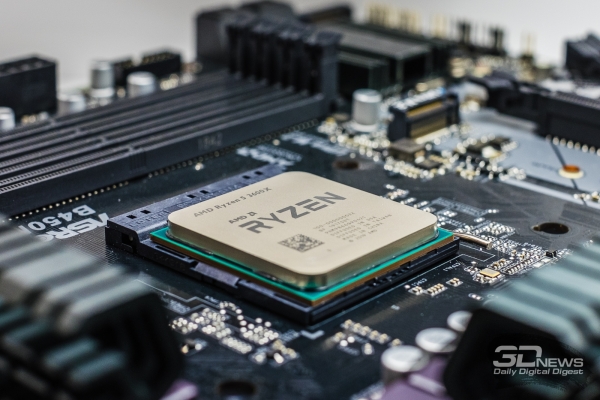
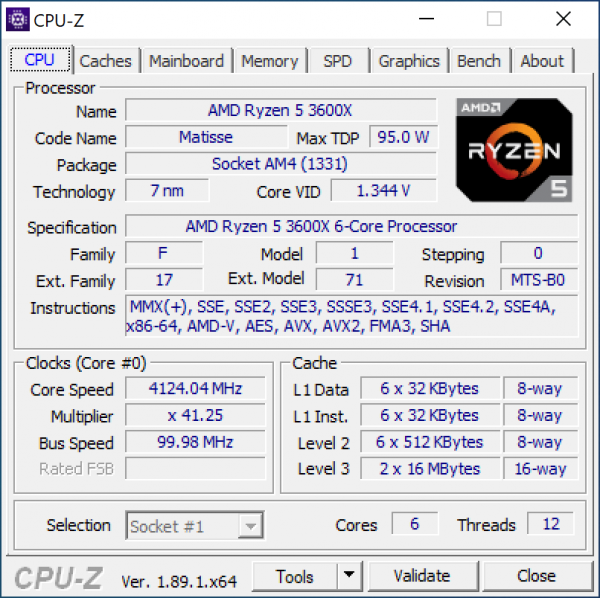
The new Ryzen 5 3600X and Ryzen 5 3600 indeed have a good chance of finally earning the title of the best processors for "optimal" level gaming assemblies (in the terminology of our), meaning those that provide sufficient frame rates at Full HD and WQHD resolutions. The newcomers received not only a new microarchitecture with a 15% increase in specific performance but also a number of other improvements due to the use of TSMC's 7nm process and a fundamentally new chiplet design. For example, increased clock speeds, reduced heat output, and a more flexible and versatile memory controller.
As a result, from the Ryzen 5 3600X and Ryzen 5 3600, one can expect not only unconditional superiority over the competitor's processors priced at $200-250 in content creation and processing but also much more significant achievements from the perspective of the average user: eliminating the previous lag behind Core i5 in gaming workloads. We will see how well these expectations are met in this review.
Ryzen 5 3600X and Ryzen 5 3600 in Detail
The Ryzen 5 processor family previously included products from three fundamentally different categories. It contained both six-core and four-core representatives, as well as four-core processors with integrated graphics cores. However, with the transition to model numbers in the fourth thousand, the nomenclature has simplified: there are no longer any four-core Ryzen 3000 with Zen 2 microarchitecture, and among the new Ryzen 5, there is only one four-core model – the hybrid chip Ryzen 5 3400G, based on the Zen+ microarchitecture with integrated Vega graphics.
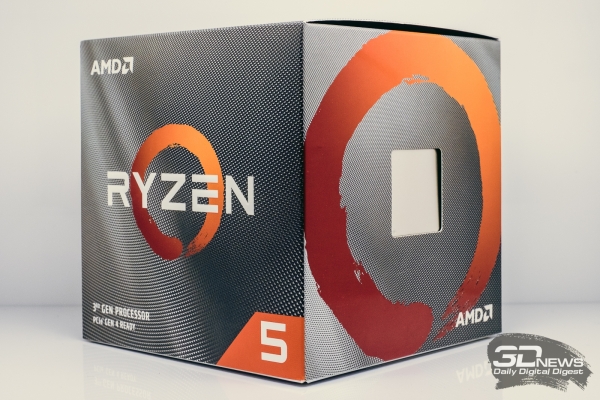
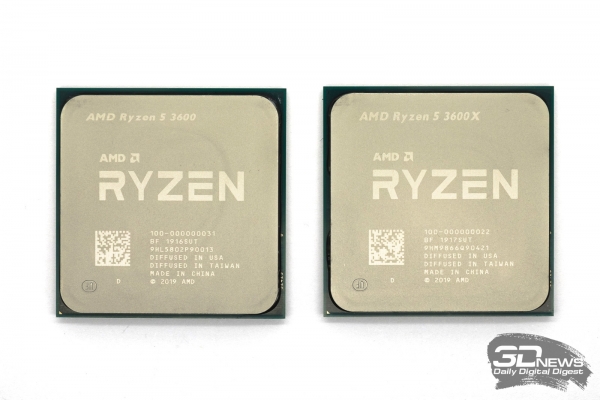
Excluding APU, which differ from "classic" Ryzen both ideologically and architecturally, AMD's lineup has only two Ryzen 5 options – the six-core Ryzen 5 3600X and Ryzen 5 3600. Generally speaking, these processors are quite similar to each other. In terms of formal specifications, the only noticeable difference is a 200 MHz discrepancy in clock frequency. However, in terms of price, Ryzen 5 3600X and Ryzen 5 3600 differ significantly – by a full 25%. This can be explained not so much by the higher performance of the older six-core model, but rather by the fact that it comes with the larger and more efficient Wraith Spire cooler as opposed to the simple Wraith Stealth cooler found in the younger model.
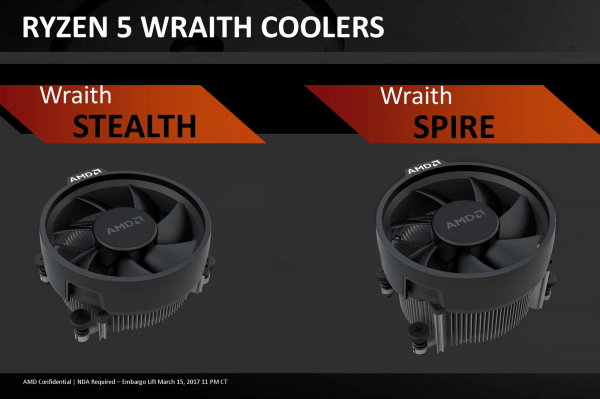
Nevertheless, operating the Ryzen 5 3600 with the standard compact cooling system seems quite acceptable, as the thermal package of this processor is officially rated at 65, rather than 95 watts.
| Cores/Threads | Base Frequency, MHz | Boost Frequency, MHz | L3 Cache, MB | TDP, W | Chiplets | Price | |
|---|---|---|---|---|---|---|---|
| Ryzen 9 3950X | 16/32 | 3,5 | 4,7 | 64 | 105 | 2×CCD + I/O | $749 |
| Ryzen 9 3900X | 12/24 | 3,8 | 4,6 | 64 | 105 | 2×CCD + I/O | $499 |
| Ryzen 7 3800X | 8/16 | 3,9 | 4,5 | 32 | 105 | CCD + I/O | $399 |
| Ryzen 7 3700X | 8/16 | 3,6 | 4,4 | 32 | 65 | CCD + I/O | $329 |
| Ryzen 5 3600X | 6/12 | 3,8 | 4,4 | 32 | 95 | CCD + I/O | $249 |
| Ryzen 5 3600 | 6/12 | 3,6 | 4,2 | 32 | 65 | CCD + I/O | $199 |
Against other Ryzen 3000 processors, the six-core variants stand out not only for having fewer computational cores but also for slightly lower frequencies. However, this does not detract from their appeal. It's worth noting that the new Ryzen 5 3600 matches the older six-core model from the previous generation, the Ryzen 5 2600X, in terms of rated frequencies, but it also features a significantly more advanced Zen 2 microarchitecture, boasting a 15% improvement in IPC (instructions per clock cycle). This means that the new Ryzen 5 models are sure to be substantially more powerful than their predecessors.
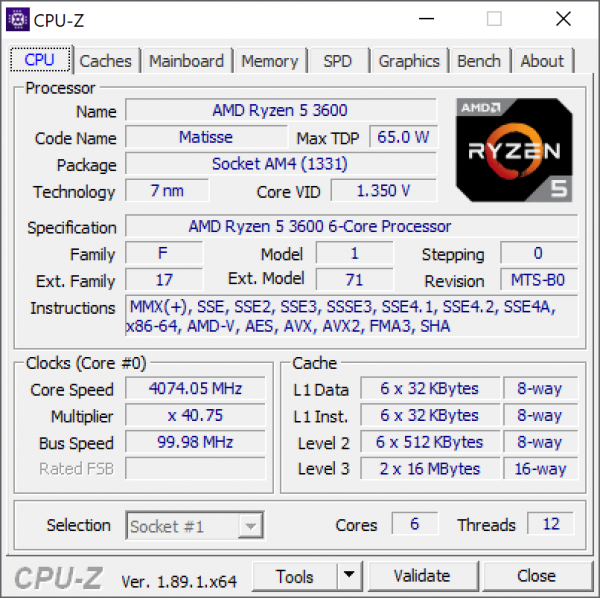
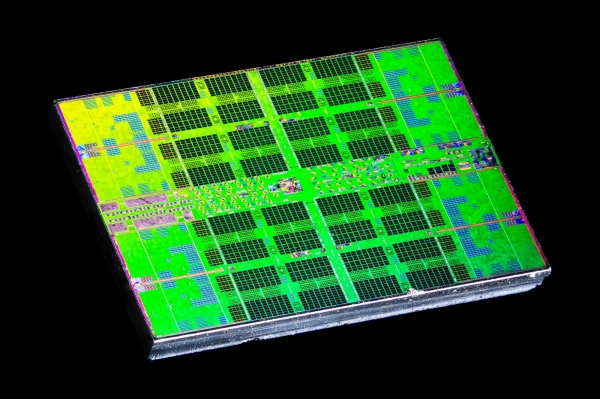
Like the new generation eight-core processors, the Ryzen 5 3600X and Ryzen 5 3600 are built using a dual-chiplet architecture comprising one chiplet with computational cores (CCD) and an input/output chiplet (cIOD), connected via the second generation Infinity Fabric bus. The base CCD chiplet in these processors is the same as that used in the higher models of the 7nm semiconductor die manufactured by TSMC. It includes two quad-core complexes CCX (Core Complex), but in the case of the Ryzen 5 3600X and Ryzen 5 3600, one core is disabled in each of them.
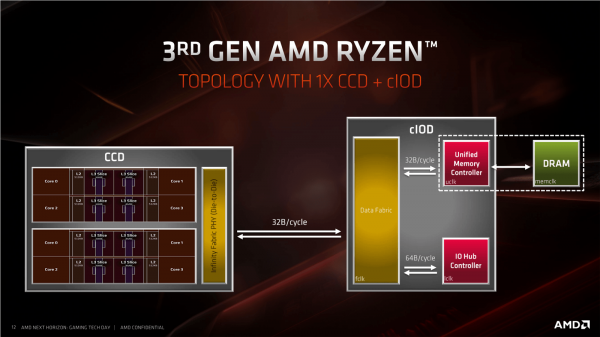
The disabling of cores did not affect the amount of L3 cache. Each CCX in processors with Zen 2 microarchitecture features 16 MB of L3 cache — and this entire capacity is available in both the Ryzen 5 3600X and Ryzen 5 3600. In other words, both hexa-core models have a 32 MB L3 cache, which has doubled compared to what was offered in the previous generation of Ryzen.
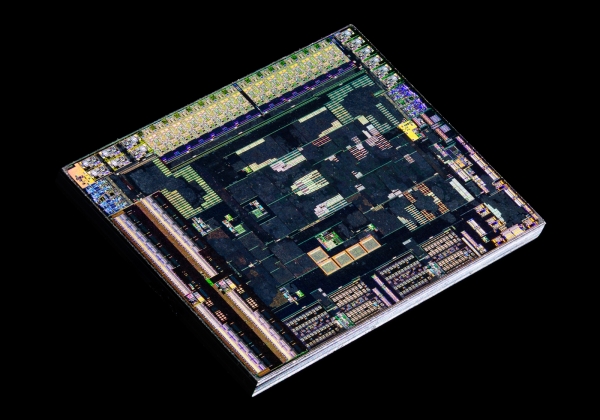
Standard for hexa-cores and cIOD chiplet. This die contains the memory controller, Infinity Fabric logic, PCI Express bus controller, and SoC elements, and is produced using GlobalFoundries' 12nm process technology. The complete unification of components in hexa-core models with the higher-end Ryzen 3000 series means they inherit all the advantages of their older siblings: hassle-free support for high-speed DDR4 memory, the ability to asynchronously clock the Infinity Fabric bus, and support for PCI Express 4.0 with doubled bandwidth.
For detailed testing, we took both new hexa-core processors: Ryzen 5 3600X and Ryzen 5 3600. However, it turned out that it would have been sufficient to limit ourselves to just one model. In practice, the differences in performance between the Ryzen 5 3600X and Ryzen 5 3600 are even smaller than reflected in the specifications.
For example, this is how the actual working frequencies of the Ryzen 5 3600X are distributed in Cinebench R20 under various loads on the computational cores.
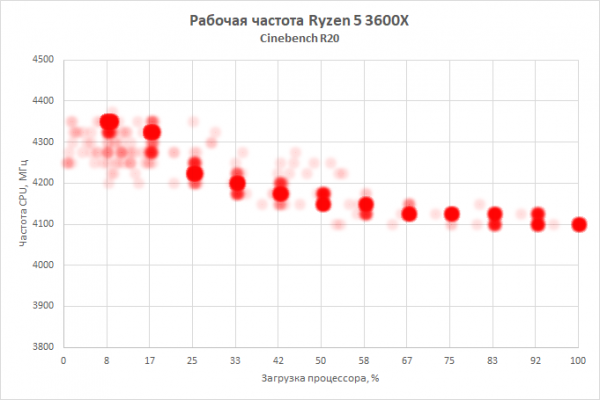
Working frequencies range from 4.1 to 4.35 GHz. The situation with the Ryzen 5 3600 is similar, but with an upper limit in the specifications, causing the frequency range to shift slightly downwards — from 4.0 to 4.2 GHz. However, even at 50% load on the computational resources, the Ryzen 5 3600X turns out to be faster than the lower model by only 25-50 MHz.
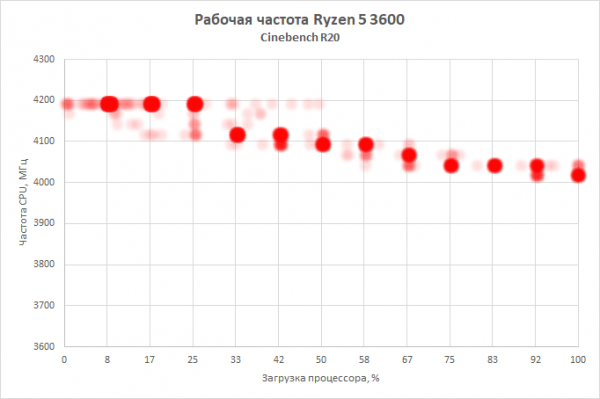
Moreover, the graphs reveal another interesting observation. Even under full load on all cores, the new generation six-core AMD processors can maintain frequencies above 4.0-4.1 GHz. This means that Intel's alternatives in the same price range no longer have a significant advantage in clock speed. The top six-core Core i5-9600K operates at only 4.3 GHz under full load on all cores, while the popular Core i5-9400 even drops its frequency to 3.9 GHz when all cores are engaged. Thus, from a specifications standpoint, the Core i5 has no convincing advantages over the Ryzen 5. AMD's alternatives support simultaneous execution of double the number of threads thanks to SMT technology, have a three and a half times larger L3 cache, are officially compatible with DDR4-3200 SDRAM, and can also work with graphics cards and NVMe drives over the PCI Express 4.0 bus.
However, an important clarification about PCI Express 4.0 support is necessary. It is only available in motherboards built on the X570 chipset, which are relatively expensive and unlikely to be common companions for Ryzen 5 3600X and Ryzen 5 3600. With older and cheaper Socket AM4 boards on the X470 and B450 chipsets, the new six-core processors will only support external interfaces in PCI Express 3.0 mode.
The most important point is that despite this limitation, the new processors are still functional with older motherboards after a BIOS update (suitable versions must be based on AGESA Combo-AM4 1.0.0.1 libraries and later). This will likely appeal not only to those who prefer a frugal approach to personal computer configuration but also to many advanced users, as motherboards based on X570 appear to be significantly overpriced.
A motherboard based on X570 is not mandatory.
AMD introduced the new X570 logic set simultaneously with the Ryzen 3000 processors, creating the impression that this chipset is the most suitable option for the new CPUs. Indeed, although the Ryzen 3000 chips continue to use the same Socket AM4 processor socket as their predecessors and are compatible with a significant number of previously released motherboards for this platform, certain advantages of the Zen 2 architecture can only be fully realized when Ryzen 3000 is installed on next-generation motherboards. Specifically, only X570-based boards can offer support for PCI Express 4.0 with double the bandwidth, whereas activating PCI Express 4.0 on older generation boards is not possible. AMD's marketing department places great emphasis on the importance of this functionality, leading to the impression that using older boards with new processors may entail negative consequences.
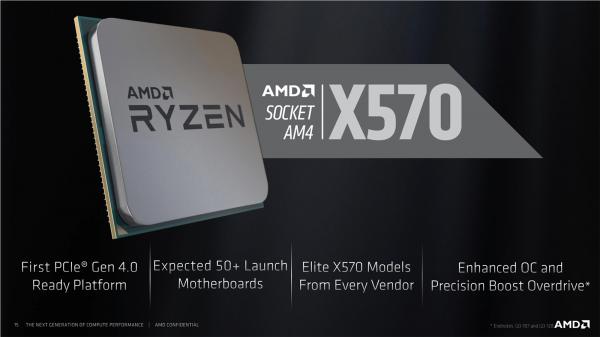
However, the necessity for PCI Express 4.0 support is currently highly questionable. Existing gaming graphics cards with this high-speed interface (there are only two: Radeon RX 5700 XT and RX 5700) gain no noticeable performance benefits from the increased bandwidth of the interface. NVMe drives operating over PCI Express 4.0 also have very limited availability at this time. Furthermore, they all rely on the relatively weak Phison PS5016-E16 controller and fall short in real performance compared to the best drives with PCI Express 3.0, meaning there is little practical sense in using them. Therefore, PCI Express 4.0 support in X570 is merely a future-proofing measure with negligible utility in the current landscape.
Does this mean that purchasing X570-based boards is without practical sense? Certainly not: in addition to the new version of PCI Express, this chipset offers significantly improved capabilities for implementing other external interfaces. It has a greater number of PCI Express lanes for additional devices and expansion slots, as well as support for more high-speed USB 3.1 Gen2 ports.
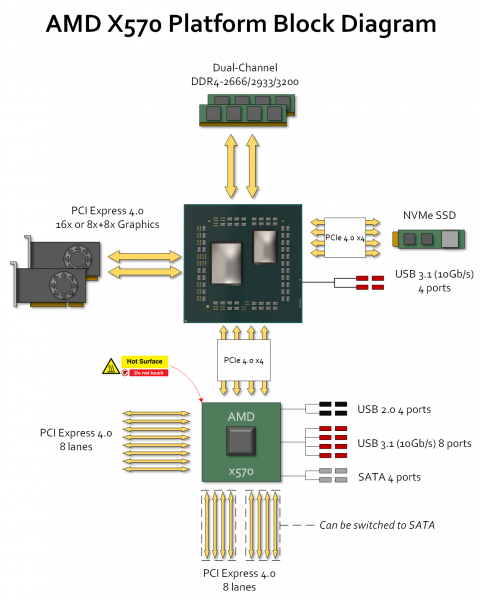
Here are its main characteristics compared to the parameters of previous generation chipsets:
| X570 | X470 | B450 | |
|---|---|---|---|
| PCIe Interface | 4.0 | 2.0 | 2.0 |
| Number of PCIe lanes | 16 | 8 | 6 |
| USB 3.2 Gen2 ports | 8 | 2 | 2 |
| USB 3.2 Gen1 ports | 0 | 6 | 2 |
| USB 2.0 ports | 4 | 6 | 6 |
| SATA ports | 8 | 8 | 4 |
Thus, solutions based on the new chipset are expected to have significantly wider and more modern capabilities.
Moreover, there is another strong argument in favor of the X570 platform. The fact is that motherboards based on this chip were originally designed for Ryzen 3000 processors, while the motherboards of previous generations were created at a time when the higher-end Ryzen processors had no more than eight cores and a maximum thermal envelope of 95 W. Therefore, only the new motherboards truly take into account that Socket AM4 processors can have up to sixteen computing cores and have increased power demands, as well as the fact that current processors are free from artificial memory frequency limits. In other words, the designs of the new boards have received additional optimizations: at a minimum, improved trace routing for DIMM slots and reinforced schemes for CPU power converters, which now have at least 10 phases (including "virtual" ones).
But everything comes at a cost. While the prices for Socket AM4 motherboards based on X470 start at around $130-140, and B450 boards can be purchased for as little as $70, a new motherboard with the X570 chipset will cost at least $170. Additionally, the support for high-speed PCI Express 4.0 bus introduced in X570 has had an impact on the chipset's heat dissipation. Previous AMD chipsets were manufactured using a 55nm process and dissipated about 5 W of heat, but the new X570 chip, although it has moved to a 14nm process, dissipates up to 15 W. Therefore, active cooling is required for it, complicating the design of motherboards and adding another fan to the system, contributing to noise levels.
Considering all this, using more affordable motherboards from the previous generation, based on the X470 or B450 chipsets, especially when paired with the six-core Ryzen 5 3600 and Ryzen 5 3600X processors, which do not have high power consumption, can be quite justified. Even AMD itself clarified before the launch of the new platform that the new Ryzen 3000 processors will (almost) not lose performance when installed on compatible Socket AM4 motherboards from the previous generation. From the company's perspective, the X570 is a flagship-level platform, and it's not necessary for all users of the new processors. More budget-friendly motherboards may be suitable for the mid-range Ryzen 5 3600 and Ryzen 5 3600X, according to AMD.
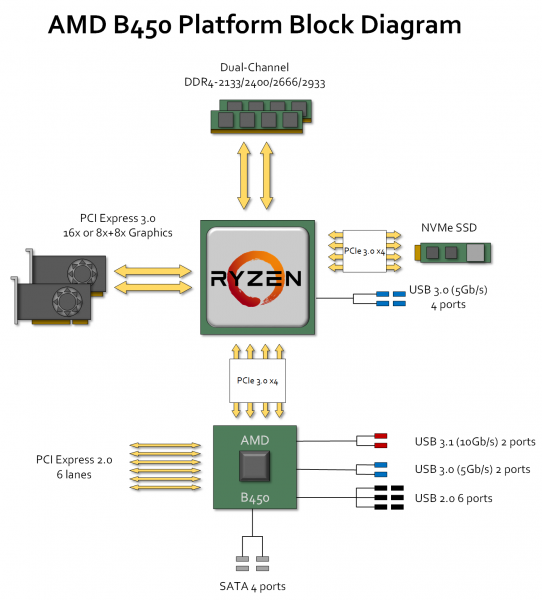
However, there are actually concerns that the third-generation Ryzen processors will perform worse on inexpensive motherboards from the previous generation than on the new platform. Therefore, we decided to take one of these motherboards and test everything ourselves.
The experiments were conducted with a budget ASRock B450M Pro4 motherboard based on the B450 chipset, which can be purchased today for only $80. Recently, several BIOS versions, built on the current AGESA Combo-AM4 1.0.0.3 libraries, have been released for this motherboard, ensuring its compatibility with Ryzen 3000. Indeed, after flashing one of these BIOS versions to the motherboard, the test processor Ryzen 5 3600X starts up and operates without any issues. But let's check out the nuances.
Memory Support and Infinity Fabric Overclocking Fabric. There were no obstacles to selecting high-speed memory modes on the motherboard with the B450 chipset. After installing the Ryzen 5 3600X, we easily activated the DDR4-3600 mode, which AMD considers the 'gold standard' for its new generation processors in terms of performance.
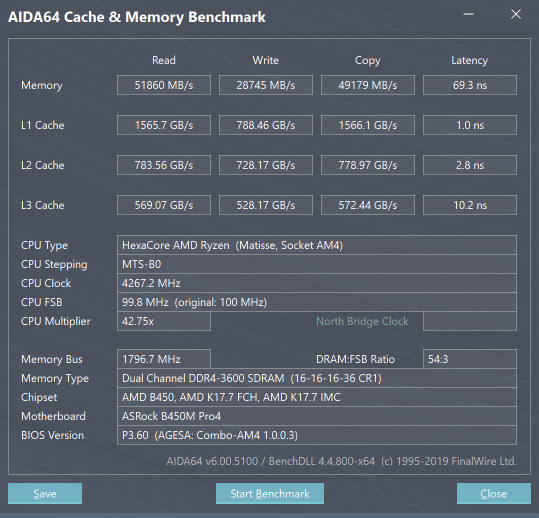
Moreover, the B450-based motherboard offers exactly the same capabilities for manually setting the Infinity Fabric bus frequency as the flagship X570 versions.
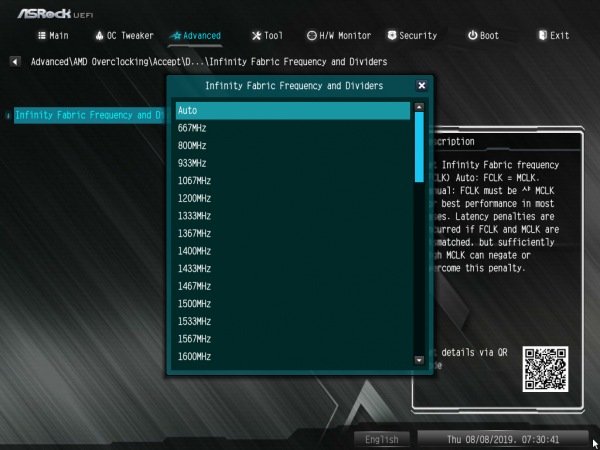
This means that if desired, the memory can be overclocked in the 'correct' synchronous mode beyond the DDR4-3600 mark. For example, with the current Ryzen 5 3600X processor, we managed to achieve stable memory operation at DDR4-3733 mode with an Infinity Fabric bus frequency of 1866 MHz using the B450 chipset motherboard.
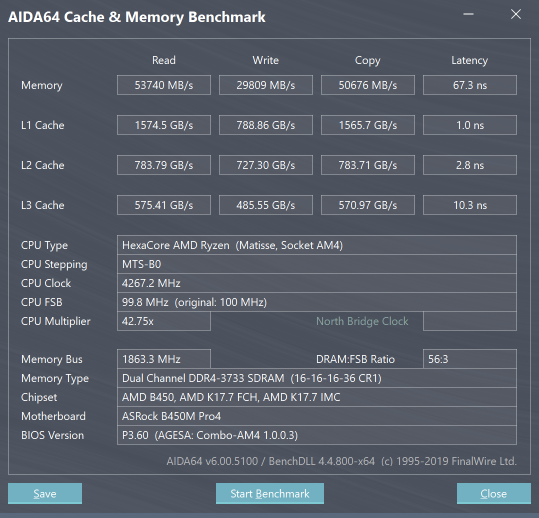
Naturally, memory overclocking in asynchronous mode is also possible—here, the B450 imposes no restrictions. However, it's important to understand that independent clocking of the memory controller and the Infinity Fabric bus results in a significant increase in latencies and a drop in performance. Moreover, the chipset on which the motherboard is based does not affect this at all. This holds true for both B450 and X470, as well as the newest X570.
Overclocking the processor via Precision Boost Override. Overclocking Ryzen 3000 processors using conventional methods is practically futile, as the automatic overclocking technology Precision Boost 2, which operates "out of the box," effectively utilizes the entire available frequency potential. Therefore, any attempts to overclock the processor to fixed frequency values typically result in those values being lower than the maximum nominal frequencies in turbo mode. This, in turn, means that a slight performance increase under multi-threaded loads is accompanied by a decrease in performance in tasks that only engage part of the processor cores.
However, to ensure that enthusiasts still have the opportunity to enhance the performance of Ryzen 3000 beyond nominal levels, AMD devised a special technology—Precision Boost Override. The essence of this technology is that the operation of the processor in turbo mode is managed based on a number of predefined constants that describe the maximum frequencies, power consumption, temperatures, voltages, and so on for each processor. A certain portion of these constants can be modified, and this capability is fully provided not only by X570-based motherboards but also by more affordable solutions.
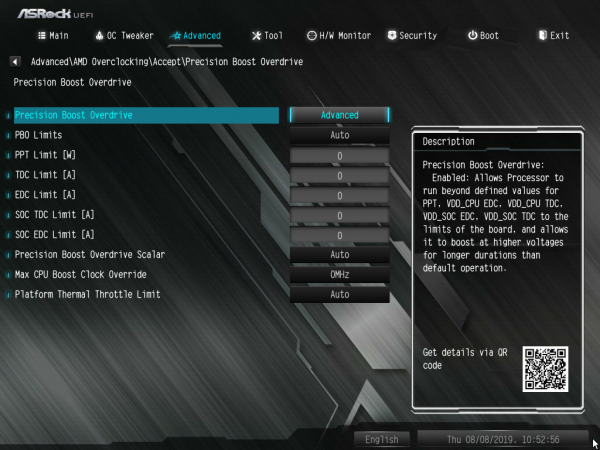
For instance, among the BIOS settings of the ASRock B450M Pro4 motherboard we tested, we found options to modify all four main constants of the Precision Boost Override technology:
- PPT Limit (Package Power Tracking) – constraints for processor power consumption in watts;
- TDC Limit (Thermal Design Current) – constraints for the maximum current supplied to the processor, which is determined by the effectiveness of the VRM cooling on the motherboard;
- EDC Limit (Electrical Design Current) – the limits for the maximum current supplied to the processor, determined by the VRM circuitry on the motherboard;
- Precision Boost Override Scalar – the factor by which the voltage supplied to the processor depends on its frequency.
Additionally, among the settings provided by the B450 motherboard is the MAX CPU Boost Clock Override – a new parameter for Ryzen 3000 processors that allows for an increase of the limit frequency permitted by Precision Boost 2 by 0-200 MHz.
Thus, motherboards based on X570 and B450 or X470 offer the same level of access to the parameters responsible for configuring the processor's turbo mode frequency. This means that the dynamic overclocking of Ryzen 3000 on cheaper boards is limited only by the design of their power converter, which may not provide the necessary currents or may overheat due to a lower number of phases. However, this problem is unlikely to arise with six-core Ryzen 5 3600 and Ryzen 5 3600X processors, as they have relatively moderate energy appetites.
Performance. When the boards built on the X570 chipset were released, there were many rumors that they would provide increased performance due to more aggressive Precision Boost 2 settings programmed by default. However, in reality, this turned out to be untrue: the B450, X470, and X570 boards we tested used exactly the same constants for PPT Limit, TDC Limit, and EDC Limit. At least, in the case of the three motherboards we examined: ASRock B450M Pro4, ASRock X470 Taichi, and ASRock X570 Taichi. This is not surprising, as the values of these constants are defined in the specs of the CPUs themselves.
| TDP | Processors | PPT Limit | TDC Limit | EDC Limit |
|---|---|---|---|---|
| 65W | Ryzen 5 3600, Ryzen 7 3700X | 88W | 60A | 90A |
| 95W | Ryzen 5 3600X | 128W | 80A | 125A |
| 105W | Ryzen 7 3800X, Ryzen 9 3900X | 142W | 95A | 140A |
Therefore, there are no objective reasons why processors installed on B450, X470, and X570 chipsets should show different performance.
Nevertheless, to further substantiate this conclusion, we conducted quick testing of the Ryzen 5 3600X processor in several applications and games, installing it consecutively in the ASRock B450M Pro4, ASRock X470 Taichi, and ASRock X570 Taichi.
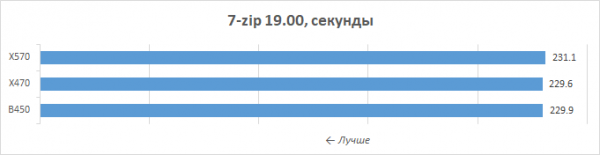
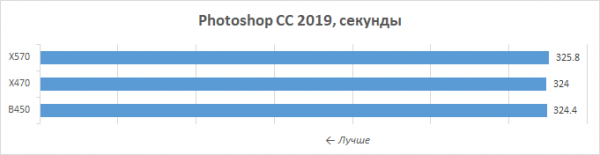
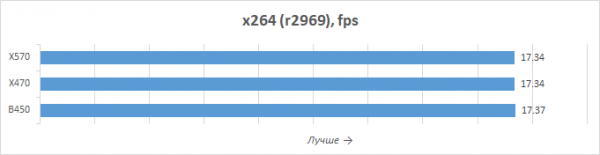
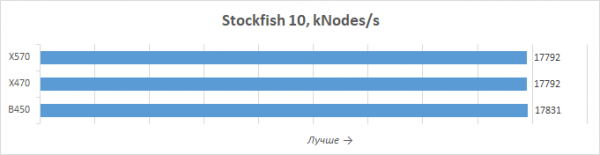
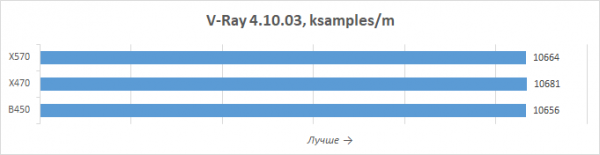
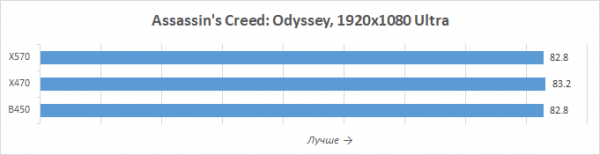
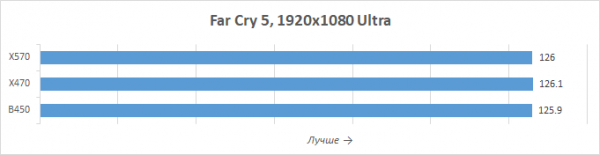
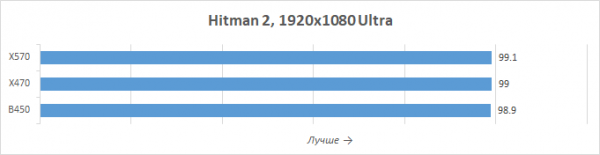
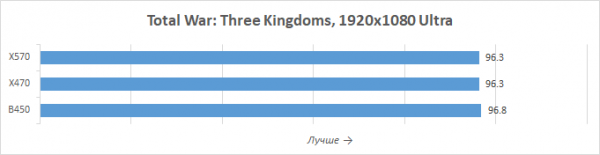
The results were predictable: Socket AM4 motherboards with different chipsets provide virtually identical performance. This means that there aren't really any compelling reasons why sixth-generation Ryzen 5 3600X and Ryzen 5 3600 processors shouldn't use motherboards from the previous generation.
Moreover, if you opt for motherboards with B450 or X470 chipsets, you can gain in energy efficiency. Due to the high power consumption of the X570 chipset, motherboards based on it consistently consume several watts more. This applies both under load and in idle states.
The takeaway from all this is simple: when selecting a motherboard for the new Ryzen 3000, you should consider the required expansion capabilities, design convenience, and adequate power converter capacity for the processor. The chipset itself in modern Socket AM4 systems doesn’t play a significant role.
Overclocking
Overclocking Ryzen 3000 processors can be an ungrateful task. We've already seen this when trying to overclock the higher models in the series. AMD has managed to extract all the available frequency potential from the new 7nm chips, leaving little room for manual overclocking. The Precision Boost 2 technology implements a highly efficient algorithm that, based on analyzing the processor's state and load at any given moment, sets the frequency to almost the maximum possible for that mode.
As a result, by manually overclocking to a fixed frequency, we will almost certainly lose performance in low-threaded modes, since Precision Boost 2 will likely be able to boost the processor higher in those situations. Nevertheless, we felt it necessary to try, if only to confirm that the Ryzen 5 3600 and Ryzen 5 3600X, like their older counterparts, are already overclocked to their limits.
The higher six-core processor, Ryzen 5 3600X, was able to operate at a maximum frequency of 4.25 GHz, stability at which was achieved with a supply voltage of 1.35 V.
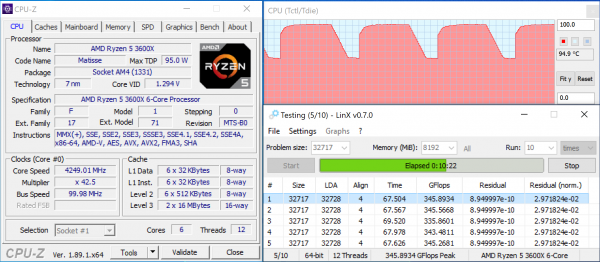
As a reminder, in nominal mode, the Ryzen 5 3600X can achieve clock speeds of up to 4.4 GHz, but only under low loads. When all cores are loaded, its frequency drops to about 4.1 GHz. In other words, our manual overclocking is somewhat effective, but one can question the practical value of this result.
A similar situation exists with the overclocking of the Ryzen 5 3600, with the caveat that AMD selects better silicon for its higher-end processor models, which gives the lower-end processors a lower ceiling for maximum achievable frequency. As a result, the Ryzen 5 3600 reached 4.15 GHz with an increased voltage of 1.4V.
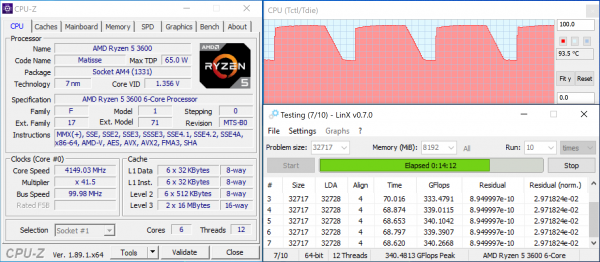
Overall, this level of overclocking can even be considered quite reasonable, given that the frequency of the Ryzen 5 3600 under full load on all cores drops to 4.0 GHz, while in low-thread scenarios, such a processor only self-overclocks to 4.2 GHz. However, the general rule that Ryzen 3000 series processors in turbo mode achieve frequencies higher than those attainable through simple manual overclocking still holds true. This is why we do not recommend aggressive overclocking: the results are likely not worth the effort.
It is worth noting that in our overclocking experiments, we encountered the issue of high temperatures with Ryzen processors again. A sufficient air cooler, the Noctua NH-U14S, was used to dissipate heat from the CPU, but this did not prevent the processors from heating up to 90-95 degrees even with moderate overclocking and slight increases in frequency and voltage. It seems that this presents yet another serious obstacle to raising operational frequencies. The processor die CCD, manufactured using the new 7nm process, has a very small area of just 74 mm2, making it extremely difficult to dissipate the generated heat from its surface. As you can see, even the soldering of the heat-spreading lid to the die surface does not help.
How does Precision Boost Override work, and is it possible to turn a Ryzen 5 3600 into a Ryzen 5 3600X?
A fiasco with overclocking does not mean that one should not interfere with the operating modes of Ryzen processors. It just requires a different approach. Noticeably better results can be achieved not by attempting to fix the CPU's operating frequency at a high value, but rather by making adjustments to how Precision Boost 2 operates. In other words, instead of trying to surpass the automatic frequency control technology, it is better to make its algorithms more aggressive. This is precisely why the Precision Boost Override function exists, allowing adjustments to the constants that dictate frequency behavior within Precision Boost 2. This is the path for buyers of the Ryzen 5 3600 to push it into modes characteristic of the Ryzen 5 3600X, or even faster.
However, simply maximizing the limits for PPT Limit, TDC Limit, and EDC Limit, which are default set at 88W, 60A, and 90A for the Ryzen 5 3600, will not be sufficient, as this does not negate the CPU's specified frequency limit of 4.2 GHz. But if we add a 200 MHz increase to this limit via the Max CPU Boost Clock Override setting, alongside raising the Precision Boost Override Scalar, we can achieve frequencies for the Ryzen 5 3600 that are nearly those of the Ryzen 5 3600X (4.1-4.4 GHz), with similar dynamic frequency regulation based on load.
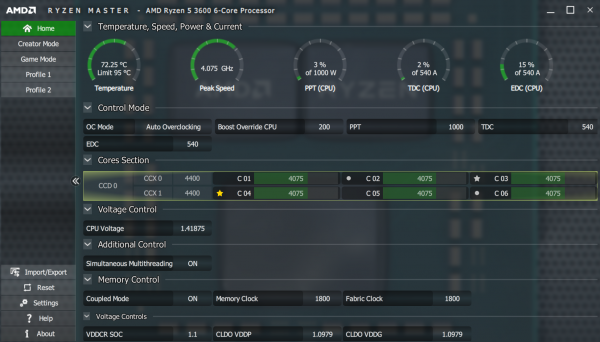
An additional boost with this approach may come from a slight increase (about 25-75 mV) in CPU voltage, made through the Offset Voltage setting, as well as enabling Load-Line Calibration. This should assist the Precision Boost 2 mechanism in confidently achieving higher clock speeds.
As a result, the performance of the Ryzen 5 3600 with these settings truly reaches the level of the Ryzen 5 3600X, which should undoubtedly please those looking to save $50 effortlessly.
Certainly, this trick with adjusting the constants of the Precision Boost 2 technology can also be performed for the higher-end six-core processor. However, it is unlikely that such a noticeable frequency increase can be achieved. While the Ryzen 5 3600 can be overclocked by an average of 100-200 MHz due to Precision Boost Override, the Ryzen 5 3600X, when consumption limits are removed, typically adds no more than 50-100 MHz in frequency.
To assess the effect of such fine-tuning of frequency modes, we conducted an express test. In the provided diagrams, we indicated the performance of processors with modified PPT Limit, TDC Limit, and EDC Limit with the shorthand PBO (Precision Boost Override).
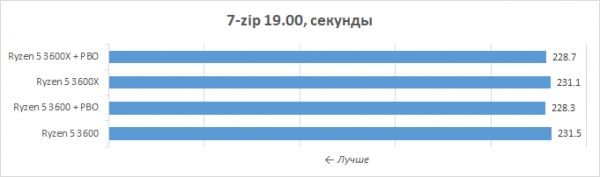
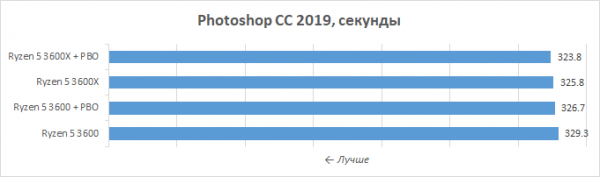
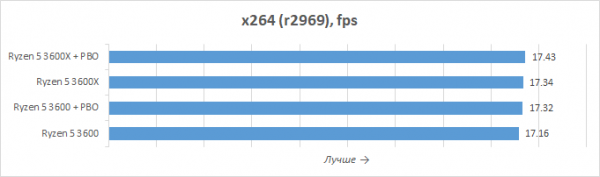
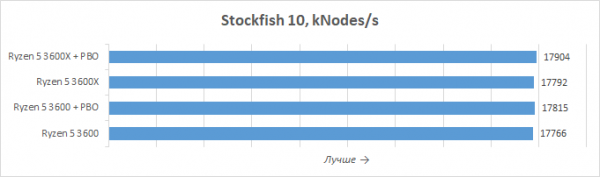
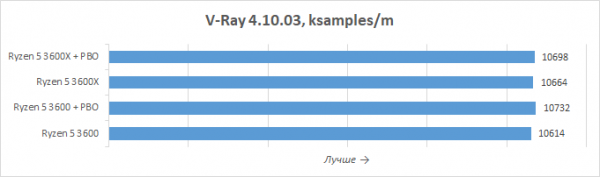
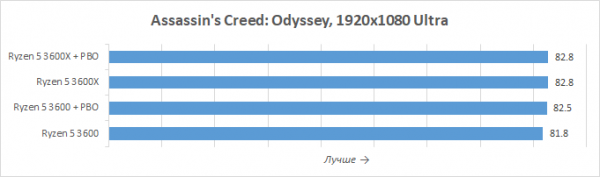
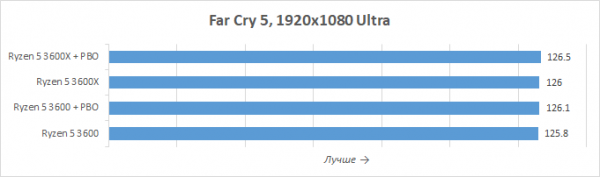
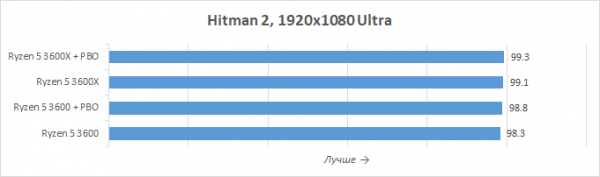
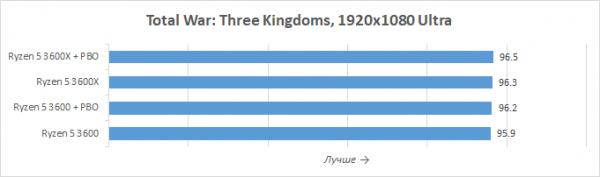
In summary, we wouldn’t claim that Precision Boost Override significantly speeds up the processor, especially when it comes to the Ryzen 5 3600X. As the results show, the performance gain is literally just a few percent, and one should not pin any special hopes on this technology, just like with traditional overclocking methods.
However, for owners of the Ryzen 5 3600, it makes sense to enable Precision Boost Override right away to gain performance close to that of the more expensive six-core Ryzen 5 3600X for free.
Source: 3dnews.ru
