

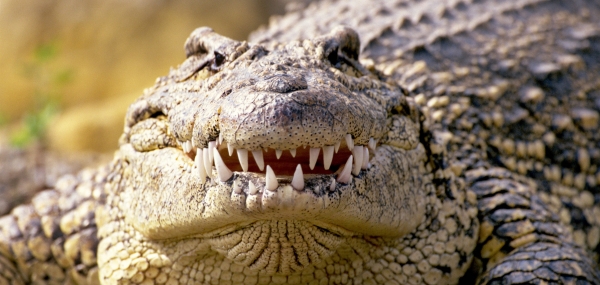
You enter a dimly lit corridor, where you encounter destitute souls tormented by pain and suffering. But there will be no peace for them here, for behind each door lies even greater torment and fear, filling every cell in their bodies and overwhelming all thoughts. You approach one of the doors, behind which you hear a hellish scraping and buzzing that chills you to the bone. Gathering the remnants of courage, you extend your cold hand to the doorknob when suddenly someone touches your shoulder from behind, startling you. "The doctor will be free in a few minutes. Please take a seat; we will call you," a gentle voice of the nurse informs you. This is how some people imagine a trip to the dentist, particularly those who have a strong aversion to these "sadists" in white coats. But today, we will not speak about dentophobia; we will talk about crocodiles. Yes, indeed, about them, or rather about their teeth, which do not require dental treatment.
Scientists from the University of Missouri (USA) conducted a study on crocodile teeth that revealed interesting features of the enamel of these impeccable hunters, who rely heavily on their jaws. What did the researchers find out, how do the teeth of modern crocodiles differ from their prehistoric relatives, and what is the benefit of this study? We will learn this from the research group's report.
The foundation of the research
For most vertebrates, teeth are an essential attribute of obtaining and consuming food (anteaters are not included). Some predators rely on speed while hunting (cheetahs), others on teamwork (lions), and for some, the strength of their bite plays a huge role. This also applies to crocodiles, which sneak up on their prey in the water and grab them with their powerful jaws. For the prey to be unable to escape, the grip must be strong, resulting in significant loads on the bone structure. To neutralize the negative effect of their powerful bites, crocodiles have a secondary bony palate that is firmly connected to the skull.
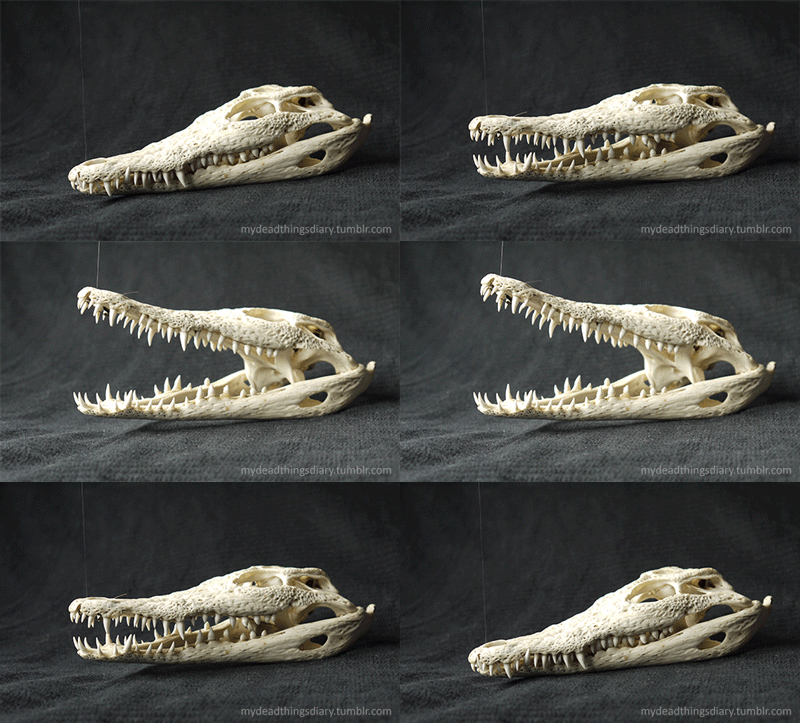
A clear demonstration of the opening and closing of a crocodile's jaw.
One of the main features of crocodile teeth is their constant replacement with new ones as the old ones wear out. The thing is, crocodile teeth resemble a nesting doll, inside which new teeth develop. Approximately every two years, each tooth in the jaw is replaced with a new one.
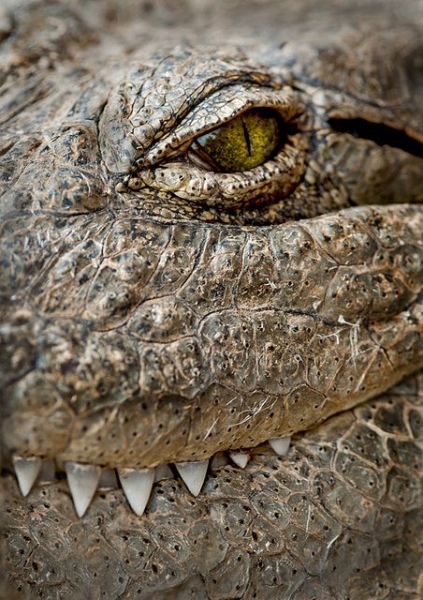
Notice how tightly this "dental trap" closes.
Crocodile teeth are divided into several categories based on their shape and corresponding function. At the front of the jaw, there are four large canines that are crucial for effectively capturing prey. In the middle, there are thicker teeth that increase in size along the jaw. This part is necessary for cutting prey. At the base, the teeth widen and become flatter, allowing crocodiles to crack open the shells of mollusks and turtle shells like seeds.
How strong is a crocodile's jaw? Naturally, it depends on its size and species. For example, in 2003, it was found that a 272-kilogram Mississippi alligator bites with a force of about 9500 N (N — Newton, 1 N = 1 kg·m/s²). Meanwhile, a 1308-kilogram saltwater crocodile demonstrated an astounding force of about 34500 N. For reference, the absolute bite force of a human is approximately 1498 N.
Bite force depends not so much on the teeth as on the jaw muscles. In crocodiles, these muscles are very dense and numerous. However, there is a significant difference between the well-developed muscles responsible for closing the mouth (which provides such biting power) and the weaker muscles responsible for opening it. This explains why a closed crocodile mouth can be held shut with simple tape.
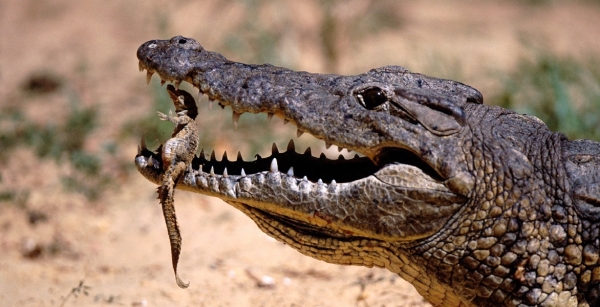
Well, show us who called you a little one.
But crocodiles need their jaws not only for merciless killings for food but also for caring for their offspring. Female crocodiles often carry their hatchlings in their jaws (it's hard to find a safer place for them, as who would dare to go there). The mouths of crocodiles are equipped with very sensitive receptors, allowing them to regulate their bite force, which enables them to better hold onto their prey or gently carry their young.
Unfortunately, human teeth do not grow back after the old ones fall out, but there is something in common with crocodiles — enamel.
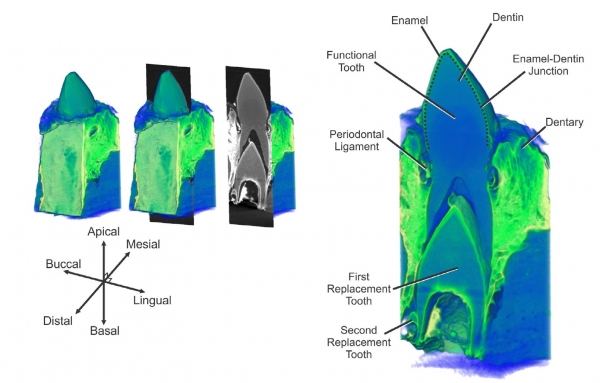
Image #1: the caudal tooth of the American alligator (Alligator mississippiensis).
Enamel is the outer covering of the crown part of the tooth. This is the hardest part of the human body, as well as that of many other vertebrates. However, unlike us, as we know, teeth do not get replaced, so our enamel needs to be thicker. Crocodiles, on the other hand, replace worn teeth with new ones, so there is no need for thick enamel. Sounds quite logical, but is that really the case?
Scientists say that understanding the changes in enamel within one taxon will allow for a better understanding of how enamel structure changes depending on the biomechanics and diet of the animal.
Crocodiles, namely Alligator mississippiensis, are well suited for this research for several reasons. First, their teeth, bite force, and enamel structure change depending on the age and size of the individual, which is also influenced by dietary changes. Second, crocodile teeth have different morphologies depending on their position in the jaw.
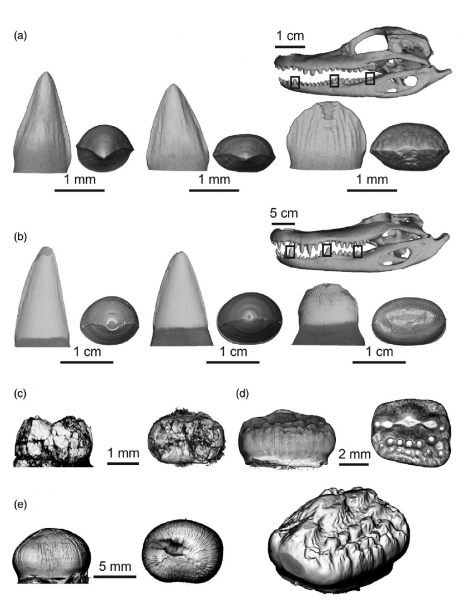
Image #2: a and b show the difference in teeth between large and small individuals, while c and e show the teeth of fossil ancestors of modern crocodiles.
Rostrally positioned teeth are slender and are used for capturing prey, while caudally positioned teeth are blunt and are used for crushing with higher bite forces. In other words, the stress on the tooth depends on its position in the jaw and the size of the owner of that jaw.
This study presents the results of analysis and measurements of absolute enamel thickness (AET) and size-standardized (relative) enamel thickness (RET) of crocodile teeth.
AET is an estimate of the average distance from the enamel-dentin junction to the external surface of the enamel and is a linear measurement. RET, on the other hand, is a dimensionless quantity that allows for the comparison of relative enamel thickness across different scales.
Scientists evaluated AET and RET of rostral (at the 'nose' of the jaw), intermediate (in the middle of the row), and caudal (at the base of the jaw) teeth in seven individuals of the species. Alligator mississippiensis.
It is also important to note that enamel structure can depend on the diet of the individual and the species as a whole. Crocodiles have a very diverse diet (whatever they catch becomes lunch), but it differs from that of their extinct relatives. To verify this in terms of enamel, scientists conducted an analysis of AET and RET in fossils. Protosuchidae (UCMP 97638), Iharkutosuchus (MTM VER 2018.837) and Allognathosuchus (YPM-PU 16989). Protosuchidae is a representative of the Jurassic period, Iharkutosuchus — of the Cretaceous period, and Allognathosuchus from the Eocene.
Before the actual measurements began, researchers conducted a brainstorming session and proposed several theoretical hypotheses:
- Hypothesis 1a — since AET is a linear measure and should depend on size, it is assumed that variance in AET will be best explained by skull size;
- Hypothesis 1b — since RET is standardized by size, it is assumed that variance in RET will be best explained by tooth position;
- Hypothesis 2a — since AET and skull length are linear size measures, they should scale with an isometric slope;
- Hypothesis 2b — since posterior teeth experience the greatest bite forces in the dental row, therefore RET will be higher in posterior teeth.
The tables below present data from samples (skulls of crocodiles of the species Alligator mississippiensis, taken from the Rockefeller Refuge in Grand Chenier, Louisiana, and fossils).
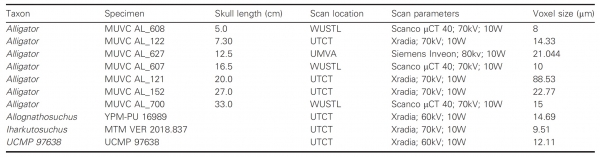
Table 1: crocodile tooth scanning data (rostral, intermediate, and caudal).
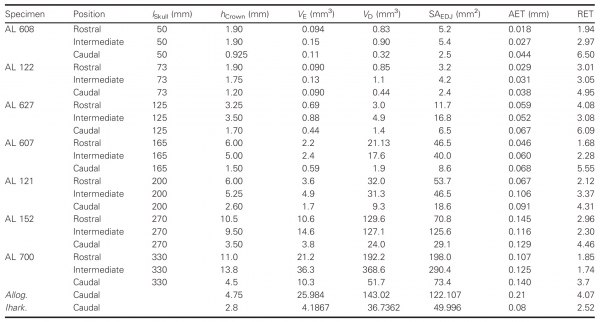
Table 2: tooth data (LSkull — skull length, hCrown — crown height, VE — enamel volume, VD — dentin volume, SAEDJ — enamel-dentin interface area, AET — absolute enamel thickness, RET — relative enamel thickness).
Research Results
According to the dental data presented in Table 2, scientists concluded that enamel thickness scales isometrically with skull length regardless of tooth position.
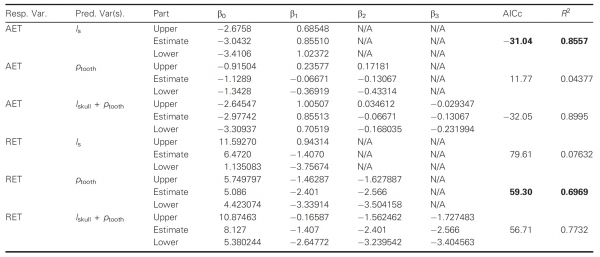
Table 3: AET and RET values depending on variables.
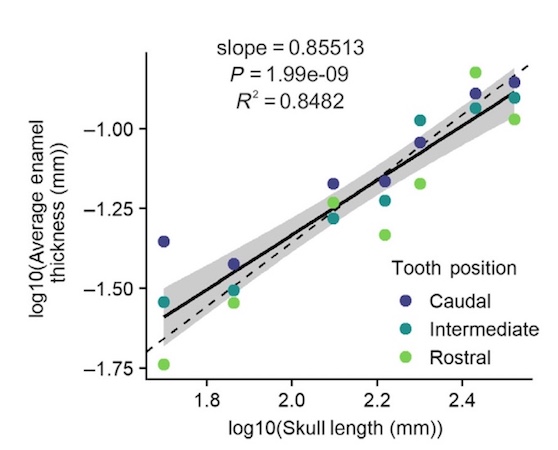
Figure 3: AET/RET scaling concerning skull length.
At the same time, the enamel thickness in caudal teeth is significantly greater than in others, but it is also independent of skull length.
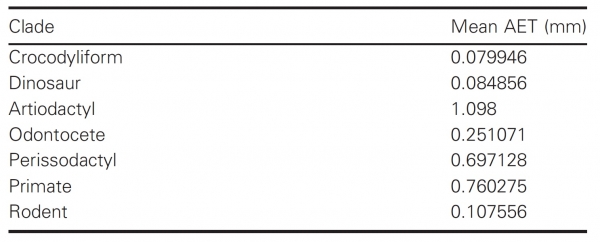
Table No. 4: average enamel thickness values in higher vertebrates (Crocodyliform — non-taxon group of crocodiles, Dinosaur — dinosaurs, Artiodactyl — even-toed ungulates, Odontocete — suborder of cetaceans, Perissodactyl — odd-toed ungulates, Primate — primates, Rodent — rodents).
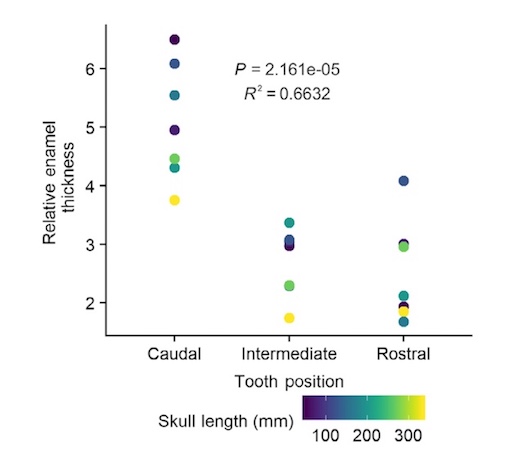
Image No. 4: the enamel thickness of caudal teeth is greater than that of others.
The data regarding scaling (table No. 3) confirmed hypothesis 1a, explaining the dependence of AET value on skull length, rather than tooth position. Meanwhile, the values of RET depend on the tooth position in the row, not on skull length, which supports hypothesis 1b.
The other hypotheses (2a and 2b) were also confirmed, as evidenced by the data from the average enamel thickness analysis of teeth with different positions in the row.
A comparison of enamel thickness in the modern Mississippi alligator and its ancient ancestors revealed many similarities, but also differences. For instance, in Allognathosuchus, the enamel thickness is approximately 33% greater than in modern crocodiles (image below).
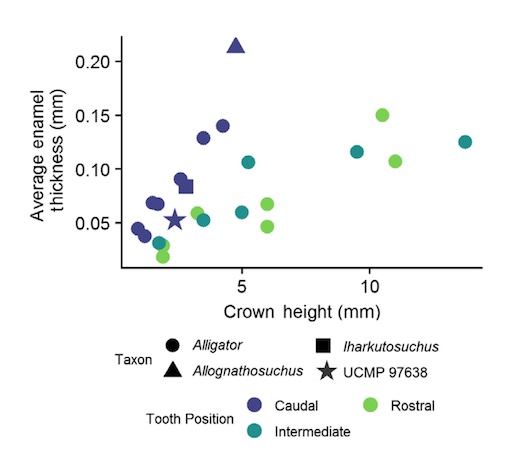
Image No. 5: comparison of average enamel thickness in alligators and fossil crocodilians based on the height of the tooth crown.
Summarizing all the above data, scientists concluded that enamel thickness directly depends on, so to speak, the role of the teeth. If these teeth are necessary for crushing, their enamel will be significantly thicker. It has previously been established that the pressure (compression force) on caudal teeth is higher than on rostral ones. This is precisely related to their role — to hold prey and crush bones. Thus, thicker enamel prevents tooth damage during feeding, as these are subjected to maximum stress. Indeed, the data indicate that caudal teeth in crocodiles break significantly less often despite the heavy loads.
Moreover, it was found that the enamel of the teeth Allognathosuchus is significantly thicker than that of other studied crocodilians. It is believed that this fossil species preferred to feed on turtles, and to crush their shells, strong teeth and thick enamel are necessary.
Scientists also compared the enamel thickness of crocodilians and some dinosaurs of corresponding hypothesized weight and size. This analysis showed that crocodilians had thicker enamel (diagram below).
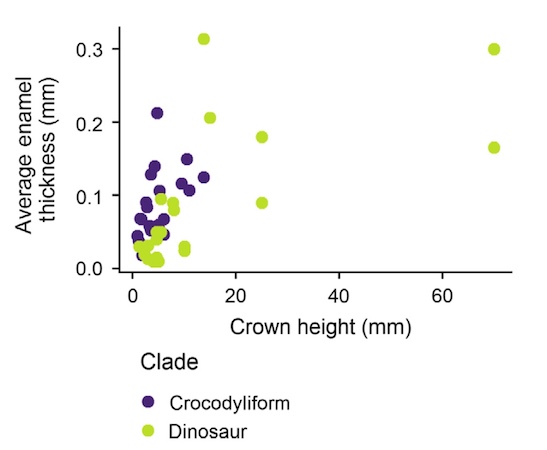
Image #6: comparison of enamel thickness between crocodiles and dinosaurs.
Interestingly, the enamel of the tyrannosaurid was nearly the same thickness as that of the significantly smaller Allognathosuchus and even modern crocodiles. It makes sense that the structure of crocodile teeth is influenced by their hunting and dietary habits.
However, despite their records, the enamel of archosaurs (crocodiles, dinosaurs, pterosaurs, etc.) is thinner than that of mammals.
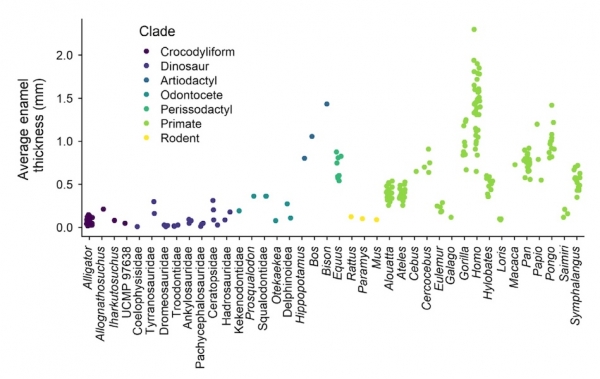
Image #7: comparison of enamel thickness (AET) between crocodiles and some mammal species.
So why is the enamel of hunters, who heavily rely on their jaws, thinner than that of mammals? The answer lies in the early replacement of worn teeth with new ones. While crocodiles have strong teeth, they do not need them to be exceptionally durable since a new tooth always replaces a broken one. Most mammals lack this talent.
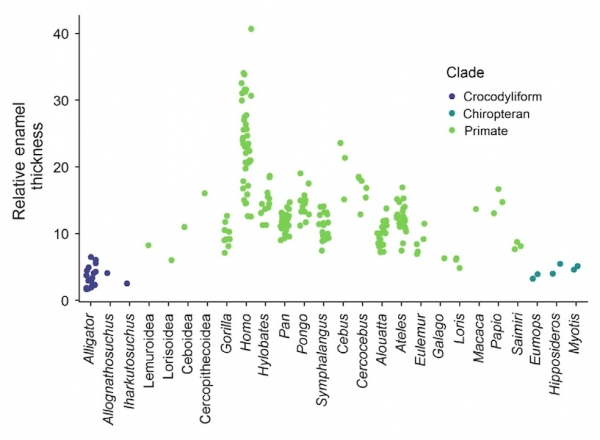
Image #8: comparison of enamel thickness (RET) between crocodiles and some mammal species.
Specifically, the enamel thickness in archosaurs ranges from 0.01 to 0.314 mm, while in mammals it varies from 0.08 to 2.3 mm. The difference is quite noticeable.
For a more detailed understanding of the nuances of the study, I recommend checking out
Epilogue
Teeth, as strange as it may sound, are an extremely important tool for obtaining food. Yes, modern humans can always correct any dental defect, but among wildlife, there are no dentists. Even humans did not always know about dental treatment. Therefore, some species choose strong, durable teeth, while others prefer to replace them as if they were gloves. Crocodiles and their distant relatives can belong to both groups. The enamel on the teeth necessary for effectively holding prey and crushing bones is quite thick in crocodiles, but given the serious stress, their teeth still wear down and sometimes break. In such cases, a new tooth takes the place of the old one.
For humans, one of the distinguishing features is the opposable thumb, which has greatly aided us in many endeavors, ranging from 'picking up a stick and whacking the annoying neighbor on the branch' to 'taking a pen and writing a sonnet.' For crocodiles, however, their tool is their jaws, particularly their teeth. This part of their body makes crocodiles such dangerous and lethal hunters that they are best avoided.
Friday off-topic:

A very curious and aesthetically pleasing short animated film in which the crocodile is not quite a crocodile.
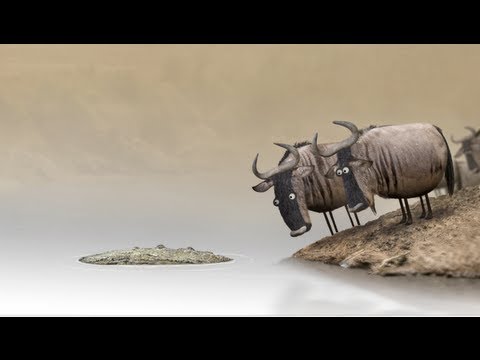
An animated film about how you should not trust suspicious 'logs' in the water, especially if you are a wildebeest.
Thank you for your attention, stay curious, and have a great weekend, everyone! 🙂
Thank you for staying with us. Do you enjoy our articles? Would you like to see more interesting materials? Support us by placing an order or recommending us to your friends. 30% discount for Habr users on a unique entry-level server designed by us for you: (options available with RAID1 and RAID10, up to 24 cores and up to 40GB DDR4).
Dell R730xd for half the price? Only with us in the Netherlands! Dell R420 — 2x E5-2430 2.2GHz 6C 128GB DDR3 2x960GB SSD 1Gbps 100TB — from $99! Read about how
Source: habr.com
