

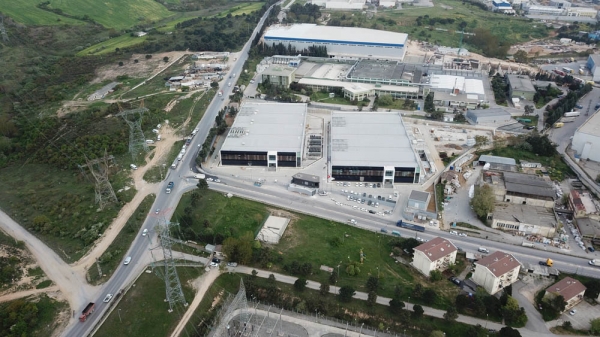
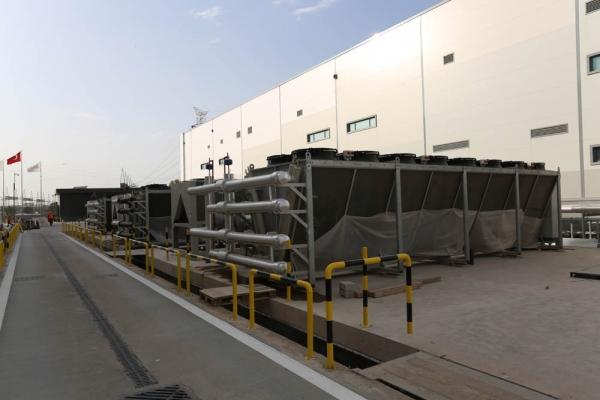
A structure on a 'floating' foundation to protect against earthquakes.
My name is Pavel, and I manage the network of commercial data centers at KROK. Over the last 15 years, we have built more than a hundred data centers and large server rooms for our clients, but this project is the largest one abroad. It is located in Turkey. That's where I traveled for a few months to advise foreign colleagues during the construction of the facility and the cloud.
There are many contractors here. Naturally, we often communicated with the local IT professionals, so I have stories to share about the market and what IT looks like there from a Russian perspective.
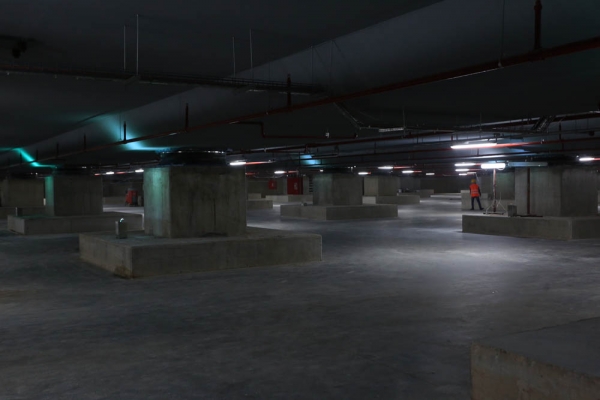
The foundation supports are essentially hinge connections, allowing shifts and jumps.
Market
The market is somewhat similar to the Russian one. There are local flagship companies that, for economic reasons, look at bleeding edge technologies, waiting six months to a year for tech trials to complete before adopting them. Some departments in banks, retail, and various tech businesses in our country operate this way. Then there are multinational companies that come into the country with their own standards: infrastructure is built around them. And there are laggards who are trying to emerge from the 80s and 90s in terms of technology, management approaches, and general awareness. Nonetheless, the Turkish market itself lags behind ours about as much as we lag behind Europe. They are only now beginning to consider commercial data centers, similar to how we did many years ago in Russia.
State regulation is no less significant than ours, and in particular, the local equivalent of Rostelecom — Turk Telekom — holds around 80% of the country's telecom market regarding communication channels. I didn’t fully grasp the scheme, but minimum tariffs are set for providers that cannot be lowered in tenders. As a result, the communication infrastructure is effectively a state monopoly, while all services on top of the infrastructure are commercial, but highly dependent on state regulation.
It's quite similar to the story with personal data that we have. But here, we are talking about critical systems, rather than personal data. These critical systems cannot be taken outside the country; the data must be stored locally. Therefore, powerful data centers (DC) are needed, and this DC was built with seismic protection on a 'floating' foundation. Many server buildings here have different seismic protection: through strengthening structures. But that's not ideal for servers. In the event of an earthquake, the racks would shake. This DC essentially floats in an iron lake of joints, like a duck, while the racks seem to hang in the air—their stability is unaffected by tremors.
Regarding data centers: there are very few providers here who take seriously the need for well-structured operational processes. It's fair to say that this is just starting to develop here. It's difficult to find a large certified facility from the Uptime Institute. There are many smaller ones, and lots that only hold Design certification. Only two data centers have Operational Sustainability, and only one of them is commercial, with certification for just one tier. They are working on optimization.
In Russia, three data centers already have the Uptime Institute TIII Operational Sustainability Gold certification (two commercial ones for renting out machine rooms in parts, and one corporate one for internal needs), and two more are at the Silver level. It's important to note that Tier I, Tier II, and Tier III certifications measure downtime. Tier I is any server room, Tier II has redundant critical nodes, Tier III has all nodes redundantly equipped, meaning that the failure of any single node does not lead to data center downtime, and Tier IV is 'double Tier III': this data center is essentially for military purposes.
Initially, we could obtain a Tier III project. Moreover, these were obtained through both TIA and Uptime certifications. Customers only looked at the third level. Whether it was in accordance with the standard for constructing contact centers or data centers was not very important. Then only Uptime Institute certificates and IBM ones started to gain recognition. Customers began to understand TIII levels. There are three aspects: whether the project meets the requirements, whether the facility is built according to the project specifications, and whether the facility operates and adheres to all regulations. This last aspect, combined with the fact that 'in practice, everything has been functioning for several years'—that is what UI TIII Operational Sustainability means.
What I mean is that in Russia, it's now quite common to announce tenders for TIII data centers to procure space for hosting one’s hardware. There are options available. In Turkey, however, it's simply impossible to find suitable TIII facilities for conducting a tender.
The third feature is that service providers here are under stricter supervision compared to the Russian market. In our case, if you've received services related to telematics or communication, the responsibility for the systems lies with the owner. Once you've rented out your servers, you are no longer involved. It seems that it’s not your business anymore: whether your client is mining or doing something even worse. Here, this approach doesn't work. In fact, every data center provider is obliged to explain that there was nothing you could have done to prevent illegal actions. If you failed to explain properly, they will revoke your license.
On the one hand, this adds a lot of paperwork and complicates the entry into outsourced infrastructure for businesses and government companies, but on the other hand, the reliability level is higher here. If we’re talking about IaaS, there will definitely be security services such as DDoS protection. The usual way clients in our market approach this is:
— Oh, we have a web server, a site will be running.
— Let’s set up DDoS protection.
— No need, who needs it? But leave your phone number; if there’s an attack, then we will set it up, okay?
But here, it’s set up immediately. And companies are willing to pay for it. Everyone has a better understanding of the risks involved. They inquire with the provider about the specific details of traffic implementation. This further leads to situations where, when a client comes to IaaS with a designed system, they might be told:
— Oh, you have some non-standard specs for physical machines. Use standard ones or find another service operator. Or it will be expensive...
In Turkey, it will be like this:
— Oh, you have specifications for physical machines that are quite specific. Let’s buy that hardware for you and rent it out, just sign for three years, and then we’ll give you good prices. Or better yet, let’s do it for five years right away!
And they sign. They even get a reasonable price because, in our case, any contract involves insurance against the situation where you buy hardware for a project, and then the client suddenly backs out and leaves after two months. Here, they won't leave.
There are also differences in perception.
When a client comes in Russia, the dialogue is roughly like this:
— Sell us the cloud, here are the technical requirements.
They reply to him:
— We looked at the technical requirements, it will cost 500 parrots.
He says:
— 500? Are you kidding? No, 500 is way too expensive. How many servers are there? 250? And what's the other 250 for?
They explain it to him. And then—continuation:
— Come on, let’s say you can take some of my hardware, it’s almost new. My guys will help your team set it up. I have a license for VMware. There's a specialist for Zabbix here. How about 130, without the servers?
While it’s not explicitly stated, it is implied that when it cost 500, all risks were on you. When it costs less, and the client does part of the work, it turns out that they take the simplest part, and you're left with only risks. Plus, throughout the project, they often try to throw in more risks. Like, you’re used to Dell hardware, but for open-source software it doesn’t matter; I’ll give you last year’s Supermicro instead. In the end, the entire risk model becomes a disaster. Ideally, you should be looking at 1000 instead of 500.
You might not quite understand what I mean right now. I used to think this was a story about budget optimization. But that’s not the case. There’s a strange mentality in the Russian mindset—playing with building blocks. I think we all played too much with metal blocks as kids, and when we grow up, we’re still curious. When we’re presented with a trendy new gadget, we want to take it apart and see what’s inside. Plus, you can report that you pressured the supplier and utilized internal resources.
In the end, it turns into not a finished product, but an unclear assembly kit. Before I landed my first major contracts in Europe, it seemed strange to me that they wouldn’t allow completion of the client's product parts. It turned out that it slows down services. Instead of providing a standard service and refining it, service providers are engaged in customization for local clients. They play along with the client, tinkering with custom parts to make it work. In Turkey, on the other hand, they prefer ready-made services so that they don’t have to refine anything later.
Again, there's a difference in mentality. If a provider like us approaches a large client and talks about an enterprise application that will affect half the company, two professionals are needed. One from the provider who will show everything, explain, and reveal the insides. The other from the business who will understand how things are grounded, where everything works. It's not about integration or external interfaces, but about the core system, which is not visible from the outside. We dig into it during purchase. But here the client comes for a solution, and they are not very interested in what's inside. No one cares. What matters to the client is that if you promised it works — then it should really work well, just like you promised. How it does that — doesn’t matter.
Perhaps, it's simply a slightly higher level of trust between each other. Again, this is dictated by the responsibility for any problems. Mess up big time — you risk the entire business, not just one client.
This resonates with the mentality of the locals. They are very open with each other. Because of this openness, their relationships are well-developed. A lot is formalized with us, while they think: "Well, you trust me, I trust you, so let's go, you will do the project." And then informal matters are simply handled without extra questions.
Therefore, it is very easy to sell managed services here. This process was much more complicated in Russia. In the RF, they dissect you into parts. But here, every outsourcing of ready-made products is flying off the shelves like hotcakes.
People
On the other hand, it's not necessary for us to meet in person for any reason. Personal communication matters less than just attention. But here, attention and personal communication are one and the same. Questions are not resolved over the phone or by email. You need to come to the meeting; otherwise, locals won’t do anything, and things won’t move forward.
When you request information from us in the spirit of "Please send the configuration," the admin would just take and send it. It doesn't work like that here, in principle. And not because they are bad; it’s more of a subconscious level: why doesn’t he like me enough to just jot down a letter — and that’s it? But how can we chat?
Contacts need to be maintained constantly. If you want local help at the data center, you need to come in once a week instead of discussing things remotely. An hour and a half there and back, plus an hour of conversation. But if you save that time, you'll lose a month waiting. And this happens all the time. It's absolutely unclear to me with my Russian mentality to grasp "What did you expect us to do this remotely?" or "Why didn't you come?" It's as if they haven’t seen the emails, haven’t perceived them. They weren't offended, just set them aside until your arrival. Sure, you wrote. Now that you're here, we can discuss. Let's start with this, from two weeks ago, marked "ASAP." Grab a coffee, calmly explain what happened...
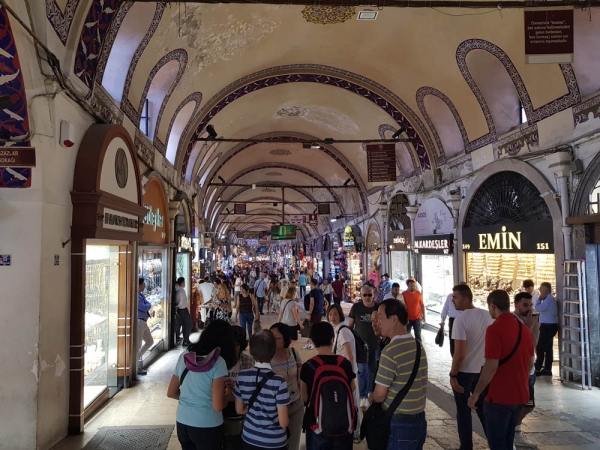
Instead of a console, they have a phone with the contractor. Because you promised, and you came yourself and can't avoid doing it. Because you looked them in the eye and said it. There’s definitely something to that.
What’s even more shocking is what's happening on the roads. It's chaos. Nobody uses turn signals, they change lanes as they please. It's normal for people to drive into oncoming traffic across a solid double line—after all, they need to get around a bus somehow. On city streets, where my Russian mind sees a speed limit of 50 kilometers per hour, they drive nearly a hundred. I've seen many rollovers. Once, I saw a rollover at the entrance to a gas station. I don’t understand how they manage to do that.
If the light is red at the intersection, stopping isn’t exactly the theme. "I went for the tender pink one." Then the grievances start. Someone wasn’t let through on their green light because someone else almost made it but not quite. They can't hold back and go through, no longer obeying the traffic light but when it feels fair to them. This blocks someone else on the perpendicular flow. From there it spirals, and the whole road gets blocked. Traffic jams in Istanbul, in my view, are largely tied to a strange attitude towards rules. I've been told that the provider market here is developing slower than in Europe for a similar reason: clear rules are needed for infrastructure, and they almost all operate on a conceptual basis here.
There is a lot of personal interaction. Across from my house was a local retail store similar to our Meggi. They can deliver any product to your door. It's just a service like that; you just tell them what you need. For instance, I cut my finger, called the pharmacy across the street, and asked them to bring a band-aid to the checkpoint (about 20 rubles). They brought it for free.
All districts in Istanbul have very expensive land, so every bit of it is utilized. The cheaper or less expensive areas are built up tightly. The roads are one lane in each direction, or sometimes they are even one-way. Right next to it is a sidewalk about a meter and a half wide, and then there's a house. A balcony hangs over the width of the sidewalk. It's strange to talk about greenery or places for walks in such areas; you still have to walk to find greenery. What’s most unpleasant is that half the roads are horizontal along a slope, and half of them have a serious incline; it can easily be 15-20 degrees (for comparison, 30 degrees is the slope of a metro escalator in Moscow). Our signs saying, 'Caution!!! Incline seven percent!!!' seem funny. During the rain, I wonder if I’ll start sliding back down the wet asphalt. It feels almost like riding an escalator. I might have to stop in the rain and go again. There are those who back up the hill.
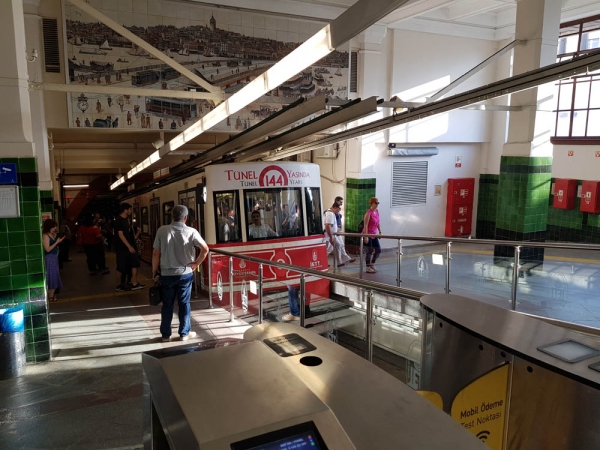
The oldest metro line in Istanbul is 144 years old. In a sense, it’s a cable car.
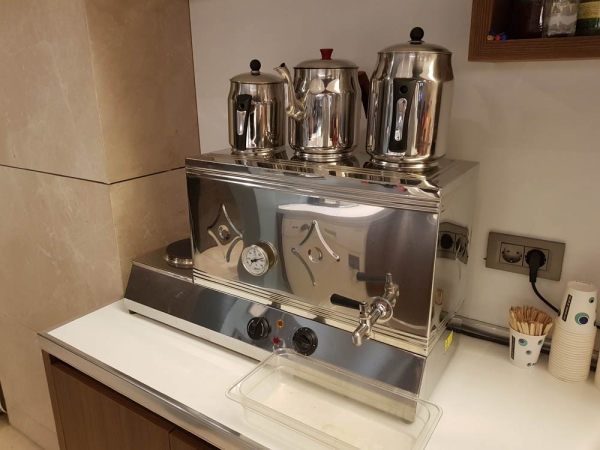
They constantly drink tea for any reason or none at all. It's an unusual taste for us, and I don't really like it. It feels like they make a stronger brew that sits in the kettle. They boil it to the limit for flavor. There are stations everywhere like our thermoses, with little holes on top where tea infusers are placed, containing hot tea.
As for food, when I started dining out with the locals, they showed me many almost home-style restaurants. The local specialty includes a lot of vegetables and plenty of meat. But there is no pork; instead, there's lamb.
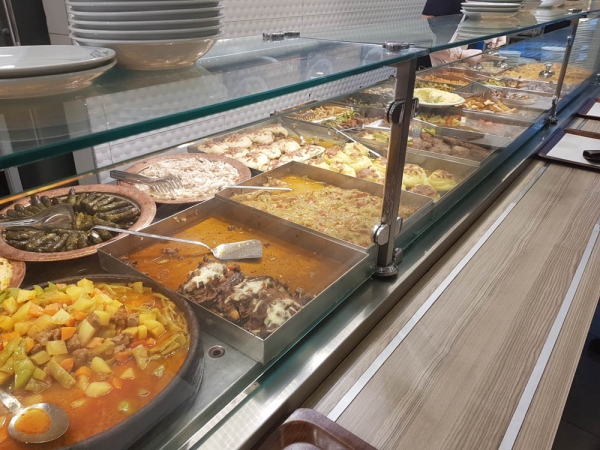
The food is very tasty. Interestingly, it is more diverse than what we have in Moscow. The vegetables are easier to digest, and it's warmer. There are many different dishes. The order of dishes is different here: it’s not salad, first and second courses plus dessert. The distinction between salad, second course, and meat is very blurred. Delicious strawberries starting from March, melons and watermelons from May.
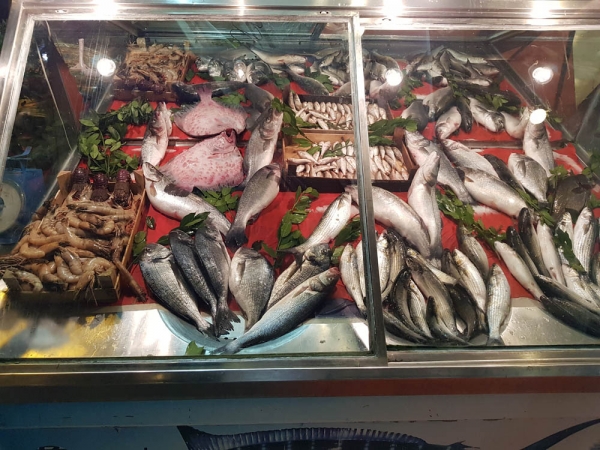
A Muslim country, everywhere women are in hijabs. But many do not wear them, short skirts and bare arms are common.
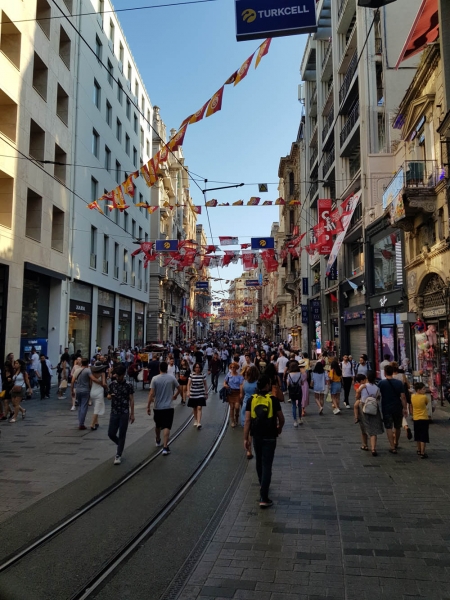
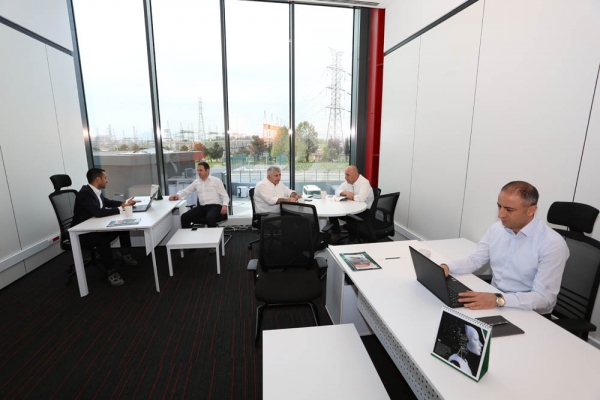
In the office, everyone is dressed quite normally for us; there are no significant differences in dress etiquette.
Among other contrasts: as I mentioned, land here is very expensive, yet there are numerous shops and stalls where you can buy very cheap food and items. I was also surprised by their approach to waste disposal. Apparently, there is a separation of waste by type, but in reality, everything is thrown into one large container. Then, special people with two-cubic-meter bags on carts clear away plastics, glass, and paper throughout the day and take them for recycling. That's how they live... Begging is not encouraged. At least not in its purest form. In reality, some elderly lady might try to sell paper tissues, approaching cars at intersections. She doesn't specify a price; you can pay whatever you have. Many give money and do not take the tissues.
They might also be late for meetings, but no one will be overly upset if you are late. One time, our contractor arrived three hours late, and my colleagues were happy to see him. They said, 'Great that you came, we're glad to see you. It's good you made it. Come in!'
That's all about Turkey for now. We actually participate in similar projects around the world as a technology partner. We advise and help local companies navigate technologies. Today, this includes over 40 countries from the Middle East to Australia. In some places, it’s VR, machine vision, and drones — things that are currently on the rise. In others, it’s good old classics like tech support or IT system implementation. If you're interested in learning about the specifics, we can share some details.
Links:
- My email: PKolmychek@croc.ru
Source: habr.com
