

In 2018, the idea of developing a cloud helpdesk system seemed rather impractical — at first glance, there was a market, both domestic and foreign solutions existed, and there were plenty of custom-built systems. To consider developing a new system when you already have a large CRM project and over 6,000 active clients who constantly need something — it seemed like sheer madness. But it was precisely those six thousand clients that drove us to create our helpdesk. At the same time, we were conducting market research, talking to our future competitors, engaging focus groups, and testing demo versions, hoping to understand that everything had already been thought of. But no — we found no reason to halt development. Our debut on Habr in early August proved that it was all worth it. Therefore, today I'll share a few subjective observations about the world of helpdesk systems.
When support didn’t quite work out
Reasons that led us to write our helpdesk
Our didn't appear out of nowhere. So, we are developers of automation solutions for small and medium businesses, among which our flagship product is RegionSoft CRM. We've written around 90 articles about it on Habr, so the veterans of niche hubs have already split into haters and a support group. But if you haven't joined yet and are hearing about it for the first time, let us explain: it is a universal desktop CRM system installed on the client's server, actively customized to meet business requirements, supported, updated, etc. Additionally, we have several thousand clients who ask questions, send bug reports, request help, and just want something. This means we receive a huge volume of inquiries and requests. As a result, at a certain point, our support team experienced an overload, leading to overheated headsets, ringing phones, and frayed nerves, along with confusion regarding the prioritization of tasks, among other issues. For a long time, we tackled these problems using our desktop CRM, then tried various bug trackers and task management systems, but nothing worked well. We realized that to work efficiently, we must first provide our clients with the ability to independently and around-the-clock create inquiries (requests) and monitor their processing by our operators in real-time. This leads to the conclusion that the solution should be cloud-based, accessible from any device at any time. We formulated several main conditions:
- maximum simplicity and transparency: request → clarifications → work progress → result
- cloud client portal with maximum simplicity and a linear interface: registered → logged in → wrote → checked status → communicated → satisfied
- no overpayment for unnecessary features like social media integrations, complex dashboards, client databases, etc. In other words, we didn't need a hybrid help desk and CRM.
And what do you think — we couldn't find such a solution. In other words, we reviewed over 20 solutions, selected 12 for testing, tested 9 (we won't say why we couldn't test more, there's no need to offend competitors, but one of them, for example, just wouldn't start — promised in 5 minutes, but got stuck there).
All this time, we have been assessing the market and recording observations from the perspectives of a developer, support staff, and marketer. What did we learn that was somewhat disheartening?
- Some help desks lack client portals, meaning the client cannot see the status of their request or who is handling it. Nearly all services boast about omnichannel capabilities (collecting requests even from Odnoklassniki), but most lack straightforward access to the service, where you can log in and see your requests clearly.
- Most help desks are tailored specifically to the needs of IT departments, aligning with ITSM services. This is certainly not a bad thing, but help desks are needed by many companies with a support service, from online stores to service centers and advertising agencies. Yes, solutions can be adjusted to any theme, but how many unnecessary features will end up cluttering the interface!
- The market has industry-specific solutions for service centers: equipment accounting and labeling, repair services, geolocation of couriers and technicians. Again, these do not cater to non-service companies.
- Universal solutions that can be tailored to any business requirements are quite expensive. And naturally, customization (you'll understand why it's not an enhancement later) comes at an additional cost. Foreign solutions are outrageously expensive for the Russian market.
- Some vendors require payment upfront for a minimum period of 3 or 6 months; you cannot rent software on a SaaS model for a month. Yes, they promise to refund 'unused' funds if you decide to stop using their help desk during this period, but this situation is inconvenient, especially for micro-businesses that need to tightly control expenses.
- To our great surprise, most help desk vendors either flatly refused to make modifications altogether, stating that such a service does not exist, or directed us to the API. Even platform solutions responded that they could potentially help but suggested, 'you might as well try it yourself — an in-house programmer can figure it out.' Well, we have one, but what about those who don't?!
- More than half of the solutions have a cluttered interface, and as a result, staff training is required, as there is a need to navigate through it all. Let's say an engineer can figure it out in a few hours or a day, but what about the regular support staff, who are already overwhelmed?
- Finally, what outraged us the most was the astonishingly slow performance of the majority of the tested systems! Portals take a long time to create, open, and start; requests are saved slowly—this is with a good connection speed (around 35 Mbps during tests). Even during demonstrations, the systems lagged, and opening a simple request took 5 seconds or more.By the way, we were particularly amused by one of the managers from a well-known vendor, who, when asked why the loading wheel spins so long, replied that this is how Skype transmits it, and in reality, it’s not hanging.In some cases, we found the reason—data centers are far from Moscow, while in others, we couldn't get to the bottom of it. Interestingly, some helpdesk developers emphasized multiple times during the conversation that all data is stored in Russian data centers (this is what 152-FZ has led to!).
In general, we felt downcast. We decided that we needed to develop our own helpdesk—one that would suit us, our clients from all business sectors, service centers, and IT companies (including for organizing internal client support—it works great as assistance for system administrators). Said and done: on August 3, 2019, we launched it into production. — a simple, user-friendly cloud helpdesk with client access. By that time, we had been actively using it ourselves—here's how it looks for us now:
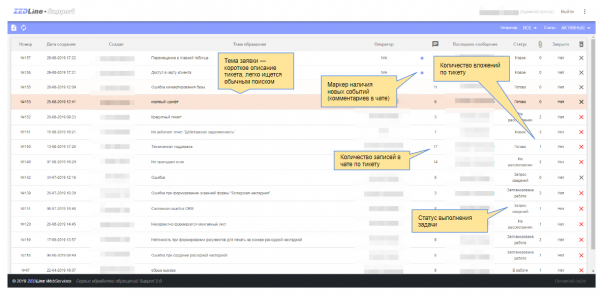
Main window with a list of client requests and inquiries
So, we went into production.
And here comes the moment to talk about Habrahabr on Habrahabr. We have been maintaining a blog for over three years, experienced and savvy—so why not launch a new product? It was a bit daunting, but we took the first three steps:
- We wrote a post ""—a bit revealed the topic of organizing tech support in a company and presented ZEDLine Support.
- We wrote a post ""—we talked about the complicated relationships between the manager and the system administrator, revealing the topic of forming technical support for internal clients.
- We launched contextual advertising on Google and Yandex — in both cases only for search, as we have long and firmly been disappointed with the contextual display network.
Our concerns turned out to be exaggerated. In the first month, we received over 50 registered portals (to be honest, we didn't even plan for such a result), numerous contacts with potential clients, and even the first warm and pleasant feedback, highlighting especially... the simplicity and speed of our ZEDLine Support. This is exactly what we initially set out to achieve with the development of this service. Now we are actively working with inquiries, equally actively filling the backlog and adding features.
Dreams into reality: how ZEDLine Support looks now
The main essence of any ticket system is the request form. It should be client-friendly, simple, devoid of unnecessary and confusing options while providing comprehensive information about the issue so that the operator can immediately take on the task and understand what exactly is wrong, in what direction to correct the issue, or request additional information.
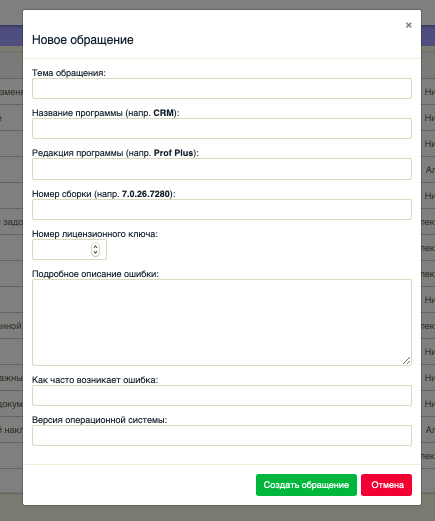
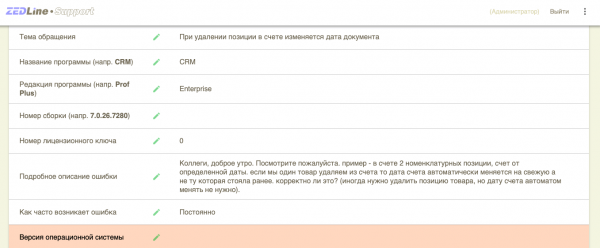
As a result, we receive requests of this kind:
And most importantly, we implemented the long-desired portal scheme. A portal is a personal environment for the portal owner to interact with their clients. If you create a portal for yourself, it will have a unique URL, its own database, disk space, etc. Your clients will be able to access this portal via the provided URL and create requests or inquiries that are immediately sent to a unified log, from where your operators will process them.
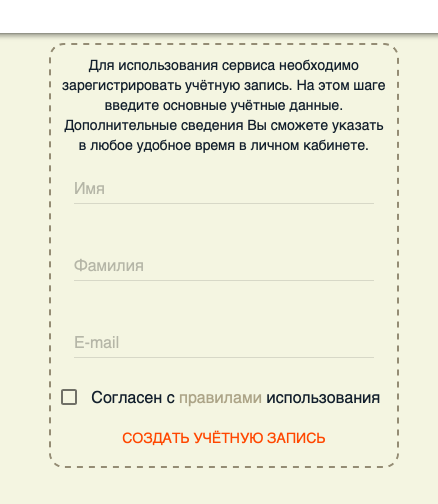
How does a client find out the URL of your portal? With our helpdesk, you place the link everywhere users might wish to ask you a question: on your website, in social networks, in emails, or messengers and chats, even in a widget or article on Habr. The user clicks your link, registers in a three-field form, and enters the application. The login and password are sent to their email.
Furthermore, operators can generate invitations for clients from their personal account to relieve them of even the basic task of filling out a small form. The invitation will be sent to the client's email, and the text of the invitation will already contain all the necessary information for portal access: URL, username, password.
Immediately after registration or receiving an invitation, the client logs into the portal, creates a request by filling out the application form fields, and gains access to their instance. — meaning they can see the statuses of their inquiries, create and view messages in the internal chat with the operator, attach and view files, generally monitor the progress of solving their issue. The user receives notifications about all events in their email, so there is no need to stay in the interface and press F5 to refresh ticket parameters.
This approach to the interface allows for a simple registration process and immediate engagement, rather than getting lost in the complexities of functionality. This makes sense because a client might only use the helpdesk a few times (or sometimes just once) throughout their entire interaction with you, and they should not be overloaded.
Appetite comes with eating, and while we were developing the operator interface and client portal, the thought occurred that the personal account should also be logical, convenient, and comprehensive. And so we proceeded: in the personal account, one can set up their profile (if you are an operator), configure ZEDLine Support, track payments, view users, set up the application form, and view statistics (if you are an administrator). Again, we have implemented the principle of "efficient simplicity": the operator works in an extremely simple interface, which provides several advantages:
- they are not distracted by other sections
- system settings are unified
- the responsibility of the administrator for configuration failures is evident
- most information is protected from operators
- operators learn to work with such an interface very quickly (saving on training + quick start).
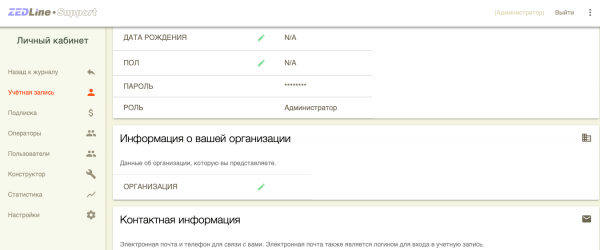
By the way, regarding training — upon the first login, users are greeted by an interactive tutorial that 'guides' newcomers through the entire interface and explains how ZEDLine Support works. It will be displayed until you click the 'don't show again' button.
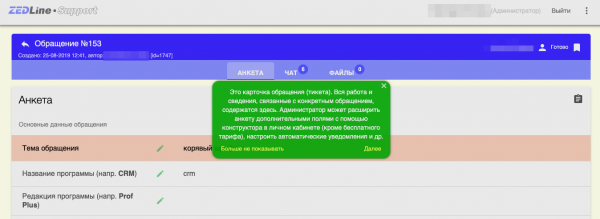
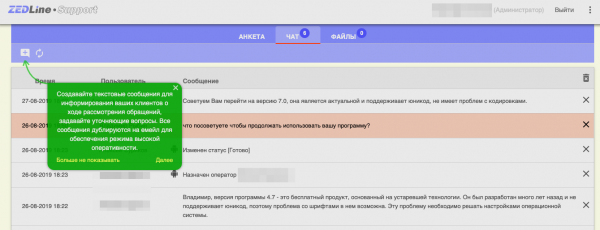
All clarifications and questions can be asked in the chat, thus you can:
- track the progress of the issue resolution and monitor status changes
- delegate tasks to other employees without recounting the previous history
- quickly exchange necessary files and screenshots
- keep all information about the problem and easily refer back to it if a similar issue arises.
Now, let's return to the admin panel. There, among other things, there's an email setup for notifications, disk space monitoring, and so on. Additionally, there’s billing — you will always know when, how much money was spent, and on what.
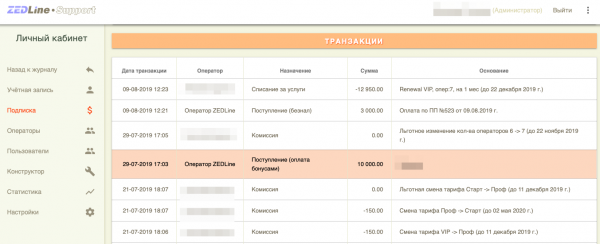
In billing, there are two sections: subscription and transactions. In the subscription section, you can change the plan, the number of operators, renew the subscription, and top up the balance with just one action. When topping up, an invoice is generated for you directly in the ZEDLine Support interface.
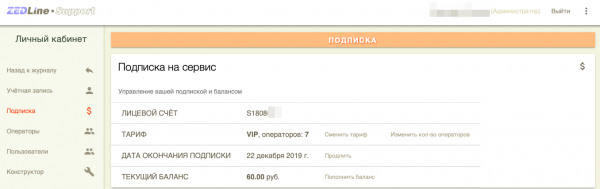
In transactions, you can see all operations related to payments and deductions. You can also see who made the payment and when the transaction took place. By the way, paying with bonuses in the screenshot is not a coincidence and not a test: until September 30, 2019, there is a promotion — when topping up the balance, we give a bonus of 50% of the recharge amount. For example, when paying 5,000 rubles, 7,500 rubles will be credited to your balance. And in the billing interface, a similar entry will appear 🙂
And yes, since we're on the topic of payment: we have a free plan + three paid ones. We can also state that we are ready to customize the ZEDLine Support helpdesk to meet your business requirements — at the standard rate for our company programmers. We often do customizations for RegionSoft CRM, quickly drafting and agreeing on technical specifications and starting work, so our experience allows us to create custom solutions as well.
Currently, the ZEDLine Support helpdesk is integrated with our CRM system, RegionSoft CRM. However, we can provide access to the beta version of the API upon special request, and in addition to enhancements, there will be many integration opportunities.
Finally, we have achieved another very important goal from our perspective — to make the system very fast. After all, the speed of the system’s response to user actions makes the users' experience comfortable. As the system develops, which is inevitable, we will pay special attention to speed and strive for it.
In short, this is what we have accomplished. — and judging by the feedback from the first users, we hit the mark.
Who needs a helpdesk and why?
At the beginning of the article, we mentioned that most helpdesks are for IT and IT specialists. There is a logic to this, but it is not entirely accurate. Here's just a tentative list of those whose work will be simplified by a straightforward and user-friendly helpdesk.
- System administrators who can create an internal ticketing system to handle requests from colleagues and respond to official requests calmly instead of rushing chaotically around the floors and offices (these requests also serve as proof of worked hours).
- Service companies and service centers that work with various equipment and different tasks related to customer complaints.
- Any companies with customer support via phone and chat — to allow clients to formulate their questions in writing and track the progress of work while keeping all requests in one place.
There are a million reasons to write to a company rather than call, with two main ones being: the habit of communicating via text in messengers and the ability to start resolving issues during working hours without hiding with a phone in corners and disturbing colleagues. A single link to your helpdesk instance will help solve all issues of omnichannelity, availability, speed, etc.
Today, our team is using the helpdesk. For the longest time (which makes sense), we, as experienced business automatons, constantly exchange opinions, seek new features, and sometimes argue. But one opinion converges: it's convenient for us, and it's convenient for our clients who submit requests. Furthermore, it has become significantly easier for support operators to handle user requests.
When a company surpasses a certain barrier, management realizes that it's not enough to simply sell a product or service to a client. It is essential to organize interaction with the client in such a way that they appreciate the quality of post-sales service, whether paid or free. It's important to fight for every client and combat the loss of regular customers while building up the client base. This, in turn, is achieved by working to enhance loyalty levels. Therefore, the client must be assured that their request to the company with an issue will not be lost or hang somewhere in the depths of the staff, nor will it depend on the human factor. This is precisely the problem that .
Source: habr.com
