

Articles about relocating to different countries are quite popular on Habr. I gathered information about moving to the capital of Estonia – Tallinn. Today, we will discuss how easy it is for a developer to find job vacancies with relocation options, how much one can earn, and what to generally expect from life in Northern Europe.
Tallinn: Developed Startup Ecosystem
Despite the fact that the population of Estonia is about 1.3 million, with around 425 thousand living in the capital, there is a real boom in the development of the IT sector and technological startups. Today, four startups related to Estonia have achieved unicorn status – their has surpassed $1 billion. This list includes projects like Skype, the gaming platform Playtech, the taxi and transportation rental service Bolt, and the money transfer system TransferWise.
There are about 550 startups in Estonia, and the total investment in them over the past year €328 million.
Quality and Cost of Living in Tallinn
The country and its capital demonstrate good results in terms of quality of life. According to the analytical company Mercer, the Estonian capital ranks among the top hundred cities in terms of quality of life. Tallinn ranked 87th. In comparison, Moscow was only 167th, while St. Petersburg came in at 173rd.
Also, according to the Numbeo website, the cost of living in Tallinn is lower than in Moscow and many other European capitals (Berlin, Vienna, etc.). For instance, rental prices in Tallinn are, on average, more than 27% lower than in Moscow. You will pay 21% less in restaurants, and consumer goods are 45% cheaper!
Another advantage of Tallinn is that Estonia is part of the European Union and the Schengen Area, making it easy and inexpensive to reach any point in Europe.
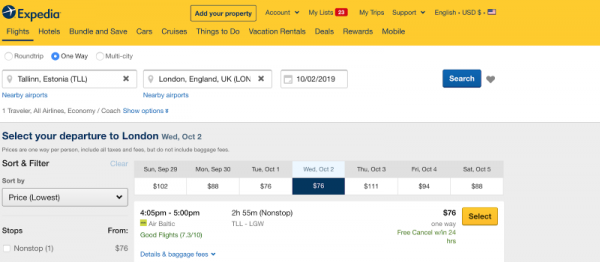
A flight ticket from Tallinn to London can be found for $60-80.
Working in Estonia: How to Find Jobs and What You Can Earn
Currently, the profession of a developer is one of the most in-demand in Estonia, as hundreds of local IT companies are in desperate need of staff.
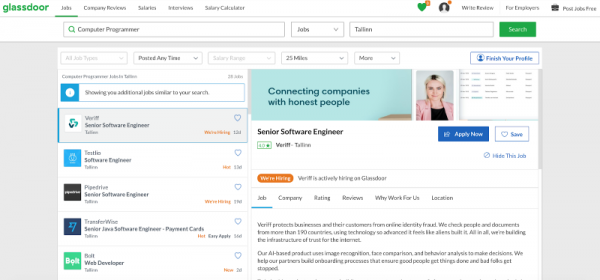
Job vacancies for programmers in Tallinn
When it comes to salaries, Estonia is also part of the Eurozone. For this reason, salaries here tend to be higher than in EU countries that have retained their own currency, such as Hungary… A brief analysis of startup job listings on Angel.co shows that the typical salary range in the IT sector today is €3,500-5,000 per month before taxes, although there are companies that pay significantly more – for instance, the Estonian unicorns.
Even an entry-level developer's salary in Estonia will be very good. The average income in the country in the second quarter of 2019 €1,419 before taxes – the country still lies on the outskirts of Europe and is not among the wealthiest.
Let’s talk about where to search for jobs in the country’s IT sector. The list is heavily influenced by the fact that a significant portion of the industry consists of startups:
- – on this popular site for startups, there is also a section with job listings that can be filtered by country.
- – jobs for developers with relocation options are occasionally posted here.
- – a decent number of job openings can also be found on Glassdoor.
LinkedIn is quite popular among Estonian companies, so having a well-organized profile on this social network increases the chances of finding a job. It is not uncommon for strong developers to be approached directly by recruiters from Estonian companies inviting them to interviews.
Moreover, the ‘startup’ approach to hiring often implies unconventional job search opportunities – for example, various hackathons and competitions organized by Estonian companies are quite common.
As a result of such competitions, it is also possible to receive a Job Offer. For instance, there is currently with a prize fund of 350,000 rubles, and the best programmers will have the chance to interview and receive an offer with relocation options all in just a day.
Documents and settling in after relocation.
The process of relocating for work in Estonia is described in detail on the internet, so we will cover only the main points. First of all, you will need a work permit for relocation – this is arranged by the employer, and there is an expedited procedure for startups.
After going through interviews and receiving an offer, the permit is issued very quickly – it can be obtained within a day. So, the main waiting time will be spent on processing the visa for entering the country.
Once you enter and receive your residence permit, you will experience the full benefits of Estonia's electronic government. A vast number of services in the country can be accessed online – even prescriptions written by doctors are linked to your ID and can be viewed online. This is very convenient.
Another advantage of Estonia, especially noticeable to those moving from large cities, is its compactness. You can reach almost any point in Tallinn in about 15-20 minutes, often on foot. Even the airport is located very close to the city.
Communication and Entertainment
The presence of a large number of international companies in Estonia has led to an influx of expats. In some areas of the city, you can often hear English being spoken – this language is quite sufficient for communication and a normal life. Russian speakers also feel comfortable here – in recent years, Estonian companies have actively relocated developers from former Soviet countries, so finding acquaintances with a similar mentality is not a problem.
The developed startup ecosystem is great due to the abundance of professional meetups and gatherings – in terms of quantity, small Tallinn is not inferior to huge Moscow.
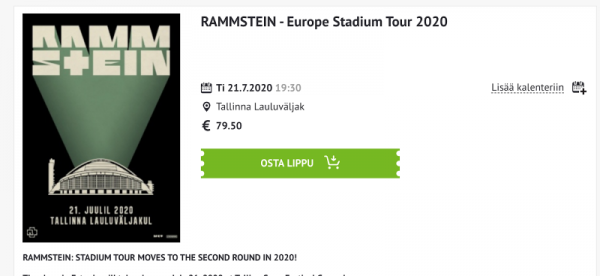
Moreover, the Estonian capital is conveniently located – hence, concerts on world tours are often held here by international stars. For example, here’s the poster for the Rammstein concert, which will take place in 2020:
Of course, there are also things to which one must adapt in a small country – for instance, IKEA arrived in Estonia only recently, and before that, furniture had to be purchased elsewhere. The overall richness of cultural life is also somewhat lower than in Moscow or Petersburg – in a city of 425 thousand, there simply cannot be as many theaters as in a megacity.
Total
Estonia is a small, quiet European country. Everyday life here does not bustle as it does in a megacity, and the locals generally do not earn very much.
But for engineers today, this is a very good place. There is a vast amount of work, powerful IT companies, many with billion-dollar valuations, decent salaries, an active social scene, and rich opportunities for networking and career development. Additionally, it has one of the most advanced e-governments in the world, making it pleasant and comfortable to live here.
Source: habr.com
