


A guide for anyone in need of a name for a product or business—existing or new. We will discuss how to come up with, evaluate, and choose names.
For three months, we worked on rebranding the control panel serving hundreds of thousands of users. It was painful, and at the beginning, we were in desperate need of advice. So once we finished, we decided to compile our experience into a guide. We hope it will be useful to someone.
Should the name be changed?
Skip to the next part if you're creating a name from scratch. If not, let’s delve into this. This is the most crucial of the preparatory stages.
A bit of our background. The flagship product is , a hosting management panel that has been in the market for 15 years. In 2019, we planned to release a new version, but decided to change everything. Even the name.
There can be many reasons for a name change: from simple 'dislike' to poor reputation. In our case, there were such prerequisites:
- The new product has a different concept, interface, and functionality. With it, we are targeting a new audience, which the cumbersome name 'ISPmanager' may scare away.
- The previous name is associated not with management panels but with internet providers (ISP, Internet Service Provider), to which it is unrelated.
- We want to reach out to foreign partners with a new product and name.
- ISPmanager is difficult to write and pronounce.
- Among competitors, there is a panel with a similar name—ISPconfig.
The only argument against changing the name was: 70% of the market in Russia and the CIS uses our panel, and there is a lot of content online where it can be found.
So, it was 5 against 1. It was easy for us to decide, but very scary. Why do you need to change the name? Are the reasons sufficient?
Who to trust with the rebranding?
In this article, we discuss how to conduct a rebranding on your own. However, it is worth considering outsourcing this task. There are pros and cons to all options.
When making a decision, one must consider:
Time. If the name is needed 'yesterday', it’s better to contact an agency right away. They can get things done quickly, but might miss the mark with the idea and take time to revise. If there is time, take it on yourself. It took us three months to come up with 30 working options, select the best one, and purchase the domain from parkers.
Budget. It's simple. If you have the money, you can go to an agency. If your budget is limited, try doing it yourself. Keep in mind that you will need money regardless, for example, to purchase a domain or for branding. We definitely decided to outsource the logo design to an agency.
Blurred vision. Another reason to 'go external' is the realization that you're not stepping beyond familiar solutions, you're stuck in one place. We experienced this in the second month of work; in a complete deadlock, we considered hiring consultants. In the end, it wasn’t necessary.
Complexity. Assess the requirements, constraints, product, or service. How manageable is this for you considering all the previous points? Does the agency have relevant experience?
A little hack. If you understand that you can't manage by yourself and don't have the budget for consultants, use crowdsourcing services. Here are just a few: , or . You describe the task, pay the money, and accept the results. Or not — there's a risk involved everywhere.
Who among the employees will take it on
Has anyone in your marketing team dealt with branding and can organize the process? Is your team creative? What about language skills, do they speak it fluently in the company (if you need an international name, not in Russian)? These are the minimum skills to consider when forming a working group.
We developed a new name as a team. It was important for us to gather opinions from different departments working with the product: marketing, product managers, development, UX. The working group consisted of seven people, but there was only one responsible person — the marketer, the author of this article. I was in charge of organizing the process and also came up with the name (believe me, around the clock). This task always remained a top priority, although not the only one.
The product manager, developers, and other team members came up with names when inspired or held personal brainstorming sessions. What we needed most in the team were people who knew about the product and its concept better than anyone else, as well as those capable of evaluating options and making decisions.
We have made an effort — and we recommend this to you — not to inflate the team size. Trust me, it will save your nerve cells that will otherwise die in trying to consider very different, sometimes opposing opinions.
What to be prepared for
When creating a new name, you will feel nervous, angry, and want to give up. I will share the unpleasant moments we encountered.
Everything is already taken. An original and worthy name may be occupied by another company or product. Coincidences are not always a sentence, but they can be demotivating. Don’t give up!
Literalness and skepticism. Both you and the team will be overly skeptical about many options. In such moments, I remembered the anecdote about Facebook. Surely when someone suggested this name, someone else said, 'Not the best option; people will think we sell books.' As you can see, that association didn't stop Facebook from becoming the largest social network in the world.
“Behind cool brands stands not only the name but also its history, strategy, and innovations.”
I don’t like it! You will repeat this phrase to yourself and hear it from colleagues. My advice is to forbid yourself from saying this and explain to the team that 'I don’t like it' is not a criterion for evaluation, but mere taste.
There will always be comparisons. Team members and clients will long use the old name and compare it with the new one (not always in favor of the latter). Understanding, forgiving, enduring — this will pass.
How to come up with a name
And now the most difficult and interesting part — generating options for a new name. At this stage, the main task is to come up with as many words as possible that might suit your company and sound good. We will evaluate them later. There are many ways to do this; you need to choose a couple and try them out, and if it doesn’t work, take other ones.
Searching for ready solutions. You can start simply — explore websites that sell domains along with names and even logos. You can find really interesting names there. However, they may cost from $1,000 to $20,000, depending on how creative, brief, and memorable the name is. Here's a lifehack: you can negotiate on those sites. and .
Contest among employees. This is a great way to generate ideas rather than ready-made options. It also helps to diversify the routine and engage employees in marketing. We had 20 participants with hundreds of options, some of which made it to the final stage, while others became sources of inspiration. There was no winner, but we selected the 10 most creative ideas and awarded their authors gift certificates to a fine restaurant.
A competition among users. If a brand has a loyal community, it can involve them in the creation of a new brand. However, if there are many dissatisfied customers or if you are unsure about the product launch, it's worth considering carefully. Assess the risks. In our case, this was complicated by the fact that current users were unaware of the concept of the new product, so they couldn't offer anything.
Team brainstorming sessions. There has been much written about brainstorming; you just need to choose a format that fits your task. Here, we will limit ourselves to a few tips.
- Conduct several brainstorming sessions with different people.
- Get out of the office (to a retreat or nature, a coworking space or a café) and make the brainstorming a happening rather than yet another meeting in the conference room.
- Don't limit yourself to a fixed brainstorming session: set up boards in the office where anyone can write down their ideas, establish 'mailboxes' for ideas, or create a separate thread on the internal portal.
Individual brainstorming sessions. For me, the task of coming up with a name was paramount, so thoughts about naming occupied my mind around the clock. Ideas struck me at work and during business lunches, before sleeping, and while brushing my teeth. I relied on 'remembering' or jotted things down wherever I could. I still think: maybe I buried something great this way? Therefore, I recommend starting with one document where all ideas will be stored.
How to evaluate and what to choose.
When a certain number of options has accumulated in the idea bank, they need to be evaluated. At the first stage, a scale from 'this is utter nonsense, definitely not' to 'there is something in this' will suffice. The evaluation can be done by a project manager or a marketer; simple common sense is enough. All names that have 'something in them' should be transferred to a separate file or highlighted. The rest should be set aside but not deleted, in case they come in handy.
Here is an important note. The name should sound good and be memorable, distinguishing you from competitors, and also be free and legally clean. We will go through these general criteria in this article, but some need to be defined beforehand. For example, should the new name be typical for your market, include certain clichés, or have continuity with the old one? For instance, we have decided in advance to avoid the word 'panel' in the name and our 'manager' (which is part of the entire product line from ISPsystem).
Checking for matches and meanings
Ideas that have passed the nonsense filter need to be checked for matches and hidden meanings: is there anything among them that sounds like a curse word or profanity in English? For example, we almost named a product 'Fat Girl'.
Here too, you can and should manage without a team. When there are many names, it's convenient to use . The columns will contain names, and the rows will contain factors from the list below.
Exact matches. Check in Google and Yandex, with different language settings and in incognito mode so the search doesn’t adjust to your profile. If there is an identical name, mark it with a minus in the table, but don’t completely cross it out: projects can be amateur, local, or abandoned. Definitely cross out if you match exactly with a global player, a market player, etc. Also, take a look at the 'Images' section in the search; it might show logos of real or sold names along with their domain that weren't found in the site searches.
Available domains. Enter the suggested name in your browser's address bar. If the domain is free, that's good. If it’s occupied by a real, 'live' site, make a note, but don’t cross it out—there may be similar domains at the registrar. It’s hard to find an available name in the .com zone; it’s easier with our .ru. Don’t forget about thematic extensions like .io, .ai, .site, .pro, .software, .shop, etc. If the domain is occupied by a park, make a note with the contacts and price.
Social media platforms. Check the name in the browser address bar and through searches in the social media. If the account is already taken, a solution would be to add the word 'official' to the name, for example.
Meaning in other languages. This point is particularly important if you have consumers around the world. If your business is local and won’t expand — skip this. Google Translate can help: enter the word and select the option 'Detect Language.' This way, you’ll find out if even a made-up word has meaning in one of the 100 languages that Google processes.
Hidden meanings in English. Check out , the largest dictionary of English slang. Words come into English from all over the world, and Urban Dictionary is filled in by anyone without verification, so you're likely to find your version here. That's how it happened for us. After that, you need to determine if the word is indeed used in that meaning: ask Google, native speakers, or translators.
Based on all these factors, summarize each option in your table. Now, the list of options that passed the first two stages of evaluation can be shown to the team.
Show the team
The team will help weed out the unnecessary, choose the best one, or indicate that more work needs to be done. Together, you will determine three to five options, from which you will select 'the one' after legal review.
How to present? If you just list the options, no one will understand anything. If you present at a general meeting, one person might influence the opinion of the others. To avoid this, we recommend doing the following.
Send the presentation personally. Here are three important points. First — ask not to discuss or show it to anyone. Explain why this is important. Second — be sure to show logos in the presentation, even several. You don't necessarily need to involve a designer for this (although you can). Use online logo makers and let the team know that these are just examples. And lastly — briefly describe the idea on the slide, show domain options and their prices, and indicate whether social media handles are available.
Conduct a survey. We sent out two surveys. In the first, we asked to list three to five names that stood out. In the second, we posed ten specific questions to avoid the subjective assessment of 'Like/Dislike.' You can take a ready-made template or part of the questions from
Discuss with the entire working group. Now that people have made their choice, we can discuss options collectively. During the meeting, showcase the most memorable names and those that scored the highest.
Legal Check
You need to check if the word you've chosen is a registered trademark. Failing to do so could result in the new brand being prohibited. This way, you'll see trademarks that the search engine did not issue.
Determine your Nice Classification (NCL). First, you need to identify the industry you are operating in, and then check if there are any products with your name in that category. All goods, works, and services are grouped by classes in the International Classification of Goods and Services (NCL).
Find the codes in the NCL that correspond to your activity. For this, study the or use the search feature : enter the word or its root. There can be multiple NCL codes, even all 45. In our case, we are focusing on two classes: 9 and 42, which include software and its development.
Check in the Russian database. — is the Federal Institute of Industrial Property. FIPS manages patent databases. Go to the , enter the name and check if it exists there. This system is paid, but there are also free resources with complete databases, for example, . First, check the exact spelling, then look for similar sounding and meaning variants. If you decided to name the product LUNI, you should search for LUNI, LUNY, LOONI, LOONY, etc.
If a similar name is found, check its NCL class. If it doesn't match yours, you can use it. If it does match, registering the trademark on standard terms won't be possible, only with the consent of the current rights holder. But why would you want such complications?
Check in the international database. Trademarks are registered by the World Intellectual Property Organization — WIPO. Go to the and do the same: enter the name, check the NCL classes. Then look for related and similar words.
Select
Now it's time to weigh the pros and cons of each item on the shortlist. Immediately eliminate those that are not suitable for trademark registration. Using them poses significant risks for the product, company, or service. Then evaluate the costs of purchasing domains and reanalyze the search results. Also, ask yourself two main questions:
- Is there a legend, story, or unique feature behind this name that can be used in marketing? If yes, it will make life easier for the brand, you, and even your consumers.
- Do you feel comfortable with this name? Try living with it for a couple of days, say it out loud, and imagine it in different contexts. I envisioned technical support responses, user questions, business development presentations, and trade shows.
Meet with the team and make a decision. If you can't decide between two, hold a vote among employees or, if you're very brave, clients.
What's Next
If you think this is the end, I must disappoint you. This is just the beginning, and there's more to come:
- Buy domains. Besides standard ones, it may be worth purchasing the most successful thematic extensions.
- Develop a logo and corporate identity (we don't recommend trying your hand at this).
- Register a trademark (not mandatory), which will take about a year just in Russia. You don't have to wait for the procedure to finish to launch; it's important that you have the date of submission for registration.
- And the most challenging part — inform employees, current and potential clients, and partners about the rebranding.
What we ended up with
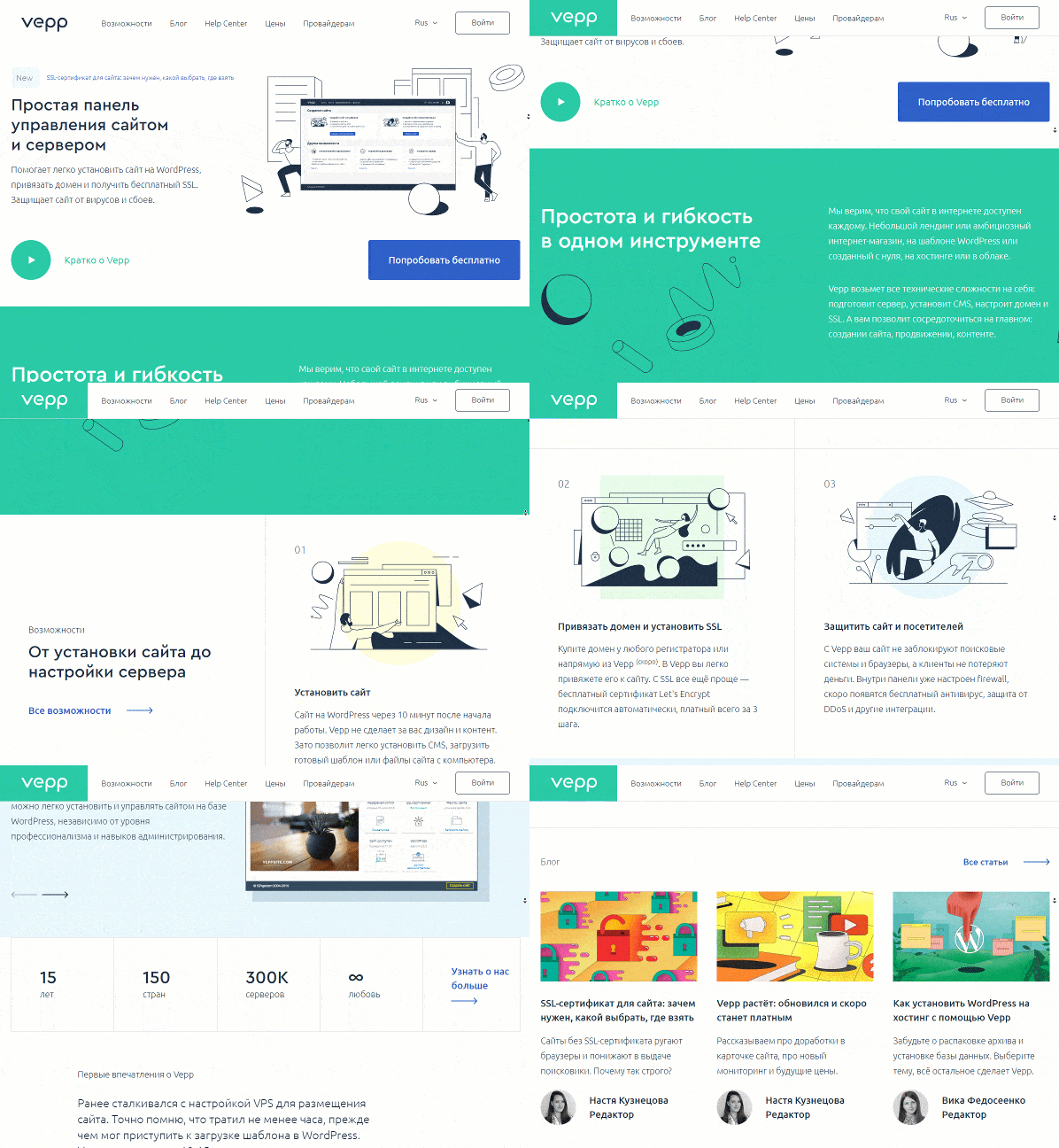
Now let's talk about the results. We named the new panel Vepp (it was ISPmanager, remember?).
The new name resonates with 'web' and 'app' — which is exactly what we wanted. The development of the logo and design was entrusted to the guys . Check out what came out of it.
Only registered users can participate in the survey. , please.
What do you think of the new name and corporate identity?
ISPmanager sounds proud. Let's embrace the old school!
Oh, that turned out quite well. I like it!
74 users voted. 18 users abstained.
Source: habr.com
