

Conversations about teeth are most often associated with cavities, braces, and sadists in white coats who dream of turning your teeth into jewelry. But jokes aside, without dentists and established hygiene rules for oral care, we would only be eating mashed potatoes and soup through a straw. This is all due to evolution, which gifted us with teeth that are certainly not the most durable and do not regenerate, much to the delight of those in the dental industry. When it comes to teeth in the wild, thoughts immediately turn to majestic lions, bloodthirsty sharks, and surprisingly cheerful hyenas. However, despite the power and strength of their jaws, their teeth are not as remarkable as those of sea urchins. Yes, that clump of needles underwater, which can ruin a good part of your vacation if stepped on, has quite decent teeth. They are few in number—only five—but they are unique in their own way and can sharpen themselves. How scientists discovered this feature, how this process occurs, and how it might help humans will be revealed in the report from the research team. Let’s go.
The foundation of the research
First of all, let's get to know the main character of the study—Strongylocentrotus fragilis, in human terms, the pink sea urchin. This species of sea urchin is not much different from its other relatives, except for its more flattened shape and glamorous coloring. They inhabit relatively deep waters (from 100 m to 1 km) and grow up to 10 cm in diameter.
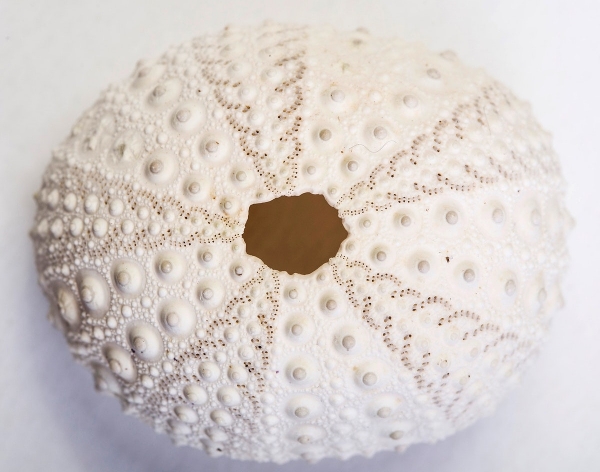
The 'skeleton' of the sea urchin, showcasing its five-rayed symmetry.
Sea urchins can be, however bluntly put, regular and irregular. The former have almost perfectly round body shapes with pronounced five-rayed symmetry, while the latter are more asymmetrical.
The first thing that catches the eye when seeing a sea urchin is its spines, which cover its entire body. Depending on the species, spines can range from 2 mm to as much as 30 cm. In addition to spines, the body has spheroid organs (balance organs) and pedicellariae (appendages resembling pincers).
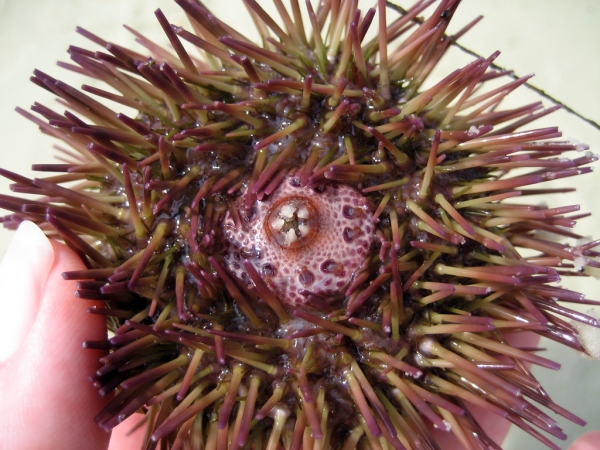
The five teeth are clearly visible in the center.
To depict a sea urchin, you must first turn upside down, as its mouth is located on the lower part of its body, while other openings are on the upper side. The mouths of sea urchins are equipped with a chewing apparatus known scientifically as the “Aristotle's lantern” (it was Aristotle who first described this organ and compared its shape to an ancient portable lantern). This organ has five jaws, each ending with a sharp tooth (the Aristotle's lantern of the studied pink urchin is shown in image 1C below).
There is a suggestion that the durability of sea urchin teeth is ensured by their constant sharpening, which occurs through a gradual degradation of mineralized plates of the tooth to maintain the sharpness of the distal surface.
But how exactly does this process take place, which teeth need sharpening, which do not, and how is this important decision made? Scientists have been trying to find answers to these questions.
Research Results
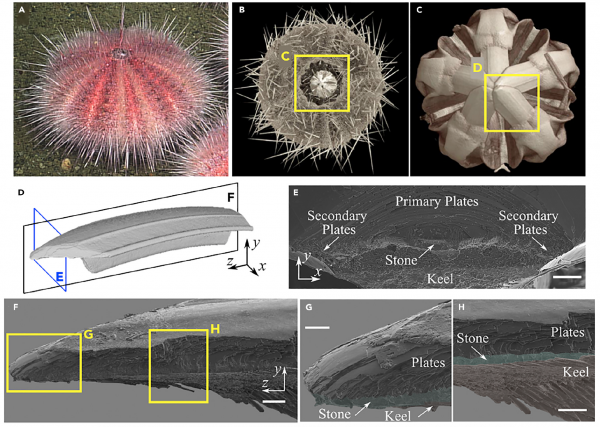
Image No. 1
Before uncovering the dental secrets of sea urchins, let's consider the structure of their teeth as a whole.
In the images 1A—1C the hero of the study — the pink sea urchin is shown. Like other sea urchins, representatives of this species obtain their mineral components from seawater. Among skeletal elements, the teeth are heavily mineralized (99%) with calcite enriched with magnesium.
As we discussed earlier, sea urchins use their teeth to scrape food. But besides that, they also use their teeth to dig burrows in which they hide from predators or bad weather. Given such an unusual application of their teeth, they must be extremely strong and sharp.
In the image 1D shown is a micro-computed tomography of a whole tooth segment, indicating that the tooth is formed along an elliptical curve with a T-shaped cross-section.
The cross-section of the tooth (1E) shows that the tooth consists of three structural areas: primary plates, the stone area, and secondary plates. The stone area is made up of fine fibers surrounded by an organic sheath. The fibers are embedded in a polycrystalline matrix composed of magnesium-rich calcite particles. The diameter of these particles is approximately 10-20 nm. Researchers note that the concentration of magnesium is heterogeneous throughout the tooth and increases closer to its tip, which enhances its wear resistance and hardness.
Longitudinal section (1F) of the stone area of the tooth shows the destruction of fibers as well as detachment due to delamination at the interface between the fibers and the organic sheath.
Primary plates typically consist of monocrystals of calcite and are located on the convex surface of the tooth, while secondary plates fill the concave surface.
In the image 1G , you can see an array of curved primary plates lying parallel to each other. The image also shows fibers and a polycrystalline matrix filling the space between the plates. The keel (1H) forms the base of the transverse T-section and increases the tooth's stiffness during bending.
Now that we know the structure of the pink sea urchin tooth, we need to determine the mechanical properties of its components. For this, compression tests were conducted using a scanning electron microscope and the nanoindentation*. The nano-mechanical tests involved samples cut along the longitudinal and transverse orientations of the tooth.
Nanoindentation* — a method of testing materials by pressing a special tool—the indenter—into the surface of the sample.
Data analysis showed that the average Young's modulus (E) and hardness (H) at the tip of the tooth in longitudinal and transverse directions are: EL = 77.3 ± 4.8 GPa, HL = 4.3 ± 0.5 GPa (longitudinal) and ET = 70.2 ± 7.2 GPa, HT = 3.8 ± 0.6 GPa (transverse).
Young's modulus* — a physical quantity that describes a material's ability to resist tension and compression.
Hardness* — the property of a material to resist the penetration of a harder body (the indenter).
Additionally, longitudinal indentations were made with a cyclic added load to create a model of viscous-plastic damage for the stone area. In 2A the load-displacement curve is shown.
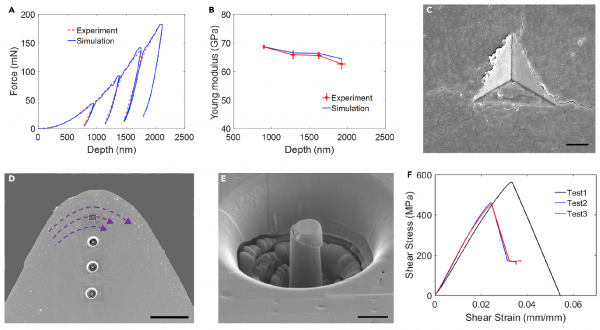
Image #2
The modulus for each cycle was calculated based on the Oliver-Farr method using unloading data. Indentation cycles showed a monotonic decrease in modulus with increasing indentation depth (2B). Such degradation of stiffness is explained by the accumulation of damage (2C) due to irreversible deformation. Notably, the development of the third occurs around the fibers rather than through them.
The mechanical properties of the composite components of the teeth were also assessed using quasi-static compression experiments of micro-columns. Focused ion beam was used to fabricate micro-sized columns. To evaluate the strength of the bond between primary plates on the convex side of the tooth, micro-columns with an inclined orientation relative to the normal interface between the plates were fabricated (2D). The image 2E shows a micro-column with an inclined interface. The graph shows 2F the results of shear stress measurements.
Scientists note an intriguing fact — the measured modulus of elasticity is nearly half that of indentation tests. This discrepancy between indentation and compression tests is also noted for dental enamel. Currently, there are several theories explaining this discrepancy (from the influence of the environment during testing to sample contamination), but there is no clear answer as to why this discrepancy occurs.
The next stage of the research on sea urchin teeth involved wear tests conducted using a scanning electron microscope. The tooth was affixed to a special holder and pressed against a substrate made of ultrananocrystalline diamond (3A).
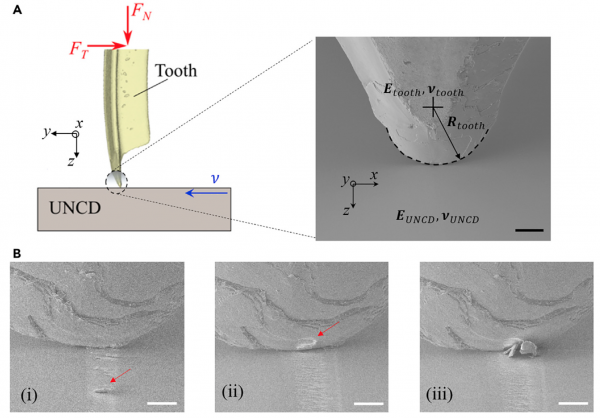
Image #3
Scientists point out that their version of the wear test is opposite to those typically conducted, where the diamond tip is pressed into a substrate made of the material under investigation. Changes in the wear test methodology allow for a better study of the properties of microstructures and the components of the tooth.
As we can see in the images, chips begin to form when critical load is reached. It is important to note that the "bite" strength of Aristotle's lantern in sea urchins varies by species from 1 to 50 newtons. The test used forces ranging from hundreds of micronewtons to 1 newton, i.e., from 1 to 5 newtons for the entire Aristotle's lantern (since there are five teeth).
In the image 3B(i) small particles are visible (red arrow), formed as a result of wear in the stone area. As the stone area wears down and compresses, cracks at the interfaces between the plates may occur and propagate due to compressive-shear loading and stress accumulation in the calcite plate region. The images 3B(ii) and 3B(iii) show the locations where fragments have chipped off.
For comparison, two types of wear experiments were conducted: with a constant load corresponding to the yield point initiation (WCL) and with a constant load corresponding to the yield point (WCS). As a result, two wear variants of the tooth were obtained.
Wear test videos:
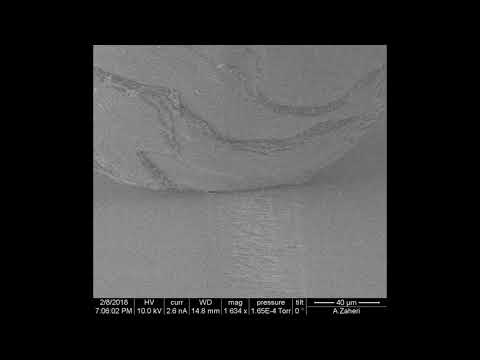
Stage I
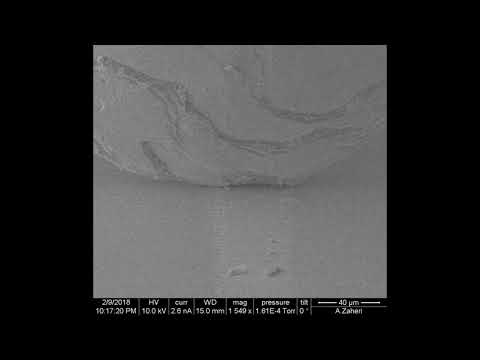
Stage II
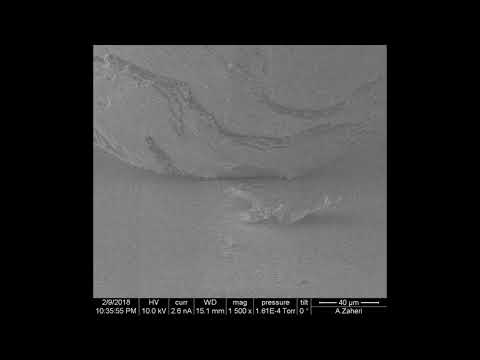
Stage III
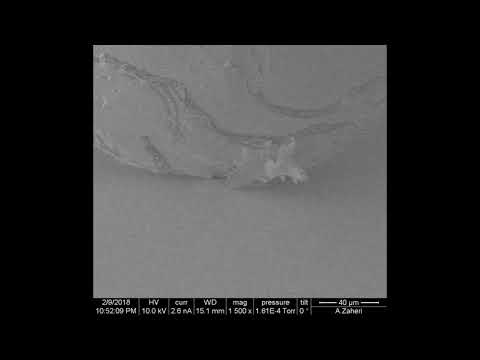
Stage IV
In the case of a constant load in the WCL test, compression of the area was observed; however, no chips or other damage to the plates were noted (4A). In contrast, in the WCS test, when the normal force was increased to maintain the nominal contact stress constant, chips and plate dislodgment were observed (4B).
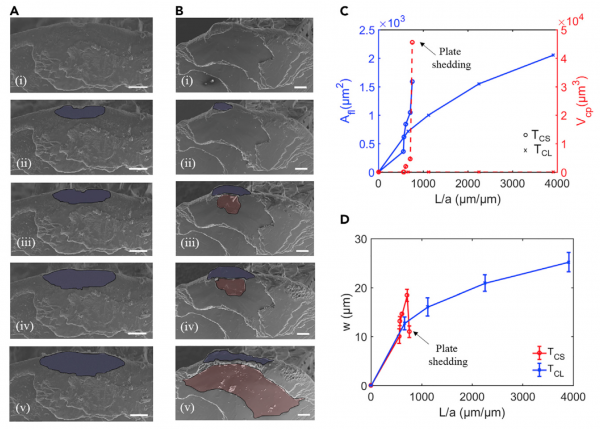
Image No. 4
These observations are confirmed by the graph (4C) of the measurements of the area of compression and the volume of chipped plates as a function of the sliding distance (sample on diamond during the test).
This graph also shows that in the WCL case, chips do not form even if the sliding distance is greater than in the WCS case. Examination of the compressed and chipped plates at 4B allows for a better understanding of the self-sharpening mechanism of the sea urchin teeth.
The area of the compressed stone region increases as the plate chips off, leading to the removal of part of the compressed area [4B (iii-v)]. Microstructural features, such as the interface between the stone and plates, facilitate this process. Microscopy showed that the fibers in the stone area bend and penetrate through the layers of plates in the convex part of the tooth.
On the graph 4C a spike in the volume of the chipped area is visible when a new plate detaches from the tooth. Interestingly, at the same moment, there is a sharp reduction in the width of the flattened area (4D), indicating a self-sharpening process.
In simpler terms, these experiments showed that during sustained normal (non-critical) loads in wear tests, the tip dulls while the tooth remains sharp. This suggests that the teeth of the hedgehog sharpen themselves during use as long as the load does not exceed the critical threshold; otherwise, damage (chipping) can occur instead of sharpening.
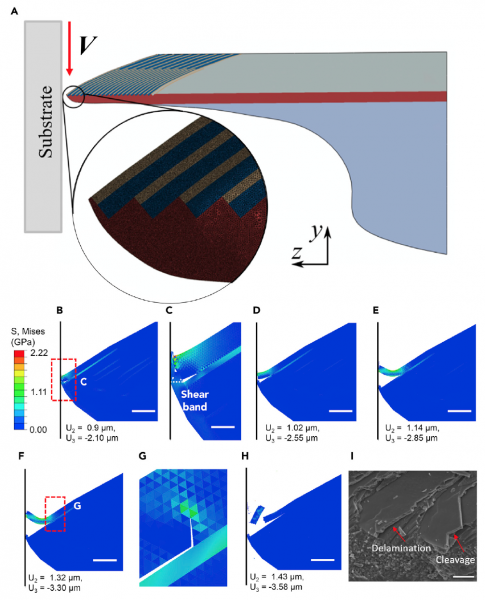
Image No. 5
To understand the role of the tooth's microstructures, their properties, and their contribution to the self-sharpening mechanism, a nonlinear analysis of the wear process was conducted using the finite element method (5A). For this purpose, images of the longitudinal section of the tooth tip were used as the basis for a two-dimensional model, which consisted of rock, plates, a keel, and interfaces between the plates and the rock.
Images 5B–5H — are contour plots of the Mises criterion (plasticity criterion) at the edge of the rock and plate area. When the tooth is compressed, the rock undergoes significant viscoplastic deformations, accumulating damage and compressing ('flattening') (5B and 5C). Further compression causes a shear band in the rock, where most of the plastic deformation and damage accumulates, detaching part of the rock and leading to its direct contact with the substrate (5D). This fragmentation of the rock in the model corresponds to experimental observations (chipped fragments on 3B(i)). Compression also leads to delamination between the plates, as the interface elements are subjected to mixed loading, resulting in decohesion (separation). As the contact area increases, the contact stresses rise, inducing the initiation and propagation of cracks at the interface (5B—5E). The loss of adhesion between the plates enhances bending, where the outer plate detaches.
Scraping worsens damage at the interface, leading to the removal of the plate when the plates are subjected to splitting (where cracks deviate from the interface and penetrate the plate, 5G). As the process continues, shards of the plate detach from the tip of the tooth (5H).
Interestingly, the modeling very accurately predicts flaking both in the area of the stone and in the area of the plates, as observed by scientists during their observations (3B and 5I).
For a more detailed understanding of the nuances of the research, I recommend checking out the and related to it.
Epilogue
This work reaffirmed that evolution has not been particularly kind to human teeth. More seriously, in their research, scientists were able to closely examine and explain the self-sharpening mechanism of the teeth of sea urchins, which is based on an unusual tooth structure and the correct load on it. The plates covering the urchin's tooth peel off under certain loads, keeping the tooth sharp. But this doesn’t mean that sea urchins can crush stones, as critical load thresholds on the teeth lead to cracks and chips. It turns out that the principle 'strength is good, brains are not needed' would certainly be of no benefit.
One might think that studying the teeth of deep-sea creatures holds no benefit for humans, aside from satisfying insatiable human curiosity. However, the knowledge gained from this research could serve as a foundation for creating new types of materials that possess similar properties to urchin teeth — wear resistance, self-sharpening at the material level without external help, and durability.
Be that as it may, nature hides many secrets that we still have yet to uncover. Will they be useful? Perhaps yes, perhaps no. But sometimes, even in the most complex research, the journey itself is more important than the destination.
Friday off-topic:
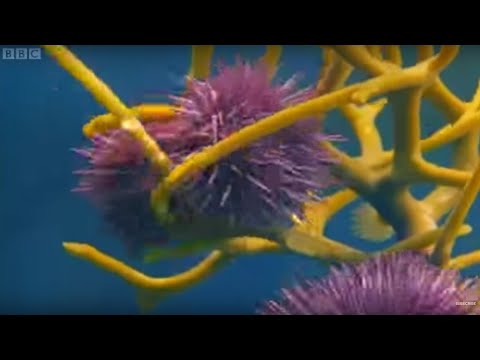
Underwater forests of giant kelp serve as gathering places for sea urchins and other unusual inhabitants of the oceans. (BBC Earth, voiceover — David Attenborough).
Thank you for your attention, stay curious, and have a great weekend, everyone! 🙂
Thank you for staying with us. Do you enjoy our articles? Would you like to see more interesting materials? Support us by placing an order or recommending us to your friends. 30% discount for Habr users on a unique entry-level server designed by us for you: (options available with RAID1 and RAID10, up to 24 cores and up to 40GB DDR4).
Dell R730xd for half the price? Only with us in the Netherlands! Dell R420 — 2x E5-2430 2.2GHz 6C 128GB DDR3 2x960GB SSD 1Gbps 100TB — from $99! Read about how
Source: habr.com
