

It may seem that IT engineers have it easy. They earn good money and can freely move between employers and countries. But it's not that simple. The 'typical IT specialist' spends their time glued to a computer since school, then continues in university, graduate school, and beyond... After that, it's work, work, work, years of production, and only then can they think about relocating. And then it's back to work again.
Of course, from the outside, it may seem like luck. But aside from the time and effort spent on education, skill development, and climbing the career ladder, the relocation itself is a guarantee of gray hair and a crisis of nerve cells.

Moving to another city, country, continent, or planet is not that simple. There's a different mentality, culture, rules, laws, prices, healthcare, and you still need to find a place to move to, get an offer, housing, and sort out a visa... thousands of details. How to avoid getting a nervous tick and instead maximize benefits and enjoyment from the process will be discussed by Denis Neklyudov ().
What are the reasons people leave, what awaits them there, and how do you choose where to move? How to navigate the job market, find work, prepare for interviews, and select the best offer. Using Denis's experiences moving to Phuket, Singapore, San Francisco, and the experiences of many other expats, we will prepare for new adventures. Denis's story is a roadmap or checklist that will be useful for anyone considering relocation.
Disclaimer. 'The Earth is round' and it rotates. Someday we will return to where we started. Denis's move does not encourage you to permanently leave your homeland. Don't view the topic of relocation negatively; think of it as a way to expand your horizons. This article is based solely on the experiences of ordinary developers, without the gloss of a luxurious life of crypto-millionaires or the harsh realities faced by unskilled migrants.
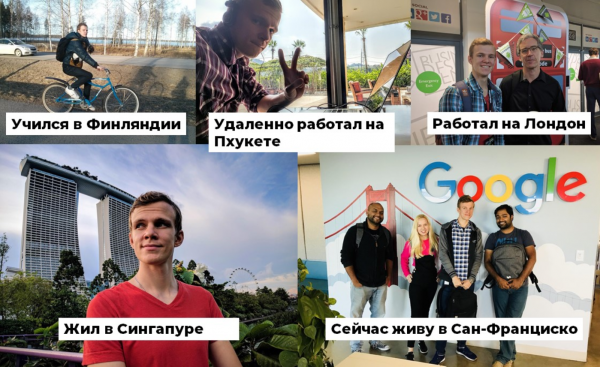
Denis Neklyudov — Google Developer Expert in Android, Pay, and IoT. He has worked in several startups in Russia, Asia, and Europe, and is currently at Lyft in California. No article can convey the energy that Denis exuded when sharing his experiences, valuable advice, and anecdotes about acquaintances at — check out .
Employment
As you may have already guessed, we will talk about SWE — Software EngineerAs IT engineers, we have it easier when it comes to living and moving. This is because we invest a lot of time and effort since school. Only after diligent work does the chance for relocation appear.

A life illustration (there are still many ironic images).
It's not that simple. The first step on this path is employment and job searching.
Job market and job searching
Job searching starts with friends, acquaintances, and referrals.
Everyone you know is your main resource for finding interesting offers, in addition to your core programming skills.
If you can't find referrals and friends, contact recruiters and employees. Before this, translate your LinkedIn profile to the countrywhere you plan to move. Without this, you won't even be considered.
An interesting option that you don't think about right away is local forums. These are groups on Facebook and other communities where people receive referral bonuses. They know that even if they bring in someone unfamiliar, if accepted, they will get a bonus. So they post job offers under their name and say: "Sure, I will refer you with pleasure," and they will also do a prescreen by looking at your CV.
But the most successful option is meetups and conferences. Look for people from the companies you are interested in and ask for a referral. The first option is a meetup in your country, where we look for contacts for relocation. The second option is a meetup in the places you want to move to. Want to go to Berlin? Find a meetup there and move.
A few recommendations about CVs.
Check your CV with a native speaker of the country you want to move to.
Most likely, it won't even have grammatical errors, but phrase and sentence structures that show that this language is not native. It must be a native speaker, not a teacher from Skyeng.
Practice English with native speakers.
By the way, on Skyeng and italki, you can practice with native speakers. After spending 10 hours and 10,000 rubles on communication with a native speaker, your confidence will increase. You’ll feel calm and won’t stumble during a recruiter call.
Where to find examples of good CVs? The first way is LinkedIn profiles of well-known developers.Most likely, they don't have a profile picture, the last job was at Google 15 years ago, and that's all. Such guys don't stress too much. But those who are early in their careers, who haven't landed their dream job yet, write great CVs. Take a look at theirs.
The second way is through resumes of acquaintances who successfully landed a job. If you know such people, ask them to help you craft your resume. Writing a compelling resume deserves a separate article, so we won't dwell on this.
Interview
The larger the company, the more general questions there will be.
In a small startup, you'll be asked about Android or iOS. At FAANG companies (Facebook, Apple, Amazon, Netflix, Google), they don't need a developer specifically for Android or iOS. They need a Software Engineer — a versatile person who can be sent to Android, iOS, or even allow you to grow in a completely different career path.
Corporations prefer to know where to assign you, but first, they need to assess your basic skills, suitability, and engineering mindset. Therefore, there will be a lot of "whiteboarding" — where you solve problems at the board and don't use a computer.
How to prepare? Solve problems and don't fear Google or Facebook.
The book "" is essential reading. It lists all the main data structures and categories of problems that are asked in "whiteboarding" interviews. If you've never prepared for such interviews — this is a great book. From there, you can delve deeper into foundational books about algorithms.Websites Hackerrank.com, Leetcode.com.
My favorite is Leetcode.com, because it allows you to tackle problems that have leaked from Google and Amazon interviews. With a paid account, you can even select problems specifically from Google, for instance. The more problems you solve, the higher your chances of success.
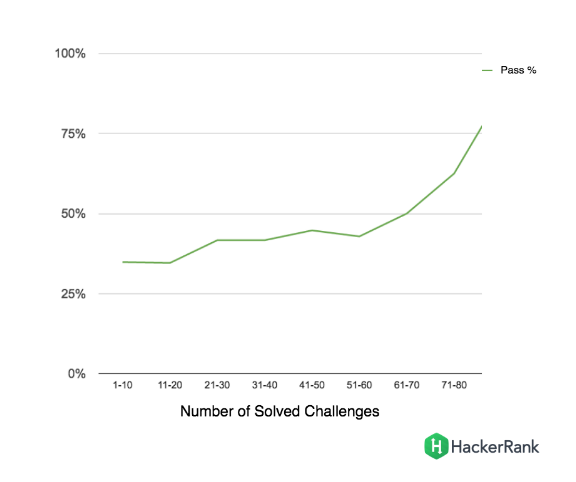
This is evident in the graph showing the relationship between success and the number of problems solved on HackerRank.
Whether 75% of success is linked to solving 70-80 problems, or if it's about lengthy preparation — I don't know. But there is a connection — the more problems you solve, the more confidence you gain.
Keep a template of your application handy.
Keep a job application template handy.
If you're interviewing with small companies, time and again you will be asked the same thing: 'Write an application!'. When you already have an application template, just update it before you start preparing again abroad. Sketch out an architecture you like, implement a simple design, but make sure it doesn't look like 'I already have a bag of solutions.' Reuse the template and don’t write from scratch every time.
Don't mess up in front of the manager.
That's understandable, but some still manage to do it. The main thing is, when you come to SpaceX and the very person conducts the interview, remember that he’s asking not so much about development as about general soft skills.

In all large companies, there’s a technical developer interview, and there’s a manager interview. In the latter, they check how you will fit into the team culturally. During the interview, put yourself in the manager's position and think before responding — would you want to hear what you're saying from a candidate? This will help.
The simplest advice for successfully passing an interview is — don't act like a fool if you're not one.
Confidently follow this rule, and you will succeed. I guarantee it. Maybe not on the first try, but surely on the second. If you try to act strangely, the guarantee will fall apart.
Offer
Let’s assume everything went well: you passed the interview, the feedback is positive, you received a call from the recruiter saying, 'Let's negotiate!'.
For the company, even after all the interviews, you are a black box, especially when moving to another country. They don't want to overpay.
Startup No. 37 and any foreign company won't call Yandex, Avito, or Kaspersky to learn something about you. In Silicon Valley, they call each other and find out, but not in Russia. You are a cat in a bag for them, and they try not to overestimate you.
Therefore, they will negotiate downwards. But you want to ensure that everything for you and your family is covered in the highest manner: from a private jet to packing your cat in such a way that he doesn't notice, and when he runs on American soil, he immediately meows in English.
In Russia, it’s not customary to pay sign-up bonuses, so many engineers are unaware of them. But as an engineer, you must demand them.
People are simply paid for accepting offers, can you imagine?
When you’re told that they will help you with the move, it’s one thing. But you should say:
— Yes, you’re helping me with the move because I’m not local. But I’m accepting your company’s offer, not the neighbor’s, and let’s see if you’ll pay me for this!
It’s really true! At one time on Facebook, this was even called the "Tesla bonus." It amounted to about $75,000, half of which was taken by taxes, but it was still enough for a Model 3, instead of a Model S.

Did I get a Model S? No, I didn’t receive the bonus :( Don’t make my mistakes.
Negotiate for every last RSU.

Robert Kiyosaki knows how to work with money.
RSU — restricted stock units or shares. It’s your right to own stocks for free in the future. You’re told that as soon as they have stocks, you can receive and sell them for free. You will also have to pay taxes on this.
Options — are a more favorable condition, but they are only given in the early stages. This is the right to buy company shares at a fixed price when they become available.
This culture isn’t developed in Russia. Recently, Russian law introduced RSUs and options. Therefore, many people are still unqualified in this area and think that only unreal CTO positions get options. No, demand right away:
— Give me RSUs or an option right away if you’re a small startup. If you’re a public company, how many shares will I receive per year, and how often does vesting occur?
But remember that you will have to pay taxes on your salary and bonuses.
Ideally, you should be showered with planes, stocks, and cookies. But before agreeing to this fairy-tale job, check out and other review sites. You can find reviews like: "The worst culture and management ever! I worked full-time at this company."
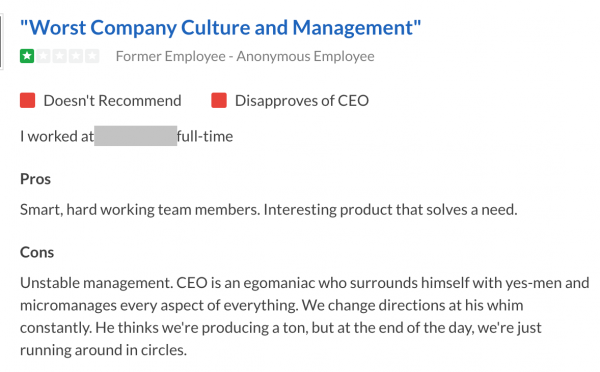
"A great place to learn about bad management," writes an anonymous employee from Singapore…

Before the interview at your dream company, keep a couple of trump cards from smaller companies up your sleeve. If you already have an offer from another company in the same region, you're in luck. You can negotiate a better position for yourself. I read about a developer who negotiated with Airbnb and Google; he started at $180,000 a year and ended up at $300,000.
When you have multiple offers, don't rush to agree. They'll take you anyway, even if you quote a high price — of course, they will lower it later. But stand your ground, ask for sign-up bonuses and stocks.
I feel like after this article, the real estate market in San Francisco will heat up and burst :)
Abroad
You're planning to leave. Look at how many migrants have dispersed everywhere. You are not alone.
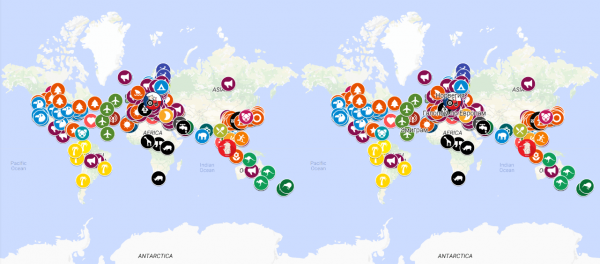
Telegram channels about immigration for May 2019.
Before you go, set a clear goal for your move.
- More money.
- Being at the center of the coolest companies.
- I'm going for better healthcare, education, weather, air, and Amazon delivery.
- For residency, citizenship, and a passport.
- For the future of the children.
- For the career of the second spouse.
- To see the world.
If you are young, you lose nothing — you can always return. You can always come back, buy an apartment, renovate it, buy an apartment for the kids, renovate it, buy a car and fix it, but you won't have time to see the world.
For questions about remote work, don't come to me. Artur Badretdinov writes excellent and reports on how to live and travel while working remotely. There is also the Podlodka podcast with Sergey Ryabov about Digital Nomads.
Career. Questions for the recruiter
Let’s ask the right questions to the recruiter, what is this galleon about.

How constructive is the company's contribution to the development of the planet. Perhaps, now I have too distorted a worldview about companies, but you can ask such a question. I used to work in startups where it was unclear how their work would affect the planet. But when you feel that you've worked on the weekend today, and Earth became a little cleaner, you have a double impact.
How interesting are the tasks of your future team. They may promise you millions of dollars, but for boring tasks. For example, finishing a financial application that is a million years old. You won't even be able to improve it because your task is just to write unnecessary features.
How quickly can you grow in your career. Are the career paths defined in the company, do they understand how developers grow, or will you be the first experimental developer in the company?
Will the company help with residency?Many people find that companies only assist with relocation and obtaining a work visa, but to become independent and obtain a residence permit, you will need your own resources.
Career. Questions for Relocators
When you plan to relocate, connect with others who have moved. I am often asked to talk about Singapore and America. Find similar individuals and ask them.
How many companies with suitable vacancies are there in this city or region? Is there a chance to back out? It would be upsetting to sell everything, move with your dog, children, and spouse, only to find out that this is the only company around, especially if you moved to a remote village in northern Norway where no one else is present. However, if it’s Berlin or London, there are still 100 companies that will compete for you.
Openness to ForeignersI have been told (but I haven't verified) that Switzerland has a negative attitude toward foreigners. In Asian countries, for instance, in Singapore, there are legends that when you move there, people look at you like this: 'Oh, a white person has arrived! Now he's going to teach us and then go home.'
The primary language of communication within companies and at meetups. I have a cool story. An English-speaking developer lives and works somewhere in Scandinavia. One day, he attended a meetup as the only visitor not speaking the local language, and everyone switched to English. Throughout the meetup, they only spoke in English—so tolerant is the society towards foreigners. Can you imagine that at our meetup everyone would switch from Russian to English?
How prestigious is your profession in public perception?From my perspective, there are no questions about prestige in California, but in Bali, it is prestigious to be a hotel manager. In Singapore, few young people want to become developers, even though the pay is high. They want to be managers who oversee developers—why be a manual laborer when you can manage them right away?
Resident Status
Relocation without a higher education degreeIf you have a higher education degree, there are no problems. But if you don’t, clarify this question. In many countries, there are no options without a higher education degree.
When my mom told me to go to graduate school, I asked, "Why? I'm already working full-time and making good money, I bought a car?" I didn’t think that graduate school would make everything so much easier when I would be applying for a visa to Singapore and America. Bachelor's degrees are often viewed in many countries as, "What, couldn't you have gone to graduate school?" whereas graduate degrees are seen as, "Oh! You went to graduate school! Come join us!"
Visa. There are different types of visas: some make you a company's slave, others require your spouse not to work, and some give you complete freedom. Clarify all the conditions.
Visa processing times — vary by country. Lyft promised me that I would move to the USA in 7 days, but the H1B visa takes a year and a half to process. I found that my visa for the USA took 5 months, Singapore 2 months, while a visa for Germany can be obtained in 4 months.
The ability to earn on the side. This is an important issue for me; it’s not enough to work for one company without additional income. I'm frustrated that I can't start my own company in the USA on my current visa and earn simultaneously.
In England, Ireland, and many other European countries, you can register as a sole proprietor, work on the side, and pay taxes on additional income. My American visa doesn’t allow this.
Social security. This is something you need to sort out before moving. How do people live there, how does the government care for its citizens?
Confidence in the future. Probably, this is important. Every spring in California, it begins: "That's it, my grandmother, who works at Bloomberg/CIA/World Bank, whispered to me that this autumn is definitely the end — this bubble will burst!" But it doesn’t burst.
Temporary residence and citizenship, is dual citizenship allowed. Italy, Greece, Canada, and the USA definitely allow dual citizenship. But there are few such countries. In others, you will have to choose whether you want to become a citizen of Germany or Singapore and give up your home country's citizenship. If this is important — keep this point in mind.
The view from the window
I also advise you to pay attention to the view outside your window — do you want to see a beach or mountains, fogs, rains, greenery, or concrete?
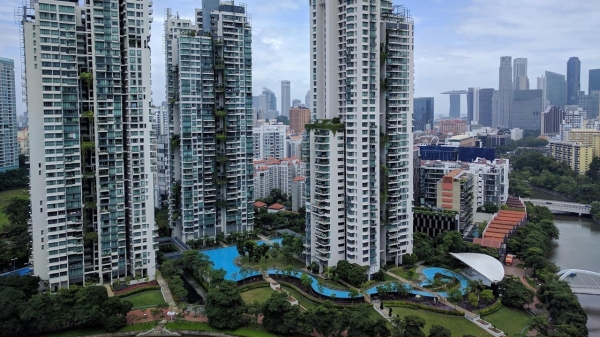
This is what typical expat housing looks like in Singapore.
Don't believe the pictures and movies. Below on the left is a typical photo of San Francisco, and on the right is the reality of those living there.

People enjoy the blue sky and sunshine while legally high.
The right picture is even embellished — there’s too much greenery, and nothing is lying on the pavement.
Health
Climate and ecology. Some people love the rain. In Singapore, my suffering friends from St. Petersburg and Siberian cities hate the heat.
Medicine and insurance. Everywhere except for the Northern European countries, people complain that healthcare is poor and expensive, and they only have plantain as a medicine. I don’t know where one needs to go to enjoy good healthcare.
There are government and private insurances. Find out who pays for them and what they cover. In some countries, healthcare is free. But in Britain, they say: 'We have free healthcare — great, but it’s terrible; better to pay. But you can’t pay because paid care is also terrible.'
In the USA without insurance, you’re done — if you scratch your finger, it can cost you a fortune unless it heals on its own.
Unpleasant surprises
I didn’t think about this when preparing for the moves. But I advise you to.
Solar radiation. In Australia and New Zealand, it can cause your skin to peel. I knew that New Zealand has horrible statistics for skin cancer and other skin diseases due to the ozone hole, but that Australia is the same way was unexpected for me. The radiation is so strong that it even reaches Singapore.
In addition, be prepared for poisonous insects, flying cockroaches, infections. For example, dengue. Throughout Southeast Asia, mosquitoes bite, causing you to feel sick for at least a week with fever and chills. If a mosquito with the same strain bites you a second time, your immune system might give out and it could be 'nice meeting you!'

When I decided to take a bath in Australia.
Housing
Housing varies greatly. It’s categorized by ownership type, amenities, and styles.
- Styles: apartments/houses/condos/bungalows.
- Amenities: balcony/backyard/parking/garage/pool/bbq/gym.
- Ownership: rent/buy.
In Singapore, people live in condos: pool, enclosed courtyard, gym, barbecue area, no dirty, cluttered parking — everything is beautiful and pleasant. But Americans say: 'How awful it is to live in Singapore! I can't afford my own house; I have to live in one house with other people!' Everyone has their own criteria.
Find out what the housing situation is like in this country.
The best way to understand the market is through those who have lived there for a few years.
The impressions from what we read on forums and in books always differ from what we see when we visit new friends. It's clear to see what you can afford and for what price.
Money
Anticipation: "In America, they will pay $200,000!"

Reality: "Taxes, taxes are increasing, prices are higher, and what, is there really nothing left?"


What to pay attention to.
The relativity of income to the world currency, taxes, and prices. You might be paid astronomical amounts, but in first-world countries, only a scorched first step will remain from it, meaning nothing. First, check the taxes in the country, and then look at aggregator sites where the prices of basic necessities are listed relative to the salary. You'll understand how much your diet costs based on the prices of milk, mangoes, potatoes, cigarettes, beer, and seeds.
Services, unexpected expenses: parking, insurance, internet. I didn't expect to have to pay separately for parking at home in the USA. In a country of car owners, I have to pay an additional $300 for parking, not to mention $3,000 for a one-bedroom apartment?! In Canada, car insurance can cost up to $300 a month.
In many countries, the internet is very expensive. In the USA, I pay $120 for mobile service for 2 lines, while in Russia, I could have unlimited service for that amount for a year.
Prices for garden, school, nannies, plumbers, pool cleaners. Children are a separate topic. Kindergarten can be quite costly. There are few countries where it is free or heavily subsidized, but schools in many countries are free.
Other services can also be very expensive. In Singapore, it is common to have a domestic helper. Pool cleaners earn well in countries where pools are common in homes.
Pets. You cannot bring a cat or dog from Russia to Australia — it is prohibited. But there is a life hack — bring the cat to Singapore, it will gain Singapore citizenship in 3 months, and then you can take it to Australia! There are many nuances. My colleague, when moving to Singapore, paid more for his cat than for his children because the cat-horse gained weight up to 8 kg. During acclimatization and while staying in a hotel, he also paid $20 a day for the cat.
Local tourism and leisureIn some countries, everything is private. Going out into the field or taking a stroll by the lake is rare; you have to pay to enter places everywhere. This also includes the cost of cultural life: cinema, theater, diversity, community, pubs.
Also consider the cost of flights home. Sometimes you’ll have to return or move your parents.
Surprise
You've moved, everything is fine, you think: "Awesome! I’m going to enjoy myself!" And then you realize that everywhere are weekdays. Yes, you've moved to Thailand and now you're having fun. But you still need to go to work, sit under the air conditioning because nothing is visible in the sun on the beach, it’s inconvenient, and who knows, a snake might crawl into your shorts.
Depression can come very easily.
No friends or relatives nearby — they stayed far away: on Skype, on Telegram, but not nearby. You won’t easily find communication — the cultural code of the environment is completely different, there’s little of your native language and the "chemistry" that was understood from birth. You’ll miss the "cultural code" that you absorbed from birth — no one will understand your jokes or familiar film quotes. Except in Cyprus or Brighton — everyone speaks Russian there. Or if you are a child of migrants who have changed 7 countries, then it’s also all good.
No familiar anchors. You wake up today, start your car, warm it up, go, stop by your favorite café, drink coffee, argue at the post office waiting for a package — just like usual. There’s none of that — you have to build everything anew.
Small flaws cause great rejection. Any little thing just drives you crazy. The laptop broke — you don’t know where to fix it, you get angry, throw it out the window, and drive back.
Any problem: illness, visa issues, fear of the new, can throw you off track
Quotes from the greats
The body and belongings move in a couple of days. The soul and mind adapt much longer. It’s serious: you’ll relocate yourself, but you will still remain where you came from for a long time. Not everyone, but on average, that’s how it works.
People after moving try to find a "second Moscow," a "second St. Petersburg," and, not finding it, become despondent. Some leave with hatred, making it easier to adapt. But if you go just to look and want to stay, you’ll still search for something familiar and feel sad when you don’t find it.
The main idea of relocating is to find something new, something that wasn't there before: a new culture, food, rules, clothing, holidays, and lifestyle. You need to explain this to yourself because you tend to forget.
Don't look for the familiar, seek the new! This was written by a woman on one of the immigrant forums in America when, once again, they complained about how 'everything is bad in this Valley, I want to go back to my St. Petersburg.'
There are drawbacks everywhere, as long as there’s a reason to put up with them. So, dear, pack your bags; we are leaving here.
My wise wife
Sources of additional information
Maximum information about any country at . Here, our compatriots by language (not necessarily from Russia) write about how they moved to another country. Each week, a new participant shares details about the country they relocated to. For example, Leha moved to Singapore, hangs out with friends and his wife, goes to work, drinks with local Singaporean grandpas, learns their views on politics and a bunch of insights — really cool information!
Additionally, read T—Ж: . A comparison of expectations and reality when relocating, along with the experiences of those who have moved.
A well-known blogger who The best part —
in a lengthy post by VastrikAlarm! The post is filled with curse words, super-beautiful funny expressions, and postmodernism. Be prepared for that. The Podlodka podcast in
-th and -th episodes discusses relocation. Conclusion: Stages of relocation
Decide.
You think the main thing is to decide and move, but that’s not it. I prepared for a long time, but everything happened quickly. 'What, am I going somewhere?!' — and I'm in Thailand. After that, there was no turning back. It's like playing a video game — snap! — I wrote my own, and now I don’t want to play, I want to write. It's the same here.Get an offer
: 'That's it, now it's definitely time to pack my suitcase and move.'Move
: 'Well, now it's just about settling in!'Settle in
: 'Well, now there are definitely no problems!'Integrate.
This is the hardest part — not to be a labor migrant but to become one of your own in a new culture and new environment..
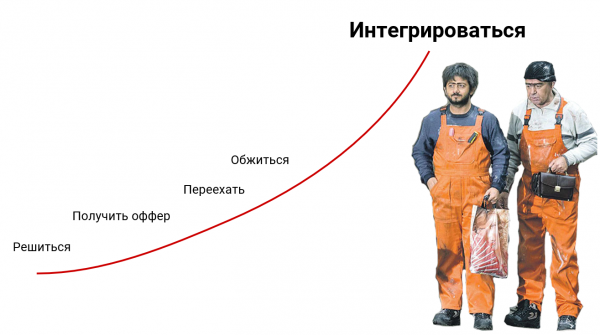
However, as we remember, you can always revert to a previous step where you felt more comfortable. Don’t forget about this. In general, don’t leave your relatives and friends behind; always visit them or take them with you on trips.
Bonus
If you don’t want to move anywhere, leverage your unique position as a highly sought-after specialist that everyone wants across different countries (in the best sense of the word). You can engage in a slightly questionable activity (but a little bit is permissible!) — HR tourism. You receive invitations for interviews in London, San Francisco, or Singapore, and you say, "Yes, I’ll fly for the interview, but can I stay a couple more days?" and travel at the companies' expense to different countries to see them.
To be continued! On October 22, at Saint AppsConf in St. Petersburg, Denis will discuss in more detail In total, there are
In total, the program of features 35 amazing presentations and 12 live meetups on iOS and Android technologies, architecture, processes, cross-platform issues, and professional and personal development. And all of this is happening in less than two weeks—make sure to join in.
Source: habr.com
