

Hello everyone. After six months have passed, during this time I have managed to speak at two more conferences and give lectures on knowledge management at two large IT companies. While communicating with colleagues, I realized that in IT we can still only talk about knowledge management at a 'beginner' level, or rather, just acknowledge that knowledge management is necessary for any department in any company. Today, I will share minimal personal experience – I would like to consider existing international standards in the field of knowledge management.
Let's start, perhaps, with the most popular brand in standardization – ISO. Imagine, there is a whole separate standard dedicated to knowledge management systems (ISO 30401:2018). But today I wouldn’t focus on it. Before figuring out 'how' a knowledge management system should look and work, we need to agree that it is fundamentally necessary.
Let's take, for example, ISO 9001:2015 (Quality management systems). As the name suggests, this standard is dedicated to quality management systems. To be certified to this standard, an organization must ensure transparency and continuity of its processes and the products and/or services produced. In other words, a certificate means that everything in your company functions smoothly and cohesively, you understand the risks posed by the current organization of processes, know how to control these risks, and strive to minimize them.
What does this have to do with knowledge management? Well, here's how:
7.1.6 Organization's Knowledge
An organization must identify the knowledge necessary for the functioning of its processes and for achieving product and service conformity.
Knowledge must be supported and accessible in the necessary volume.
When considering changing needs and trends, an organization should take into account the existing knowledge it possesses and determine how to obtain or ensure access to additional knowledge and its updates.
NOTE 1. The organization's knowledge is specific to the organization; mostly acquired based on experience.
Knowledge is information that is used and exchanged to achieve the goals of the organization.
NOTE 2. The foundation of the organization's knowledge may be:
a) internal sources (for example, intellectual property; knowledge gained from experience; insights derived from failed or successful projects; gathering and sharing undocumented knowledge and experience; results from improvements in processes, products, and services);
b) external sources (for example, standards, scientific community, conferences, knowledge obtained from consumers and external suppliers).
And below, in the appendices:
The requirements related to the organization's knowledge have been introduced with the aim of:
a) protecting the organization from knowledge loss, for example, due to:
- staff turnover;
- inability to obtain and share information;
b) encouraging the organization to acquire knowledge, for example, based on:
- learning from one's own experience;
- mentorship;
- benchmarking.
Thus, the ISO standard in the field of quality management states that to ensure the quality of its activities, the enterprise must engage in knowledge management. That's how it is, unconditionally - "must". Otherwise, there will be nonconformity, and goodbye. This fact alone suggests that this is not an optional aspect in an organization, as knowledge management in IT is often perceived, but a mandatory component of business processes.
Moreover, the standard outlines the risks that knowledge management is supposed to mitigate. In fact, they are quite obvious.
Let's imagine... no, not that way - please recall a situation from your career when you really needed some information for work, but its only carrier was on vacation/business trip, had left the company, or was simply sick. Remember? I think almost any of us has faced this.
If at some point the management of the department examines the reasons for the project deadline being missed, they will certainly find someone to blame and will be satisfied with that. But for you personally, at the moment when the knowledge was needed, understanding that "the project manager is to blame for going to Bali and not leaving any instructions for questions" did not help at all. Certainly, he is to blame. But that does not help you solve your task.
If the knowledge is documented in a system accessible to those who may need it, the described 'resort' scenario becomes practically impossible. This ensures the continuity of business processes, meaning that vacations, employee departures, and the infamous bus factor are not a threat to the enterprise — the quality of the product/service will remain at its usual level.
If the company has a platform for exchanging and storing information and experiences, and a culture (habit) of using this platform has been established, employees do not have to wait several days for a response from a colleague (or spend days searching for that colleague) and put their tasks on hold because of this.
Why do I mention habit? Because it's not enough to create a knowledge base for it to be used. We are all accustomed to searching for answers to our questions on Google, and the intranet often evokes associations with vacation requests and bulletin boards. We do not have the habit of 'looking for information on Agile frameworks' (for example) on the intranet. Therefore, even if we suddenly have a fantastic knowledge base, no one will start using it in the next second (or even in the next month) — there is no habit. Changing habits is painful and takes time. Not everyone is ready for this, especially after 15 years of 'working the same way.' Without this, the initiative for knowledge management in the company is doomed to fail. This is precisely why masters in the field of Knowledge Management closely associate knowledge management with change management.
It is also worth noting that 'When considering changing needs and trends, the organization must take into account the knowledge it possesses...,' i.e., develop a culture of referring to past experiences when making decisions in a changing world. And notice, again, 'must'.
Interestingly, this small section of the standard emphasizes experience. Typically, when knowledge management is discussed, stereotypes conjure an image of a knowledge base filled with hundreds of documents represented as files (regulations, requirements). However, ISO focuses on experience. The knowledge gained from the past experiences of the company and each employee is what enables the avoidance of repeating mistakes, making more profitable decisions promptly, and even creating new products. In the most mature companies regarding knowledge management (including Russian ones, by the way), knowledge management is viewed as a tool for enhancing company capitalization, creating new products, developing new ideas, and optimizing processes. This is not just a knowledge base; it is a mechanism for innovation. To delve deeper into this, we are assisted by PMBOK Guide by PMI.
PMBOK is a guide to the Project Management Body of Knowledge, a reference book for PMs. The sixth edition (2016) of this guide includes a section dedicated to project integration management, which in turn contains a subsection on project knowledge management. This point was created 'based on user comments to the guide,' meaning it emerged from the experience of using previous versions of the guide in real conditions. And reality demanded knowledge management!
The main output of the new section is the 'Lessons Learned Register' (which is also mentioned in the aforementioned ISO standard). Moreover, according to the guide, this register must be compiled throughout the entire project implementation, not after its completion when it is time to analyze the results. In my opinion, this resonates strongly with retrospectives in Agile, but I will write a separate post about that. The text in PMBOK reads as follows:
Project knowledge management is the process of using existing knowledge and creating new knowledge to achieve project objectives and facilitate learning within the organization.
The knowledge area of 'project integration management' requires the consolidation of results obtained in all other knowledge areas.
Emerging trends in integration processes include, among other things:
…
• Project Knowledge Management
The increasingly mobile and interchangeable nature of the workforce demands a more stringent process for identifying knowledge throughout the project lifecycle and conveying it to target audiences to prevent knowledge loss.
***
The key benefits of this process lie in utilizing previously acquired organizational knowledge to achieve or enhance project outcomes, while knowledge gained during the current project remains accessible to support the organization's operational activities and future projects or their phases. This process occurs throughout the entire project.
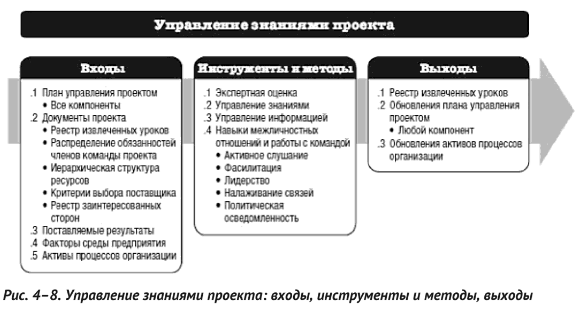
I won’t copy and paste the entire lengthy section of the guide here. You can review it on your own and draw appropriate conclusions. The quotes provided above are, in my opinion, quite sufficient. The existence of such detailed task descriptions for the project manager in knowledge management already indicates the importance of this aspect when working on projects. By the way, I often hear the thesis: 'Who needs our knowledge in other departments?' In other words, who needs these lessons learned?
In reality, it’s often seen that a department considers itself a 'unit in a vacuum.' Here we are with our little library, and then there's the rest of the company, and knowledge about our library is of no use to them. Maybe knowledge about the library is useful. But what about related processes?
A simple example: during the project, there was interaction with a contractor, for instance, a designer. The contractor turned out to be quite unreliable, missing deadlines and refusing to make revisions without extra payment. The project manager recorded in the lessons learned registry that it is not worth working with this unreliable contractor. Meanwhile, the marketing team was also searching for a designer and stumbled upon the same contractor. At that moment, there are two options:
a) if the company has a well-established culture of reusing experience, a colleague from marketing will check the lessons learned registry to see if anyone has previously worked with this contractor, notice the negative feedback from our project manager, and will not waste time and money engaging with this unreliable contractor.
b) If the company lacks such a culture, the marketer will turn to the same unreliable contractor, losing both the company's money and time, and may jeopardize an important and urgent promotional campaign, for example.
Which option seems more successful? Notice that the useful information did not concern the product being developed, but rather the accompanying processes involved in the development. Furthermore, it was not beneficial for another PM, but for an employee from an entirely different department. The conclusion is clear: development cannot be viewed separately from sales, technical support cannot be separated from business analytics, and IT cannot be cut off from operations. Everyone in the company has work experience that can benefit someone else. It is not necessarily only the representatives of related departments who will find it useful.
However, the technical aspect of the project can also be helpful. Try conducting an audit of the projects in your company over the past few years. You will be surprised by how many 'bicycles' were invented to solve similar problems. Why? Because the processes for sharing knowledge are not properly established.
Thus, knowledge management, according to the PMI guide, is one of the PM's tasks. As we can see, two well-known organizations that offer paid certifications according to their standards include knowledge management in their must-have toolkits for quality control and project work. So why do managers in IT companies still believe that knowledge management is merely documentation? Why do the water cooler and smoking area remain the centers for knowledge sharing? It's all a matter of understanding and habits. I hope that gradually IT managers will gain a better understanding of the field of knowledge management, and the oral tradition will cease to be the method for preserving knowledge within the company. Study your work standards - there is a lot of interesting material in them!
Source: habr.com
