

The dream of every person is to remain young for as long as possible. We do not want to age and get sick; we fear everything—cancer, Alzheimer's disease, heart failure, stroke... It's time to understand where cancer comes from, whether there is a connection between heart failure and Alzheimer's disease, infertility and hearing loss. Why do antioxidant supplements sometimes do more harm than good? And most importantly: can we live long and healthy lives, and if so, how?
In our bodies, tiny 'energy stations' called mitochondria are at work. They are responsible for our health and well-being. When they function well, we don't experience a lack of energy. But when they don't, we suffer from illnesses. Dr. Lee Know reveals the secret: diseases that seem unrelated at first glance—diabetes, cancer, schizophrenia, chronic fatigue, Parkinson's disease, and others—share a common nature.
Today we know how to improve the functioning of the mitochondria that provide 90% of the energy to our bodies. This book contains relevant information about nutrition, lifestyle, ketogenic diets, and supplements that restore health to our mitochondria and, consequently, to us.
Excerpt. Mitochondrial Syndrome
I feel awkward admitting this, but I was a viewer of the reality show 'The Bachelor.' I was very impressed by the third episode of Season 17 (January 2013), in which Sin (the bachelor) and Ashley (a contestant) went on a date with two girls suffering from mitochondrial disease. For many of you, if you watched the episode, this was your first introduction to mitochondrial syndrome (mitochondrial syndrome is a complex of diseases related to congenital mitochondrial damage). However, this group of diseases is being studied in greater detail as genetic testing and sequencing technologies become easier, cheaper, and more accessible.
Until the early 1980s, when the human mitochondrial genome was fully sequenced, reports of mitochondrial diseases were rare. The situation changed with the advent of the ability to decode mtDNA from many patients. This led to a dramatic increase in the number of registered patients suffering from hereditary mitochondrial diseases. Approximately one in five (or even 2.5) thousand people are affected. This does not account for those with subtle forms of mitochondrial diseases. Moreover, the list of mitochondrial syndrome features has expanded significantly, indicating the chaotic nature of these disorders.
Mitochondrial diseases are characterized by extremely complex genetic and clinical pictures, representing a mix from a very broad range of existing diagnostic categories. The patterns of inheritance here sometimes comply with, and at other times do not comply with, Mendelian laws. Mendel described the patterns of inheritance of traits through normal nuclear DNA genes. The probability of a genetic trait or hereditary disease can easily be calculated based on quantitative predictions of the offspring's segregation results for various qualitative traits through the random inheritance of one of two copies of the same gene from each parent (resulting in each offspring receiving two copies of each gene). In cases where the mitochondrial syndrome is caused by a defect in nuclear genes, the corresponding inheritance patterns indeed follow Mendel's rules. However, there are two types of genomes that enable mitochondrial function: mitochondrial DNA (inherited only through the maternal line) and nuclear DNA (inherited from both parents). As a result, inheritance types vary from autosomal dominant to autosomal recessive, as well as through maternal line transmission of genetic material.
The situation is further complicated by the fact that complex interactions occur between mtDNA and nDNA. As a result, the same mtDNA mutations can lead to strikingly different symptoms in siblings living in the same household (they may have different nuclear DNA despite having identical mtDNA), while other mutations can cause identical symptoms. Even identical twins with the same diagnosis can have radically different clinical pictures of the disease (specific symptoms depend on which tissues are affected by the pathogenic process), while individuals with mutations may suffer from similar symptoms that align into the same disease pattern.
Nonetheless, there exists a significant number of mtDNA variations in the maternal egg cell, which undermines all predictions regarding the outcomes of genetic inheritance. The nature of this group of diseases is so chaotic that the symptom set associated with these conditions can vary from decade to decade and can even differ among siblings with identical mitochondrial DNA mutations. Furthermore, sometimes, the mitochondrial syndrome can simply vanish, even though it was (or should have been) inherited. However, such fortunate cases are rare, and more often than not, mitochondrial diseases progress. Tables 2.2 and 2.3 present the diseases and symptoms associated with mitochondrial dysfunction, as well as the genetic factors of these diseases. Currently, science recognizes over 200 types of mitochondrial mutations. Research results indicate that many degenerative diseases are caused by such mutations (which means we need to reclassify a vast number of diseases, moving them into the category of mitochondrial diseases).
As we know, these mutations can cause mitochondria to stop performing their energy production function, leading to cell disruption or death. All cells (except for red blood cells) contain mitochondria, and consequently, mitochondrial syndrome affects various multi-component systems in the body (either simultaneously or sequentially).
Table 2.2. Signs, symptoms, and diseases caused by mitochondrial dysfunction
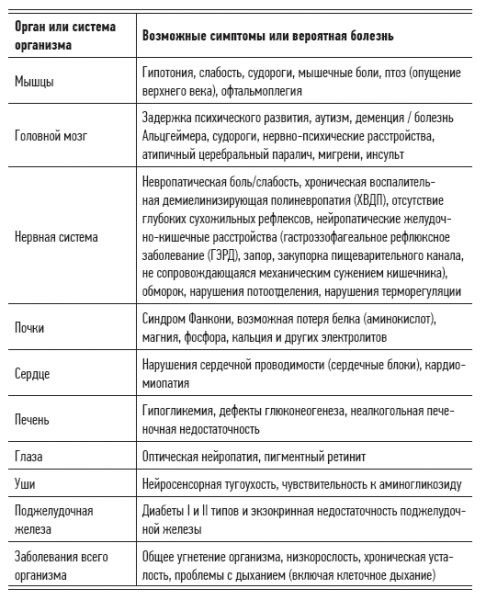
Table 2.3. Genetic disorders caused by mitochondrial dysfunction
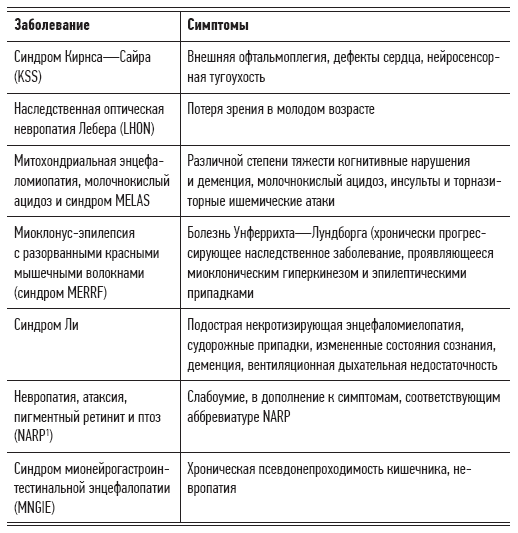
Of course, some organs or tissues require more energy than others. When the energy needs of a particular organ cannot be fully met, symptoms of mitochondrial syndrome begin to manifest. Primarily, they affect the functions of the brain, nervous system, muscles, heart, kidneys, and endocrine system, that is, all organs that require a substantial amount of energy for proper functioning.
Acquired diseases caused by mitochondrial dysfunction
As our understanding of mitochondrial function and dysfunction grows, we start to compile a long list of diseases rooted in mitochondrial dysfunction and clarify the mechanisms behind their onset and progression. Data from recent studies indicate that one in every 2500 people suffers from mitochondrial syndrome. However, if you closely examine the list below, you may agree that mitochondrial diseases (whether congenital or acquired) are likely to be diagnosed in one in every twenty-five or even one in every ten residents of Western countries.
- Type II diabetes
- Cancer diseases
- Alzheimer's disease
- Parkinson's disease
- Bipolar affective disorder
- Schizophrenia
- Aging and frailty
- Anxiety disorder
- Non-alcoholic steatohepatitis
- Cardiovascular diseases
- Sarcopenia (loss of muscle mass and strength)
- Exercise intolerance
- Fatigue, including chronic fatigue syndrome, fibromyalgia, and myofascial pain
At the genetic level, very complex processes are involved. The energy potential of a specific individual can be assessed by examining the inherited disorders of their mitochondrial DNA. But this is just the starting point. Over time, acquired defects in mtDNA accumulate in the body, and once a particular organ reaches a specific threshold, it begins to malfunction or becomes susceptible to degeneration (each organ has its own threshold of tolerance, which we will discuss in more detail).
Another complexity lies in the fact that each mitochondrion contains up to ten copies of mtDNA, and each cell, tissue, and organ has numerous mitochondria. This means that there can be countless defects in mtDNA copies within our body. The dysfunction of a specific organ begins when the percentage of defective mitochondria present exceeds a certain level. This phenomenon is known as the threshold effect. Each organ and tissue is subject to specific mutations and has its own mutation threshold, energy requirements, and resistance to the effects of free radicals. The combination of these factors determines how a living system will react to genetic abnormalities.
If only 10% of the mitochondria are defective, the remaining 90% of normal cellular energy generators can compensate for the dysfunction of their 'colleagues'. Likewise, if the mutation is not very serious but affects a large number of mitochondria, the cell can still function normally.
There is also the concept of defective mitochondrial segregation: when a cell divides, its mitochondria are randomly distributed between the two daughter cells. One of these cells may receive all the mutated mitochondria, while the other acquires all the healthy 'powerhouses' (naturally, intermediate variations are more likely). Cells with dysfunctional mitochondria will die through apoptosis, while healthy cells will continue to perform their functions (one explanation for the sudden and unexpected disappearance of mitochondrial syndrome). The phenomenon of differences in mitochondrial (or plastid) DNA sequences within the same organism, often even within a single cell, where some mitochondria, for example, may contain a pathological mutation while others do not, is called heteroplasmy. The degree of heteroplasmy can vary even among family members. Moreover, the level of heteroplasmy can change within a single organism depending on the specific organ or cell type, leading to a wide range of manifestations and symptoms of various mitochondrial diseases.
In the growing embryo, as cells divide, mitochondria with mutations populate organs and tissues that differ in their energy needs. If a significant number of mutated mitochondria inhabit cells that eventually turn into metabolically active structures (such as the brain or heart), the organism may face quality of life issues later on (if it is even viable). On the other hand, if a mass of dysfunctional mitochondria accumulates primarily in cells with low metabolic activity (say, in skin cells that regularly replace each other), the carrier of such mitochondria may never realize their genetic predisposition to mitochondrial syndrome. In the aforementioned episode of 'The Bachelor', one of the women with mitochondrial disease appeared to be perfectly normal, while another clearly suffered from a serious ailment.
Some mitochondrial mutations spontaneously develop with age due to the formation of free radicals during normal metabolism. What happens afterward depends on several factors. For example, if a cell filled with dysfunctional mitochondria divides rapidly, as stem cells do in tissue regeneration, defective energy generators will actively expand. However, if a weakened cell no longer divides (let's say it's a neuron), the mutations will remain confined to that cell, though this does not rule out the possibility of a successful random mutation. Thus, the complexity of the genetic basis of mitochondrial syndrome explains why the depletion of the organism's bioenergetic resources caused by mitochondrial mutations manifests within a wide range of diverse and complex diseases and symptoms.
We must also remember that there are many genes outside of mtDNA that are responsible for the normal functioning of mitochondria. When a mutation affects genes that encode RNA, the consequences are usually quite serious. In cases where a child receives a mutated mitochondrial transcription factor from either parent at conception (recall that transcription factors are proteins that control the synthesis of mRNA on a DNA template by binding to specific DNA regions), all mitochondria in their body will be subjected to pathogenic effects. However, if the mutation only relates to specific transcription factors that are activated only in certain organs or tissues or in response to the release of a specific hormone, the corresponding pathogenic effect will be exclusively local.
The wide range of mitochondrial diseases and their manifestations is a serious issue for both theoretical and practical medicine, including the actual impossibility of predicting the progression of mitochondrial syndrome. There are so many mitochondrial diseases that it is difficult to even name them all, and many of them have yet to be discovered. Even some well-known degenerative diseases (such as cardiovascular diseases, cancers, certain forms of dementia, etc.) are currently associated with mitochondrial dysfunction by modern science.
It is important to realize that, although there is no complete cure for mitochondrial diseases, many people with these conditions (especially in cases of mild or moderate forms of the disease) can live long and fulfilling lives. However, this requires systematic work, utilizing the knowledge that has become available to us.
About the Author
Li Nou is a licensed naturopathic doctor from Canada, and an award-winning practitioner. Colleagues know him as a visionary entrepreneur, strategist, and physician. Li has served as a medical consultant, scientific expert, and director of research and development in large organizations. In addition to his scientific work in his company, he also acts as a consultant in natural health products and dietary supplements, and is part of the editorial advisory board of Alive magazine — the most widely read health magazine in Canada. He calls the Greater Toronto Area home, where he lives with his wife and their two sons, and has a particular interest in promoting natural health and environmental protection.
» Learn more about the book at
»
»
For Habr users, a 25% discount with the coupon — Mitochondria
Upon payment for the print version of the book, an electronic version will be sent to your email.
Source: habr.com
