

While chatting with friends today, we began to reminisce about "how it all was" in Runet — not from the words of politically biased "Ashmanovs and other affiliates," but how it really was.
I was inspired to write an article. There was nothing to do, so I sketched out some thoughts on what could come next ©
Essentially — a series of unknown stories from the formative period of IT in Russia, some funny and some not, plus a description of a typical career at that time.
If it will be interesting — there are many photographs and stories — all old-fashioned, taken not on digital cameras. Back when there were still black and white monitors 🙂

A description of how life led me to the most interesting places connected to global IT.
My career in IT began with the fact that I somewhat "blew up" the school principal in his own personal bathroom.
Yes, just like in today's comedies 😉
The Russian labor book starts at 14 years old — officially, we set up a network across the entire school (and did the same in other schools), connecting to the granddaddy of the internet ( — a minute of communication from Norilsk with a call to the USA cost about $100, so we hacked it right from the principal's phone)
In one school, we installed pyrotechnic charges in the principal's toilet, and a year later I went to another school (expelled from the first) and met the same principal there.
He recognized me but didn't remember from where. So he accepted me.
At that time, I didn't know how to say "spoon" in English (which is what I failed the entrance exams in school for), which seems quite amusing — because I am a UK citizen today.
The principal accepted me "without exams" since I came to negotiate (you know how that skill helped later in life?) without parents.
This was the "Elite Education of Russia" program — "ELIOR" ("under the MGIMO ELIOR program (elite education in Russia)").
Yes, there was a brief moment in Russian history when the wife of another oligarch (at that time, such words weren't even known) decided to invest in the children of Russia — but then suddenly died in a plane crash and everything crumbled.
Very few people know, that (for example) essentially Russian internet technologies are bound for eternity to the same George Soros — in 1998 he Now, this is a completely different matter, a lot more money) to provide communication for all leading institutions and students, when at that time many internet providers literally started with how 'a couple of train cars of oil were stolen' and continued to exist on the money of those 'damn Westerners' 🙂
I was lucky to witness the era when everything was just starting — which allowed me, if not to become a 'star,' then at least to feel quite good, including in 'California' and being called top '🙂
So, let's rewind back to 1995.
We were finishing college in Norilsk, where (on one hand) we managed to witness (and even work on) computers with punch cards and the uniquely reliable Dec Vax (and did you know that MS Windows NT is a team from Alpha / Dec Vax, which Bill Gates personally lured away?), while on the other hand, we had already managed even to work on Intel Pentiums, used as Novell Netware servers (which I personally broke in the first week of getting acquainted with it — NLM modules and all that, who remembers 😉 ).
Yes, Norilsk is the place where it often reaches -50C and even lower.
As a result, there are many strong IT specialists, because there's not much else to do.
Next, we were expecting .
I'm sure that my alma mater is just a treasure trove:
1) We were the only ones preparing to manage the nuclear reactors of Russian submarines.
Training included flooding with ice-cold water in a sealed chamber, screaming idiots in uniform, and so on. Therefore, my military department ended on the very first day when in response to the screaming monkey I stood up, told him to shove it (literally), and asked — 'who's with me, let's go solder computers.'
Unfortunately, this didn’t spare us from dealing with 'fuzzy monsters' on the Automated Control Systems — we assembled stands (simulating torpedo targeting on US aircraft carriers, for example), where we connected thousands of wires. It was a hassle 🙂
2) Anticipating — what we were doing there, for instance, when we had to submit a project for the 4th year, we did speech recognition.
I and a friend wrote an application (1998, by the way) that operated over IPX / NetBIOS, which transmitted speech from the 8th floor to the 2nd floor and allowed for feedback. We were visited by professors who dealt with satellites in the USSR. For example, landing on Venus.
As a result, in 1998, the professor was talking to the computer, and the computer answered him (!) and solved the tasks set by voice correctly (!!!).
The fact that hundreds of people in the entire dormitory were rolling on the floor with laughter is a different story 😉
By the way, I sometimes read this on anekdot.ru and others, but as always — a bunch of distortions.
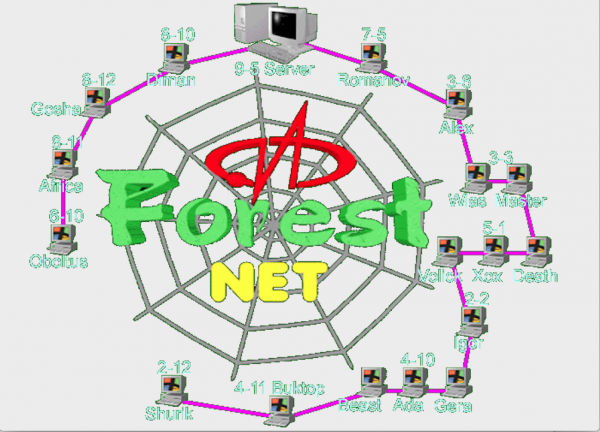
In the end — we built and controlled the entire university and dormitory network (more than 1000? people, the whole institute, etc.).
We became untouchable.
We patched the Linux kernel (especially QOS), FreeBSD, NetWare.
A lot of interesting technologies on "how to divide 10 megabits among 1000 people," including participation in the development (at that time it was a proxy server developed in Russia that seriously competed with Squid).
Essentially, the knowledge gained during this period allowed us to later launch huge projects on a planetary scale — including a complete understanding of protocol operations and all the "tricks" that can be done on the Linux / BSD kernel.
We ordered door reservations in the room because drunk students constantly tried to break down the door, protected professors with non-traditional orientations who had been exposed on the internet, warded off senior students with bats and other nuances of IT professionals' lives in Russia.
We ran around with soldering irons in the rooms (two buildings of 9 floors) — the network was token-ring on coaxial cable 😉
3) In our third year, we started working (I remember the first meeting at McDonald's on Kyivskaya) with Israelis on the (legal) porn business — there were already millions of users, servers running Solaris X86, Zeus Web Server (which, like Nginx, was eventually acquired by one of the most successful IT companies in the world, whose office in Russia I helped to open), ultra-high loads, and a lot of interesting things.
Western journalists came to interview me — how and why "Russians can hold this market"?
4) The FBI and FSB (together) visited us several times because the dormitory was (in 1998+) connected to the internet with an unlimited channel, and the dorm not only learned to generate credit cards for free but also had the brains to spread viruses to the US government.
Funny enough — when the "Russian services" arrived, they said everyone was doing great, we were working to undermine the enemy's economy (c) and left.
Tons of goods purchased by students on generated cards were arriving at the dormitory.
At that time, the provider was sending messages to the pager "the FSB is coming to you."
5) When SUN Microsystems (now eliminated by Oracle) donated servers to IATE (our institute), not a single professor could set up the equipment.
The rector called me (at that point, I was already recognized as ‘exceptional’ in the sense of exclusions attempted every year) and proposed a deal: I set up the servers at the institute, and we would be given permission (but not money or equipment) to connect for free to Sorovsky Internet.
The point was clear — at that time, a radio link at 1 megabit cost about 50 thousand dollars, and everyone at the institute assumed that even theoretically it was impossible for students.
In the end, I not only set up all the equipment but also negotiated with the institute for a couple hundred shovels and several kilometers of ‘military’ coaxial cable.
We (hundreds of students) laid the RG75 cable with Russian military network cards I (the driver of which I rewrote for Novell Netware 3) and launched the tcp/ip link at the institute in two days.
It was a show — hundreds of students with shovels were digging trenches, climbing trees and poles, lifting concrete slabs weighing hundreds of kilograms. Many of those 'students' are now highly respected people in Russia (business owners) and abroad.
6) How we handled the technical part of all the leading online projects in Russia (Andrey Andreev, spylog.ru, begun.ru, mamba.ru, badoo.com, and many others) — why we had a lot of fun at mail.ru and yandex.ru at that time (it was a complete technical kindergarten), why for a long time badoo.com was much cooler than Facebook, etc.
7) Why in the end almost everyone left — stories about London, Prague, Miami, Hong Kong, and other Californias.
Like how I ended up in the hospital in the UK for 5 days with a suspected mini-stroke while translating Badoo from Cisco to F5 🙂
Essentially, I really am not sure that all of this is interesting to anyone beyond a narrow circle.
Source: habr.com
