

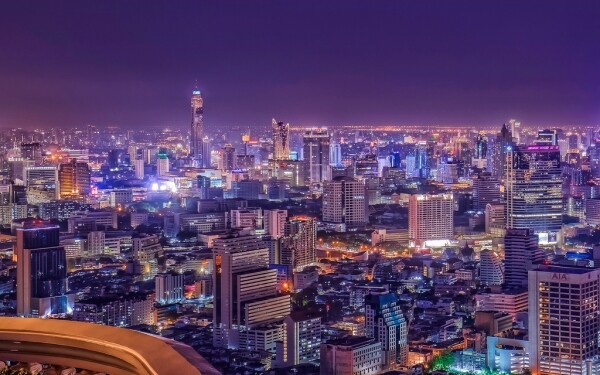
My story began sometime in October 2016 when the thought struck me, "Why not try working abroad?" Initially, there were simple interviews with outsourcing companies from England. There were many job openings describing "frequent business trips to America," but the workplace was still in Moscow. Yes, they offered good money, but my heart longed for a change. To be honest, if someone had asked me a couple of years ago, "Where do you see yourself in three years?" I would never have answered, "I will be working in Thailand on a work visa." After successfully passing the interview and receiving an offer, on June 15, 2017, I boarded a one-way flight from Moscow to Bangkok. This was my first experience moving to another country, and in this article, I want to discuss the challenges of relocation and the opportunities that await you. Ultimately, my main goal is to inspire! Welcome to the journey, dear reader.
Visa Application Process
First of all, I must commend the onboarding team at the company where I was employed. As is usually the case for obtaining a work visa, I was asked to provide a transcript of my diploma, and, if possible, letters from previous jobs to confirm my Senior level. Next began the hustle of having the diploma and marriage certificate translations notarized. After the copies of the translations were sent to the employer, a week later, I received a package via DHL, which I needed to take to the Thai embassy to obtain a Single Entry visa. Strangely enough, they didn’t take the diploma translation, so I think it was overall unnecessary; however, it's better to have it when leaving the country.
Two weeks later, my passport received a Multy-Entry visa and a Work Permit, and with these documents, you have the right to open a bank account to receive your salary.
Relocation and the First Month
Before moving to Bangkok, I vacationed in Phuket twice, and deep down, I thought work would blend seamlessly with regular trips to the beach, enjoying cold mojitos under the palms. How mistaken I was. Even though Bangkok is near the sea, swimming isn't an option. If you want to swim in the ocean, you have to budget about 3-4 hours for a trip to Pattaya (2 hours by bus plus an hour on the ferry). With the same effort, you could just book a flight to Phuket, as the flight takes only an hour.
Everything is brand new! First of all, what stands out after Moscow is how skyscrapers coexist with slums on the same street. It's incredibly surprising, but next to a 70-story building, there can be a hut made of corrugated metal. Overpasses on the roads can be constructed in four levels, allowing everything from luxury cars to handmade stools that resemble orc structures from Warhammer 4000.
I’m quite calm about spicy food, and for the first three months, it was a novelty for me to constantly eat tom yum and fried rice with chicken. But after a while, you start to realize that all the food tastes the same, and you begin to miss mashed potatoes and meat patties.
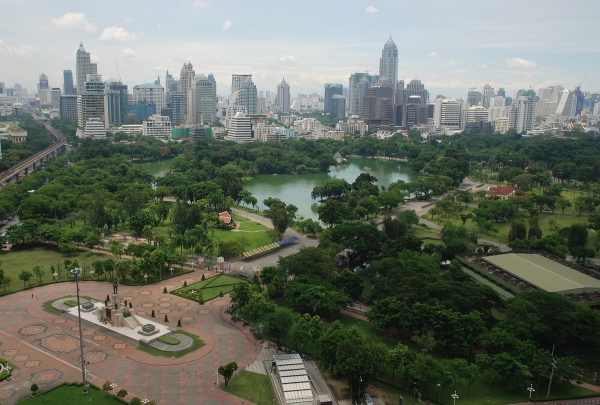
Adjusting to the climate was the hardest part. At first, I wanted to live near Lumpini Park, but after two or three weeks, you realize you can't go out during the day (+35 degrees), and it's not much better at night. This is both a plus and a minus of Thailand. It’s always hot or warm here. Why is that a plus? You can forget about warm clothes. Your wardrobe consists of only shirts, swim shorts, and a set of smart casual clothes for work. Why is it a minus? After 3-4 months, you enter 'Groundhog Day.' Every day feels almost the same, and the passage of time becomes imperceptible. I miss strolling in a cardigan through a cool park.
Housing search
The housing market in Bangkok is huge. You can find accommodation to suit any taste and financial capability. The average price for a 1-bedroom apartment in the city center is around 25,000 baht (which averages to 50,000 rubles). However, this will be a great apartment with floor-to-ceiling windows and a view from the twenty-fifth floor. Also, a 1-bedroom is different from a 'one-room' in Russia. It's more like a kitchen-living room + bedroom with an area of about 50-60 square meters. In 90% of cases, each complex has a free swimming pool and gym. Prices for 2-bedroom apartments start from 35,000 baht per month.
Your landlord will sign a yearly contract with you and request a deposit of 2 months' rent. This means you will owe for the first month times three. The main difference between Thailand and Russia is that here the landlord pays the realtor.
Transportation system
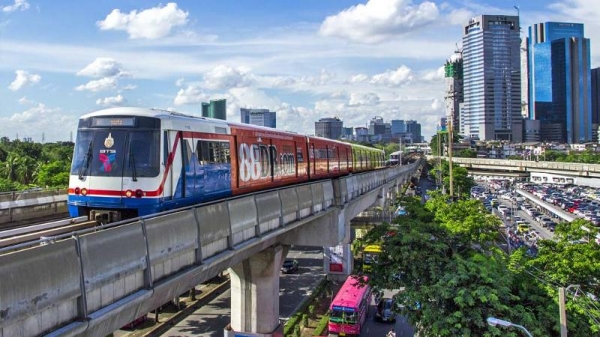
In Bangkok, there are several main transportation systems:
MRT — underground metro
BTS — elevated train
BRT — buses on dedicated lanes
If you're looking for accommodation, try to choose a place that is within walking distance to the BTS (preferably 5 minutes); otherwise, the heat can be quite surprising.
I'll be honest that I haven't used buses in Bangkok even once this year.
Taxis deserve special mention in Bangkok. They are among the cheapest in the world, and often, if you are traveling somewhere with two other people, it will be much cheaper to take a taxi than public transport.
If you're considering personal transport, you will also have a huge selection here. Interestingly, in Thailand, there is a subsidy for the development of the agricultural industry, and a Nissan Hilux will cost less than a Toyota Corolla. My first purchase here was a Honda CBR 250 motorcycle. When converted to rubles, the price came out to around 60,000 for a 2015 model. In Russia, you can get the same model for 150,000 to 170,000. Registration takes a maximum of 2 hours and requires almost no knowledge of English or Thai. Everyone is extremely friendly and wants to help you. Parking in the city center at a shopping mall costs me 200 rubles a month! Thinking back to the prices in Moscow City, my eye starts to twitch.
Entertainment
Thailand is rich in opportunities to enhance your leisure time in various ways. First of all, I want to say that Bangkok is a huge metropolis, and its size, in my opinion, is quite comparable to Moscow. Here are a few options for actively spending time in Bangkok:
Trips to islands
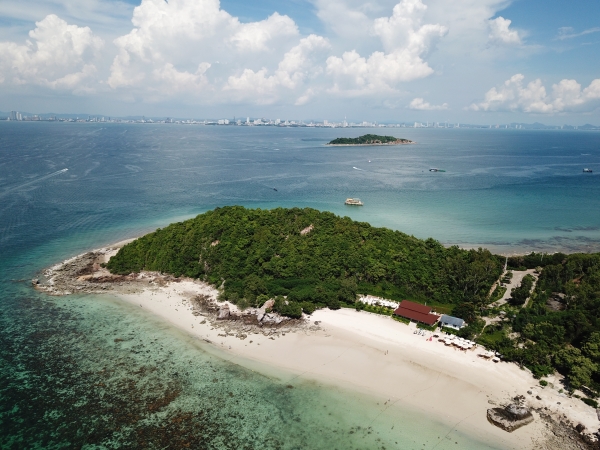
"When moving to Bangkok from Spain, I thought my weekdays would go something like this: [Wrist] Where's my elephant? Fifteen minutes later, I'm at the beach under a palm tree sipping cold mojitos and writing code" — A quote from one of the employees. In reality, it’s not as magical as it seems at first glance. To get from Bangkok to the sea, you need to spend about 2-3 hours. Nevertheless, there's a huge selection of beach vacations available at a fraction of the cost! (You don’t even have to pay for a plane ticket). Just imagine that a flight from Bangkok to Phuket costs 1000 rubles!
Traveling to neighboring countries
In the year I've lived here, I've flown more than in my entire life. A clear example is that round-trip tickets to Bali cost about 8000! Local airlines are extremely cheap, and you have the opportunity to see Asia and learn about the culture of other countries.
Active sports
Almost every weekend, my friends and I go wakeboarding. Bangkok also has trampoline parks, an artificial wave for surfing, and if you love riding motorcycles, there are race tracks. In short, there’s definitely no time to be bored.
Moving with +1
This is perhaps one of the biggest issues in Thailand (and in general any other country). At best, your husband or wife might find a job as an English teacher. Once, I stumbled upon an interesting about the lives of expats abroad. Overall, everything is stated as it is.
In our company, there’s a chat for expats, and they often get together for gatherings and spend time together. The company even pays for a corporate outing for them once a quarter.
I think, in each case, it depends on the mentality of the expat. Some find activities here, some work remotely, and some have children. Overall, there’s definitely no time to be bored.
Additionally, here are some price tags for raising children:
Tuition for an international kindergarten is about 500k rubles per year
School costs start from 600k to 1.5 million rubles per year, depending on the grade.
Given this, it's worth considering the practicality of relocating if you have more than two children.
IT community
In general, the community life here seems less developed than in Moscow, in my opinion. The level of conferences they hold seems not high enough. The first one that comes to mind is Droidcon. Also, within the company, we actively try to hold meetups. Overall, there's definitely no time to get bored.
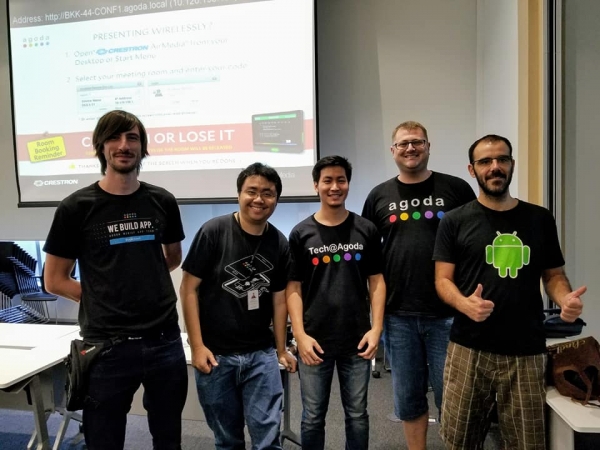
My opinion might be slightly subjective in this aspect, as I am not aware of meetups or conferences in Thai.
The level of specialists in Thailand seems lower to me. The difference in mindset between Post-USSR and other people is immediately noticeable. A small example is the use of technologies that are currently trending. We call these guys Fancy-guys; they heavily push top technologies that have 1000 stars on GitHub, but don't even understand what's happening inside. There's a lack of understanding of the pros and cons. Just hype.
Local mentality
Here, it's probably worth starting with the most important thing — religion. 90% of the population are Buddhists. This leads to many things that reflect on behavior and worldview.
In the first months, it was extremely frustrating that everyone walks slowly. For example, you can be standing in a small queue on an escalator, and someone might just zone out on their phone, blocking everyone.
Traffic on the roads seems extremely chaotic. If you drive against the flow during a traffic jam — that's okay. I was quite surprised when a policeman told me, "drive against the flow, don't create a jam."
This is also reflected in work aspects. Just do it, don't stress, take the next task...
What is extremely annoying is that here, you are a perpetual tourist. I walk the same route to work every day, and I still hear this "here — tuk — have — you — going — mister." It's a bit irritating. Also, the fact that you will never fully belong here. This is evident even in pricing policies for national parks and museums. Prices can sometimes vary by 15-20 times!
Particular color is added by food carts. In Thailand, there is no sanepidservice, and people are allowed to prepare food on the street. In the morning, on the way to work, the air is filled with the aroma of food (a rather specific smell, I must say). At first, we bought dinner from these carts for three weeks. However, the food quickly became monotonous. The street food selection is quite simple, and overall, it’s the same everywhere.
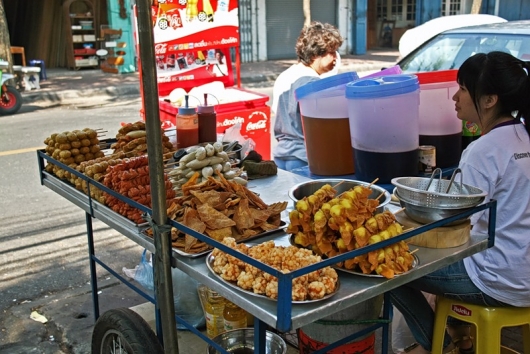
But what I like about the Thais is that they are like children. Once you understand this, everything becomes easier. You order food at a café, and they bring you something else — that’s okay. It’s good that they brought something at all; they often forget. For example, my friend ordered the correct shrimp salad only on her third attempt. The first time they brought her fried beef, the second time battered shrimp (yes, yes, almost there…), and finally on the third try, it was spot on!
I also like that everyone is extremely friendly. I've noticed that I’ve started smiling more often here.
Life Hacks
First of all, you should exchange your driver's license for a local one. This will allow you to pass as a local in many places. Plus, you won’t need to carry your passport and work permit around.
Use regular taxis. Be persistent and demand that they turn on the meter. One or two might refuse, but the third will comply.
You can find sour cream in Pattaya.
I recommend looking for an apartment at the intersection of MRT & BTS for maximum mobility. If you plan to fly frequently, check near the Airport Link; it will save you money and, most importantly, time on the road.
It was very difficult to find a potato masher. We spent about two weeks searching for one. Prices for this simple item were around 1000 rubles, but in the end, we found one at IKEA.
Conclusion
Am I planning to return soon? Most likely not in the near future. And not because I feel any dislike toward Russia, but because the first relocation breaks some zone of comfort in your mind. It used to seem like something unknown and difficult, but in reality, it's quite interesting. What have I gained here? I can say that I’ve made interesting friends, I’m working on an intriguing project, and overall, my life has changed for the better.
Our company has around 65 nationalities working here, and it's an amazing experience in exchanging cultural knowledge. Comparing myself to who I was a year ago, I feel a kind of freedom from borders of nations, nationalities, religions, and so on. You simply engage with good people every day.
I have no regrets about making this decision a year ago. I hope this won't be the last article about relocating to other countries.
Thank you, dear Habr user, for reading this article to the end. I want to apologize in advance for my writing style and sentence structure. I hope this article sparked a little spark within you. And believe me, it's not as difficult as it seems. All barriers and borders are just in our minds. Good luck with new beginnings!
Only registered users can participate in the survey. , please.
Your current work situation
In Russia and looking for relocation opportunities
In Russia and not considering relocation
Abroad as a freelancer
Abroad on a work visa
506 users voted. 105 users abstained.
Source: habr.com
