

"Excessive automation was a mistake."
To be precise — my mistake.
People are undervalued."
Elon Musk
This article may seem like a speech of bees against honey. It is indeed strange: we automated business for 19 years and suddenly, on Habr, we boldly assert that automation is dangerous. But this is just at first glance. Excess is harmful in everything: in medicine, sports, nutrition, security, gambling, and so on. Automation is no exception. Modern trends toward increasing automation of everything possible can cause significant harm to any business, not just large industries. Hyper-automation is a new risk for companies. Let's discuss why.
Seemed, seemed...
Automation is wonderful.
Automation came to us in the form we know it through the thickets of three scientific and technological revolutions and has become a consequence of the fourth. Year after year, it freed people's hands and minds, helped, and changed the quality of labor and life.
- The quality of development and products is increasing — automation ensures an accurate, increasingly refined production mechanism, eliminating the human factor where maximum precision is required.
- Clear planning — with automation, production volumes can be predetermined in advance, a plan can be set, and it can be completed on time if resources are available.
- The increase in productivity against the backdrop of reduced labor intensity gradually leads to a decrease in production costs, making quality accessible.
- Labor has become significantly safer — in the most dangerous areas, automation replaces humans, and technologies protect health and lives in production.
- In offices, automation frees managers from routine tasks, organizes processes, and allows for more focus on creative, cognitive work. CRM, ERP, BPMS, PM, and the rest of the zoo of automation systems for business exist for this purpose.
There could be no talk of any potential harm!
Tesla spoke about the problem openly.
The topic of hyper-automation has been discussed before, but it entered an active stage of discourse when Tesla faced financial failure with the launch of the Tesla Model 3.
The assembly of cars was fully automated, and it was expected that robots would solve all issues. However, in reality, things became more complicated — at one point, due to reliance on robotic assemblers, the company was unable to increase production capacity. The conveyor belt system turned out to be incredibly complex, and the factory in Fremont, California, faced an urgent need for optimizing production and hiring qualified personnel. "We had this crazy, complex web of conveyor belts, and it wasn't working. So we decided to get rid of all of it," Musk commented on the situation. This is a landmark moment for the automotive industry and will likely become a case study.
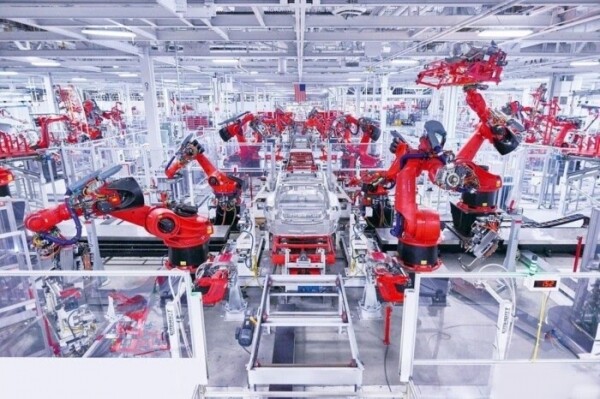
Tesla's assembly shop at the Fremont factory
What does this have to do with small and medium-sized businesses in Russia and the CIS, which are automated in less than 8-10% of companies? It's better to understand the problem before it affects your company, especially since some very small companies manage to automate everything, sacrificing human careers, money, time, and interpersonal relationships within their teams for the sake of automation. In such companies, it is Algorithm Majesty that begins to dictate terms and make decisions.
Five lines of advertisement
We advocate for reasonable and thoughtful automation, which is why we have:
- — a powerful universal CRM in 6 editions for small and medium-sized businesses
- — a simple and convenient cloud ticket system and mini-CRM with instant start-up capabilities
- — a powerful CRM for media holdings and outdoor advertising operators; a true industry solution with media planning and other capabilities.
How could this even happen?
Automation tools for any business have become technologically and financially accessible, and many business owners have started viewing them as a kind of cargo cult: if everything is done by robots and programs, there will be no mistakes, everything will be smooth and wonderful. Some executives look at technology as if it were a living entity, and vendors often encourage this misconception: CRM will sell itself, ERP resources will allocate themselves, WMS will bring order to your warehouse… This understanding of automation has proven dangerous for those who have become its blind devotees. Ultimately, a company recklessly buys up everything that can replace people and… ends up with a completely paralyzed IT infrastructure.
What are the dangers of hyper-automation?
Hyperautomation refers to the automation (of production, operational activities, analytics, etc.) that leads to inefficiency. This situation often arises when the automated process does not take the human factor into account.
The brains are drying up.
Machine learning and artificial intelligence (ML and AI) have already found applications in industry, security, transportation, and even in large ERP and CRM systems (deal scoring, customer journey prediction, lead qualification). These technologies solve not only quality and safety control issues but also engage in distinctly human tasks: monitoring other equipment, managing mechanical machines, recognizing and utilizing images, generating content (not in the sense of articles, but in terms of necessary fragments for operations—sounds, texts, etc.). Thus, while previously operators worked with CNC machines and became more skilled from incident to incident, the role of humans is diminished, and the qualifications of those same masters in the industry sharply decline.
Charmed by the possibilities of ML and AI, entrepreneurs forget that this is just code created and written by people, and the code will execute with precision and "from this point to that point," with no deviations whatsoever. Consequently, across all fields—from medicine to your office work—the flexibility of human thinking, the value of cognitive functions, and professional expertise are lost. Imagine the outcome if pilots from a "cornfield" relied entirely on autopilot? Similarly, in business—only human thinking is capable of creating innovations, methodologies, cleverly adapting, and efficiently working within the "human-human" and "human-machine" systems. Blind reliance on automation is not advisable.
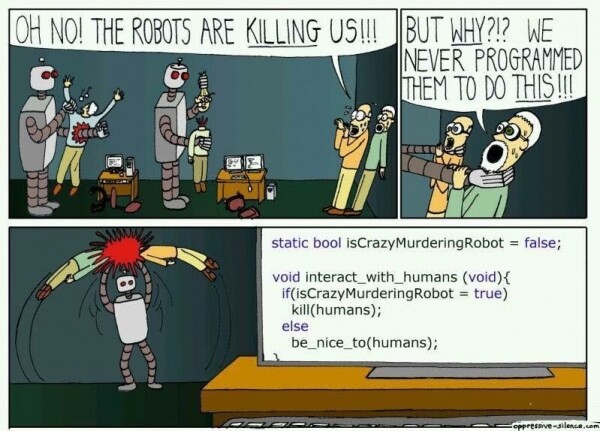
And don't mix things up in the code, okay?
It's a bit inhumane.
Surely, there's no one among Internet users who hasn't encountered bots at least once: on websites, in chats, on social media, in the news, on forums, and specifically (with Alice, Siri, Oleg, finally). And if you haven't experienced this fate, surely you've interacted with phone robots. Indeed, the presence of such electronic operators in business helps lighten the load on managers' work, making it simpler and more efficient. However, this seemingly innocent technology, which small businesses have also embraced, turns out to be not so straightforward.
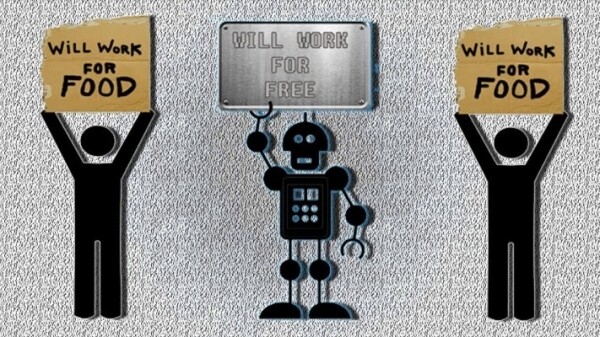
According to the CX Index 2018 report, 75% of respondents stated that they severed their relationship with a company due to a negative experience with chat. That's a concerning number! It turns out that consumers (the ones who bring money to the company) do not want to communicate with robots.
Now let's ponder a rather commercial and even PR-related issue. Here’s your company; it has a wonderful website — there’s a chatbot on the site, a chatbot in the help section, on the phone a robot + IVR, and accessing a live person is difficult. So it turns out that the face of the company becomes... a robot? In other words, it becomes faceless. And you know, there's a certain trend in the IT industry to humanize this new face. Companies are creating a technological mascot, giving it charming traits, and presenting it as an assistant. This is a dreadful trend, hopeless, based on a deep psychological dilemma: how to humanize what we ourselves have stripped of humanity?
The client wants to control the process of communication with the company, wanting a real person with flexible thinking, not this ‘please rephrase your request once more.’
I'll provide an example from life.
Alfa-Bank has a very good online chat in their mobile app. At its inception, there was even a post on Habr that highlighted the humanity of the operators — it looked impressive, interacting was pleasant, and friends repeatedly expressed their enthusiasm about it in Runet. Unfortunately, now more and more often the chatbot responds based on keywords in the query, which creates an unpleasant feeling of being abandoned, and urgent issues are taking longer to resolve.
What was good about Alfa's chat? The fact that a human is at the center, not a bot. Clients are tired of robotic, mechanical communication — even introverts. Because a bot is... stupid and soulless, just an algorithm.
Hyper-automation of customer communication leads to frustration and loss of loyalty.
Processes for the sake of processes
Automation is tied to individual processes within the company — and the more processes that are automated, the better, as it frees the company from the problems of routine tasks. However, if there are no people behind the processes who understand how they work, what principles are at their core, and what limitations and failures may occur, the process will hold the company hostage. That’s why it’s often better if processes and automation are handled not by external consultants, but by a working group within the company in collaboration with the system developer. Yes, it is labor-intensive, but in the end, it is reliable and effective.
If you have well-established processes but no one who understands them, any failure will lead to downtime, dissatisfied customers, and missed work tasks — it will turn into complete chaos. Therefore, it is essential to develop internal expertise and appoint process holders who will oversee them and implement changes. Automation without human involvement, especially in a company’s operations, is still of limited capability.
Automation for the sake of automation is a dead end, offering neither profit nor benefit. If, against this backdrop, you find yourself wanting to reduce staff because "something will do everything by itself," the situation will only get worse. Therefore, it is crucial to find a balance between automation, a valuable tool of the 21st century, and people, our most precious asset of the time.
In short, I'm done 😉
Source: habr.com
