


In the city district of Suzhou (Anhui province) in China, street cameras were used to identify individuals wearing "inappropriate" clothing. Using facial recognition software, officials identified offenders and publicly shamed them by posting their photographs and personal information online. The city management department believed that this approach would eradicate the "uncivilized" habits of the city's residents. Cloud4Y reports how it all happened.
Beginning
Officials in a large city (with approximately 6 million residents) in eastern China received a directive to eliminate the "uncivilized behavior" of the population. They couldn't come up with anything better than using facial recognition software applied to the widely installed cameras. After all, they're quite effective at identifying instances of "uncivilized" behavior.
A special explanatory post was even published on WeChat (which was later deleted), stating: "Uncivilized behavior means that individuals act in ways that disrupt public order due to their lack of accepted moral values. Many consider this nonsense rather than a serious problem... Others believe that public spaces are truly "public," and there should be no oversight or social pressure there. This has led to a kind of complacent, undisciplined thinking.».
But what did the city authorities decide to eradicate that they deemed shameful, uncivilized, and deeply immoral? You won't believe it — pajamas! Specifically, wearing pajamas in public places.
The essence of the problem
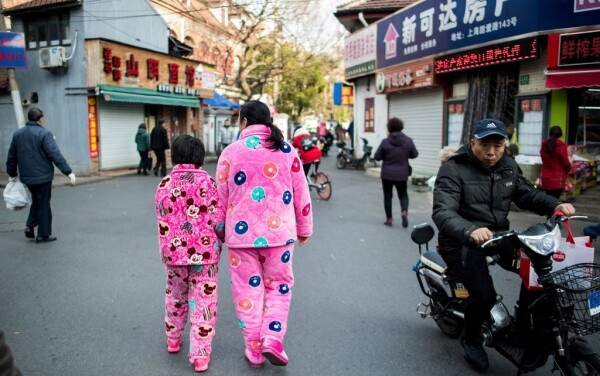
Bright pajamas are a common streetwear for many women.
It should be noted that wearing pajamas in public is a common phenomenon in China, especially among elderly women who prefer bright colors, as well as floral or cartoon patterns. In winter, in southern China, this is also a popular form of clothing, since, unlike northern cities, most homes do not have central heating. You can't go to bed without pajamas. They are warm, soft, and comfortable. It’s hard to part with them! So, they wear pajamas all day long. Both at home and outside. In general, the origin of the tradition to wear pajamas outside has numerous versions and is widely discussed online, but everyone agrees on one thing: pajamas are extremely convenient.
Shanghai, for example, was long considered the capital of 'pajama fashion'. In 2009, the authorities attempted to ban this practice by placing outdoor advertisements around the city with loud slogans like 'Pajamas don’t leave the house' or 'Be a civilized resident'. Moreover, a special 'pajama police' was even created, patrolling various neighborhoods of the city. However, since the initiative was tied to a major economic event, after its conclusion, the efforts to combat pajama wearers sharply declined. And the tradition persisted.
In Suzhou, they went further. They tracked offenders for some time, and then published photographs of seven residents of the city who were seen wearing pajamas in public places. Along with the photographs taken by surveillance cameras, the names, government ID card numbers, and addresses of those caught 'behaving uncivilized' were also published.
Not much time was spent on everything. The information databases were stored in , and the analysis of existing and incoming data was performed almost 'on the fly'. This allowed for the quick identification of repeat offenders.
With the help of social media, the Suzhou department publicly shamed a young woman with the surname Dong, who was spotted wearing a fancy pink robe, trousers, and pointy orange ballet flats. In the same way, a man with the surname Niu was criticized for strolling through the shopping mall in a black-and-white checkered pajama suit.
Such activities by officials have sparked a wave of discontent online. As one commentator aptly noted, "these things happen when very advanced technology falls into the hands of very low-level bureaucrats, and by low-level, I mean a low level of intelligence."
It's worth noting that public shaming is a common practice in China. In cinemas, laser pointers are used to shame viewers who play on their phones during the screening. In Shanghai, face recognition systems have been installed at some crosswalks to identify escaped prisoners.
There have been other examples of the government's attempts to eliminate "uncivilized" habits. Authorities imposed fines for spitting in public places, and just recently implemented a ban on "", a practice where men roll up their shirts in summer to expose their stomachs.
Comprehensive video surveillance of society
The legality of using facial recognition software by law enforcement agencies remains a hot topic for discussion worldwide. In Russia, there are even against automatic facial recognition. In some places, video surveillance is entirely banned. In China, it's not the same.
In recent years, the use of facial recognition software has become a common phenomenon. The police have employed it to create a powerful system for surveillance and to identify members of racial minorities, to catch toilet paper thieves, and to manage and . With this system, Chinese citizens can board a plane or order food.
About toilet paper thievesChinese officials have been working for years to curb the excessive use of toilet paper in public places. The devastating poverty of certain segments of the population has forced them to seek every means to save, even on toilet paper.
Toilet paper thieves from the Temple of Heaven in Beijing were an elusive group. They blended in with the majority of park visitors, practicing tai chi, dancing in courtyards, and stopping to enjoy the delightful fragrance of ancient cypress and juniper trees. However, their large bags and backpacks contained far from gadgets or picnic blankets. Inside, they held crumpled sheets of toilet paper secretly torn from public restrooms.
Due to the activities of these individuals, the toilet paper, which was freely provided in restrooms, quickly ran out. Tourists had to use their own supplies or look for other toilets. Installing toilet paper dispensers partially solved this issue but created a number of inconveniences.
To receive toilet paper, a visitor must stand in front of the dispenser for 3 seconds, where a facial recognition system is installed. After this, the machine dispenses a two-foot-long sheet of toilet paper. If visitors request more, they are out of luck. The machine will not dispense a second roll to the same person for nine minutes.
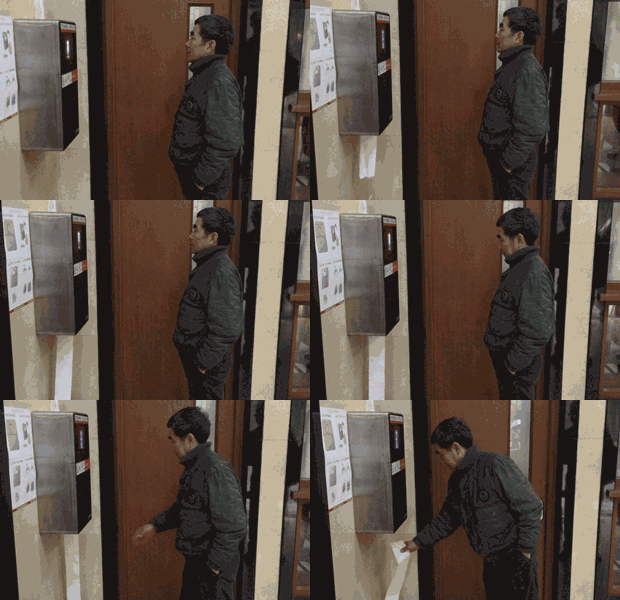
The scale and real necessity of using facial recognition technology in China, where enthusiasm for new digital tools often outpaces existing capabilities, are not always clear and transparent. Nevertheless, many Chinese people have embraced this technology and do not resist it.
However, exposing names and publicly shaming those who wear pajamas in Suzhou is considered beyond acceptable by many Chinese citizens. Some WeChat users commented on the department's post, expressing their disagreement with officials' decision to publish personal information online. Others simply wanted to know what was so wrong about wearing pajamas in public. After all, 'when celebrities wear pajamas to events, they are called fashionable. But when ordinary people wear pajamas on the streets, they are labeled uncivilized,' noted internet activists.
Summary
Only after the scandal gained national attention did the city officials quickly delete the initial post and issue an official apology. They explained their actions by stating that Suzhou was vying for the title of 'Most Civilized City in China' in a state-level competition. All their efforts were focused on winning this contest.
It is worth noting that an increasing number of citizens are expressing concerns about the privacy of personal data and the inviolability of their private lives. They are even trying to challenge the growing powers of government agencies to track individuals. This is understandable. Few would appreciate the possibility of their data being easily leaked online by some minor official for a fabricated reason. Furthermore, a database of 'dissidents' could quickly find its way to the black market.
Overall, the story is amusing, but the situation is dire. It seems quite possible to reach a point where wearing the wrong clothes, participating in the wrong event, or simply talking to the wrong person could result in public condemnation from both the government and 'conscientious' law-abiding citizens.
What else is useful to read in the blog
→
→
→
→
→
Subscribe to our -channel, so you won’t miss our next article! We write no more than twice a week and only on relevant topics. Remember, startups can get 1,000,000 rubles from Cloud4Y. Conditions and the application for those interested can be found on our website:
Source: habr.com
