

The milestone version of Linux Kernel 5.0 was released in early March. However, work on Kernel 5.1 is already underway. In this article, we will explore several new features that are expected in this version.
/ Flickr / /
Discontinuing support for a.out
Linux supports binary files since the very first version of the kernel. After 25 years, is planned to be moved into deprecated status. Developers say that this is a necessary procedure, as over time, .
Linus Torvalds emphasized The retirement of a.out will occur in two stages. In Linux 5.1, the core dumping code (
core dumping approximately 500 lines In subsequent releases, support will be completely discontinued, but only if no one in the community steps up to maintain the format.
Changes are being made to patches against Spectre
Several changes will be made to the Retpoline patch for protection against the Spectre v2 attack. It uses a special sequence of instructions that blocks the speculative execution mechanism in the processor. Developers plan to
increase the threshold for generating indirect calls from branches from five to twenty. In some cases, this will allow for a 20% performance improvement. Also, Kernel 5.1
introduces a new flag, PR_SPEC_DISABLE_NOEXEC, which disables protection against the Spectre v4 vulnerability in all child processes running on the server. It is related to the memory disambiguation we wrote in one of our previous materials .
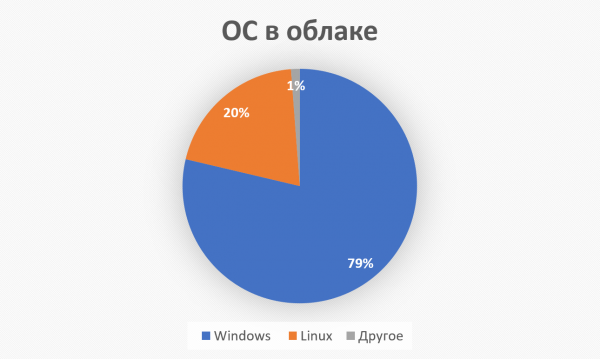
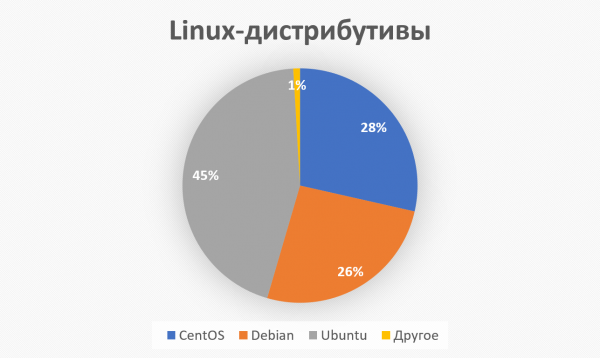
1cloud We compiled statistics — the most popular operating system in the cloud among our clients remains Windows (79%). The share of Linux is 20%. In the future, we expect the second OS to regain some market positions. We also present a chart of the distribution shares among Linux distributions (The most popular distribution among our clients remains Ubuntu — 45%, followed by CentOS with 28% and Debian with 26%).
Adding audio drivers (a lot)
In one of the threads on Hacker News, residents , that Linux has always had difficulties with hardware support. However, version 5.1 will include for audio equipment.
For example, a driver for , designed for work in recording studios and concert halls will be added. Also, MediaTek BTCVSD for the Bluetooth chip proposed by developers from MediaTek will be included.
Support is expected for Asahi Kasei Microdevices AK4497, Cirrus Logic CS4341/CS35L26, and built-in controllers for Google ChromeOS. The list also mentions Ingenic JZ4725B, MT8183 and MT6358, NXP MICFIL, Rockchip RK3328, Spreadtrum DMA controllers, and many others.

/ Flickr / /
What else to expect in Linux kernel 5.1
As Phoronix writes, developers the ability to use persistent memory as RAM in Linux 5.1. In particular, Optane NVDIMM (based on 3D Xpoint technology) on the DDR4 bus can be 'turned into' volatile memory.
Read more about the work being done in this direction . Currently, Linus on the behavior of Optane from Intel developers. Only after receiving them will he decide whether to include the new feature in kernel 5.1.
You can also expect patches that address On January 19, 2038, the time value will stop fitting into a signed 32-bit integer. This will cause widespread failures in programs. Therefore, developers are gradually to the corresponding system calls — the new version of the kernel will be no exception.
More information about potential changes in the Linux kernel code can be expected soon. We will continue to write about them in subsequent materials.
In our corporate blog:
Source: habr.com
