

In August 2019, Russia became the first in the world (Yes, it's true) to carry out a commercial project for wireless backup of a trunk optical cable with a capacity of 40 Gbit/s. The operator 'Unity', a subsidiary of Norilsk Nickel, used such a channel to establish an 11-kilometer wireless backup across the Yenisei.
Periodically, the press, including Habr, features . They are interesting in terms of technological progress, but they are always research tests. However, this is a real commercial project, not set in Silicon Valley or a European university, but directly in the taiga on the Arctic Circle. Surprisingly, it's the vast country and its challenging geographical and climatic conditions that create opportunities for projects that surpass the best research laboratories.
Timeline of recent wireless communication records:
- May 2013, at an experimental frequency of 240 GHz as a joint experiment by scientists from the Karlsruhe Institute of Technology, Radiometer Physics GmbH, and the Fraunhofer Institute for Applied Solid State Physics. The signal frequency is not available for commercial use.
- May 2016: in the 70/80 GHz range, the same team, but as a new experiment at frequencies allocated for commercial projects.
- November 2016: , Facebook Connectivity Lab research center,
- January 2019, , Deutsche Telekom's test site with serial equipment from Ericsson, in May 2019, scaling the same links on the same site to 8 in a row resulted in about 100 Gbit/s.
- August 2019, , Norilsk operator 'Unity' on serial equipment from DOC LLC (Saint Petersburg).
In fact, there might not have been any record of wireless communication in the Polar Circle if it weren't for the ice drift on the Yenisei. The backstory of the project is as follows: in 2017, after the major operators decided not to develop connectivity towards Taymyr, the company PAO 'GMK Norilsk Nickel' independently funded the construction of a long fiber-optic trunk line (FOTS) from Novy Urengoy to Norilsk, stretching 956 km and providing 40 Gbps capacity. This is a genuinely complex route that goes through difficult terrain, and the builders received government awards for their work.
One of the challenges in operation was the transition of the 40-gigabit FOTS cable across the Yenisei in the absence of bridges, which was managed by laying the cable along the riverbed, and for reliability, several cables were installed. However, ice drift easily damages the optics. Moreover, the ice drift on the Yenisei is not a one-day event, and no repair work on the water is allowed during this time due to high risks for personnel.
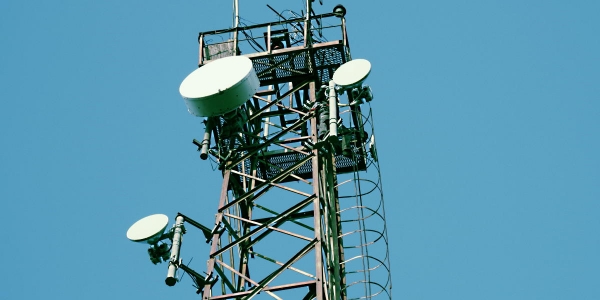
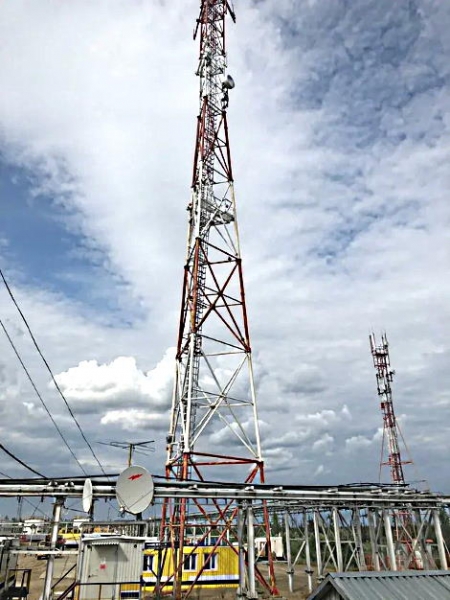
In addition to the extra cables on the bottom of the Yenisei, the route was supplemented by a wireless microwave link of 1 Gbps from telecommunications towers on both sides of the river, in Igarka and the village of Priluki (this radio channel can be seen in the top photo — the large dish). But what is 1 Gbps for ensuring the entire Norilsk industrial area in the event of optical damage… — just tears. Therefore, in the autumn-winter period of 2018-2019, the Norilsk operator 'Edinstvo', part of PAO 'GMK Norilsk Nickel', began project work on constructing a wireless channel across the Yenisei with a capacity comparable to the FOTS.
To the surprise of the specialists at "Unity," none of the global telecommunications brands accepted the proposals for supplying equipment for a 40-gigabit wireless channel over a distance of 11 km. The issue lies in the complex combination of high channel capacity and distance. Modern serial equipment, with a capacity of 10 Gbps or more in the 70/80 GHz range, has the characteristic of very limited range. This is due to the fact that with complex coding schemes like QAM128 or QAM256—only they can provide a bandwidth of 10 Gbps and more—it is challenging to ensure any significant transmitter power. Distances of 3-5 km are manageable, but at 11 km, the signal attenuation becomes excessively high, making it impossible to establish a connection at the 10GE standard.
A domestic developer from St. Petersburg took up the challenge— . They already had developments for radio bridges that could achieve the required distance. Prior to this project, they tested a 40 Gbps channel using 4 working together radio bridges of 10 Gbps each on their 4 km test site and were confident that such capacity was achievable. However, in practice, no one in the telecommunications industry had ever attempted to deploy 4 parallel working radio bridges of 10 Gbps each over a distance of 11 km.
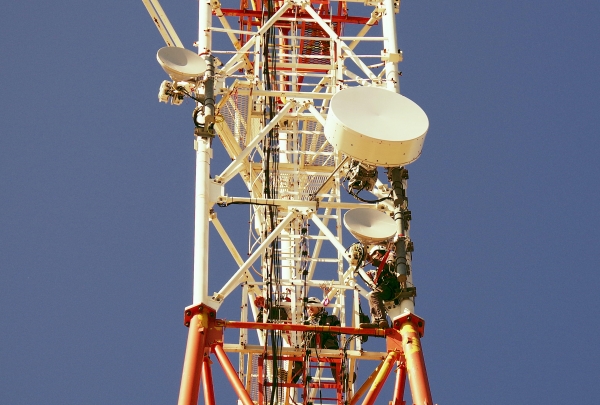
After receiving rejections from global brands, the client, LLC "Unity," was also skeptical about whether domestic equipment would handle the project. Therefore, it was decided to initially deploy just one 10 Gbps radio bridge over 11 km as a pilot stage. If it performed well, the task would then be scaled up to 4 parallel working radio bridges.
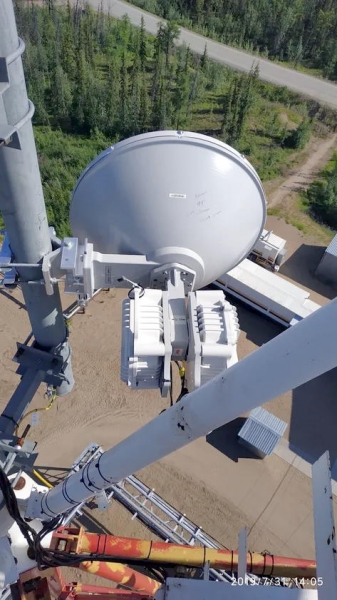
From a technical standpoint, it is not necessary to transmit 40 Gbps in one channel, whether over the air or through optical cable. It is much simpler to transmit data through several parallel "threads" of 10 Gbps. Networking equipment of the 10GE standard is cheaper and more accessible than 40GE standard switches. Additionally, parallel "threads" provide greater reliability for the entire channel.
However, there was a problem in that, unlike optical cables where signals in parallel fibers do not interfere with each other, radio channels experience mutual interference, potentially leading to complete communication failure. This is addressed by applying different signal polarizations and separating signals by frequency. However, it is easier said than done when it comes to implementation in hardware. The engineers from Peter designed the circuitry on large MMICs (Monolithic Microwave Integrated Circuits) based on gallium arsenide and were confident in their engineering solution.
“Modern radio bridges of the 10GE standard are being manufactured globally using purchased microwave chips. In this sector, it is inefficient to conduct vertically integrated development where all processes are done within a single company—from the deposition of microwave chips to assembly of components into a final product. It is somewhat similar to how many companies produce computer boards based on chips from Intel and AMD. However, unlike mass-produced PC boards, configuring microwave chips, amplifying signals, and transmitting them to antennas require specific expertise, which is essentially the know-how of the companies,” commented Valery Salomatov, project manager at LLC 'DOC'.
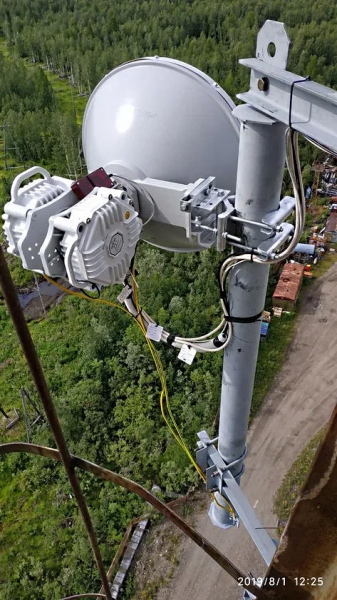
The pilot radio bridge of the 10 Gbit/s model PPC-10G-E-HP successfully operated on the towers along the banks of the Yenisei for a couple of months (May-June 2019). Summer rains pose the greatest challenge for millimeter-wave radio communication since raindrops are comparable to the wavelength (about 4 mm), leading to signal attenuation. This issue does not occur in winter, as snowflakes, like fog and smoke, are radio transparent for wireless communication in the 70/80 GHz range.
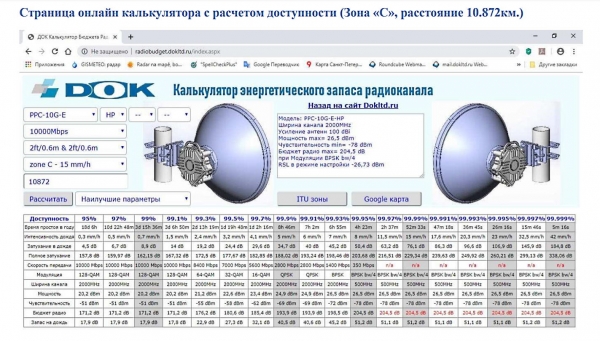
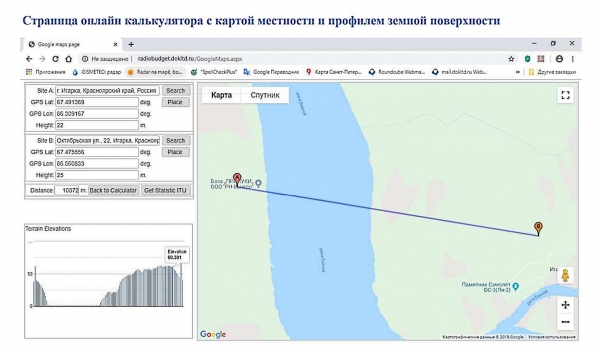
The 10 Gbit/s radio bridge from LLC 'DOC' handled the weather conditions and distance well, after which, based on the statistics of link availability, the operator 'Yedinstvo' decided to scale to four parallel wireless channels, each with a capacity of 10GE. The installation was carried out by specialists from the 'Yedinstvo' company, who independently figured out the intricacies of the setup using the equipment manuals. By the end of July 2019, the radio bridge
40 Gbit/s (4x 10 Gbit/s) across the Yenisei was put into industrial operation in the presence of the chief installation team from 'DOC'.
Source: habr.com
