

In this article, I propose an excursion into sociobiology and discuss the evolutionary origins of altruism, kin selection, and aggression. We will briefly (yet with references) review the results of sociological studies and neuroimaging research that show how the recognition of relatives among humans can influence sexual behavior and promote cooperation, while on the other hand, the recognition of members of an outsider social group may enhance the display of fear and aggression. We will then recall historical examples of manipulation of these mechanisms and touch upon the topic of dehumanization. Lastly, we will discuss why research in this field is critically important for the future of humanity.
Contents:
1. Amoebas as heroes and bees as volunteers — examples of altruism in nature.
2. Self-sacrifice by calculation — the theory of kin selection and Hamilton's rule.
3. Brotherly love and disgust — Taiwanese marriages and Jewish kibbutzim.
4. Almond of discord — neuroimaging of racial prejudice.
5. False kinship — real cooperation — Tibetan monks and migrant workers.
6. Non-humans. Dehumanization — propaganda, empathy, and aggression.
7. What’s next? — in conclusion, why all this is very important.
The word “brother” in the Russian language is used not only to refer to biological relatives but also to denote members of a group with close social ties. Thus, the cognate word “brotherhood” signifies a community of people with shared interests, views, and beliefs [1][2]. The English equivalent of the Russian fraternity — “brotherhood” likewise shares a root with the word “brotherbrother” — similar to French, where fraternity is “fraternité”, brother is “frère”, and even in Indonesian, “persaudaraan”. Could this universal pattern indicate that there are direct biological roots to such a social phenomenon as “brotherhood”? I suggest we delve a little deeper into the topic and see how an evolutionary-biological approach can provide a deeper understanding of social phenomena.ru.wiktionary.org/wiki/братствоwww.ozhegov.org/words/2217.shtml» — «ru.wiktionary.org/wiki/братствоdictionary.cambridge.org/dictionary/english/brotherhood?q=Brotherhood
[1]
[2]
[3]
Amoebas as heroes and bees as volunteers
Family relationships typically involve a higher level of altruism. Altruism, characterized by self-sacrifice and the willingness to set aside one's own interests for the benefit of others, is indeed one of the most remarkable human qualities, or is it only human?
It turns out that animals are also quite capable of displaying altruism, including many insects living in colonies[4]. Some monkeys give alarm calls to their kin when they see predators, thus putting themselves in danger. In bee colonies, there are individuals that do not reproduce themselves but spend their entire lives caring for others' offspring [5] [6], and amoebas of the species Dictyostelium discoideum, when faced with adverse conditions for the colony, sacrifice themselves by forming a stalk on which their relatives can elevate themselves above the surface and have the opportunity to disperse as spores into a more favorable environment [7].
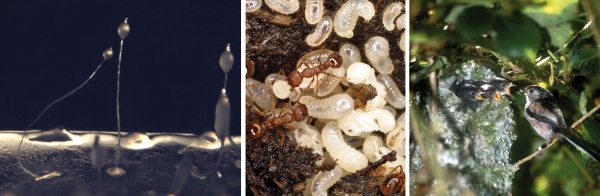
Examples of altruism in the animal world. Left: Fruiting body of the slime mold Dictyostelium discoideum (photo by Owen Gilbert). Center: Brood tending in the ant Myrmica scabrinodis (photo by David Nash). Right: Parental care in long-tailed tits (photo by Andrew MacColl). Source:[6]
[4]
[5]
[6] (06)01695-2
[7]
Calculated self-sacrifice
Alright primates, but self-sacrifice in insects and single-celled organisms? Something doesn’t seem right! — a Darwinian of the early 20th century would exclaim. After all, by risking themselves for another, an individual reduces its chances of producing offspring, and according to classical selection theory, such behavior should not be favored.
All this caused serious concern among proponents of Darwinian natural selection, until in 1932, John Haldane – an emerging superstar of evolutionary biology, noted that altruism could be solidified if it was directed towards relatives, formulating this principle into a subsequently famous phrase [8]:
“I would give my life for two relatives or eight cousins.”
Indicating that full siblings are genetically 50% identical, while cousins are only 12.5%. Thus, thanks to Haldane's work, the foundation for a new "synthetic theory of evolution" began to be laid, where the main actor is no longer an individual organism, but genes and populations.
Indeed, if the ultimate goal of an organism is to spread its genes, there is a rationale for increasing the reproductive chances of those individuals who share more genes with you. Based on this data and inspired by statistics, William Hamilton formulated a principle in 1964 that later became known as Hamilton's rule, which states that altruistic behavior between individuals is only possible when the ratio of their shared genes, multiplied by the increased likelihood of gene transmission for the individual receiving altruism, is greater than the increased risk of not transmitting one's genes for the individual performing the act of altruism, which can be simply expressed as:

Where:
r (relatedness) — the share of shared genes between individuals, e.g., for full siblings ½,
B (benefit) — the increased probability of the second individual's reproduction in the case of the first individual's altruism,
C (cost) — the decreased probability of the individual performing the altruistic act's reproduction.
And this model has been repeatedly confirmed by observations. For example, in a study conducted by biologists from Canada, over 19 years they tracked a population of red squirrels (a total of about 54,785 individuals in 2,230 litters) and recorded all instances where squirrels feeding their offspring adopted orphaned squirrels whose mothers had died.
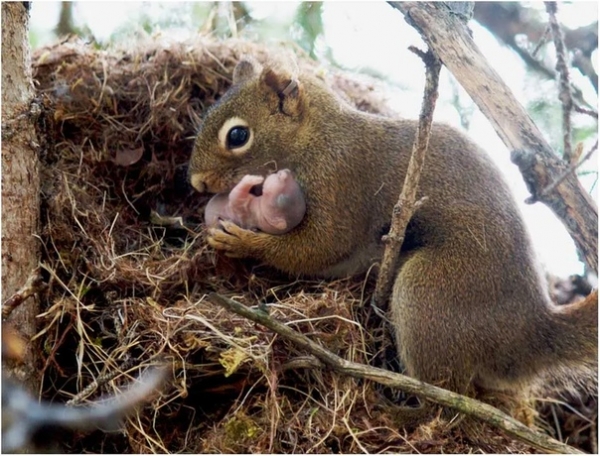
A female red squirrel prepares to move a newborn between nests. Source [12]
For each case, the degree of relatedness and the risk for the donor's offspring were calculated, and after compiling a table with these data, the researchers found that Hamilton's rule was upheld to three decimal places.
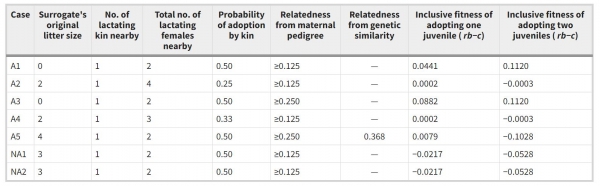
Rows A1 to A5 correspond to cases where female squirrels adopted чужих children; rows NA1 and NA2 correspond to cases where adoptions did not occur. The column "Inclusive fitness of adopting one juvenile" gives the calculation according to Hamilton's formula for each case. Source [12]
[8]
[9]http://www.uvm.edu/pdodds/files/papers/others/1964/hamilton1964a.pdf
[10]
[11]
[12]
As can be seen, recognizing relatives is an important factor in selection, and this is confirmed by the great diversity of mechanisms for such recognition. Understanding who you share more genes with is crucial not only for determining with whom it is more beneficial to exhibit altruism but also to avoid sexual contact with closely related individuals (inbreeding), as offspring from such unions tend to be weaker. For instance, it has been confirmed that animals can recognize relatives by scent[13], through the major histocompatibility complex[14], birds by their songs[15], and primates can even identify their relatives by facial features, even those they have never encountered[16].
[13]
[14]
[15]
[16]
Brotherly Love and Aversion
For humans, it is even more interesting and complex. A research group from the School of Psychology at the University of Aberdeen published intriguing findings in 2010 from a study[17] on how 156 women aged 17 to 35 evaluated photographs of various men's faces. In addition to ordinary photos of random people, the researchers secretly included images of faces artificially created from photos of the participants themselves, as if they were their biological brothers, meaning with a 50% similarity.
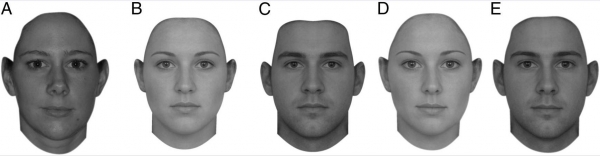
Examples of constructing self-similar faces from the study. A 50% similarity of the artificial face was used, as if it were a biological brother or sister of the participant Source [17].
The study's results showed that women more often rated self-similar faces as trustworthy, yet at the same time, as less sexually attractive. Among these, women who had real brothers or sisters were least attracted to similar faces. This suggests that the perception of kinship in humans, just like in animals, can both stimulate cooperation and help avoid inbreeding.
There is also evidence that non-relatives can begin to perceive each other as relatives under certain conditions. In the early 19th century, Finnish sociologist Edward Westermarck studied human sexual behavior and suggested that the mechanism for identifying relatives might work based on the principle of imprinting. In other words, people will perceive each other as relatives and feel repulsion towards the idea of having sex together, provided that they spent a significant amount of time in close contact during the early stages of life, such as being raised together [18][19].
Let’s look at some of the most striking examples of observations that support the imprinting hypothesis. In the early 20th century, kibbutzim— agricultural communes comprising several hundred people— became popular in Israel. Along with the rejection of private ownership and equality in consumption, children in such communities were raised together from a very young age, allowing adults to devote more time to work. Statistics from over 2,700 marriages of people raised in these kibbutzim showed that marriages were virtually non-existent among those who were raised in the same group during the first six years of life [20].
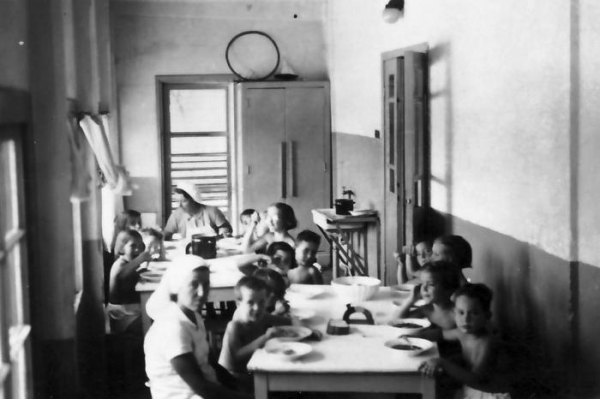
A group of children in Kibbutz Gan-Shmuel, around 1935-40. Source
Similar patterns were observed in Taiwan, where until recently, there was a practice of Sim-pua marriages (translated as "little bride"), where the bride was adopted at the age of 4 by the family of the newly born groom, after which the future spouses were raised together. Statistics from such marriages showed that infidelity occurred 20% more often, divorces happened three times more frequently, and such marriages accounted for a quarter fewer births [21].
[17]
[18]
[19]
[20] Incest. A biosocial view. By J. Shepher. New York: Academic Press. 1983.
[21]
The Almond of Discord
It would be logical to assume the evolutionary usefulness of mechanisms that identify not only 'one's own' but also 'others'. Just as kinship recognition plays an important role in cooperation and altruism, identifying outsiders is crucial for the expression of fear and aggression. To better understand these mechanisms, we need to delve into the fascinating world of neuropsychological research.
There is a small but very important paired structure in our brain—the amygdala, which plays a key role in emotions, especially negative ones, in remembering emotional experiences, and in triggering aggressive behavior.
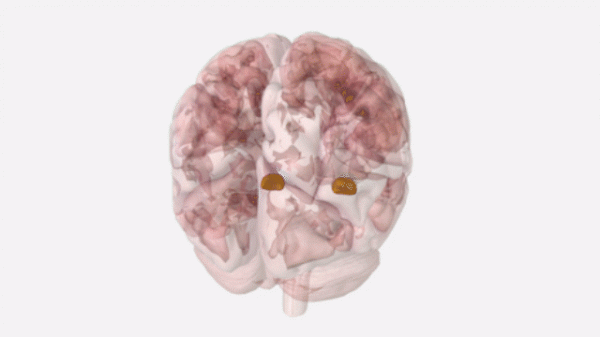
The location of the amygdalae in the brain, highlighted in yellow, source
The activity of the amygdala is highest when making emotional decisions and actions in stressful situations. When activated, the amygdala suppresses the activity of the prefrontal cortex [22]—our center for planning and self-control. It has been shown that individuals whose prefrontal cortex is better at suppressing amygdala activity may be less prone to stress and post-traumatic disorder [23].
A 2017 experiment involving individuals who had committed violent crimes showed that during a specially designed game, provocations from opponents in the game more frequently elicited aggressive responses from those who had committed violent crimes, with the activity of their amygdalae, measured using fMRI, being significantly higher than that of the control group [24].
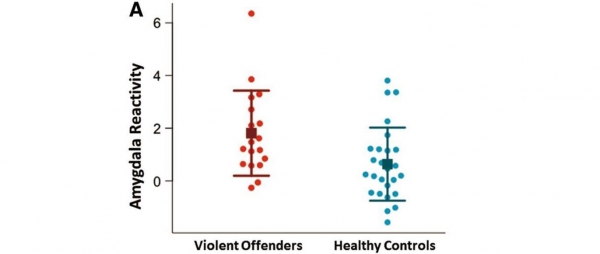
‘Amygdala reactivity’—signal values extracted from the left and right amygdalae of the subjects. Violent offenders (red dots) exhibit higher amygdala reactivity to provocations (P = 0.02). [24]
A classic study showed that amygdala activity increased when viewing photos of faces from another race and correlated with results from the Implicit Association Test regarding racial bias [25]. Further exploration of this topic revealed that the activation effect for faces of another race intensified when the image was presented in a subliminal perception mode for about 30 milliseconds. This means that even when a person did not have time to consciously recognize what they saw, their amygdala was already signaling danger [26].
A reverse effect was observed in cases where, in addition to the image of a person's face, information about their personal qualities was presented. Researchers placed participants in an fMRI machine and monitored brain activity while performing two types of tasks. Participants were shown visual stimuli in the form of random faces of European and African descent and asked to respond to questions about the person, such as whether they were friendly, lazy, or forgiving. Along with the photograph, additional information was provided, with the first case being unrelated to the person's character, while in the second, data about the person was included, such as whether they grew vegetables in their garden or left clothing in the washing machine.
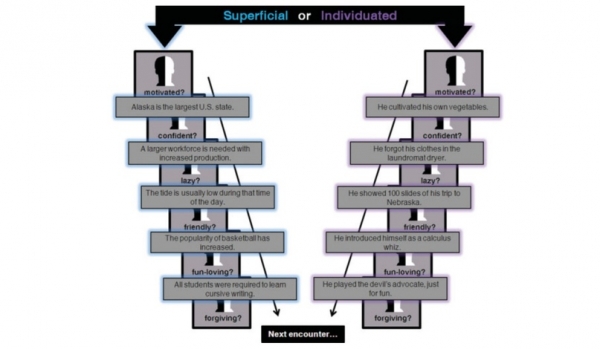
Examples of tasks that participants in the study addressed. For 3 seconds, participants made personality judgments indicating 'yes' or 'no' based on the image of a person's face (either a white or black man) and an informational segment under the image. In cases of 'superficial' judgments, the informational segments were not personifying. In the 'personality' judgment model, the information was personalized and described unique properties and qualities of the target. Thus, participants were either given the opportunity to individualize the image of the face or not. Source [27]
Results showed increased amygdala activity during responses requiring superficial judgments, meaning when information unrelated to personality was presented. In contrast, during personality judgments, amygdala activity was lower, and areas of the cerebral cortex responsible for modeling the personality of another person were activated [27].
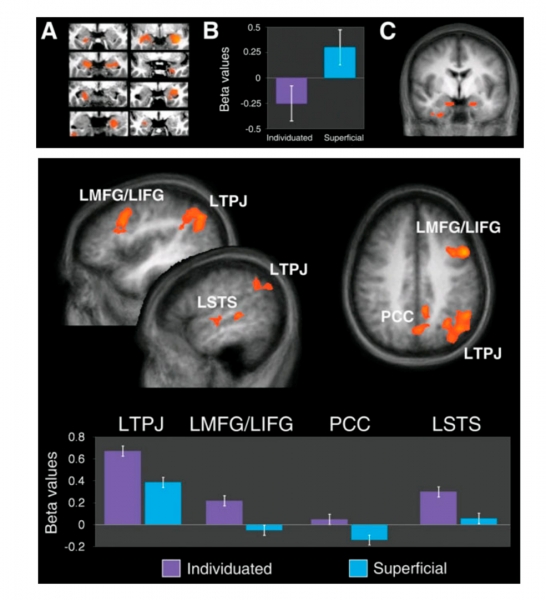
At the top (B), the average activity values of the amygdala are represented by the blue bar, corresponding to surface judgments, while the purple one corresponds to individual assessments. Below is the diagram of the activity in brain areas related to personality modeling when performing similar tasks [27].
Fortunately, the biased reaction to skin color is not innate and depends on the social environment and the context in which personality is formed. This was supported by research examining amygdala activation in response to images of faces from different races in 32 children aged 4 to 16. It was found that children's amygdalae do not respond to faces of different races until approximately puberty, and that the amygdala's response to faces of different races was weaker if the child was raised in a racially diverse environment [28].
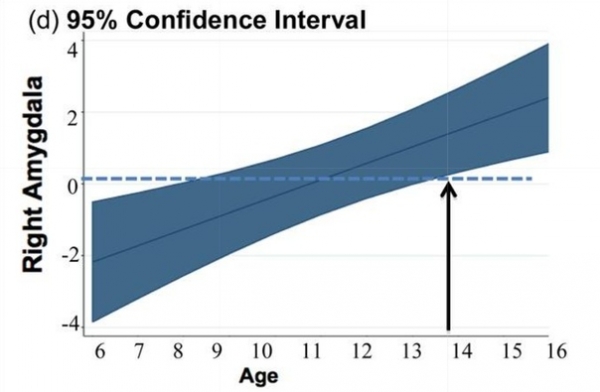
Amygdala activity in response to faces of different races depending on age. Source: [28]
In summary, our brain, shaped by childhood experiences and environment, can learn to recognize "dangerous" traits in people's appearances, subsequently subconsciously influencing our perceptions and behavior. Thus, if shaped in an environment where Black people are viewed as dangerous outsiders, your amygdala will send an alarm signal upon seeing a person with dark skin, even before you have a chance to logically assess the situation and judge the individual's qualities. In many cases, such as when a split-second decision is required or in the absence of other data, this can be critically important.
[22]
[23]
[24]
[25]
[26]https://www.ncbi.nlm.nih.gov/pubmed/15563325/
[27]
[28]
False kinship — real collaboration
On one hand, we (humans) have mechanisms to recognize relatives, which can be trained to activate not just for relatives; on the other hand, there are mechanisms to identify dangerous traits in a person, which can also be adjusted accordingly and typically are triggered more often by members of external social groups. The benefits here are clear: communities with higher cooperation among their members have advantages over more fragmented ones, and increased aggression towards external groups can aid in the competitive struggle for resources.
The strengthening of cooperation and altruism within a group is possible when its members perceive each other as greater relatives than they actually are. Apparently, even the simple act of addressing community members as 'brothers and sisters' can create a sense of pseudo-kinship — this can be seen in numerous religious communities and sects.
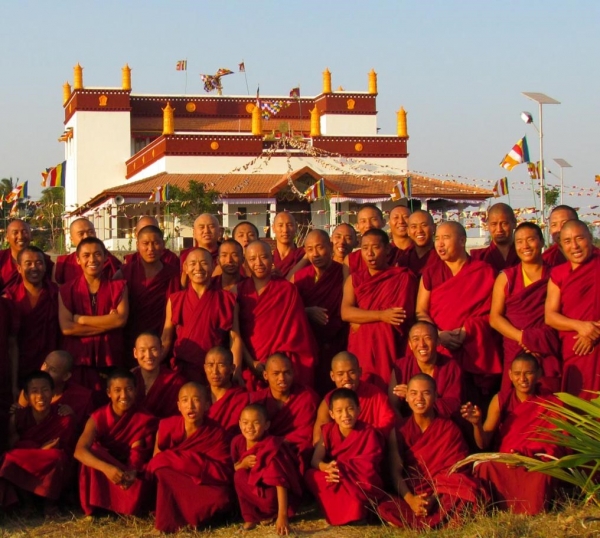
Monks from one of the main Tibetan monasteries, Rato Dratsang. Source:
Instances of forming pseudo-kinship ties as a beneficial adaptation within ethnic groups of emigrants working in Korean restaurants have also been documented; thus, a work collective, becoming a pseudo-family, gains advantages in terms of increased mutual assistance and cooperation.
It's no surprise that this is how Stalin addressed the citizens of the USSR in his speech on July 3, 1941, calling for them to go to war against the German troops.
[29]https://journals.sagepub.com/doi/abs/10.1177/1466138109347000
[30]https://topwar.ru/143885-bratya-i-sestry-obraschenie-iosifa-stalina-k-sovetskomu-narodu-3-iyulya-1941-goda.html
Inhuman cruelty
Human communities are distinguished from animals and other primates by a greater predisposition towards cooperation, acts of altruism, and empathy, which can serve as a barrier to the manifestation of aggression. The removal of such barriers can enhance aggressive behavior; one way to remove barriers is through dehumanization, as perceiving the victim not as a human can eliminate empathy.
Neuroimaging shows that when viewing photographs of representatives of 'extreme' social groups, such as the homeless or drug addicts, the areas of the brain responsible for social perception do not activate, and this can create a vicious cycle for people at the 'social bottom,' as the lower they sink, the less willing others will be to help them.
A research group from Stanford published a study in 2017 with data showing that dehumanization of the victim increased aggression in situations where there was a financial incentive involved. However, on the other hand, when aggression was committed based on moral criteria, such as punishment for a crime, detailing the victim's personal characteristics could actually increase approval of the aggression.
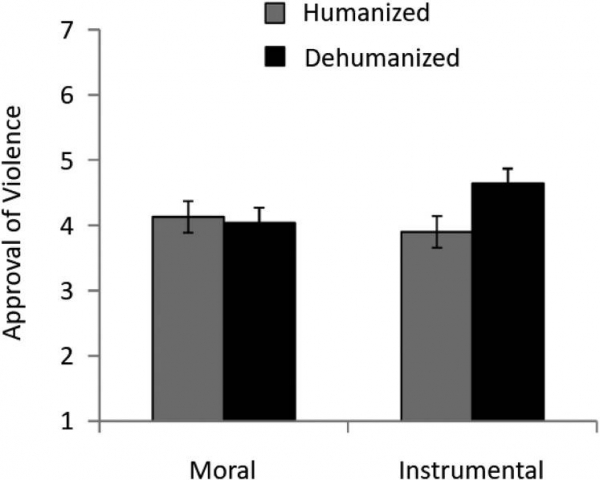
The average willingness of subjects to harm another person depending on the motive, with moral motives on the left and gain motives on the right. Black bars correspond to dehumanized descriptions of the victim, while gray bars represent humanized descriptions.
There are numerous historical examples of dehumanization. Almost every armed conflict involves propaganda using this classic technique. For example, propaganda from the early to mid-20th century during the civil and second world wars in Russia clearly demonstrates a pattern of creating an image of the enemy with characteristics of a dangerous animal, complete with claws and sharp fangs, or direct comparisons to animals that provoke dislike, such as spiders. This serves on one hand to justify the use of violence, and on the other hand to reduce the aggressor's level of empathy.
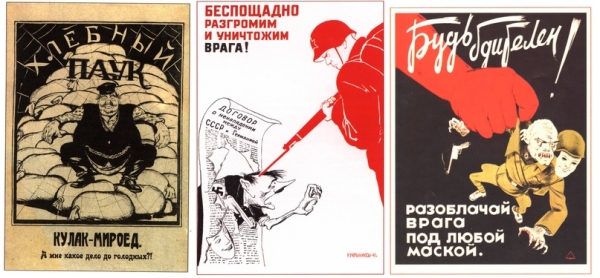
Examples of Soviet propaganda posters using dehumanization techniques. Source:
[31]
[32]
[33]https://www.pnas.org/content/114/32/8511
What's next?
Humans are an exclusively social biological species, forming complex interactions both within and between groups. We possess an extraordinarily high level of empathy and altruism and can learn to perceive completely foreign individuals as close relatives, empathizing with their suffering as if it were our own.
On the other hand, we are capable of extreme cruelty, mass murder, and genocide, and we can just as easily learn to perceive our kin as dangerous animals and exterminate them without moral contradictions.
Balancing between these two extremes, our civilization has repeatedly gone through both flourishing periods and dark times, and with the invention of nuclear weapons, we have come closer than ever to the brink of total mutual destruction.
Although this danger is now perceived more commonly than during the height of the superpower confrontation between the USA and the USSR, the catastrophe remains just as real, as confirmed by the assessment of the "Doomsday Clock" initiative, where leading world scientists evaluate the likelihood of global catastrophe in terms of time until midnight. Since 1991, the clock has been steadily approaching the fateful mark, reaching its maximum in 2018 and still showing "two minutes to midnight" [34].
[34]
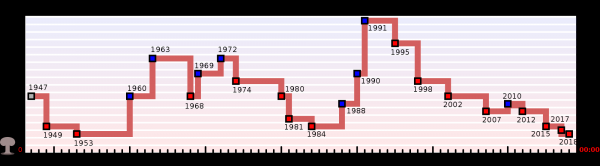
The fluctuations of the minute hand of the "Doomsday Clock" project as a result of various historical events, more details of which can be found on the Wikipedia page:
The development of science and technology inevitably creates crises, for which new knowledge and technologies are required, and it seems we have no other path to development except the path of knowledge. We live in an amazing time on the brink of breakthroughs in technologies such as quantum computers, thermonuclear energy, and artificial intelligence – technologies that can elevate humanity to a completely new level, and the critical issue will be how we utilize these new opportunities.
In this light, it is difficult to overstate the importance of researching the nature of aggression and cooperation, as they can provide crucial insights in the search for answers to the critical questions for the future of humanity – how we can tame our aggression and learn to cooperate on a global scale to expand the notion of "us" to the entire population, not just to specific groups.
Thank you for your attention!
This review was written under the impression and largely using materials from the lectures on 'Human Behavior Biology' by American neuroendocrinologist Professor Robert Sapolsky, which he delivered at Stanford University in 2010. The complete lecture series has been translated into English by the Vert Dider project and is available on their YouTube channel. .
For a deeper dive into the topic, I recommend reviewing the recommended reading list for this course, which is conveniently organized by topic: docs.google.com/document/d/1LW9CCHIlOGfZyIpowCvGD-lIfMFm7QkIuwqpKuSemCc
Source: habr.com
