

— the genetic code of a part"
L.I. Volkov, Head of 4th Central Research Institute of the Ministry of Defense
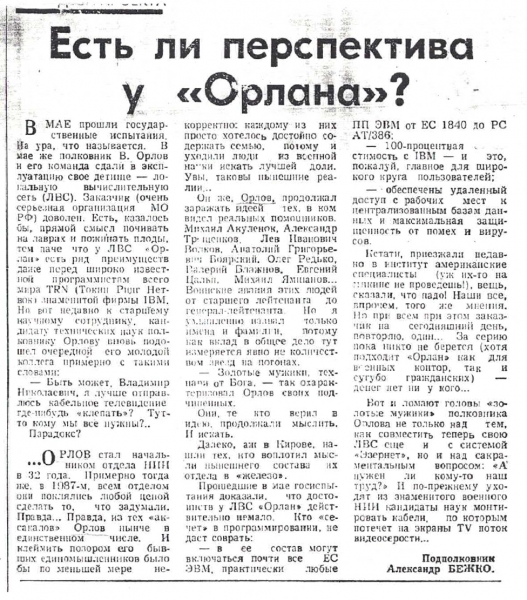
The title of the article combines the headlines of two publications that appeared in the distant 1994 in the newspapers "Moscow Warrior" and "Red Star". The basis of the publications was an interview conducted by military correspondent Colonel Alexander Bezhko.
And these two publications caught my eye:
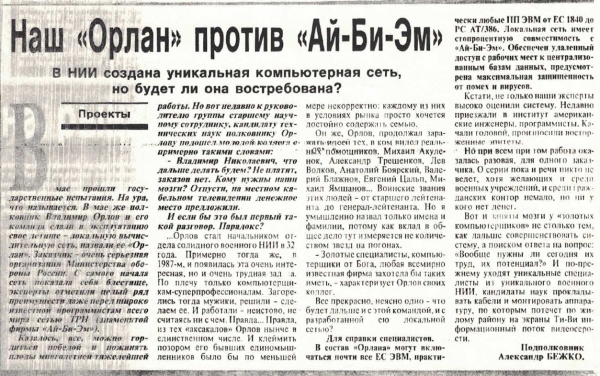
The second publication also has a subtitle "A unique computer network has been created at the Research Institute, but will it be in demand?":
And it seems to me that this subtitle intersects with the events of today, with the noise surrounding .
This project was born as our response to the American SDI (Strategic Defense Initiative) and was called Anti-SDI. The work was overseen at the highest level. This is clearly visible in the following photo:
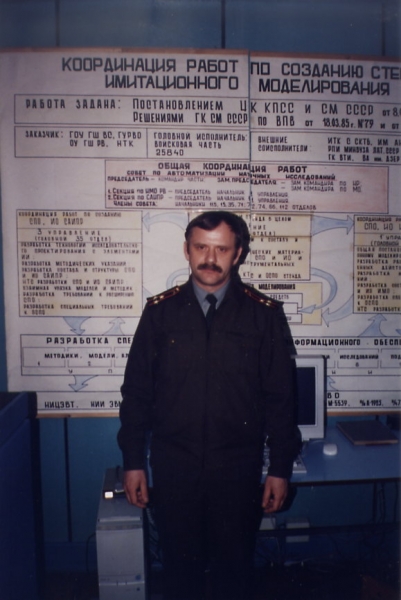
When we started this work, nothing foreshadowed the outcome described in this interview. The challenges we faced and the project itself can be .
Of course, some may find reason to laugh at the terminology present in these publications, but that is not the main point. The main thing is for it to resonate as a warning today, so that we do not keep stepping on the same rake.
I was considering whether to include the full text of the publication and still decided to do so (since the screenshots are not quite quality). Remember, it was 1994!
Our "Orlan" against "IBM"
A unique computer network has been created at the Research Institute, but will it be in demand?
In May, state tests were successfully completed. As they say, with flying colors. In May, Colonel Vladimir Orlov and his team commissioned their creation – a local computing network, named "Orlan". The customer is a very serious organization of the Ministry of Defense of Russia. From the very beginning, the network demonstrated outstanding performance, experts noted a number of advantages even over the well-known TRN network (by the famous company "IBM").
It seemed everything was in place, we could be proud of our victory and reap the benefits of many years of hard work. But recently, a young man approached the group leader, Senior Researcher, candidate of technical sciences Colonel Orlov with the words:
— Vladimir Nikolaevich, what shall we do next? They aren't paying, there are no orders. Who needs our brains? Let go, I’ve been offered a lucrative spot at the local cable TV station.
And if this were the first such conversation. A paradox?
…Orlov became the head of a solid military research institute at the age of 32. Around that time, in 1987, this very interesting but also very challenging task emerged. Only professional computer scientists could handle it. The men became excited, decided — we will do it. And they worked fervently, disregarding everything else. However… However, among those 'elders,' Orlov is now the only one left. To publicly shame his former like-minded colleagues would be, at the very least, inappropriate: each of them simply wants to provide decently for their family under current market conditions.
Orlov continued to inspire those he considered real helpers. Mikhail Akulenok, Alexander Treshchenkov, Lev Ivanovich Volkov, Anatoly Grigoryevich Boyarsky, Oleg Redko, Valery Blazhnov, Evgeny Tsalp, Mikhail Yashmanov… Their military ranks range from senior lieutenant to lieutenant general. But I intentionally mentioned only their names and surnames because the contribution to the common cause here is clearly not measured by the number of stars on the epaulettes.
— Golden specialists, computer scientists from God, any world-renowned company would want to have such people, — Orlov characterizes his colleagues.
Everything is fine, but one thing is unclear — what will happen next with this team and the local network they developed?
For the reference of specialists.
The composition of “Orlan” can include almost all ES computers, practically any hardware from ES 1840 to PC AT/386. The local network is fully compatible with 'IBM.' Remote access from workstations to centralized databases is ensured, with maximum protection against interference and viruses.
By the way, not only our experts highly praised the system. Recently, American engineers and programmers visited the institute. They shook their heads, uttering enthusiastic epithets.
(My comment, at that time we were disarming).
But despite all this, the work turned out to be a one-time deal for a single client. No one is talking about a series yet, although there are many interested parties among military establishments and civilian companies, but no one has any money.
The minds of the 'golden computer specialists' are not so much occupied with how to further improve the system, but rather with seeking the answer to the question: 'Are their labor and potential even needed today?' Unique specialists from the unique military research institute continue to leave, PhD holders are laying cables and installing equipment that will transmit the flow of video information to the screens in residential areas.
Lieutenant Colonel Alexander Bezhko.
P.S. And our brainchild ultimately . However, it also participated in .
Source: habr.com
