

Almost every developer wonders how they should develop their skills and which growth path to choose: vertical — meaning to become a manager, or horizontal — as a full-stack developer. Years of working on a single product, contrary to myths, become not a limitation, but a valuable opportunity. In this article, we share the experience of our backend developer Alexey, who dedicated 6 years to certifications and progressed to an architect during this time.
Who is an architect
An architect in IT (tech lead) is a high-level developer who deals with global issues in IT projects. They immerse themselves in the client's business processes and help solve their problems with technology, as well as define how a particular information system will be structured.
Such a professional must not only understand individual subject areas but also see the entire process:
- Defining the business task.
- Development, including programming, preparing, storing, and processing data.
- Deployment and infrastructure support.
- Testing.
- Deployment.
- Analytics and operational maintenance.
This means having the ability to put oneself in the place of any specialist or team in the development life cycle, to understand the current state of systems from within, identify mistakes made, and formulate goals. Sometimes — personally conduct operational interventions.
The path of professional development from developer to architect takes a long time — usually several years. For this, a developer needs both practical skills and theoretical knowledge, which can be validated through international certification.
More than 5 years on a single project — routine or an opportunity for growth?
A few years ago, we started working on a large medical IT system for a foreign client. This massive project faced certain challenges:
- limited access;
- unstable production;
- incredibly stretched sprints and lengthy approvals.
"It's time to upgrade my qualifications,"— this decision was made by one of the leading developers, Alexey, to overcome the aforementioned difficulties and better understand the system.
Alexey shared his experience on how to start learning, which certificates are essential to obtain, and how and why to do it.
Step one: improve your English
Programming languages are a fundamental component of development, but languages for communication are equally important, especially in communications with English-speaking clients!
From experience
One fine day, a client-side employee called Alexey. At that time, our developer could not boast a stack of certificates—neither in technologies, management, nor communication. Perhaps they wouldn’t have been useful, as one can be a competent specialist without additional accolades. However, a problem did arise.
It’s important to understand that spoken language is radically different from written language. If you are well-versed in English specifications but do not practice listening and speaking, we have bad news for you. In that case, phone negotiations with partners can lead to a dead end.
During the call, Alexey picked up on some familiar words, but his colleague's speech was so fast and unlike the classic pronunciation from audio lessons that the essence of her questions went right past him. Out of politeness and a desire not to complicate the situation, Alexey quickly agreed to all proposals.
Needless to say, unpleasant discoveries were made during the work process? Our developer signed up for something he would have consciously declined had the offer been made in a language he understood.
At that moment, it became clear that improving listening and speaking skills was absolutely necessary. The best way to do this was through certifications.
English Language Certification
To enhance communications within our medical project, Alexey studied through several programs at once. As a result, he passed the FCE — First Certificate in English. This helped him start understanding the client and conveying his thoughts to him.
Life hack:
Avoid basic English training programs. The skill should be targeted. If business communication in English is required—that's what you should focus on. Just don’t go to extremes and attempt to pass the CAE (Certificate in Advanced English). Its characteristic feature is sophisticated words and specific expressions that are hardly ever used in international communications.

Step Two: Certification Across the Entire Technology Stack
Initially, the project's foundation was built on Object-Relational Mapping (ORM) technology. The client's development team took great pride in their creation, as everything was done using advanced concepts, making it complex and impressive.
However, issues in production — particularly a constantly hanging SQL server — were common. It reached a point where the typical solution was to restart the service. The client would call the team lead and inform them that it was time to restart. Finally, we decided to put an end to this.
The client wished to improve system performance — for this, it was necessary to implement profiling and conduct regular optimizations. The profiling tool chosen at that time — around 2015 — was Ants Profiler, but it performed poorly. With low granularity, it was difficult to obtain information about the critical block of code. At maximum granularity, Ants Profiler began altering the code in ways that threatened system functionality — where profiling was set up, everything simply crashed. Therefore, we changed our approach.
We started by analyzing the statistics.
Upon analyzing the production statistics, it became clear that 95% of the operations on the server had primitive business logic condensed into four lines. They were sufficient with just one SQL query, rather than a full set of queries generated by the business logic block using ORM.
Alexey proposed and implemented a stored procedure for moving operations without ORM. The idea went against the project's conventional paradigm, and the team lead met it with caution, but the client accepted it and requested implementation. This was not surprising, as the new method allowed reducing processing delays in production from four hours to just a few minutes — on average, by 98 times.
And yet, we still had doubts: was this the right decision or merely a matter of personal preference? Faith in the omnipotent C# and ORM was shaken by an incident that revealed the strength of simple solutions.
Case Two
The team wrote a query for data handling within the ORM paradigm, composed according to all the rules, without errors. Its processing took 2-3 minutes, and these parameters seemed acceptable. However, an alternative implementation using simple selects and views provided a result faster — in 2 seconds.
It has become clear that it's time to choose a specialist who will undergo certification across the entire project stack to understand all the nuances and select the optimal method. Alexey took on this task.
First Certificates
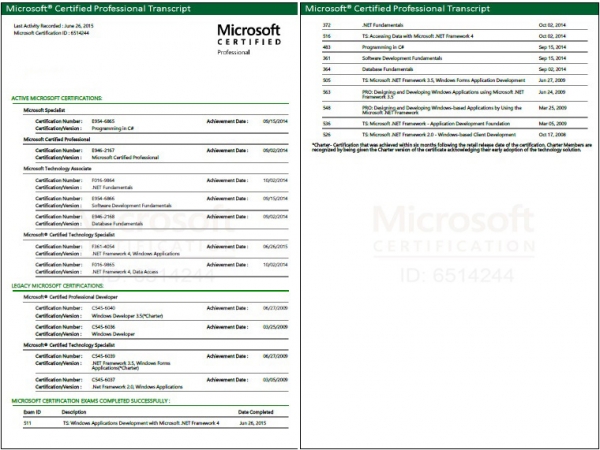
To grasp the essence, Alexey completed , covering the entire technology stack of the project:
- TS: Windows Applications Development with Microsoft .NET Framework 4
- TS: Accessing Data with Microsoft .NET Framework 4 Programming in C#
- TS: Microsoft .NET Framework 3.5 Windows Forms Application Development
- PRO: Designing and Developing Windows Applications using Microsoft .NET Framework 3.5
- PRO: Designing and Developing Windows-based Applications by Using the Microsoft .NET Framework
- TS: Microsoft .NET Framework 2.0 — Windows-based Client Development
In an effort to optimize work on the new project, the team came to the following conclusions:
- For systems to function effectively, it is essential to adhere to coding standards: not just indentation and comments, but technical specifications — the number of database queries, server load, and much more.
- The application of contradictory concepts can lead to complications. The database concept is the theory of sets, while ORM is an operations concept.
- Ideas that disrupt the usual order may meet resistance within the team. Development is also about relationships and the ability to articulate one's viewpoint.
- Certification broadens one's perspective and helps understand what can and cannot be used.
Step Three: Study Beyond Code
When working on large-scale IT solutions, many factors are important. For instance, not every developer pays attention to network parameters — yet even bandwidth can affect solving business problems.
Understanding this comes from Series 98 certifications:
They allow for a wider view of things and help step outside the limited concept of 'code only.' These are Fundamentals, basic principles, but they are essential for understanding everything on a deeper level.
The Series 98 certifications are small tests — 30 questions in 45 minutes.
Step Four: Process Management
Working with clinics is a more responsible endeavor than, for example, creating a mobile game. You cannot simply add a feature and deploy it to production — it is crucial to follow the approval process and incorporate numerous revisions from the client, as the health and lives of people are at stake.
The typical Agile approach did not yield the desired results for this project, and each sprint lasted quite a long time. Between deployments, it took from 6 months to a year.
Moreover, it was technically impossible to bring the processes of the ten serviced clinics to any common denominator.
To achieve results more swiftly in these conditions, the developers required personal responsibility and a broad vision of processes — which meant constant focus and high qualifications.
When a specialist is immersed in the process, they see results, causes, and effects clearly, as well as the overall picture. This is both a factor of additional motivation and awareness, enhancing problem-solving abilities.
With a well-structured infrastructure, thoughtfully designed architecture, and optimal code, one person can take on many processes. However, this does not mean we should cultivate universal soldiers who can single-handedly manage a project. Communication and teamwork are critically important.
In a team, every developer understands that their colleagues depend on their actions. Saving 5 minutes during development may lead to 5 additional hours of testing. For this understanding, it is crucial to establish communication.
In our project, Alexey was supported in mastering processes by :
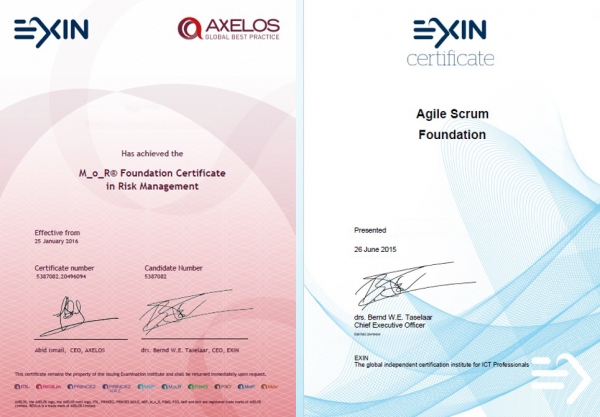
- M_o_R Foundation Certificate in Risk Management
- Agile Scrum Foundation
- IT Service Management Foundation
- EXIN Business Information Management Foundation
- PRINCE2 Foundation Certificate in Project Management
- Test Engineer Certificate
- Microsoft Operations Framework Foundation
- Agile Service Projects
Courses taken on edX helped to view the system from the perspective of statistics and lean programming, later prompting the pursuit of a architect certificate:
- Lean Production
- Six Sigma: Analyze, Improve, Control
- Six Sigma: Define and Measure
According to the principle of Six Sigma, statistical control ensures quality results with an extremely high probability.
As developers enhance their skills, they typically draw the following conclusions:
- Work not more, but more effectively.
- Do not complicate life in the pursuit of the outside: advanced technologies do not necessarily solve problems better.
- Collaborate with specialists at all stages of the cycle and identify their pain points. The architect must master the processes of problem identification, task definition, network topology design, development, testing, support, and operation.
- Test every feature from start to finish.
- Sometimes, IT processes do not align with business processes, and this needs to be addressed.
Step five: understand architecture through the lens of Big Data.
On the project, we dealt with quite large databases. At least, that was the perception until a certain point. When Alexey began exploring big data on edX, it turned out that 1.5 Tb in a project is a small database. Serious scales require at least 10 Tb, and different methods are necessary.
The next step towards certification was a course on big data. It helped understand the organization of data flow and accelerated operations in production. It also focused on smaller tools, such as starting to use Excel for solving specific micro-tasks.
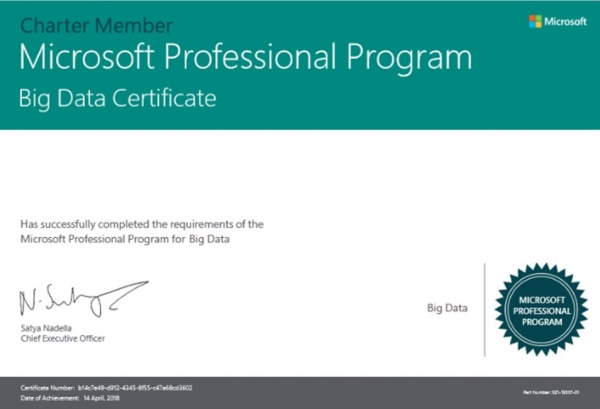
Certificate:
Microsoft Professional Program: Big Data Certificate
Step six: from developer to architect.
After obtaining all the certifications listed, while still a developer, Alexey began to realize that the acquired information has a high level of abstraction, which is not necessarily a bad thing.
A broad vision of processes leads to the architect level, one of the highest levels of certification.
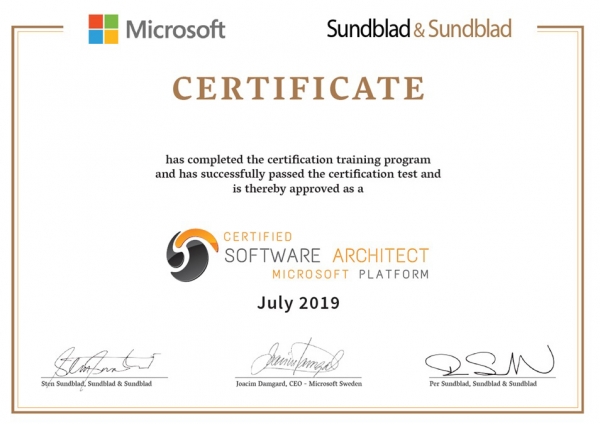
In search of architect certification, Alexey came across from Sundblad & Sundblad. This is a Microsoft-recognized program that began development 14 years ago in collaboration with the company's headquarters and its Swedish office. It covers .NET Framework, requirements gathering, information flow management, and many other high-level issues, and is considered a solid confirmation of an architect's skills.
The program included courses for study. The certification systematized knowledge and allowed for a new level of development — from developer to architect.
In summary
As Alexey notes, in the process of working with a large IT system, it is important to remember that programming is not an expensive pastime, but a tool for solving business tasks. When facing challenges, it is essential to outline the business value so that the project does not reach a dead end.
An architect has a unique perspective on programming and its fundamental components:
- Creating and/or supporting a data flow
- Extracting an information stream based on the data flow
- Extracting a value stream based on the information stream
- Monetizing the value stream
When looking at the project from an architect's perspective, you should start from the end: define the value and then move towards it through the data flow.
The architect adheres to development rules while maintaining a global vision of the project. Achieving this through practice and personal mistakes is almost impossible — more precisely, it is possible, but very slow. Certification allows for a broader perspective and a look at the complete context of each issue, gaining insights from the experiences of thousands of professionals and developing the skill of effective problem-solving.
To date, we have been working with the aforementioned medical system for over five years and have achieved significant improvements. During this time, Alexey has passed over 20 certification exams:
- TS: Windows Applications Development with Microsoft .NET Framework 4
- TS: Accessing Data with Microsoft .NET Framework 4 Programming in C#
- TS: Microsoft .NET Framework 3.5 Windows Forms Application Development
- PRO: Designing and Developing Windows Applications using Microsoft .NET Framework 3.5
- PRO: Designing and Developing Windows-based Applications by Using the Microsoft .NET Framework
- TS: Microsoft .NET Framework 2.0 — Windows-based Client Development
- 98-361: Software Development Fundamentals
- 98-364: Database Fundamentals
- M_o_R Foundation Certificate in Risk Management
- Agile Scrum Foundation
- IT Service Management Foundation
- EXIN Business Information Management Foundation
- PRINCE2 Foundation Certificate in Project Management
- Test Engineer Certificate
- Microsoft Operations Framework Foundation
- Agile Service Projects
- Lean Production
- Six Sigma: Analyze, Improve, Control
- Six Sigma: Define and Measure
- Microsoft Professional Program: Big Data Certificate
- Certified Software Architect — Microsoft Platform
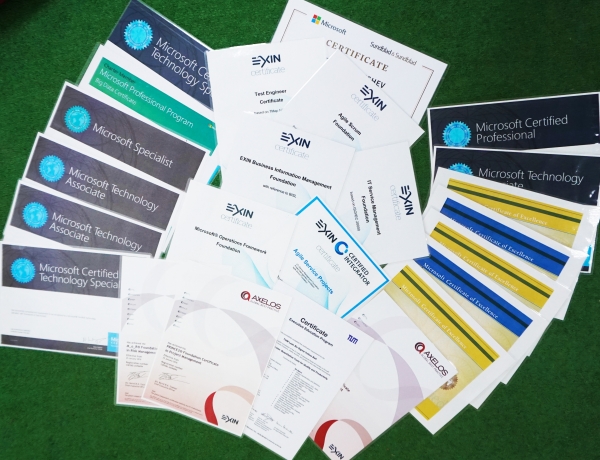
Having passed all the exams, Alexey has grown from a lead developer to a project architect. At the same time, certification has become a powerful tool for both professional development and establishing a reputation in the eyes of the client.
"Certification sledgehammer" helped gain access to certain critical processes that required control and elaboration. European IT solution clients typically highly value certified specialists and are willing to give them more freedom in their actions.
Thank you for your attention! We hope this article has been helpful to you.
Source: habr.com
