

In the comments to the text "" we got to talking about the best friend of Karandash — Samodelkin, and I promised to tell you about his origin. Here’s what I promised, below is a sort of spin-off.
Samodelkin is practically like Homer. Seven ancient cities competed for the right to call themselves the birthplace of the blind bard. There are fewer contenders for the title of Samodelkin's creator, but there are still quite a few.
Even the main source of knowledge about the modern world — Wikipedia in the article "Samodelkin" recently mentioned two surnames.
At first, it claimed:
The character was created by the Soviet artist and animator Vakhtang Bakhtadze.
but later clarified:
In the early 1960s, the books of writer Yuri Druzhkov were published, who, taking the idea from V. D. Bakhtadze, made Samodelkin and his friend Karandash the main characters of his books.
In all this, the true birthplace of Samodelkin — the magazine "Veselye Kartinki" — somehow got lost.
So what really happened?
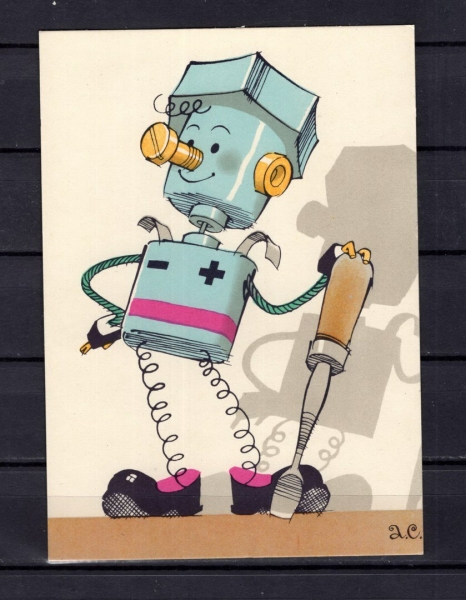
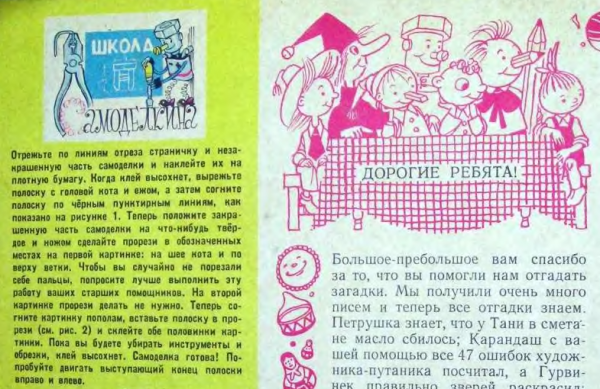
In fact, the true creator of the familiar image of Samodelkin is the artist Anatoly Sazonov, who invented and illustrated him for the magazine "Veselye Kartinki" in the mid-1958. Here is the author's depiction of this character.
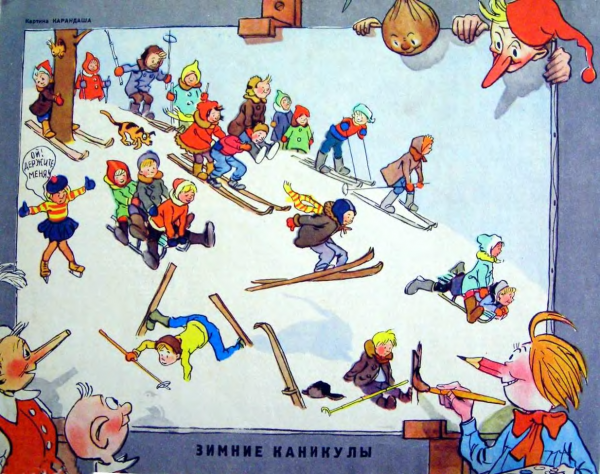
The date is established quite accurately because in early 1958, there were only five cheerful little people — Karandash, Buratino, Chipollino, Gurvinek, and Petrushka. Here, for example, is a drawing by the famous artist (and editor-in-chief of the magazine) Ivan Semyonov from the January issue:
And here is a page from the July issue. Pay attention to the frame.
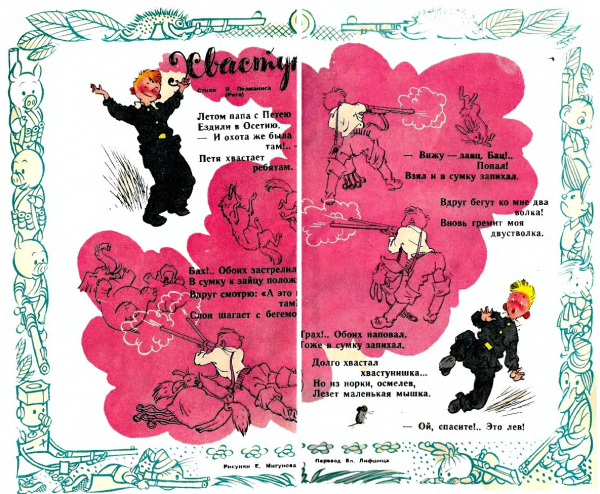
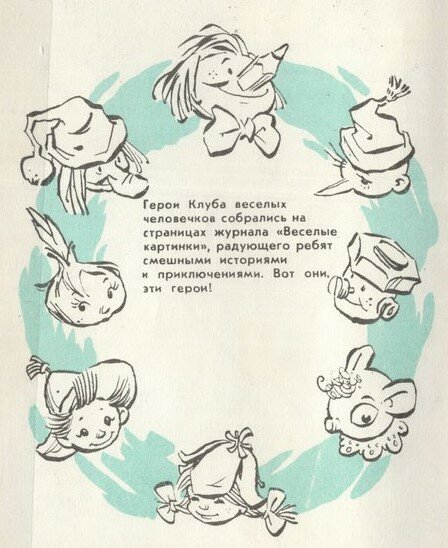
As we can see, the rapidly rising popular 4-year-old Neznayka joined the company, along with Samodelkin, created specifically for the magazine. Later, to diversify the exclusively male company, Thumbelina will join them, and that will be the canonical composition of the Club of Cheerful Little People.
So where did the "Georgian version" come from? The matter is that in 1957, the Georgian animator Vakhtang Bakhtadze invented a robot made from construction set parts and named it "Samodelkin." Here’s what he looked like — a quite Georgian-looking mechanical man in the famous svanuri hat.
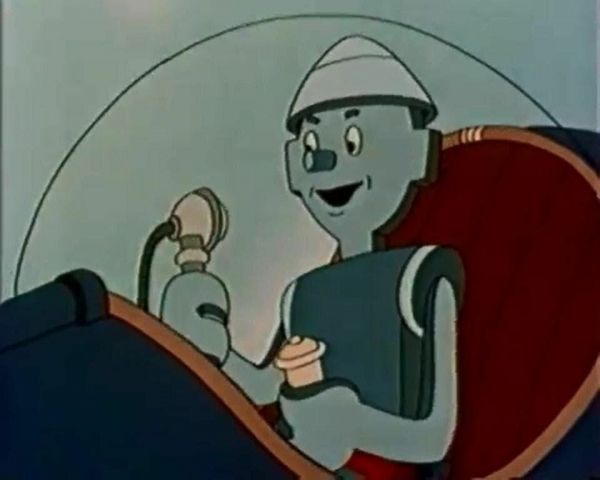
The first cartoon featuring him, "The Adventures of Samodelkin", was released in 1957, and later Bakhtadze produced many more films with this character, the last one dating back to 1983. It cannot be said that these cartoons became very popular, but the first one made quite a splash and even won an award at the 1st All-Union Film Festival in Moscow.
I should note that there were plenty of animators among the employees of "Cheerful Pictures" — Sazonov himself was a very well-known set designer and taught animation art at VGIK for many years.
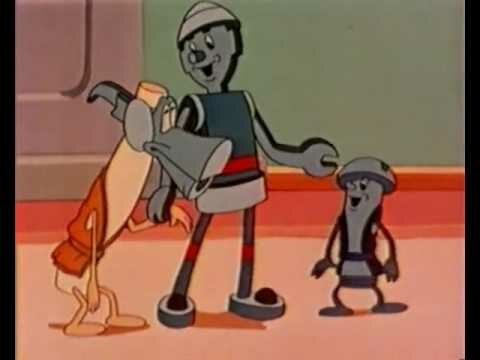
It results in an interesting chain. In 1957, the Georgian "Adventures of Samodelkin" won an award, while in 1958, "Cheerful Pictures" introduced their own version of Samodelkin. But still — a cheerful robot, assembled from parts.
It seems that the magazine simply borrowed the name and concept of the character from the Georgians, but created their own visual image.
And don't rush to blame anyone — don't forget that the Soviet Union had a unique attitude towards copyright. On one hand, copyright was respected to some extent, with fees paid firmly for the use of someone else's works; even restaurant musicians made orderly payments to the authors of the songs performed in the cabarets.
On the other hand, exclusivity of rights was certainly not encouraged.
One could not proclaim: "Cheburashka is only mine, bring me money, and do not dare to use it without a contract with me!" Successful creations were officially replicated at all levels and in all sectors, and, for instance, confectionery factories produced "Cheburashka" candies without asking anyone and without paying anything. Simply put — you would always get paid for your specific book, but a character you created would be public domain. Otherwise, Chizhikov with his Olympic Mishka would have been the richest person in the Soviet Union.
One way or another, Samodelkin immediately became a full-fledged member of the club.
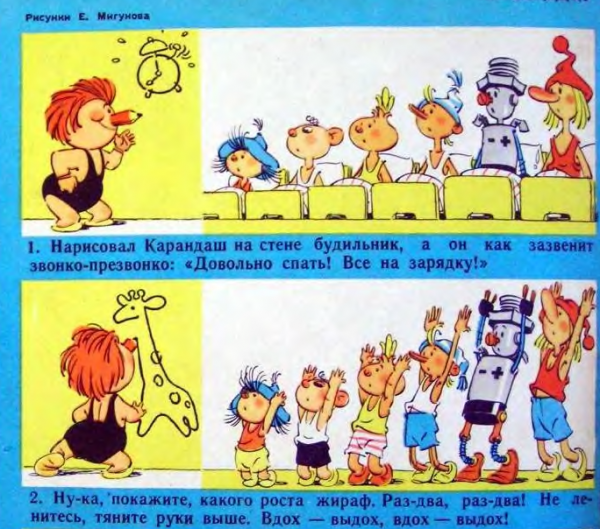
I should note that the image wasn't established immediately and initially varied a bit. For example, the Samodelkin drawn by Migunov for the first cartoon about the Club of Cheerful Little People titled "Exactly at Three Fifteen" differs somewhat from the original.
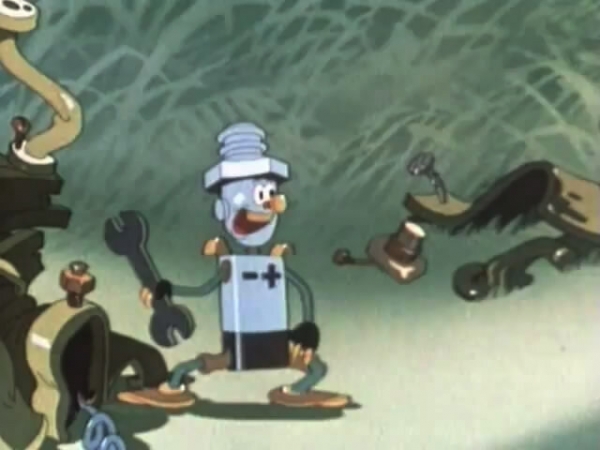
Samodelkin quickly gained popularity and even got his own feature in a magazine.
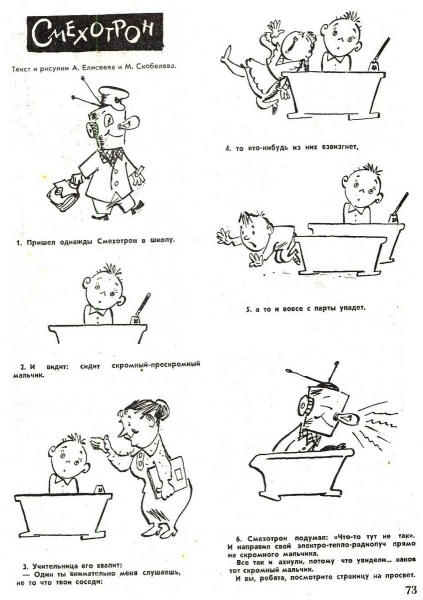
Overall, the robot turned out to be a fortunate find for a children's magazine, and other publications followed the example of 'Fun Pictures.' For instance, in the early 1960s, the magazine 'Pioneer' introduced its own robot host named Smekhotron.
There's one last question — what connection does Yuri Druzhkov, mentioned on Wikipedia, have with the image of Samodelkin?
The correct answer is 'novelizer.'
The fact is that of all the 'cheerful little people,' only Karandash and Samodelkin were not characters from literary works. So, the editor-in-chief of 'Fun Pictures' (and creator of Karandash) Ivan Semyonov suggested that magazine employee Yuri Druzhkov write a fairy tale featuring beloved characters — much like how books are written today based on popular movies.
In 1964, the tale 'The Adventures of Karandash and Samodelkin' was published, illustrated by Ivan Semyonov himself.
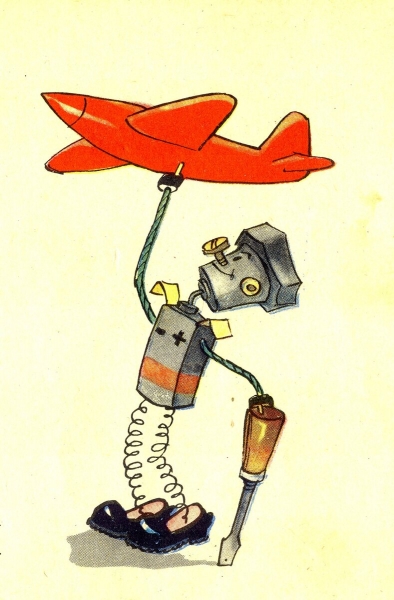
The second book, 'The Magical School,' was released after the author's death, and in our time, the writer's son, Valentin Postnikov, began mass-producing adventures of Karandash and Samodelkin.
Finally, it’s worth mentioning that Samodelkin has perhaps become the most in-demand character from the Club of Cheerful Little People.
His name is still used everywhere today by anyone who's eager.
Samodelkin is "an online store for steel containers", it's "everything for low-rise construction", it's "sale of garden gasoline and electric equipment", it's "wholesale and retail trade in construction materials, fasteners, and tools", it's "development and sale of electronic systems and ignition circuits for outboard motors", it's "the largest marketplace for buying and selling handmade works and designer items" — and all this is just from the first page of Yandex's search results.
But perhaps the most unexpected use of this name became the experimental psychedelic film 'The Path of Samodelkin,' shot in 2009 'inspired by the eponymous text of the art group Inspection 'Medical Hermeneutics' (P. Pepperstein and S. Anufriev).'
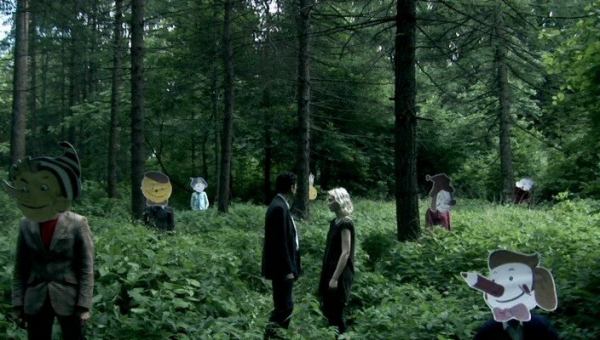
A still from the film
But the arrival of artists in 'Fun Pictures' who created 'modern art' is a separate story.
P.S. When this text was written, thanks to the renowned animation historian Georgy Borodin, the "missing link" in this investigation was found — the comic "The Story of a Strange Person" from the missing June issue of "Funny Pictures" (No. 6 for 1958).
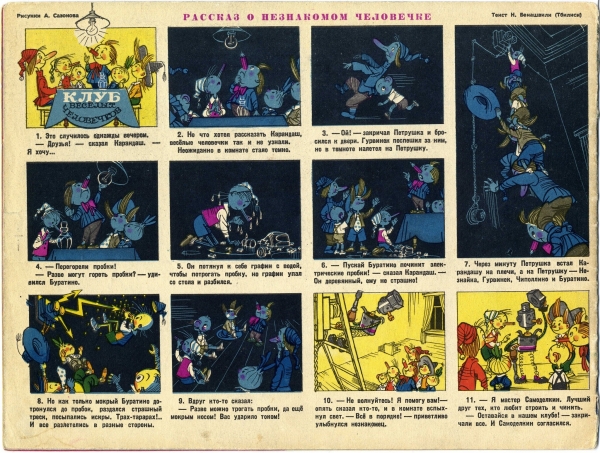
As can be read after deciphering the small print, the artist is Anatoly Sazonov, and the text was authored by Nina Benashvili. The same Nina Ivanovna Benashvili, who, as a staff writer at the "Georgia-Film" studio, wrote the scripts for all of Vakhtang Bakhtadze's cartoons about Samodelkin.
And who, apparently, is the real author of the character made up of parts. The one that was called Khelmardzhve Ostate in Georgian (literally translated as "right-handed master"), and simply Samodelkin in Russian (by the way, quite a common Russian surname — not the most widespread, but recorded at least since the end of the 19th century).
So the correct answer to the question in the title would be: Samodelkin from "Funny Pictures" is a half-blood; he has a Russian father and a Georgian mother. And the Samodelkin from the Georgian cartoons is their half-brother.
P.P.S. When one of my acquaintances read this text, he stated the following, I quote: "I once happened to chat on a forum with an Indian (more precisely, a Tamil) from Madras. He had a favorite Russian book in childhood, translated into Tamil, about Pencil and Sambarakarma. I must admit, I didn't immediately grasp what book that was and who Sambarakarma. The guy lamented that the book had long been lost, and he would gladly buy a translation, if not in Tamil, then at least in English, to read to his daughter, but unfortunately, it seems that Drushkov's books are not published abroad now. However, it turns out they were even published in India."
So, along with Samodelkin and Khelmardzhve Ostate, Sambarakarma was added. I wonder, were there any other options?
Source: habr.com
