

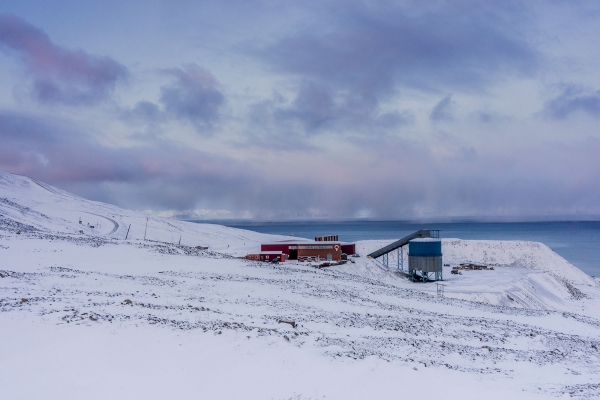
A former coal mine that houses the Arctic World Archive. : Guy Martin / Bloomberg Businessweek
Free software is the cornerstone of modern civilization and a shared legacy of humanity. The mission is to preserve this code for future generations, ensuring that the history of the Library of Alexandria never repeats itself.
To this end, GitHub will create multiple backups on various media, including long-term storage in Svalbard. It is located in a former coal mine at a depth of 250 meters in permafrost and is designed for a storage period of at least 1,000 years.
A snapshot of humanity's code will be taken on February 2, 2020..
The long-term data storage project was launched in collaboration with the Long Now Foundation, the Internet Archive, the Software Heritage Foundation, the Arctic World Archive, and other partners.
The LOCKSS project
Vital code today may be forgotten or lost over time. The worst-case scenario is that in the event of a global catastrophe, we lose all information stored on 'ephemeral' media: HDDs, SSDs, CDs, and DVDs designed for a few decades, and tapes that have a nominal lifespan of 30 years subject to strict temperature and humidity control.
The solution to the problem is to duplicate backups, meaning archiving software by multiple organizations in different forms. This project, called was launched nearly In May 2019, the program was introduced — the first prototype software for distributed long-term data preservation with support for multiple participants and external storage.
The developers of the system assume that hardware can be much more durable than ephemeral media: hence, 'there are many possible futures in which working modern computers exist, but their software is largely lost.'
GitHub reminds us of many lost technologies that could have been useful: (its recipe was rediscovered only in 2014), , and the lost It's easy to imagine a future where today's software is seen as a whimsical and long-forgotten redundancy until an unexpected need arises: "Like any backup, the GitHub Archive program is also intended for unforeseen futures," states the GitHub Archive website.
GitHub Archive
The GitHub Archive provides three levels of backups:
- Hot: almost in real-time
- Warm: updated at intervals from a month to a year
- Cold: updated every 5+ years
After any actions by GitHub users, all Git data is replicated across multiple data centers worldwide. Backups of Git, issues, pull requests, and all user data on GitHub are stored in several locations. This information is available in real-time through the GitHub API.
Additionally, recursive indexing is organized by the GHTorrent crawler, which will publish archives on a daily or monthly basis. Snapshots from the archive can be accessed through BigQuery. Other copies of code are hosted in the well-known "Wayback Machine" of the Internet Archive, which keeps copies in several locations. Finally, the Software Heritage Foundation will regularly scan GitHub and add its public repositories to its archive, which has a public API.
Arctic GitHub Storage
On February 2, 2020, GitHub will make a copy of all active public repositories and place them in Arctic GitHub Storage.
Data will be stored on 3,500-foot film reels provided by the Norwegian company Piql, which specializes in long-term data preservation. According to ISO measurements, this silver halide film in polyester has a lifespan of 500 years. Aging simulation tests have shown that Piql film retains information for at least twice as long.
In addition, GitHub Archive collaborates with researchers from the Microsoft Silica project to record all public repositories on quartz glass plates using a femtosecond laser. This medium will ensure data preservation for over 10,000 years.
The Arctic code storage on GitHub is being created based on the Arctic World Archive (AWA) at a depth of 250 meters in permafrost. The archive is located in a former coal mine on the Svalbard archipelago, not very far from the North Pole. Global warming will only affect a few meters of permafrost and does not pose a threat to the mine in the near future (for several thousand years).
Svalbard is regulated as a demilitarized zone. It is considered one of the most remote and geopolitically stable human settlements on Earth, according to GitHub. Nearby is the famous Global Seed Vault, humanity's primary hope in case of an apocalypse.
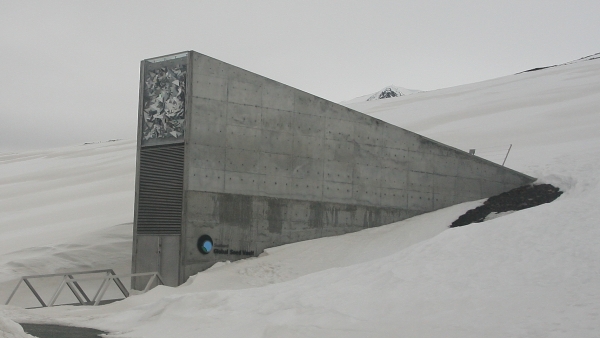
The Global Seed Vault in Svalbard
AWA is a collaborative initiative between the Norwegian state mining company Norske Spitsbergen Kulkompani (SNSK) and the digital preservation provider Piql AS. It already preserves historical and cultural data from Italy, Brazil, Norway, Vatican City, and other countries.
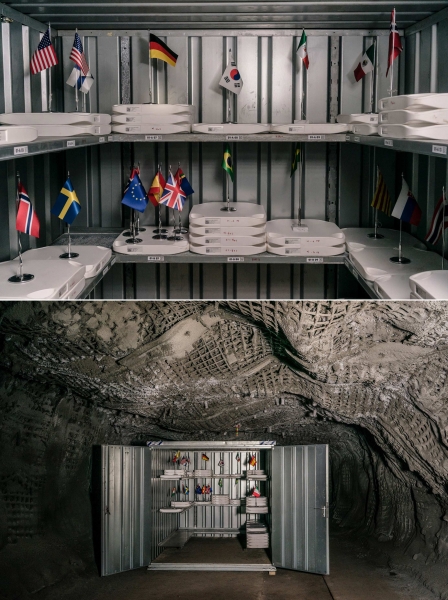
: Guy Martin / Bloomberg Businessweek
GitHub code rolls will be stored in a steel-walled container inside a hermetically sealed chamber. The snapshot on 02.02.2020 will include all active GitHub repositories and a significant portion of inactive ones (based on stars, dependencies, etc.), all binary files up to 100 KB. Each repository will be in a separate tar file. Everything should fit on 200 rolls of 120 GB.
Along with the archive, a human-readable catalog and technical guides for decoding QR codes, file formats, character encodings, and other important metadata will be included, to help descendants convert the data back into source code.
The archive will also include an overarching Tech Tree guide, in case future readers have no functioning computers and need to restore technologies from scratch.
Source: habr.com
