

This article is part of a series dedicated to .
— a SpaceX plan to provide internet through tens of thousands of satellites — is the main topic in space-related media. Every week, articles on the latest achievements are published. While the overall scheme is clear, a well-motivated person (let's say, your humble servant) can dig up a lot of details after examining the , there are still many misconceptions associated with this new technology, even among informed commentators. Articles often compare Starlink with OneWeb and Kuiper (among others) as if they were competing on equal footing. Other authors, clearly concerned for the planet’s welfare, raise alarms about space debris, space law, standards, and the safety of astronomy. I hope that by reading this rather long article, the reader will better understand and embrace the idea of Starlink.
unexpectedly struck a sensitive chord in the souls of my few readers. In it, I explained how Starship will keep SpaceX in the lead for a long time while providing a mechanism for new space research. The subtext is that the traditional satellite industry cannot keep up with SpaceX, which is steadily increasing its capabilities and reducing costs for the Falcon rocket family, putting SpaceX in a difficult position. On one hand, it has shaped a market worth, at best, a few billion a year. On the other, it has ignited an insatiable appetite for money — to build a gigantic rocket, on which, however, there is almost no one to send to Mars, and immediate profits are not to be expected.
The solution to this dual problem is Starlink. By building and launching its own satellites, SpaceX could create and define a new market for highly efficient and democratized access to communication via space, generate a flow of funds to build the rocket before it sinks the company, and increase its economic value to trillions. One should not underestimate the scale of Elon’s ambitions. There are not many industries where trillions of dollars are involved: energy, high-speed transportation, telecommunications, IT, healthcare, agriculture, government, defense. Despite popular misconceptions, , and — the business is not viable. Elon entered the energy sector with his Tesla, but a reliable and sizable market for satellites and rocket launches will only be guaranteed by telecommunications.

Elon Musk first turned his gaze toward space when he wanted to invest $80 million in a mission to grow plants on a Martian probe. Building a city on Mars will probably cost about 100,000 times more, so Starlink is Musk's main bet to provide the sea of money desperately needed to sponsor .
For what?
I had been planning this article for some time, but it was only last week that the whole picture came together. Then SpaceX President Gwynne Shotwell gave Rob Baron an amazing interview, which was later covered for CNBC in a fabulous by Michael Schiltz, to which was dedicated . This interview highlighted the vast difference in approaches to satellite communications between SpaceX and everyone else.
Concept was born in 2012 when SpaceX realized that their clients — primarily satellite communication providers — had huge pools of money. Launch pads were jacking up prices for satellite deployment and, somehow, missed one stage of work — how is that possible? Elon dreamed of creating a satellite constellation for the internet and, unable to resist the practically unachievable task, set the process in motion. The development of Starlink , but by the end of this article you, my reader, will surely be surprised at how truly minor these challenges are — considering the breadth of the idea.
Is such a massive grouping even necessary for the internet? And why now?
In my memory, the internet has transformed from a purely academic pastime into the first and only revolutionary infrastructure. This isn't a topic for an in-depth article, but I would suggest that global demand for the internet and the revenue it generates will continue to grow at around 25% per year.
Today, almost all of us get internet service from a small number of geographically isolated monopolies. In the U.S., AT&T, Time Warner, Comcast, and a handful of smaller players have divided territory to avoid competition, overcharging for services and basking in what can only be described as near-universal disdain.
Providers have a compelling reason for their anti-competitive behavior—beyond sheer greed. Building the infrastructure for the internet—microwave cell towers and fiber optics—is exceedingly expensive. It's easy to forget the miraculous nature of the internet. My grandmother first worked as a communicator during World War II when telegraphy competed strategically with carrier pigeons! For most of us, the information superhighway is something ephemeral and intangible; however, bits travel through the physical world, where there are borders, rivers, mountains, oceans, storms, natural disasters, and other obstacles. Back in 1996, when the first fiber optic line was laid across the ocean floor, . With his trademark sharp style, he vividly describes the bare cost and complexity of laying these lines, over which the damned "wet plants" still speed. Throughout most of the 2000s, cables were being laid at such a rate that the cost of deployment was staggering.
In my time, I worked in an optical lab and (if memory serves) we set a record at that time, achieving a multiplex transmission speed of 500 Gb/sec. Electronic limitations allowed each fiber to be loaded to only 0.1% of its theoretical capacity. Fifteen years later, we are ready to exceed that threshold: if data transmission surpasses it, the fiber will melt, and we are very close to that.
But the goal is to raise the data stream above the sinful earth — into space, where a satellite orbits the 'ball' 30,000 times in five years without hindrance. It seems like an obvious solution — so why has no one tackled it before?
The Iridium satellite constellation, developed and deployed in the early 1990s by Motorola (you remember them, right?), became the first global low Earth orbit communication network (as enticingly detailed in ). By the time it was deployed, its niche capability to route small data packets from asset trackers turned out to be its only application: cellular networks became so cheap that satellite phones never gained traction. Iridium operated 66 satellites (plus a few spares) on 6 orbits — the minimum necessary to cover the entire planet.
If Iridium needed 66 satellites, then why does SpaceX require tens of thousands? What makes it so different?
SpaceX approached this business from the opposite end — starting with launches. It became a pioneer in reusable rocket technology, thereby dominating the market for affordable launch services. Attempts to undercut their pricing won't yield much profit, so the only way to capitalize on their excess capacity is to become their customer. SpaceX's launch costs for its own satellites are (per kg) of Iridium, which allows them to tap into a vastly broader market.
Starlink's global coverage will provide access to high-quality internet from anywhere in the world. For the first time, internet availability will not depend on how close a country or city is to a fiber optic line, but on the clarity of the sky above. Users worldwide will gain access to a global internet free from the shackles of their variously misguided and/or corrupt governmental monopolies. The ability of Starlink to disrupt these monopolies will catalyze incredibly large-scale positive changes that will finally unite billions of people into a global cyber community of the future.
A small lyrical digression: what does this actually mean?
For people growing today, in an era of ubiquitous connectivity, the internet is like the air we breathe. It simply exists. But this is—if we forget about its incredible power to bring about positive change—and we are already at the center of it. With the internet, people can hold their leaders accountable, connect with others on the other side of the world, share thoughts, and invent something new. The internet unites humanity. The history of modernization is a story of evolving data exchange possibilities. First—through speeches and epic poetry. Then—through writing, which gives voice to the dead, allowing them to speak to the living; writing preserves data and enables asynchronous communication. Print media automated news production. Electronic communication accelerated the transmission of data worldwide. Personal devices for note-taking gradually became more sophisticated, evolving from notebooks to mobile phones, each of which is a connected computer packed with sensors, increasingly anticipating our needs every day.
A person using writing and a computer in the learning process has a greater chance of surpassing the limitations of an imperfectly developed brain. Even more encouraging is that mobile phones are both powerful data storage devices and mechanisms for sharing ideas. In the past, when people shared thoughts, they relied on spoken words jotted down in notebooks; today, it’s the norm for notebooks to share the ideas generated by people themselves. The traditional scheme has undergone an inversion. A logical continuation of this process is some form of collective metacognition, facilitated through personal devices, and interconnected. And while we still yearn for the lost connection with nature and solitude, it is important to remember that technology, and only technology, accounts for the lion's share of our liberation from the "natural" cycles of ignorance, premature death (that can be avoided), violence, hunger, and tooth decay.
How?
Let's talk about the business model and architecture of the Starlink project.
For Starlink to become a profitable enterprise, the influx of funds must exceed the costs of construction and operation. Traditionally, capital investment implies high initial expenses, sophisticated specialized financing, and insurance mechanisms—all to launch a satellite. A geostationary communication satellite can cost around 500 million dollars and take 5 years to assemble and launch. Therefore, companies in this sector simultaneously build jet aircraft or container ships. This results in massive expenditures, an influx of funds that barely covers financing costs, and a relatively small operational budget. Conversely, the initial collapse of Iridium was due to Motorola forcing the operator to pay crippling licensing fees, bankrupting the enterprise in just a few months.
To run such a business, traditional satellite companies had to service private clients and charge high rates for data transmission. Airlines, remote outposts, ships, combat zones, and critical infrastructure sites pay about 5 dollars per MB, which is 5000 times more expensive than traditional ADSL connectivity, despite the delays in data transmission and the relatively low bandwidth of satellite connections.
Starlink plans to compete with terrestrial service providers, meaning it will need to deliver data at a lower cost and, ideally, charge much less than 1 dollar per MB. Is this possible? Or, if it is possible, the question becomes: how is it possible?
The first ingredient of the new dish is cheap launches. Currently, Falcon sells launches for 24 tons for about 60 million dollars, which equates to 2500 dollars per kg. However, there are significantly higher internal costs involved. Starlink satellites will be launched on reusable launch vehicles, making the marginal costs of a single launch the cost of a new second stage (around 4 million dollars), fairings (1 million), and ground support (~1 million). In total: about 100 thousand dollars per satellite, which is more than 1000 times cheaper than launching a conventional communication satellite.
Most Starlink satellites, however, will be launched on Starship. Indeed, the evolution of Starlink, as updated reports to the FCC show, provides some insight. the internal architecture of the project. The total number of satellites in the constellation has increased from 1,584 to 2,825, then to 7,518, and finally to 30,000. If we believe the gross accumulations, the figure is even higher. The minimum number of satellites for the first stage of development to ensure the project's viability is 60 on 6 orbits (a total of 360), while complete coverage within 53 degrees of the equator requires 24 orbits of 60 satellites each (a total of 1,440). This means 24 launches for Falcon at around $150 million in internal costs. Starship is designed to launch up to 400 satellites at once, approximately for the same price. Starlink satellites need to be replaced every 5 years, so 6,000 satellites would require 15 Starship launches per year. This would cost about $100 million per year, or $15,000 per satellite. Each satellite launched on Falcon weighs 227 kg; the satellites launched on Starship could weigh up to 320 kg and carry external instruments, being slightly larger while still remaining within the allowable payload.
What contributes to the cost of satellites? Among their peers, Starlink satellites are somewhat unusual. They are assembled, stored, and launched in a flat format, making them exceptionally simple to mass-produce. Experience shows that the production cost should roughly equal the cost of the launch system. If there's a significant price difference, resources are likely being allocated incorrectly, as the overall reduction in marginal costs with decreasing expenses is not that substantial. Is it really possible for satellites to cost $100,000 each in the first batch of several hundred? In other words, is a Starlink satellite really not more complicated in design than a car?
To fully answer this question, we need to understand why the cost of an orbital communications satellite is a thousand times higher, even if it is not a thousand times more complex. Simply put, why is space 'hardware' so expensive? There are many reasons, but the most compelling in this case is this: if launching a satellite into orbit (before Falcon) costs more than $100 million, it must reliably operate for many years — to bring at least some profit. Ensuring such reliability for the first and only prototype is a painful process and can take years, requiring the efforts of hundreds of people. Add to this the costs, and it's easy to justify the additional processes, especially since launching is already so expensive.
Starlink breaks this paradigm by creating hundreds of satellites, quickly fixing early design flaws, and leveraging mass production techniques to manage costs. Personally, I can easily imagine a Starlink assembly line where a technician integrates something new into the design and fastens everything with a plastic tie (NASA-grade, of course) in an hour or two, maintaining the necessary replacement rate of 16 satellites per day. A Starlink satellite consists of many complex components, but I see no reason why the cost of the thousandth unit rolling off the assembly line can't be reduced to $20,000. Indeed, in May, Elon tweeted that the production cost of a satellite is already lower than the launch cost.
Let's take an average case and analyze the payback period, rounding the numbers. One Starlink satellite, which costs $100,000 to assemble and launch, operates for 5 years. Will it pay for itself, and if so, how soon?
In 5 years, a Starlink satellite will orbit Earth 30,000 times. During each of these one-and-a-half-hour passes, it will spend most of the time over the ocean and, probably, 100 seconds over a densely populated city. In this brief window, it transmits data, eager to earn money. Assuming that the antenna supports 100 beams and each beam transmits 100 Mb/sec, using modern encoding types , the satellite generates $1,000 in profit per orbit — with a subscription price of $1 for 1 GB. This is enough to recover the deployment cost of $100,000 within a week and greatly simplifies the capital structure. The remaining 29,900 orbits are pure profit, minus fixed costs.
The projected figures can vary greatly, in both directions. However, in any case, if you can launch a quality satellite constellation into low orbit for $100,000 — or even $1 million per unit — that’s a significant claim. Even considering the laughably low usage time, the Starlink satellite can deliver 30 PB of data over its operational lifetime, with an amortized cost of $0.003 per GB. Furthermore, the marginal costs hardly increase when transmitting over longer distances.
To understand the significance of this model, let’s briefly compare it with two other models of data delivery to consumers: the traditional one — fiber optic cable, and the satellite constellation offered by a company that does not specialize in satellite launches.
, connecting France and Singapore, was put into operation in 2005. Its bandwidth is 1.28 Tb/s, and the deployment cost was $500 million. If it operates at 100% capacity for 10 years and the overhead is 100% of capital costs, then the transmission cost comes to $0.02 per GB. Transatlantic cables are shorter and slightly cheaper, but the undersea cable is just one entity in a long chain of people wanting money for data transmission. The average estimate for Starlink turns out to be 8 times cheaper, and it offers an all-inclusive service.
How is this possible? The Starlink satellite includes all the complex electronic switching gear needed for fiber optic cable communication; however, instead of expensive and fragile wires, it uses vacuum for data transmission. The transmission through space reduces the number of cozy and outdated monopolies, allowing users to connect with even less 'hardware'.
Comparing with the competing satellite developer OneWeb. OneWeb plans to create a constellation of 600 satellites, which it will launch through commercial suppliers at a cost of about $20,000 per kg. The weight of one satellite is 150 kg, so, ideally, launching one unit will cost around $3 million. The cost of the satellite hardware is estimated at $1 million per satellite, meaning that by 2027 the total cost of the entire constellation will be $2.6 billion. Tests conducted by OneWeb showed a peak throughput of 50 Mbps, ideally, for each of the 16 beams. Following the same formula we used to calculate the cost of Starlink, we find that each OneWeb satellite generates $80 per orbit, totaling $2.4 million over 5 years — barely covering launch expenses, considering data transmission to remote regions. This gives us $1.70 per GB.
Recently, they quoted Gwynne Shotwell as saying that , which implies a competitive price of $0.10 per GB. And this is still with the initial configuration of Starlink: with less optimized production, launches on Falcon, and limitations in data transmission — only covering northern USA. This means SpaceX has an undeniable advantage: even today they can launch a far more capable satellite at a unit price 15 times lower than that of competitors. Starship will increase the lead by 100 times or more, so it's not hard to imagine that by 2027 SpaceX will launch 30,000 satellites for less than $1 billion, most of which they will fund from their own pocket.
I am sure there are more optimistic analyses regarding OneWeb and other promising satellite constellation developers, but I do not yet know how they are structured.
Recently, Morgan Stanley , mentioned that Starlink satellites would cost $1 million for assembly and $830,000 for launch. . Interestingly, the figures are similar to our calculations regarding OneWeb's costs, and are roughly 10 times higher than the initial estimate for Starlink. The use of Starship and industrial-scale satellite manufacturing could reduce deployment costs to about $35,000 per unit. That is an astonishingly low number.
The final point remains — to compare the profit generated per watt of solar energy for Starlink. According to the photos on their website, each satellite's solar panel has an area of about 60 square meters, generating approximately 3 kW or 4.5 kWh per orbit on average. By rough estimation, each orbit would yield $1,000, while each satellite generates about $220 per kWh. This is 10,000 times the wholesale cost of solar energy, further confirming that: And the modulation of microwaves for data transmission adds an exorbitant cost.
Architecture
In the previous section, I roughly outlined a non-trivial and significant part of the Starlink architecture — how it functions in areas with extremely uneven population density. A Starlink satellite emits focused beams that form spots on the planet's surface. Subscribers within a spot share a single bandwidth. The size of the spot is determined by fundamental physics: initially, its width is (satellite height × wavelength / antenna diameter), which for a Starlink satellite is, at best, a couple of kilometers.
In most cities, the population density is about 1,000 people per square kilometer, although it can be higher in some areas. In parts of Tokyo or Manhattan, a spot may accommodate over 100,000 people. Fortunately, in any such densely populated city, there is a competitive domestic broadband market, not to mention a highly developed mobile phone network. However, at any given moment, if many satellites from one constellation are present above a city, bandwidth can be increased by spatially separating the antennas, as well as by allocating frequencies. In other words, dozens of satellites can focus the strongest beam on one point, and users in that region will use ground terminals that distribute requests among the satellites.
If initially the most suitable market for services is remote, rural, or suburban areas, then funds for further launches will come from higher-quality services directed at densely populated cities. The scenario is directly opposite to the standard market expansion scheme, where competitive services focused on cities inevitably face declining profits as they attempt to expand into poorer and less populated areas.
A few years ago, when I did the calculations, .
I took data from this image and created the three charts below. The first shows the land area frequency by population density. Interestingly, most of the Earth is uninhabited, while almost no region exceeds 100 people/km².

The second chart demonstrates the frequency of people by population density. Although most of the planet is uninhabited, the majority of people live in areas with 100–1000 people/km². The extended nature of this peak (an order of magnitude more) reflects bimodality in urbanization patterns. 100 people/km² is characteristic of relatively sparsely populated rural areas, while a figure of 1000 people/km² is typical for suburbs. City centers easily show 10,000 people/km², while Manhattan’s population density is 25,000 people/km².

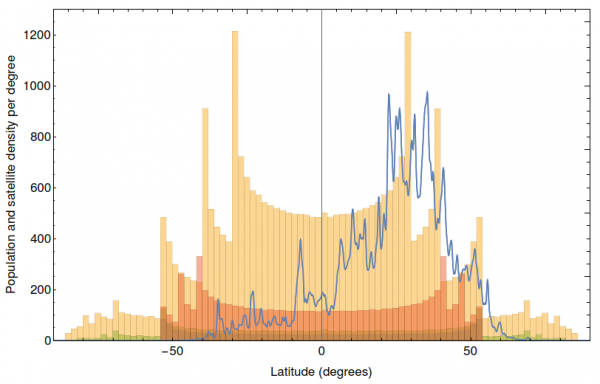
The third chart shows population density by latitude. It’s clear that almost all people are concentrated between 20–40 degrees north latitude. This distribution has largely formed geographically and historically, as a vast part of the southern hemisphere is occupied by the ocean. Nonetheless, such population density poses a daunting challenge for architects of clustering, as satellites spend equal amounts of time in both hemispheres. Moreover, a satellite orbiting the Earth at an angle of, say, 50 degrees, will spend more time closer to the specified latitude boundaries. This is why Starlink needs only 6 orbits to serve northern USA, while covering the equator requires 24.

Indeed, when the population density chart is combined with the satellite constellation density chart, the choice of orbits becomes clear. Each histogram represents one of the four reports by SpaceX to the FCC. Personally, I feel that each new report is like an addition to the previous one, but in any case, it's not hard to notice how additional satellites increase capacity over the corresponding regions in the Northern Hemisphere. In contrast, significant unused capacity remains over the Southern Hemisphere—rejoice, dear Australia!
What happens to user data when it reaches a satellite? In the initial version, the Starlink satellite immediately transmitted it back to a dedicated ground station near the service areas. This configuration is known as 'direct relay.' In the future, Starlink satellites will be able to communicate with each other via laser. Data exchange will peak over densely populated cities, but data can be distributed across a two-dimensional laser network. In practice, this means there is a significant opportunity for a hidden communication transport network within the satellite network, where user data can be 're-transmitted to Earth' at any suitable location. In practice, I think SpaceX's ground stations will combine with outside urban areas.
It turns out that satellite-to-satellite communication is a non-trivial task when the satellites do not move in unison. The latest reports to the FCC indicate 11 distinct orbital groups of satellites. Within a specific group, the satellites move at the same altitude, under the same tilt, with equal eccentricity, which means that lasers can locate satellites in close proximity relatively easily. However, the closing speeds between groups are measured in km/sec, so communication between groups, if possible, must occur through short, rapidly managed microwave links.
The topology of orbital groups is similar to the particle-wave theory of light and is not particularly related to our example, but, in my opinion, it is beautiful, which is why I included it in the article. If you are not interested in this section, feel free to skip to 'Fundamental Physics Limitations.'
A torus — or doughnut — is a mathematical object defined by two radii. Drawing circles on the surface of a torus is quite simple: either parallel or perpendicular to its shape. You might find it interesting to discover that there are two other families of circles that can be depicted on the torus's surface, both of which pass through the hole at its center and around its contour. These are called , and I used this construction when designing the toroid for the Tesla coil 'Burning Man' in 2015.

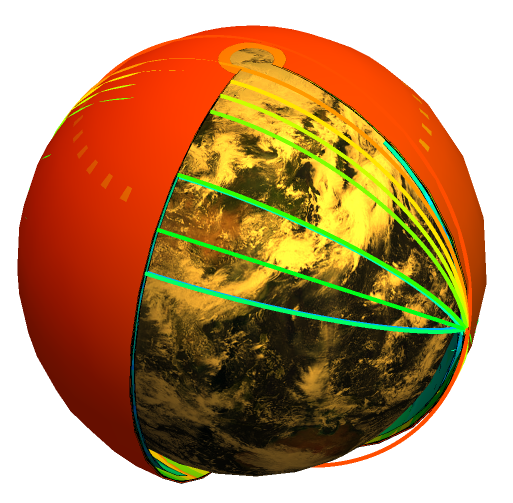
And although the orbits of satellites are, strictly speaking, ellipses rather than circles, the same construction applies in the case of Starlink. A cluster of 4,500 satellites in several orbital planes, all at a single angle, forms a continuously moving layer above the Earth's surface. The layer directed towards the north unfolds over a specified latitude point and moves back south. To avoid collisions, the orbits will be slightly elongated, so the layer moving north will be several kilometers above (or below) the one moving south. Together, these two layers form a torus with a blown shape, as illustrated below in a highly simplified diagram.

Let me remind you that within this torus, communication occurs between neighboring satellites. In general terms, there are no direct and prolonged connections between satellites in different layers, as the closing speeds for laser guidance are excessively high. The data transmission trajectory between layers, in turn, passes above or below the torus.
A total of 30,000 satellites will be positioned in 11 nested tori, well behind the orbit of the ISS! This diagram shows how all these layers are packed, without exaggerated eccentricity.
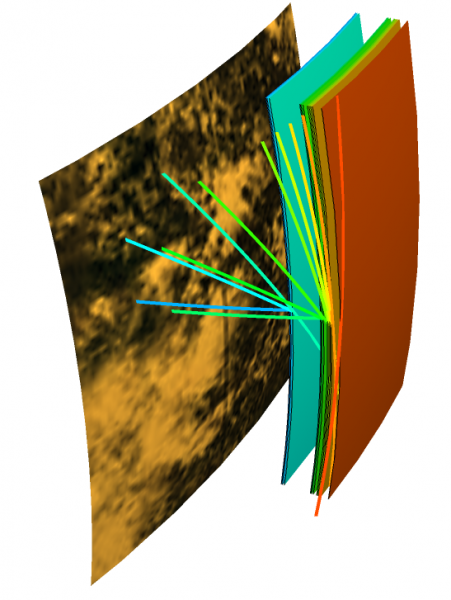
And finally, one should consider the optimal flight altitude. There is a dilemma: a low altitude that provides greater bandwidth with smaller beam sizes or a higher one that can cover the entire planet with fewer satellites? Over time, reports from SpaceX to the FCC have mentioned increasingly lower altitudes, as with advancements, Starship makes the rapid deployment of larger constellations feasible.
A low altitude also has other advantages, including reduced risk of collision with space debris or negative consequences of equipment failure. Due to enhanced atmospheric drag, satellites positioned lower than others (330 km) will burn up within a few weeks after losing control of their orientation. Indeed, 300 km is an altitude at which satellites rarely operate, and maintaining that height will require an onboard Krypton electric propulsion engine, as well as a streamlined design. Theoretically, a satellite with a sufficiently pointed shape could stably maintain an altitude of 160 km on an electric propulsion engine, but it is unlikely that SpaceX will launch satellites that low, as there are still several tricks available to increase bandwidth.
Limits of Fundamental Physics
It seems unlikely that satellite deployment costs will ever drop significantly below 35 thousand, even if manufacturing becomes advanced and fully automated, and Starship vessels are fully reusable. Furthermore, it is still unclear what limitations physics will impose on satellites. The analysis above assumes a peak capacity of 80 Gbps (rounding to 100 beams, each capable of transmitting 100 Mbps).
The ultimate limit of channel capacity is set in and is given in terms of bandwidth statistics (1+SNR). Bandwidth is often limited by the , while SNR refers to the available energy of the satellite, background noise, and interference on the channel due to . Another notable obstacle is processing speed. The latest Xilinx Ultrascale+ FPGAs have , which is advantageous given the current limitations of the information capacity of the channel without developing custom ASICs. Yet even then, 58 Gb/sec will require substantial frequency distribution, likely in the Ka or V bands. V (40–75 GHz) has more accessible cycles but is subject to greater atmospheric absorption, especially in areas of high humidity.
Are 100 beams practical? This issue has two aspects: beam width and the density of the phased array antenna elements. Beam width is determined by the wavelength divided by the antenna diameter. A digital phased array antenna is still a specialized technology, but the maximum usable dimensions are determined by the width. (approximately 1m), while using radio-frequency communications can be quite costly. The wavelength in the Ka band is about 1 cm, with a beam width needing to be 0.01 radians — at a bandwidth at 50% amplitude. Assuming a solid angle of 1 steradian (similar to the coverage of a 50mm camera lens), then in this area, 2500 individual beams would be sufficient. Linearity implies that 2500 beams would require a minimum of 2500 antenna elements within the array, which is technically feasible, though quite challenging. Plus, all of this will generate significant heat!
In total, 2500 channels, each supporting 58 Gb/sec, amounts to an enormous volume of information — roughly 145 Tb/sec. For comparison, the entire internet traffic in 2020 . Good news for those concerned about the fundamentally low bandwidth of satellite internet. If the constellation of 30,000 satellites is operational by 2026, global internet traffic could potentially reach 800 Tb/sec. If half of this volume is provided by around 500 satellites over densely populated areas at any given time, then the peak capacity for each satellite would be approximately 800 Gb/sec, which is 10 times higher than our original main estimates, meaning the financial influx could potentially increase tenfold.
For a satellite in a 330-kilometer orbit, a beam of 0.01 radians covers an area of 10 square kilometers. In particularly densely populated areas like Manhattan, up to 300,000 people may live within that area. And if they all sit down to watch Netflix at once (7 Mbps in HD quality)? The total data request would amount to 2000 GB/s, which is about 35 times the current strict limit imposed by the FPGA interface for sequential output. There are two ways out of this situation, of which only one is physically feasible.
The first is to launch more satellites into orbit so that at any given moment, more than 35 of them are hovering over high-demand areas. If we again take 1 steradian for an acceptable addressable part of the sky and an average orbital height of 400 km, we get a clustering density of 0.0002/sq.km, or a total of 100,000 — if distributed evenly across the entire surface of the Earth. It is important to note that the chosen orbits of SpaceX significantly increase the coverage density over densely populated areas within 20-40 degrees north latitude, making the number of 30,000 satellites seem magical.
The second idea is much cooler but, unfortunately, unfeasible. Recall that the beam width is determined by the width of the phased array antenna. What if multiple arrays on several satellites combined their powers to create a narrower beam — just like radio telescopes such as the (Very Large Array)? This method is associated with one complexity: the baseline between satellites would need to be calculated very carefully — with sub-millimeter accuracy — to stabilize the phase of the beam. Even if such a thing were possible, the resulting beam would hardly contain side lobes due to the low density of the satellite constellation in the sky. On the ground, the beam width would narrow down to a few millimeters (enough to track a cell phone antenna), but there would be millions of them — due to weak intermediate nulling. Thanks to the .
It turns out that channel separation through angular dispersion — since the satellites are separated across the sky — provides adequate improvements in bandwidth without violating the laws of physics.
The use of
What is the profile of a Starlink customer? By default, it's hundreds of millions of users with antennas on their rooftops the size of a pizza box, but there are also other high-revenue sources.
In remote and rural areas, ground stations do not require phased antenna arrays to maximize beam width, so smaller customer devices can be used: from IoT asset trackers to pocket satellite phones, emergency beacons, or scientific instruments for tracking animals.
In densely populated urban environments, Starlink will provide a primary and backup transport network for cellular networks. A high-performance ground station can be installed on top of each cellular tower, using land-based power sources to boost and transmit through the 'last mile.'
And finally, even in overcrowded areas during the initial rollout, there is the potential for low Earth orbit satellites to be used with exceptionally low latency. Financial companies are ready to put significant money in your hands—just to receive vital data from all corners of the world a little faster. Even if the data sent via Starlink has a longer journey than usual—through space—the speed of light in a vacuum is 50% faster than in quartz glass, more than compensating for the difference in transmission over greater distances.
Negative Consequences
The final section addresses negative consequences. The purpose of this article is to dispel any misconceptions about the project, as the potential negative impacts of disputes cause the most concern. I will provide some information while refraining from excessive interpretation. I am not a clairvoyant, nor do I have any insider information from SpaceX.
In my opinion, the most serious consequences come from increased access to the internet. Even in my hometown of Pasadena, a vibrant and technologically advanced million-person city hosting several observatories, a world-class university, and the largest NASA center, the options for internet services are quite limited. Across the US and the rest of the world, the internet has turned into a rental-oriented utility, with providers only interested in raking in their $50 million a month in a cozy, non-competitive environment. Perhaps any service supplied to apartments and residential buildings is a utility, but the quality of internet services is less consistent than that of water, electricity, or gas.
The problem with the status quo is that, unlike water, electricity, or gas, the internet is still young and rapidly evolving. We are constantly finding new applications for it. The most revolutionary has yet to be discovered, but bundled plans stifle competition and innovation. Billions of people remain left out of the digital revolution. Starlink, on the other hand, continuously beams internet from the sky, disrupting this model. I am not yet aware of any better way to connect billions of people to the internet. SpaceX is on its way to becoming an internet provider and potentially an internet company that competes with Google and Facebook. I bet you haven't thought about it like this.
It's not obvious that satellite internet is the best option. SpaceX, and only SpaceX, is in a position to quickly create a vast constellation of satellites, as it alone broke a decade-long government-military monopoly on launching spacecraft. Even if Iridium had beaten the cellular phone market by ten times, it still wouldn't have achieved widespread adoption using traditional launch platforms. Without SpaceX and its unique business model, it's highly likely that global satellite internet simply would never happen.
It's not obvious that satellite internet is the best option. SpaceX is uniquely positioned to quickly build a vast constellation of satellites because it has spent a decade disrupting the government-military monopoly on space launches. Even if Iridium had outpaced cellular phones by ten times, it still wouldn't have achieved widespread adoption using traditional launch pads. Without SpaceX and its unique business model, it's highly likely that global satellite internet would simply never have happened.
The second major blow will fall on astronomy. After the launch of the first 60 Starlink satellites, a wave of criticism arose from the international astronomical community, claiming that the dramatically increased number of satellites would obscure their access to the night sky. There’s a saying: among astronomers, the one with the biggest telescope is the best. Without exaggeration, practicing astronomy in the modern era is an incredibly challenging task, resembling a continuous struggle to improve analysis quality against a backdrop of growing light pollution and other sources of noise.
Astronomers least want to see thousands of bright satellites flashing through their telescope's focus. Indeed, the first group of Iridium gained infamy for causing 'flashes' due to large panels reflecting sunlight onto small areas of the Earth. There were instances where they reached a brightness comparable to that of a quarter of the Moon and sometimes accidentally damaged sensitive astronomical sensors. Concerns are not unfounded that Starlink may intrude into radio frequencies used in radio astronomy.
If you download an app to track satellites, you can see dozens of satellites flying in the sky on a clear evening. Satellites are visible after sunset and before dawn, but only when illuminated by sunlight. Later, during the night, the satellites become invisible in the Earth's shadow. Tiny and extremely distant, they move very quickly. There’s a chance they might momentarily obscure a distant star, but I think even detecting that would be quite a hassle.
The strong concern about sky glow arose because the first batch of satellites was launched close to the terminator of Earth, meaning every night, Europe — it was summer — witnessed an epic sight as satellites flew across the sky during evening twilight. Furthermore, simulations based on reports from the FCC indicated that satellites in orbit at 1150 km would be visible even after astronomical twilight. In general, twilight consists of three phases: civil, nautical, and astronomical, which occur when the sun is 6, 12, and 18 degrees below the horizon, respectively. At the end of astronomical twilight, sunlight is approximately 650 km from the surface at zenith, far beyond the atmosphere and most of low Earth orbit. Based on data from , I believe that all satellites will be placed at altitudes below 600 km. In this case, they would be visible during twilight but not after nightfall, significantly reducing potential impacts on astronomy.
The third issue is debris in orbit. In I pointed out that satellites and debris below 600 km will deorbit within a few years due to atmospheric drag, greatly reducing the chances of a Kessler syndrome. SpaceX seems to throw around debris as if they are not thinking about space junk at all. Here I am reviewing the details of Starlink's implementation, and it's hard for me to imagine a better way to reduce the amount of debris in orbit.
Satellites are launched to an altitude of 350 km, then use onboard thrusters to move to their designated orbit. Any satellite that fails during launch will deorbit within a few weeks, and it won’t drift anywhere else for the next thousand years. This placement is strategically designed for free-entry testing. Furthermore, Starlink satellites are flat in cross-section, which means that, when losing altitude control, they will enter dense layers of the atmosphere.
Few people know that SpaceX became a pioneer in space exploration by starting to use alternative types of fasteners instead of pyrotechnics. Almost all launch pads use pyrotechnics to deploy stages, satellites, fairings, and so on, thereby increasing the potential amount of debris. Additionally, SpaceX purposely deorbits upper stages, preventing them from drifting aimlessly in space for eternity, which could lead to aging and disintegration in the harsh cosmic environment.
Finally, the last issue I would like to mention is the chance that SpaceX will displace the existing monopoly on the internet by creating its own. In its niche, SpaceX has already monopolized launches. Only the desire of competing governments to secure guaranteed access to space has prevented the scrapping of expensive and outdated rockets, which are often assembled by large monopolistic defense contractors.
It is not too hard to imagine that by 2030, SpaceX will be launching 6,000 of its satellites annually, plus a few spy satellites—just for old times' sake. SpaceX's cheap and reliable satellites will offer 'stable-space' for external devices. Any university that develops a usable space camera will be able to launch it into orbit without the need to cover the costs of building an entire space platform. With such advanced and unrestricted access to space, Starlink is already associated with satellites, while historical manufacturers fade into the past.
History has examples of visionary companies that have taken such a huge market niche that their names became generic: Hoover, Westinghouse, Kleenex, Google, Frisbee, Xerox, Kodak, Motorola, IBM.
Problems may arise when a pioneering company resorts to anti-competitive practices to maintain its market share, although since President Reagan's time this is often not prohibited. SpaceX may maintain the Starlink monopoly by forcing other satellite constellation developers to launch their satellites on outdated Soviet rockets. Similar actions were taken by , along with the fixed postal transport prices, led to its collapse in 1934. Fortunately, SpaceX is unlikely to maintain an absolute monopoly on reusable rockets forever.
Even greater concerns arise from the fact that SpaceX's deployment of tens of thousands of satellites in low orbit could be seen as the appropriation of common goods. A private company, pursuing its own profit, could seize formerly public and unoccupied orbital positions as its permanent property. And while SpaceX's innovations have made it possible to profit in the vacuum of space, much of its intellectual capital has been built on billions of dollars allocated from research budgets.
On one hand, laws are needed to protect private investments in research and development. Without this protection, innovators will be unable to fund ambitious projects or will relocate their companies to places that offer such safeguards. In any case, the public suffers because profit is not generated. On the other hand, laws are needed to protect individuals, the nominal owners of common goods including the sky, from rent-seeking private entities that annex public resources. Neither side is correct on its own, and neither is even possible. SpaceX's developments offer a chance to find a middle ground in this new market. We will know it has been found when we maximize the frequency of innovations and the creation of public wealth.
Final thoughts
I wrote this article as soon as I finished another one — . It has been quite an eventful week. Both Starship and Starlink are revolutionary technologies being developed right before our eyes, in our lifetimes. If I see my grandchildren grow up, they will be more surprised that I am older than Starlink than that there were no cell phones (museum exhibits) or public internet in my childhood.
The wealthy and military have long been using satellite internet, but ubiquitous, common, and affordable Starlink is simply impossible without Starship.
The launch has been talked about for a long time, but Starship, being a relatively low-cost and therefore interesting platform, cannot exist without Starlink.
Manned spaceflight has been discussed for quite some time, and if you are a then you have the green light. With Starship and Starlink, human space exploration is an achievable, near-future reality, where it's just a step away from an orbital outpost to industrialized cities in deep space.
Source: habr.com
