

“Implementing a CRM? Well, we get it, we’re under scrutiny now; it’s all about control and reports now,” this is how most employees think when they hear that work will soon move to a CRM. It is believed that a CRM is solely a tool for management and their interests. This is not true. Think about how often you:
- forgot to complete a task or return to a particular job
- forgot to call a client or forward information to a colleague
- had to gather necessary work data all over again
- asked colleagues for data and waited for three days
- looked for the colleague responsible for the work delay
- reached out to colleagues or bosses only to get turned down due to their busy schedules.
If any of this rings a bell, read on; organizing work isn’t just about reading books on procrastination and time management; it’s also about having a powerful tool at your disposal. And if it doesn’t resonate — damn, who are you?!
According to Insight Managing Consulting, 64% of CRM implementation success depends on employee support. Additionally, 42% of CRM issues arise from employees themselves. And you know what? We are not surprised by this statistic. Not that we’ve seen it all in our 13 years of development and implementation, but we do know of three main reasons why CRM systems and company employees end up on opposite sides of the 'front'.
- CRM is viewed merely as a technological solution. Many users believe it is just a program meant to do something, consuming time for data entry. In reality, a CRM system is primarily about the people who use it, applying it as a tool. If you put a jigsaw on the table (even if it's plugged in), it won’t do anything; it’ll just consume electricity. But if you hand it to a craftsman, you’ll get a beautiful carved piece. Similarly, a skilled manager will extract maximum revenue from a CRM, while a lazy salesperson will only ruin the database with incorrect data.
- CRM is a sales program. Once upon a time, it was so. Now, such solutions are virtually non-existent; the minimal ones only address sales and marketing tasks, while advanced universal ones cover sales, marketing, production, warehousing, and more. Today, CRM is a corporate ecosystem that simplifies the work of nearly every employee, reduces direct communication, and streamlines most processes. However, to achieve this, one must think, make an effort, and refactor processes. It's easier to say that "nothing works, the implementation was a waste."
- CRM is a tool for the boss to impose control and enforce draconian measures on everyone. This is a lie: most CRMs lack physical and informational control features, such as input monitoring, minute-by-minute work time tracking, idle employee monitoring, or history of web page visits. Control is maintained at the same level as without CRM: reports, logging actions within the system, KPIs, etc.
These three misconceptions significantly dampen the interest of Russian entrepreneurs in CRM, create strange myths out of thin air, and often lead to abandonment of implementation.
Of course, that's not true. CRM is primarily needed by employees. Moreover, it greatly assists them.
Five lines of advertisement
We oppose time tracking and various workplace monitors—we advocate for convenient tools for employees. Our new is useful software for any support service, both internal and client-facing. Creating your own portal takes just 5 minutes, and its initial setup—10 to 15 minutes. Join us! And if you need a CRM, it's right here— .
CRM is an employee's friend
Working with clients is simpler
The main aspect of CRM is working with clients, in every respect: technical, commercial, etc. It's convenient, transparent, informative, and easier than without any automation. When an employee has a CRM as a knowledge center and a source of current information about the client, it becomes much easier to appear as a loyal company that values, remembers, and cares for each client.
We can provide an example based on our own experience. It's quite common for us to receive calls in our office where people say, 'We collaborated with you about 5 or 7 years ago, but you probably don’t remember…' To which they hear in response, 'How could we forget, Dmitry Sergeyevich? We have a CRM system; I can even tell you when and what products you were interested in, how many times we spoke on the phone, and what topics were discussed… although the employee who was in charge of you hasn’t been with us for 3 years…' 🙂 And this is just the basic starting capabilities of a CRM.
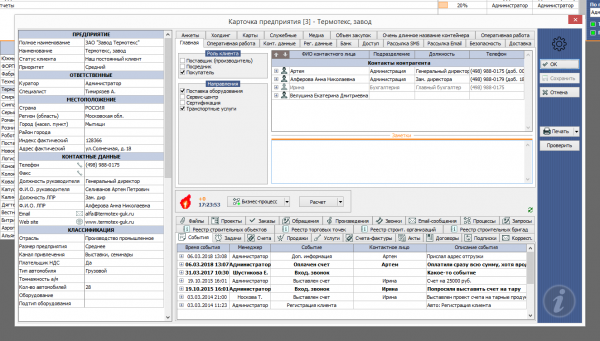
Customer card in . The top block contains all the information about the client that you can theoretically enter and accumulate. The bottom block covers operational activities, routines, and interactions with the client. If everything is filled out, it will be almost the coolest business dossier 😉
No delays or mishaps
The company's image risks are reduced, and the fear of an employee becoming the cause of reputational problems disappears. If a manager misses a meeting or forgets a call, it reflects incompetence on the company's part and a lack of interest in the deal. What could be worse? A CRM system ensures deadlines are met, provides transparency in employee workload, and sends reminders, making it virtually impossible to miss an event.
Moreover, corporate calendars and planners allow you to see the availability of the colleague you need and respect their time, or even request part of their free time—this communication reduces conflict, yet does not formalize relationships, since we are all accustomed to calendars and plugins in our personal lives; they are not associated with rigid working relationships.
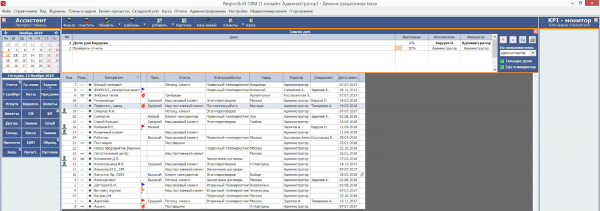
On the CRM desktop, current tasks are displayed (we call them ongoing since they are not tied to specific dates), as well as badges on the Assistant panel—numbers that inform you where to go in the interface and what to do. There are also pop-up reminders, SMS, and email notifications. Good luck trying to forget!
Speed of operation.
The speed of work increases significantly. At first glance, it seems that entering data into a CRM system increases the time spent on operational tasks. This is a logical trick used by CRM opponents for their selfish purposes. In reality, it works differently: all necessary information about the client is entered once, which in turn saves a considerable amount of time; initial data is generated based on pre-prepared templates in just a few seconds, incoming and outgoing calls are registered and can be listened to directly from the client card, corporate email is organized and distributed among contacts and clients (at least that's how it is in RegionSoft CRM).
But the main advantage of speeding up work with CRM lies not in the operational routine, but in the fact that after mastering the CRM system, productivity increases and the sales process lifecycle decreases overall, thus providing room for revenue growth. Indirectly, this affects salary increases or bonus formation.
KPI
If you create an adequate set of KPIs that are measurable and truly dependent on employee efforts, a CRM with a built-in KPI calculation system will become an excellent motivator for the employee, as they will constantly have progress bars of target achievement in front of them and will be able to redistribute their efforts to 'hit' the maximum coefficient and receive the well-deserved bonus. Thus, you will have a monitoring mechanism for achieving both general targets and those for each department/employee, and the employee will be able to automate their work and be more efficient.
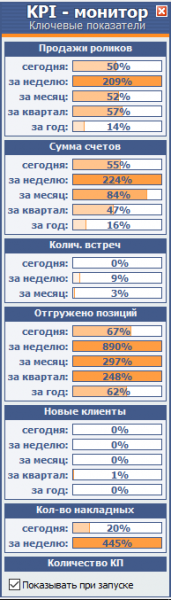
Our favorite KPI monitor in — all target indicators are at a glance. The indicators themselves can be customized, and their number is only limited by reasonable boundaries.
Teamwork without fear or reproach
A CRM system is a form of teamwork. This capability is determined by its software architecture: a single database provides information to the sales agent, support staff, marketer, warehouse manager, etc. Now, a marketer or manager does not need to ask which product sold the worst or which has been sitting in stock — they can access the necessary commercial information, draw conclusions, and make plans. The entire team works to maintain up-to-date information.
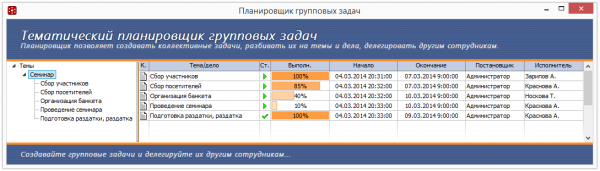
The group planner is essentially a Gantt chart, displaying responsibilities, progress levels, deadlines, and more.
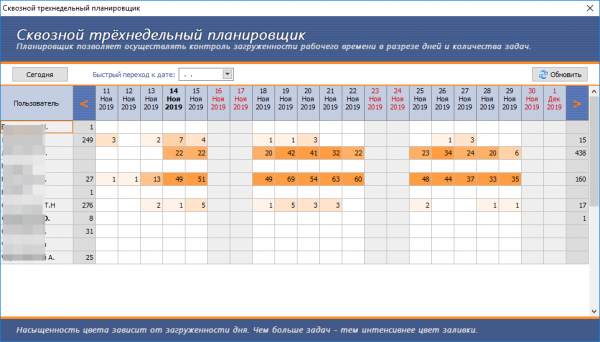
A comprehensive three-week planner provides an overview of the entire team's availability for the upcoming three weeks.
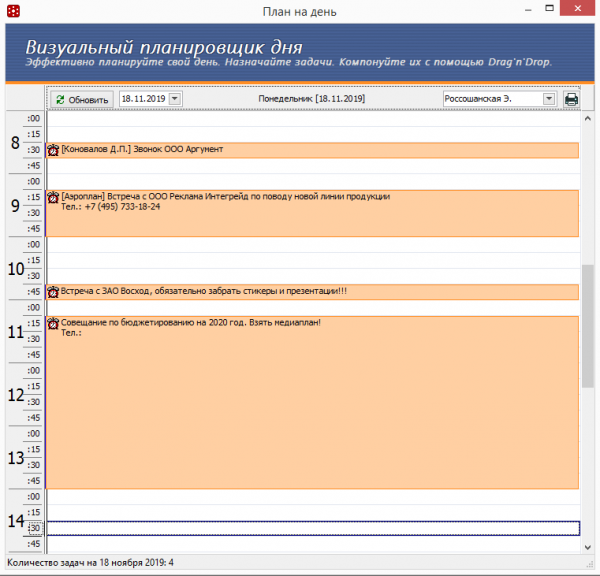
A visual daily plan for an individual employee, with direct access from planners.
Employees utilize a unified CRM environment for sharing information, delegating tasks, and collaborating on projects, making internal relationships more productive. The team efforts are consolidated within CRM as a means of managing customer relationships, and this approach yields a synergistic effect that cannot be achieved through standard meetings, requests, and discussions.
Responsibilities are clear.
Perhaps the most unpleasant aspect of teamwork is looking for the culprit when a business process falters or is delayed. Employees start blaming each other, trying to absolve themselves and point fingers at their colleagues, diluting accountability to a collective level. CRM addresses this issue as well: business processes with a visual designer, complete tracking of stage movements, control of regulatory deadlines, and interactive parameters solve the problems of employee accountability and transparency in the workflow from the ground up. The process is documented, and it is always possible to check who caused the delay or stoppage.
Therefore, do not fear business processes even in small companies — they will prove beneficial everywhere and significantly impact order in the company.
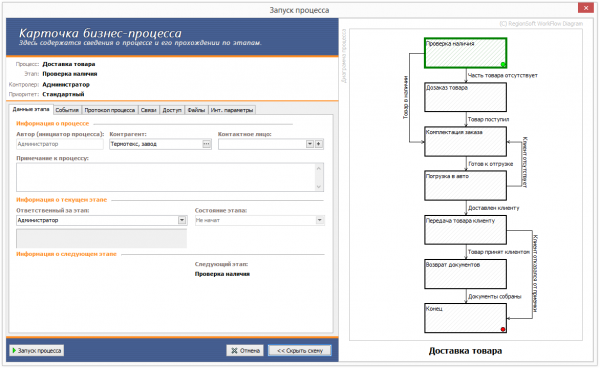
A business process in RegionSoft CRM is easy to construct and manage.
Company, let me take the wheel.
CRM enables each employee to feel like a leader in the business process: the more knowledge your employees have, the more authority and opportunities they possess. The current data accumulated and processed in a modern CRM helps to address client issues effectively, such as referring to the history of relationships, revisiting problematic questions, and evaluating the client not only in the context of the current deal but also through the lens of past interactions. From an outsider's perspective, it looks impressive and appealing. As a client, I can easily identify a company with a good CRM by the way the managers communicate with me 🙂. And, of course, the ability to 'take the lead' is very motivating.
Effective working method
Every capable manager, when working with CRM, becomes a bit of a scholar and experimenter. The software helps track the sales process, collect and analyze data on deals, based on which one can create their own innovative style of communication with clients. Consequently, the most productive behavioral models can be identified and used to increase results.
Replacement on the field
In case of absence or resignation of an employee, the transition of responsibilities to another colleague is seamless, along with granting access to the CRM. This significantly reduces risks in case of an 'unpleasant' dismissal, employee boycott, etc. Because the super admin can easily transfer rights, negative processes within the team are mitigated and addressed on an interpersonal level, without affecting work.
The implementation of CRM is always associated with high expectations. Managers and employees both hope that the CRM system will boost productivity, increase sales, simplify operations, and save money. This is correct; any change should be accompanied by expectations. However, one should not wait for CRM to deliver, but rather for the people who will work with it. Better yet, don’t wait at all—implement and take action. Then the CRM system will be much more effective than a lucky horseshoe, which, by the way, is also better nailed to the hoof and used for work—then both luck and money will follow! 🙂
Source: habr.com
