

Below you will find a review from specialists of the Houdini Team at the Krasnodar studio Plarium about the video courses and from Mix Training, dedicated to working with the Python and Vex languages in the graphics program Houdini.
In this post, the guys also share a collection of resources that will be useful for anyone interested.

A little introduction
The Vex language intimidates novice Houdini users. Much of this is due to the stereotype that coding is essential in Houdini. In reality, Houdini in allows for coding, which actually simplifies and speeds up many processes rather than complicating them. For example, it helps avoid such daunting setups:
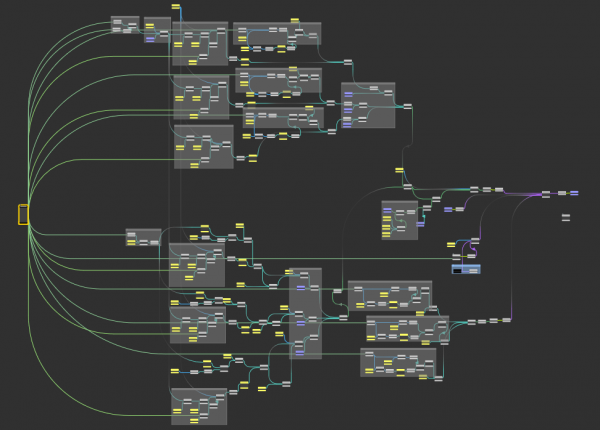
The Vex language was created for writing shaders in the Mantra renderer (the built-in renderer of Houdini), but it quickly expanded beyond its original use due to its flexibility, simplicity, and speed. The name of the language comes from the abbreviation for Vector Expressions, but it can manipulate completely different types of data. Thus, Vex is primarily used for various kinds of manipulations of geometry components (points, polygons), as well as for procedural geometry creation.
The Vex language is quite forgiving in terms of syntax and code formatting, with a relatively low entry threshold. Often, just a couple of lines are enough to achieve the desired result. Among its advantages are also multithreading and, consequently, good speed. Programming in Vex is necessary for both simple tasks and complex calculations, and the language handles all this extremely quickly. You can do a lot of amazing things in procedural modeling, animation, and simulations with it.
Of course, we like it when someone thinks we're all such programmers, but in reality, we are accustomed to functionality and convenience (though many who work in Houdini for the first time may conclude that it’s easier to sleep on nails). If a tool doesn’t make our life easier, we wouldn’t use it. So, the possibility of programming shouldn't be seen as something that hinders starting to learn Houdini. Vex is just another (albeit very good) tool among many others.
Python, far more widely known, needs no introduction or detailed description. Let's discuss its relevance. In the context of Houdini, Python is used to control the program itself (creating nodes in a project, file operations, automating repetitive tasks, executing complex combinations of actions, etc.). Additionally, programming in Python is necessary for creating beautiful interfaces in tools and writing convenient commands that manage assets with the press of a button. If there were a 'make it pretty' button in a Houdini asset, it would be written in Python. Furthermore, it is sometimes used for manipulating geometry (just like the VEX language), but it's important to understand that Python is less intuitive for such purposes and often executes these tasks slower than VEX.
Learn more about the courses
The developer of Houdini, Side Effects Software, releases so many updates and provides so many opportunities for users that the official documentation and training courses simply cannot keep up. Therefore, we are gathering information from various sources (both paid and free, official and unofficial) piece by piece to master these flexible and powerful tools — the programming languages VEX and Python (and Houdini as a whole) — in the most comprehensive way possible. We chose courses from Mix Training because they aimed for a broad coverage of material on Python and VEX in Houdini.
The course author has a (a decent resource for those looking to start learning Houdini), characterized by an informal relaxed presentation and a wide range of topics, from motion design to game development. Besides the channel, he also has his own garage death metal band. We decided the author was trustworthy and purchased and , with 8 hours for each course (you can watch at 1.5x speed).
Advantages
- Usefulness for specialists of different levels. These courses can be compared to a library containing all the most important aspects of Vex and Python in Houdini, from basic elements to advanced and complex setups. In Vex, from defining attributes and variables to the original implementation of the Space Colonization algorithm. In Python, from simple automatic node creation in the scene and small improvements within the Houdini program to a custom-built attribute manager. There is all the necessary basic information on the syntax of these two languages and their interaction with Houdini.
The course has a lot for beginners, but that didn't discourage us at all. Reviewing video lessons or re-reading articles on basic aspects of Houdini reveals new insights and offers a fresh understanding of familiar concepts. Furthermore, almost everything in Houdini can be done in different ways, gradually forming your unique style, so observing a master's work is always valuable and interesting. Even the way nodes are organized in a project can say a lot about its creator.
- Relevance. Extensive and fundamental courses are rarely up-to-date. Many have not kept pace with the development of Houdini, which has changed significantly over the past three years. Established approaches have been replaced by new, more optimized, and user-friendly methods (the old ones haven’t disappeared but are no longer preferred). In particular, the role of the Vex language has increased in Houdini work. When studying the fundamentals of Houdini, it is crucial to know which methods are current, so that when encountering older (and often more complex) learning materials, you can effectively apply the information in practice.
And the downsides…
- The courses do not provide ready-made solutions for real production. The author chooses lesson topics and ways to address tasks more for demonstration purposes than for achieving an optimized final result. These solutions are not always the most efficient, and not all of them fit the definition of "best practices." If you are looking for a step-by-step guide covering all stages of production from start to final render (such as , for example), then these courses may not be entirely for you. The author prefers to leave the ending open, which may be a bit discouraging for novice Houdini users.
- The side effects of informal delivery and improvisation. The author sometimes makes mistakes (which can be a plus) or spends class time trying to recall or concentrate on something. Given that the information in the courses is largely introductory due to the breadth of the material, there is no time to stop and delve into any specifics. As a result, the author's pauses and spontaneous decisions can lead to even more questions. Fortunately, he has on creating a project manager in Houdini using Python, and in some aspects they are more practical and detailed than the information on the same topic in the courses.
In our opinion, the pros significantly outweigh the cons. If you want to systematically study programming capabilities in Houdini (and Houdini itself), these video lessons are a great starting point. They will also serve as a useful supplement to other educational materials and resources — such as an overview of the main aspects of using Vex and Python in Houdini or a video reference where you can quickly look up something.
Bonus: some inspiring and educational links
- — the GreyScaleGorilla of the Houdini world (Cinema4D users will understand us). A very broad range of topics and excellent presentation of material. By the way, they just launched a new season recently.
- — a legendary figure in the Houdini community. He focuses more on inspiration than specific practical techniques. Remember him if you need to see and feel what can be done in Houdini.
- — an excellent designer and instructor.
- — the author of one of the most significant and popular resources for learning Houdini — . A resource that is regularly updated, it is full of useful information and ready-made solutions. Highly recommended.
- — our compatriot, the author of the well-known outstanding course for Houdini . It's unlikely that you'll master it completely on your first or even second try, but it's definitely worth pursuing: there's so much information on advanced practices in Vex and procedural modeling that is hard to find. For inspiration, we recommend checking out the author's presentation .
- A channel with very high-quality lessons on Houdini in Russian. So high-quality that some English-speaking users even wish to learn Russian just to be able to watch these lessons. The educational materials are divided by based on the level of difficulty.
Source: habr.com
