

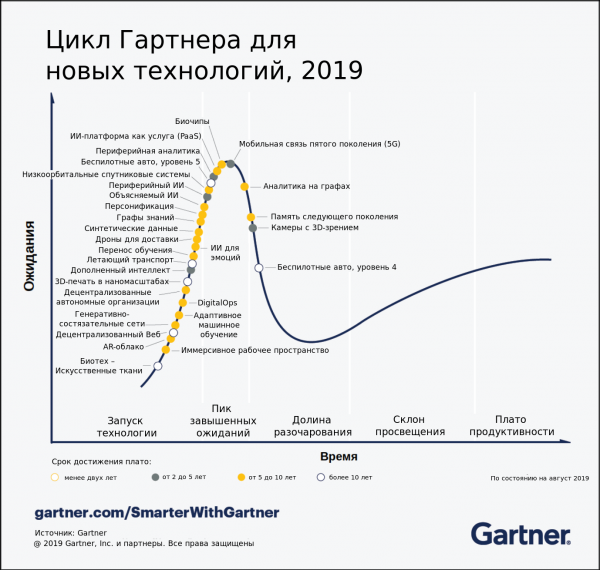
The Gartner Hype Cycle for those working in technology is like a high fashion exhibition. By looking at it, you can get an early glimpse of which words are the trendiest this season and what you'll hear at all the upcoming conferences.
We've decoded what lies behind the beautiful words on this chart so you can speak that language too.
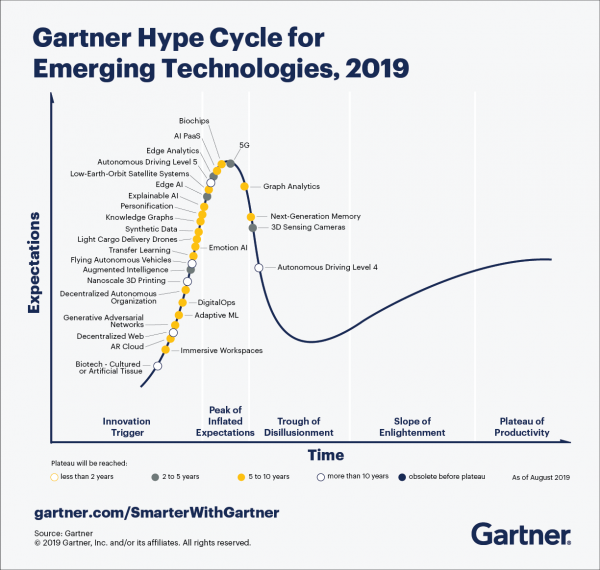
First, just a few words about what this chart is. Every year in August, the consulting agency Gartner releases a report — the Gartner Hype Curve. In English, that's known as the 'hype curve' — or more simply, hype. Thirty years ago, rappers from Public Enemy sang: 'Don't believe the hype'. Whether to believe it or not is a personal decision, but knowing these key terms is essential if you work in technology and want to keep up with global trends.
This chart represents public expectations of a given technology. According to Gartner, ideally, a technology goes through 5 stages: technology triggers, peak of inflated expectations, trough of disillusionment, slope of enlightenment, and plateau of productivity. However, sometimes it drowns in the 'trough of disillusionment' — you can easily recall examples such as Bitcoin: initially peaking as 'the money of the future', it quickly dropped when the technology's drawbacks became clear, primarily the limitations on transaction volume and the enormous amount of electricity required to produce bitcoins (which leads to ecological issues). And of course, one should not forget that the Gartner chart is just a forecast: for instance, you can read detailed , which discusses the most striking unmet predictions.
So, let's take a look at the new Gartner chart. Technologies are divided into 5 major thematic groups:
- Advanced AI and Analytics
- Postclassical Compute and Comms
- Sensing and Mobility
- Augmented Human
- Digital Ecosystems
1. Advanced AI and Analytics
For the past 10 years, we have witnessed the rise of deep learning. These networks are truly effective for their specific tasks. In 2018, Yann LeCun, Geoffrey Hinton, and Yoshua Bengio received the Turing Award for their breakthroughs in this field – the most prestigious award, akin to a Nobel Prize in computer science. So, here are the main trends in this area, which are presented on the graph:
1.1. Transfer Learning
You do not train a neural network from scratch; instead, you take a pre-trained one and assign it a different goal. Sometimes, this requires retraining part of the network, but not the entire network, which is much faster. For example, by taking the pre-trained neural network ResNet50, which was trained on the ImageNet1000 dataset, you will obtain an algorithm that can classify a wide variety of objects at a very deep level (1000 classes based on features developed by 50 layers of the neural network). However, you do not need to train the entire network, which would take months.
In Samsung "Neural Networks and Computer Vision", for instance, in the final with the classification of dishes as clean or dirty, demonstrates an approach that gives you access to a deep neural network capable of distinguishing dirty plates from clean ones in just 5 minutes, built using the architecture described above. The original network did not know what plates were; it only learned to differentiate between birds and dogs (see ImageNet).

Source: Samsung "Neural Networks and Computer Vision"
For Transfer Learning, you need to know which approaches work and what ready-made foundational architectures are available. Overall, this significantly accelerates the emergence of practical applications of machine learning.
1.2. Generative Adversarial Networks (GAN)
This is for those cases when it is very difficult for us to formulate a learning objective. The closer the task is to real-life situations, the clearer it is to us ("bring me the nightstand"), but the harder it is to define it as a technical assignment. GAN is precisely an attempt to free us from this problem.
Two networks operate here: one is the generator (Generative) and the other is the discriminator (Adversarial). One network learns to perform useful tasks (classifying images, recognizing sounds, drawing cartoons). The other network learns to teach that network: it has real examples, and it learns to find a previously unknown complex formula to compare the outputs of the generative part of the network with real-world objects (the training dataset) based on truly significant deep features: the number of eyes, proximity to Miyazaki's style, the correctness of English pronunciation.

An example of the network's output for generating anime characters.
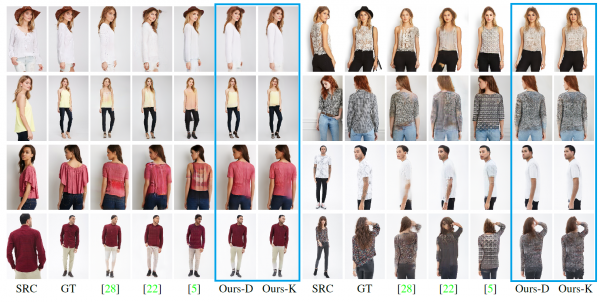
However, it is certainly challenging to build the architecture. It's not enough to just throw in neurons; they need to be trained. And teaching can take weeks. My colleagues at Samsung's Artificial Intelligence Center are working on GANs, and it's one of their key research questions. For example, such : the use of generative networks to synthesize realistic photographs of people with adjustable poses — for instance, to create a virtual fitting room, or for face synthesis, which could reduce the amount of information that needs to be stored or transmitted to ensure high-quality video communication, broadcasting, or protection of personal data.
1.3. Explainable AI
In some rare tasks, progress in deep architectures has suddenly brought the capabilities of deep neural networks closer to those of humans. Now the battle is on to expand the range of such tasks. For example, a robot vacuum could easily distinguish a cat from a dog in a head-on encounter. But in most real-life situations, it would be unable to find a cat sleeping among laundry or furniture (just like us, in most cases…).
What is the reason behind the success of deep neural networks? They generate a representation of the task that is not based on the 'visible to the naked eye' information (pixels of photographs, volume fluctuations, etc.), but on features obtained after preprocessing this information through several hundred layers of the neural network. Unfortunately, these relationships can also be meaningless, contradictory, or bear traces of imperfections from the original dataset. For instance, a small computer game illustrates what thoughtless AI application in recruiting might lead to. .
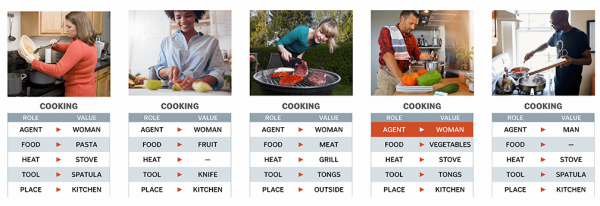
The image labeling system identified a person cooking as a woman, even though the picture actually shows a man (). This at the Virginia Institute.
To analyze the complex and deep relationships that we often cannot articulate ourselves, methods of Explainable AI are necessary. They organize the features of deep neural networks in such a way that after training we can analyze the internal representation learned by the network, rather than simply rely on its decision.
1.4. Edge Analytics / AI
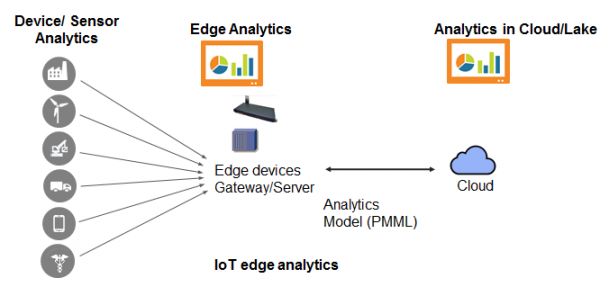
Everything that contains the word Edge literally means: transferring part of the algorithms from the cloud/server to the level of the end device/gateway. Such an algorithm will trigger faster and will not require a connection to the central server to operate. If you are familiar with the abstraction of a 'thin client', here we are thickening that client a bit.
This can be important for the Internet of Things. For example, if a machine overheats and needs cooling, it makes sense to send a signal about this right away, at the factory level, without waiting for the data to reach the cloud and then be sent to the shift supervisor. Or another example: self-driving cars can handle road conditions on their own, without consulting a central server.
Or another example of why this is important from a security standpoint: when you type texts on your phone, it memorizes your typical words so that the phone's keyboard can conveniently suggest them to you – this is called predictive text input. Sending everything you type on the keyboard to a data center would be a violation of your privacy and simply unsafe. Therefore, keyboard training occurs only within your device.
1.5. AI Platform as a Service (AI PaaS)
PaaS – Platform as a Service – is a business model through which we gain access to an integrated platform, including its cloud data storage and ready-made procedures. This way, we can free ourselves from infrastructure tasks and fully concentrate on producing something useful. Examples of PaaS platforms for AI tasks include IBM Cloud, Microsoft Azure, Amazon Machine Learning, and Google AI Platform.
1.6. Adaptive Machine Learning (Adaptive ML)
What if we allow artificial intelligence to adapt... You might ask – how so?.. Doesn't it already adapt to the task? The issue is that we carefully arrange each task before building an algorithm to solve it using artificial intelligence. You will find out that it is possible to simplify this chain as well.
Traditional machine learning operates on the principle of an open-loop system: you prepare the data, come up with a neural network (or anything else), train it, and then look at a few metrics, and if everything looks good, you can deploy the neural network to smartphones to solve user tasks. However, in applications where there is a large amount of data that gradually changes in nature, other methods are needed. Such systems, which adapt and self-train, organize into closed, self-learning loops, and they must operate seamlessly.
Applications can include stream analytics, based on which many businesspeople make decisions, or adaptive production management. In the context of modern applications and considering the better-understood risks to people, the methods that address this problem are collectively referred to as Adaptive AI.
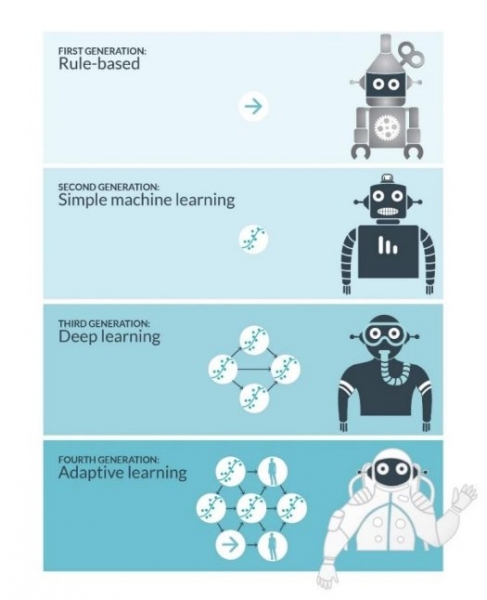
Looking at this picture, it's hard to shake the feeling that futurists should not just be fed – they should be taught to make robots breathe…
Postclassical Compute and Comms
2.1. Fifth Generation Mobile Communication (5G)
This is such an interesting topic that we immediately refer back to our . Here’s a brief summary. 5G will make Internet speeds incredibly fast due to increased data transmission frequencies. Short waves struggle to pass through obstacles, so the infrastructure will be entirely different: we will need 500 times more base stations.
Along with speed, we will witness new phenomena: real-time games with augmented reality, performing complex tasks (like surgery) through telepresence, and preventing accidents and difficult situations on roads through vehicle communication. More mundanely, mobile Internet will finally stop dropping during mass events, such as matches at stadiums.
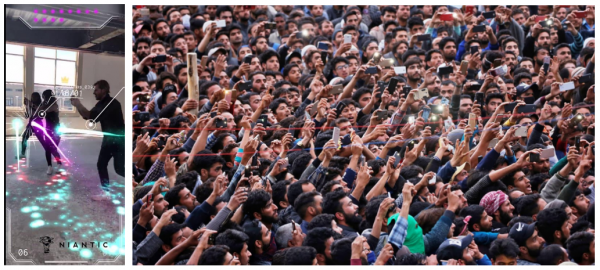
Image source - Reuters, Niantic
2.2. Next-Generation Memory
This concerns the fifth generation of RAM – DDR5. Samsung announced that products based on DDR5 will appear by the end of 2019. The new memory is expected to be twice as fast and twice as dense while maintaining the same form factor, allowing us to achieve memory modules with capacities up to 32GB for our computers. This will be especially relevant for smartphones (the new memory will have a low power consumption version) and for laptops (where the number of DIMM slots is limited). Additionally, machine learning demands large amounts of RAM.
2.3. Low-Earth-Orbit Satellite Systems
The idea of replacing heavy, expensive, powerful satellites with a swarm of small, cheap ones is not new and emerged back in the '90s. Everyone has heard that only the lazy have not heard about it lately. The most well-known company in this field is Iridium, which went bankrupt in the late '90s but was saved by the U.S. Defense Department (not to be confused with iRidium – the Russian smart home system). Elon Musk's project (Starlink) is far from the only one – Richard Branson (OneWeb – 1440 planned satellites), Boeing (3000 satellites), Samsung (4600 satellites), and others are also participating in the satellite race.
For updates on this field and how the economics are shaping up, read on We are waiting for the first tests of these systems by the initial users, which are set to take place next year.
2.4. Nanoscale 3D Printing
3D printing, although it hasn't become a part of everyone’s life (in the form of an individual home plastic factory), has long exited the niche of geek technologies. This can be judged by the fact that even schoolchildren are aware of the existence of 3D sculpting pens, and many dream of acquiring a box with a slide and an extruder for... 'just for fun' (or have already acquired one).
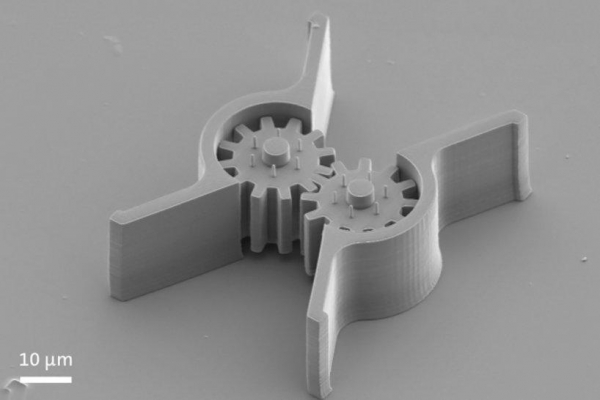
Stereolithography (laser 3D printers) allows for printing with individual photons: new polymers are being researched that only require two photons for solidification. This will enable the creation of completely new filters, fixtures, springs, capillaries, lenses, and... your ideas in the comments! And this is not far from photopolymerization – only this technology allows for 'printing' processors and computational circuits. Additionally, but without radical progress.
3. Sensing and Mobility
3.1. Autonomous Driving Level 4 & 5
To avoid confusion in terminology, it’s important to understand the different levels of autonomy (taken from detailed , to which we refer all interested parties):
Level 1: Cruise Control: assists the driver in very limited situations (for example, maintaining the car's speed after the driver lifts their foot off the pedal)
Level 2: Limited assistance with steering and braking. The driver must be ready to take control almost immediately. Their hands are on the wheel, and their eyes are on the road. This is what's already available in Tesla and General Motors vehicles.
Level 3: The driver no longer has to constantly monitor the road. However, they must remain alert and be ready to take control. This capability is not yet available in commercially sold cars. All existing models are at level 1-2.
Level 4: Real autopilot, but with limitations: only trips in well-known areas that are thoroughly mapped and generally understood by the system, and under certain conditions: for example, in the absence of snow. Prototypes exist at Waymo and General Motors, and they plan to launch them in several cities and test them in real conditions. Yandex has testing zones for self-driving taxis in Skolkovo and Innopolis: trips occur under the supervision of an engineer sitting in the passenger seat; by the end of the year, the company plans to expand its fleet to 100 self-driving cars.
Level 5: Full automation, complete replacement of a human driver. Such systems do not exist, and it is unlikely they will appear in the coming years.
How realistic is it to see all this in the near future? Here, I would like to redirect the reader to the article . This is partly due to the lack of 5G connectivity: the existing 4G speeds are insufficient. Partly due to the very high cost of autonomous vehicles: they are currently unprofitable, and the business model is unclear. In short, this is ‘quite complex,’ and it is no coincidence that Gartner states that the forecast for mass adoption of Levels 4 and 5 is not sooner than in 10 years.
3.2. 3D Sensing Cameras
Eight years ago, the Microsoft Kinect game controller made a splash by offering an affordable and relatively inexpensive solution for 3D sensing. Since then, fitness and dance games with Kinect have experienced a brief rise and fall, but 3D cameras have begun to be used in industrial robots, autonomous vehicles, and mobile phones for facial recognition. The technology has become cheaper, more compact, and more accessible.
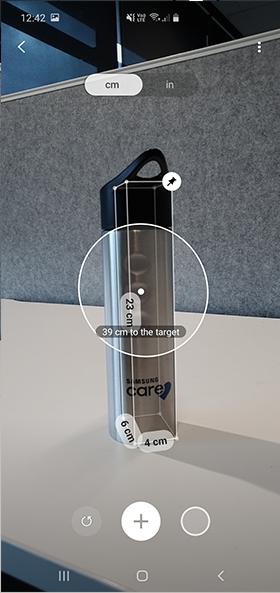
The Samsung S10 phone has a Time-of-Flight camera that measures the distance to an object – to simplify focusing.
If you are interested in this topic, we redirect you to a very good detailed overview of depth cameras: , .
3.3. Light Cargo Delivery Drones
This year, Amazon made waves when it showcased a new flying drone at the exhibition, capable of carrying small loads of up to 2 kg. For urban areas, with their traffic jams, this seems like an ideal solution. Let's see how these drones perform in the very near future. Perhaps a note of cautious skepticism is warranted here: there are numerous issues, ranging from the potential for easy theft of the drone to legislative restrictions on UAVs. Amazon Prime Air has been around for six years but is still in the testing phase.
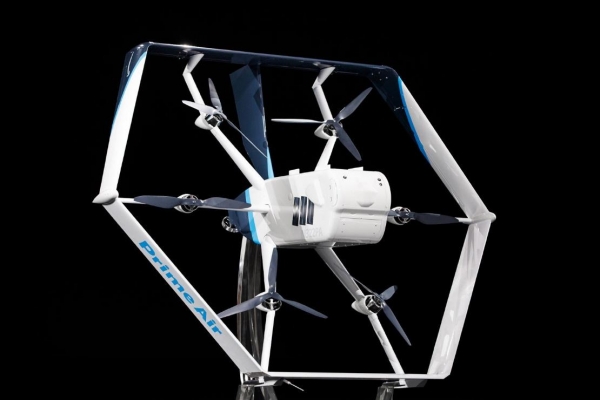
The new Amazon drone showcased this spring. It has something of the 'Star Wars' about it.
Besides Amazon, there are other players in this market (there are detailed ), but no ready-made products: everything is in the testing and marketing stages. It is worth noting some quite interesting niche medical in Africa: delivering donor blood in Ghana (14,000 deliveries by Zipline) and Rwanda (by Matternet).
3.4. Flying Autonomous Vehicles
It's hard to say anything definitive here. According to Gartner, this will not appear for at least another 10 years. Essentially, the same issues exist as with driverless cars, only they take on a new dimension—vertical. Porsche, Boeing, and Uber have all announced ambitions to build flying taxis.
3.5. AR Cloud
A constant digital replica of the real world, allowing for the creation of a new layer of reality shared among all users. To speak in more technical terms, this means creating an open cloud platform into which developers can integrate their AR applications. The monetization model is clear, akin to Steam. The idea has become so ingrained that some now believe that AR without the cloud is simply useless.
What this might look like in the future is illustrated in a short video. It looks like another episode of 'Black Mirror':

You can also read more in the
4. Augmented Human
4.1. Emotion AI
How to measure, simulate, and respond to human emotions? Some of the clients here are companies producing voice assistants like Amazon Alexa. They will truly be able to integrate into homes if they learn to recognize moods: understand the cause of user dissatisfaction and try to rectify the situation. In general, there is much more information in the context than in the message itself. Context includes facial expressions, tone of voice, and nonverbal behavior.
Other practical applications include emotion analysis during job interviews (through video interviews), assessing reactions to advertisements or other video content (smiles, laughter), and assisting with learning (for instance, for self-practice in public speaking).
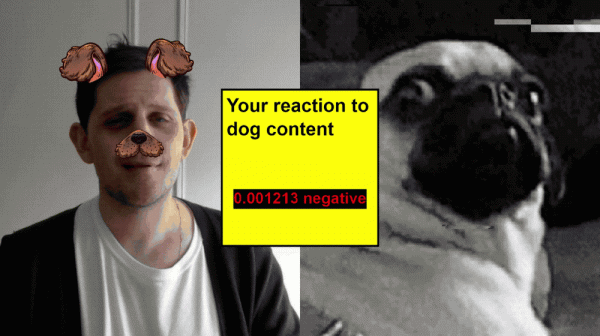
It's hard to express this topic better than the author of the 6-minute short film . The cleverly and stylishly made video shows how we can measure our emotions for marketing purposes and from your immediate facial reactions, determine whether you love pizza, dogs, Kanye West, and even what your income level and approximate IQ are. By visiting the film's website via the link above, you become a participant in an interactive video using your laptop's built-in camera. The film has already been shown at several film festivals.
There’s even an interesting study on how to recognize sarcasm in text. They took tweets with the hashtag #sarcasm and created a training set of 25,000 sarcastic tweets and 100,000 regular tweets about everything. They applied the TensorFlow library to train the system, and here are the results:
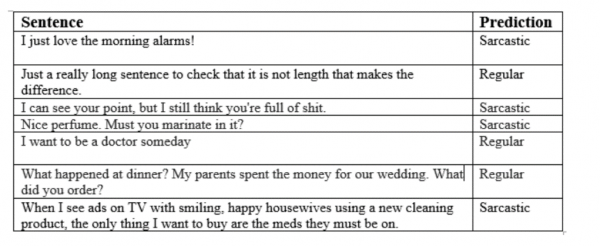
So now, if you’re unsure whether your colleague or friend was being serious or sarcastic, you can use the already !
4.2. Augmented Intelligence
The automation of intellectual labor using machine learning methods. It may seem like nothing new, but the wording is important, especially since it shares the same abbreviation as Artificial Intelligence. This takes us back to the debate about 'strong' and 'weak' AI.
Strong AI is that very artificial intelligence from science fiction movies which is fully equivalent to human consciousness and recognizes itself as a person. Such a thing does not yet exist, and it's unclear whether it ever will.
Weak AI is not an independent personality but a helper-assistant to humans. It does not claim to possess human-like thinking but simply solves informational tasks, such as determining what is depicted in a picture or translating text.
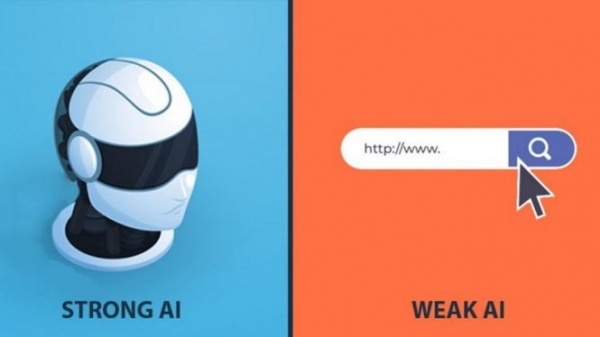
In this sense, Augmented Intelligence is purely a 'weak AI,' and the term seems appropriate as it avoids confusion and the temptation to see here that 'strong AI' which everyone dreams of (or fears, if we recall the many discussions about a 'machine uprising'). By using the term Augmented Intelligence, we immediately feel like characters from another movie: from science fiction (like Asimov's 'I, Robot') we shift to cyberpunk (where 'augmentations' refer to various implants that enhance human capabilities).
How Erik Brynjolfsson and Andrew McAfee: 'In the next 10 years, this will happen. It won't be AI replacing managers, but those managers who use AI will replace those who haven't yet.'
Examples:
- Medicine: Stanford University has developed , which performs the task of recognizing pathologies in chest X-rays with similar success to most doctors.
- Education: assistance for students and teachers, analysis of student responses to materials, building individualized learning paths.
- Business analytics: data preprocessing takes 80% of a researcher's time, leaving only 20% for the actual experiment.
4.3. Biochips
This is a favorite theme in all cyberpunk movies and books. In general, microchipping pets is not a new practice. But now these chips are also being implanted in humans.
In this case, the hype is likely connected to the notorious incident involving the American company Three Square Market. There, the employer began offering to implant chips under the skin in exchange for rewards. The chip allows users to open doors, log into computers, and purchase snacks from vending machines – essentially, it serves as a universal employee card. Moreover, this chip functions only as an identification card; it does not contain a GPS module, so it cannot be tracked. If a person wants to remove the chip from their hand, it takes only five minutes with the help of a doctor.
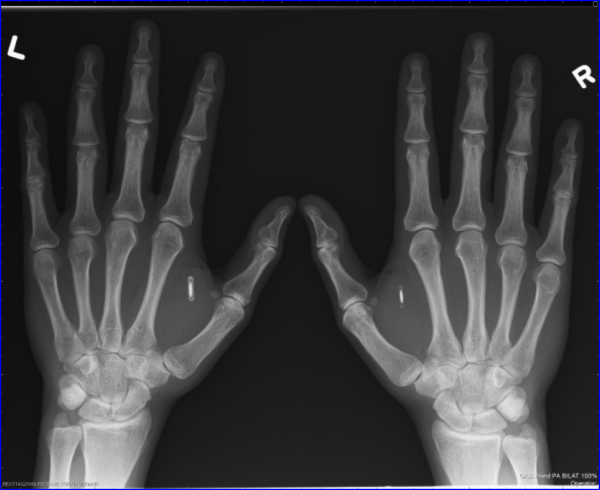
Chips are typically implanted between the thumb and the index finger.
Read more about the state of chipping around the world.
4.4. Immersive Workspace
“Immersive” is yet another new term that seems unavoidable. It’s everywhere: immersive theater, exhibitions, films. What does it mean? Immersiveness refers to creating an effect of immersion, where the boundary between author and audience, as well as between the virtual and real worlds, blurs. In relation to the workplace, this likely means erasing the line between the executor and the initiator and encouraging employees to take a more active role through reformatting their environment.
Since Agile, flexibility, and close collaboration are now ubiquitous, workplaces should be easily configurable and promote teamwork. The economy dictates its terms: there are more temporary employees, office rental costs are rising, and in the competitive job market within IT, companies strive to increase employee satisfaction by creating recreational areas and other perks. All of this influences workplace design.
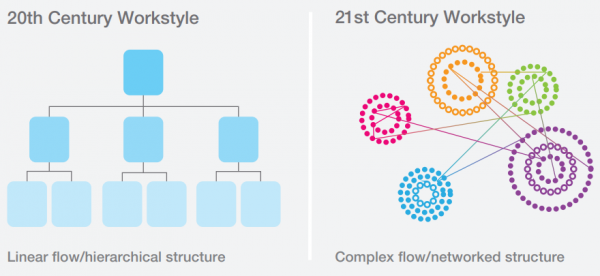
From Knoll
4.5. Personification
Everyone knows what personalization in advertising means. It’s when you discuss with a colleague how the air in the office feels too dry and that you should buy a humidifier, and the next day you see an ad on your social media saying, “buy a humidifier” (an actual case that happened to me).
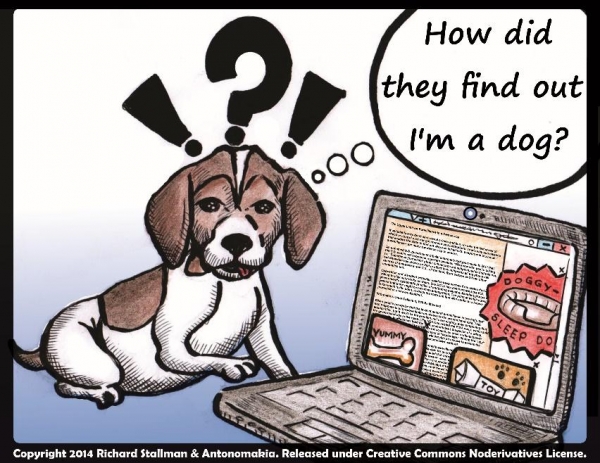
Personalization, as defined by Gartner, is a response to the growing concern among users regarding the use of their personal data for advertising purposes. The goal is to develop an approach where we are shown ads relevant to the context we are in, rather than to ourselves personally. For example, our location, device type, time of day, and weather conditions do not violate our personal data, and we do not feel the uncomfortable sensation of being 'watched.'
To read about the difference between these two concepts, check out by Andrew Frank on the Gartner blog. The distinction is so subtle and the words are so similar that without knowing the difference, you risk arguing for a long time with your interlocutor, unaware that both of you are actually correct (and this is a real situation that happened to the author).
4.6. Biotech – Cultured or Artificial Tissue
This is primarily the idea of growing artificial meat. At the same time, several teams around the world are engaged in the development of laboratory-grown 'Meat 2.0' – it is expected to be cheaper than regular meat, and fast food chains will switch to it, followed by supermarkets. Investors in this technology include Bill Gates, Sergey Brin, Richard Branson, and others.
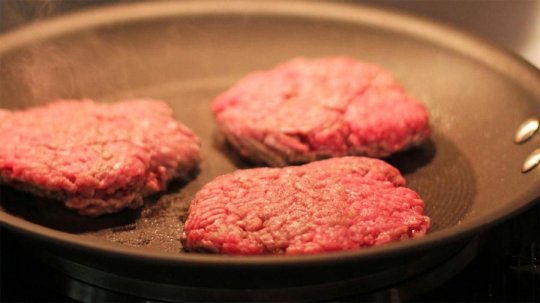
Source
Reasons why everyone is so interested in artificial meat:
- Global warming: methane emissions from farms account for 18% of global greenhouse gases affecting the climate.
- Population growth. The demand for meat is increasing, and it is impossible to feed everyone with natural meat – it is simply too expensive.
- Lack of space. 70% of the Amazon forests have already been cleared for pastures.
- Ethical considerations. There are those for whom this is important. The animal rights organization PETA has already offered a $1 million prize to the scientist who brings artificial chicken meat to market.
Replacing real meat with soy is a partial solution, as people can easily perceive the difference in taste and texture, and are unlikely to give up steak for soy. Thus, true, organically grown meat is necessary. Unfortunately, artificial meat is currently too expensive, costing over $12 per kilogram. This is due to the complex technological process of growing such meat. Read more about all of this. .
When discussing other cases of tissue growth—especially in medicine—an interesting topic is artificial organs: for instance, a "patch" for heart muscle, with a special 3D printer. There are known like the artificially grown mouse heart, but so far everything remains within the scope of clinical trials. So, we are unlikely to see a Frankenstein in the coming years.
Here, Gartner is very cautious in its assessments, apparently keeping in mind its failed prediction from 2015 that by 2019, 10% of the population in developed countries would have a 3D-printed medical device implant. Therefore, it indicates a productivity plateau period of no less than 10 years.
5. Digital Ecosystems
5.1. Decentralized Web
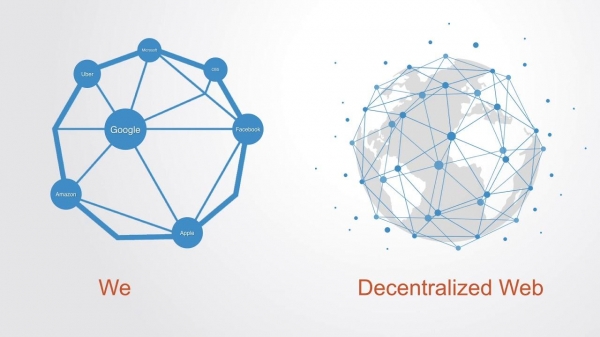
This concept is closely associated with the name of the web's inventor, Turing Award laureate Sir Tim Berners-Lee. For him, ethical issues in computing and the collective nature of the Internet have always been important: by laying the foundations of hypertext, he was convinced that the network should function like a web rather than a hierarchy. This was indeed the case in the early stages of the network's development. However, with the growth of the Internet, its structure became centralized for a number of reasons. It turned out that access to the network for an entire country could easily be shut down with just a few providers. User data transformed into a source of power and income for internet companies.
"The Internet is already decentralized," says Berners-Lee. "The problem is that one search engine, one major social network, and one microblogging platform dominate. We don't have technological problems, but social ones."
In your to mark the 30th anniversary of the World Wide Web, the Web's creator outlined three main issues of the Internet:
- Targeted harm, such as state-sponsored hacking attacks, crime, and online harassment
- The very design of the system that, to the detriment of the user, creates a ground for mechanisms such as financial incentives for clickbait and the viral spread of false information
- Unintended consequences of system design that lead to conflicts and a decline in the quality of online discussion
Tim Berners-Lee already has a response regarding the principles on which a "healthy Internet" could be based, free from problem number 2: "For many users, the only model of interaction with the web remains advertising revenue. Even if people are scared of what is happening with their data, they are willing to make a deal with the marketing machine for the opportunity to access content for free. Imagine a world where the payment for goods and services is easy and pleasant for both sides." One of the ways this could work is that musicians could sell their recordings directly without intermediaries like iTunes, and news sites could use a micropayment system for reading a single article instead of relying on advertising revenue.
As an experimental prototype of this new Internet, Tim Berners-Lee launched the SOLID project, which is based on the idea that you store your data in a "pod" — an information repository — and can allow third-party applications to access this data. Essentially, you are the owner of your data. This is closely related to the concept of peer-to-peer networks, meaning your computer not only requests services but also provides them, so as not to rely on a single server as the sole channel.
5.2. Decentralized Autonomous Organizations
This is an organization governed by rules encoded as a computer program. Its financial activities take place on the blockchain. The aim of creating such organizations is to eliminate the state from the role of intermediary and to create a shared trusted environment for counterparties, which is not owned by anyone individually but collectively by all. In theory, if the idea takes hold, this should abolish notaries and other familiar verification institutions.
The most notable example of such an organization was the venture-capital-oriented The DAO, which raised $150 million in 2016, of which $50 million was instantly stolen through a legal "loophole" in the rules. This created a complicated dilemma: either revert and return the money or acknowledge that the withdrawal was legal as it did not violate any platform rules. Ultimately, to return money to investors, the creators had to destroy The DAO, rewriting the blockchain and violating its fundamental principle – immutability.
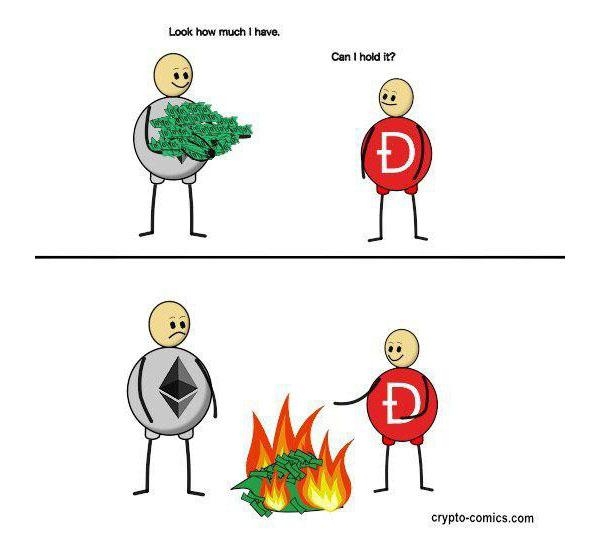
Comic about Ethereum (left) and The DAO (right).
All this damaged the reputation of the very idea of DAO. That project was based on the cryptocurrency Ethereum, and the next year a version of Ether 2.0 is expected – perhaps its authors (including the renowned Vitalik Buterin) will learn from their mistakes and introduce something new. Perhaps that’s why Gartner placed DAO on an upward trend.
5.3. Synthetic Data
Training neural networks requires large amounts of data. Manually annotating data is an enormous task that can only be performed by humans. Therefore, artificial datasets can be created. For instance, similar collections of human faces are available on the website. They are created using GANs – the algorithms mentioned above.
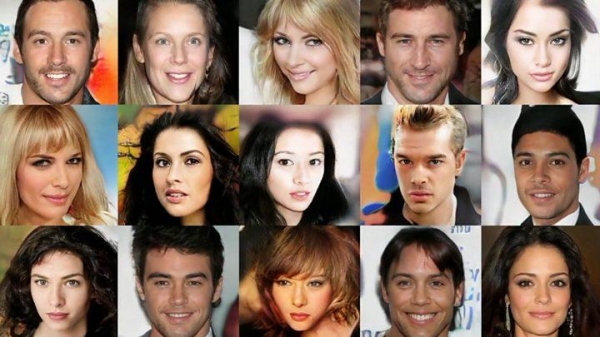
These faces do not belong to real people.
A significant advantage of such data is that there are no legal complications in their use: there is no one to give consent for the processing of personal data.
5.4. Digital Ops
The suffix "Ops" has become incredibly trendy ever since the term DevOps entered our vocabulary. Now, DigitalOps is simply a generalization of DevOps, DesignOps, MarketingOps… Are you still with me? In short, it involves applying the approach adopted in DevOps to all other aspects of business – marketing, design, etc.
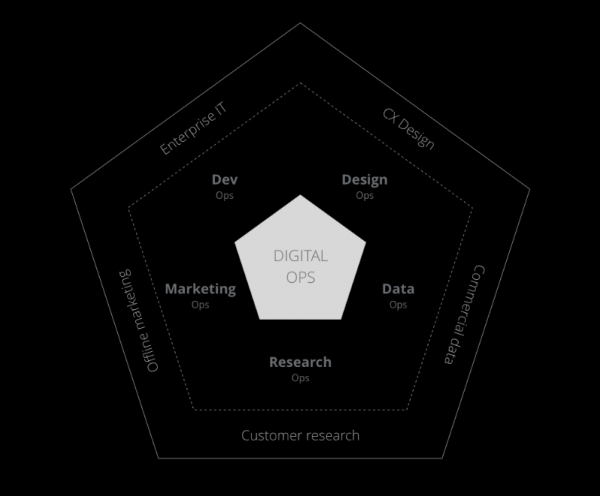
The idea behind DevOps was to eliminate barriers between Development and Operations by creating common teams that include programmers, testers, security professionals, and administrators; implementing specific practices such as continuous integration, infrastructure as code, and enhancing feedback loops. The goal was to speed up product delivery to the market. If you thought this resembles Agile, you were right. Now, mentally transfer this approach from the realm of software development to development in general, and you'll understand what DigitalOps is.
5.5. Knowledge Graphs
A software method for modeling a domain of knowledge, including via machine learning algorithms. A knowledge graph is constructed atop existing databases to unify all information: both structured (a list of events or people) and unstructured (the text of an article).
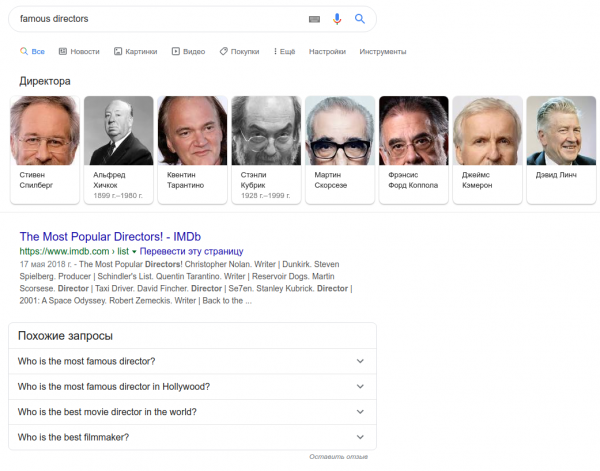
The simplest example is the card you can see in Google's search results. When you search for a person or an institution, you’ll see a card on the right.

Note that 'Upcoming Events' is not a copy of the information from Google Maps but an integration of schedules with Yandex.Events: you can easily see this when you click on the events. This represents the unification of multiple data sources.
If you request a list — for example, 'famous directors' — you will be shown a 'carousel':
A bonus for those who read to the end
And now that we have clarified the meaning of each point, we can look at the same picture, but already in Russian:
Feel free to share it on social media!

Tatiana Volkova — Author of the IoT track educational program at Samsung IT Academy, specialist in corporate social responsibility programs at the Samsung Research Center.
Source: habr.com
