

The most interesting thing that has happened in writing over the past couple of decades is the so-called 'online literature.'
A few years ago, writers gained the opportunity to earn money through their literary work without the mediation of publishers, working directly with readers. I discussed this briefly in the article '«.
On this matter, one can only repeat after the son of a Turkish subject: 'The idiot's dream has come true.'
Indeed, communism has arrived. No more humiliating yourself before a publisher, begging for publication. No more waiting for months or even years for your book to be released. No more giving greedy people the lion's share of the money earned from your talent, getting a pitiful royalty of 10 rubles per book. No more fulfilling their ridiculous demands, no more replacing the word 'butt,' simplifying or shortening the text.
Finally, it became possible to work directly with your readers—face to face. To honestly and directly look them in the eyes, enticingly shaking a cap full of change.
Finally, everything is fair: you, your books, and your greedy readers.
The truth is, it quickly became necessary to recall that honesty is one of the most unpleasant human qualities.
And it became clear that, having rid themselves of one set of problems, writers found themselves with a full pocket of others.
When working with a publisher, a writer had few concerns—just to write the text that the publisher would need, and to prevent the publisher from taking over, periodically striving for mutually beneficial cooperation.
When working directly with readers, it quickly became apparent that everything had to be done by oneself—setting the necessary letters in 'zhy-shy,' stealing images for covers, and finding new readers somewhere. To name things by their true names, you, the talented writer of the name, become an individual entrepreneur or, in Russian, a craftsman. And what's wrong with that? A craftsman, as everyone knows from Ushakov's dictionary, is 'a person engaged in home production for sale in the market, a tradesman.'
Since you'll be engaging in entrepreneurship not in the familiar reality but in the infamous "computer network Internet," you are now not just an "engineer of human souls for those who have crossed over," but also an actual internet project. And this internet project must be realized, preferably with success. Your books are no longer just, pardon the bluntness, hmm... works of art, products of human genius, but also simply products sold online.
This duality of the new working conditions, this amalgam of an ivory tower and a marketplace, this combination in one bottle of high literary standards and lowly commercial endeavors not only generates a lot of laughter but also forces you to tackle numerous problems associated with managing this unexpected internet project.
I will share some of these if there's interest.
However, the topic of the first article is quite obvious — it is the topic of piracy, which any author faces when trying to monetize their literary work online.
Let me be clear — I fully understand the toxicity and contentiousness of this subject. Therefore, I will strive to be careful in my wording, despite my cultivated "ayluli-pognali style" in the articles.
The first question is: Does internet piracy harm book sales online?
Unfortunately, the answer is unequivocal — yes, it does.
In the case of "paper" editions, the issue remains debatable — I have not seen convincing refutations of the argument that the audience purchasing "paper" and the one downloading files from Flibusta are practically non-overlapping audiences.
When it comes to online sales, it is pointless to deny the obvious — both pirates and authors selling their books are targeting the same audience.
Moreover, there is a well-argued opinion that it is precisely the strengthening of the fight against piracy that has made the phenomenon of "professional online writers" possible. The flagship of electronic book sales, "LitRes," was a subsidized project for "EKSMO" for many years, and only after the stringent anti-piracy law of 2015 did it become profitable.
There are various opinions on how much the share of illegal consumption has decreased (I have come across figures suggesting it fell from 98% to 90% in the first few months, but I do not know what they are based on), yet the fact remains — the number of e-book purchases has sharply increased since the second half of 2015.
For example, the popular author Pavel Kornev once a sales chart of his books on LitRes (in units sold), which did not include new releases, only older editions. It seems quite illustrative:
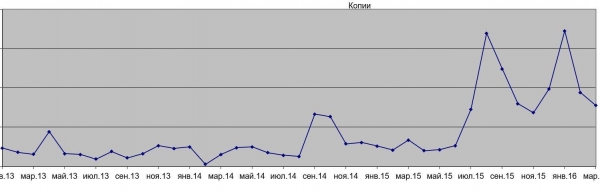
I might add that it is certainly not correct to reduce the growth of legal sales to anti-piracy efforts. At the very least, the emergence of convenient services for online purchases and the ability to pay 'with two clicks' also played a significant role. However, it would be strange to deny its impact — the mere departure of Flibusta into the underground led thousands of computer-illiterate users towards legal stores.
The second question: Did the anti-piracy law solve the problem of book piracy?
Unfortunately, the answer is no less unequivocal — no, it did not.
Yes, Flibusta has gone underground and its audience has declined significantly. Yes, selling books during the writing/release process has allowed ‘to sideline’ the pirates. And yes, it is precisely the money earned during the release of a book that accounts for up to 80-90% of its revenue.
However, the release of a finished book on Flibusta harms its sales quite significantly.
As an example — a sales chart of a very popular book on 'Author.Today':
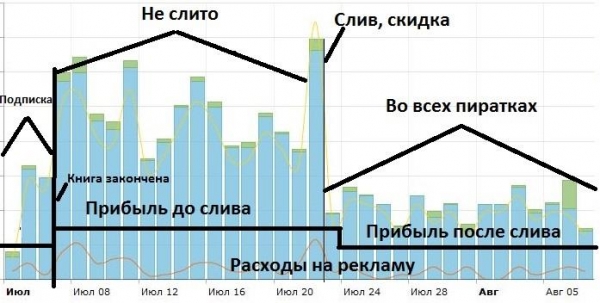
Comments, it seems to me, are unnecessary.
Thus, we can state that the diversion of books to pirates harms 'long-term' sales. If we talk about the influence of this factor on project management, I note that opinions among project managers are divided.
Many authors, aiming to protect themselves from uploads on Flibusta, disable the ability to download their books, allowing only reading on the website. It is believed that books that cannot be downloaded as files are pirated less often. On the other hand, this causes considerable inconvenience to readers, which clearly does not contribute to sales — not everyone wants to be glued to the screen for their own money. So the question remains — what causes more harm to sales, pirates or the inability to download? This question remains debatable, as popular authors do both. However, it is likely that popular authors will be pirated regardless of whether downloads are closed or open.
On the other hand, with the decline of Flibusta, not everyone is being pirated anymore, which has led to social stratification among authors and a new taunt in numerous writer disputes: "You are just an Uncatchable Joe!".
The final remark on this issue is that uploads on Flibusta harm sales but do not eliminate them. As mentioned before, a decreasing percentage of the audience is accessing pirates after the need to penetrate the library "through the back door." Good books still sell even with uploads on Flibusta, and in quite substantial quantities — your humble servant, in less than half a year of being on "Author.Today," received over 100,000 rubles for the quiet sale of a single paid volume of "Into Battle...". This is despite the fact that I am far from being a top author.
The third question, a fundamental one — what are the prospects for book piracy in Russia?
The question is indeed very important — without answering why book piracy in Russia has proven so resilient, we will never understand how to combat it.
Here, there can be no unequivocal answer; I can only present my own thoughts on the matter.
Moreover, contrary to custom, I will start with the conclusion — I will first give the answer and then attempt to justify it.
The reason for the resilience of piracy can be summed up in one phrase: Technological progress has clashed creativity with ethics.
Now, let’s go into a bit more detail. Three important markers.
First: what happened? With the advancement of technology, the means of reproducing information have become so simple and accessible that anyone, even the most illiterate person, can use them. This applies both to the reproduction of information and to the distribution of the created copies.
Second: what did this lead to? In particular, it became virtually impossible to maintain exclusive rights to distribute the products created by creative individuals — musicians, writers, filmmakers, etc. Today, everyone is their own printing house, recording studio, and factory for producing film copies.
Third: how did this worsen? Around the same time, entertainment became a well-established and powerful business industry with huge revenues, which nobody wants to lose. The reference to income concerns writers to a lesser extent, but it is not they who determine the norms of copyright law.
From the perspective of copyright holders, the primary strategy for resisting progress has been chosen, which can also be summed up in one phrase: 'Everyone who uses masterpieces not blessed directly by their creators (and their descendants) is a thief and a scoundrel.'
However, the situation has reached a deadlock. Copyright defenders are increasingly hindering the free distribution, while consumers of copyright products, in full accordance with the saying 'water will find a way through the hole,' have invented newer and more sophisticated methods of distribution.
A new question arises: why? Why do consumers behave so poorly?
Why don't they heed pleas and continue to use illegally distributed copies? Producers usually explain this by saying that people are inherently corrupt, and if there’s a chance to steal without punishment, they will definitely do so. Therefore, they need to be hit harder on the head to deter them from this dishonorable act.
While not completely dismissing this opinion, I would note that the same technical progress has significantly facilitated direct theft. For example, instead of the traditional medieval shop, where goods were displayed out of reach for buyers and guarded by a hefty owner with a club under the counter, we now have supermarkets where you can take whatever you desire. However, even though shoplifting in supermarkets has increased, it has not become a widespread issue and, for the most part, remains the concern of a relatively small group of marginalized individuals.
Why? It's quite simple: people consider stealing from stores as theft, and society, condemning theft as a phenomenon, actively hinders its spread. However, downloading a movie from the internet or a book file from a pirate library is not generally viewed as theft by society en masse.
In other words, the main thesis of copyright supporters regarding theft is perceived by consumers of these authors' products as false.
Why?
For the simplest reason: within traditional ethics, the actions of copyright violators do not constitute theft.
Opponents of free sharing are not fighting against individuals—they are at odds with an ethical system that has existed for many centuries.
Within this ethic, sharing selflessly is not a bad act but a good one. If a person legally obtained something and then gave it to me without any selfish motive, they are not a thief but a benefactor. And I am not a thief, but simply fortunate.
Because sharing in the context of traditional ethics is a virtue.
It will be extremely difficult to persuade people who grew up with the song "Share your smile, and it will return to you more than once," and the cartoon "Just Because," otherwise.
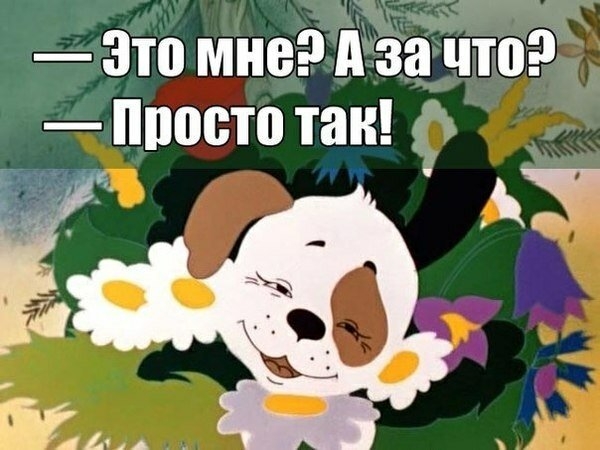
If not impossible.
Because ethical systems do not form randomly; their principles are laws derived through suffering and experience, the validity of which has been confirmed by millennia of existence of the very society that observes them.
And this historical memory states that stealing is wrong because theft threatens the stability of society's existence. Altruism is good because it is a very effective factor that contributes to the survival of the community. That's why parents usually encourage children in the sandbox to let little Vanya play with the toy car, even if it's yours.
And indeed, altruism exists not only among humans but practically among all animals, from birds to dolphins.
And a person who buys a movie on DVD with their own money, which interests me, then spends their own time watching it, subtitles it, and finally uploads it for everyone who wants to see it, including me, demands nothing in return,, — from the perspective of an average person, looks very much like an altruist.
I fully accept the idea that this ethical norm has actually become outdated; this has happened more than once in the history of human society.
Once, in response to harsh words from a man, it was necessary to kill the offender, and those who did not fulfill this requirement significantly lowered their social status in the eyes of others. This is no longer required today. Perhaps the cultural altruism of online pirates is, in fact, a social atavism in a changed world, just like blood revenge — I am certainly open to this possibility.
But the problem is that ethical norms are extremely conservative. To change them requires, firstly, time, and secondly, very serious and intensive propaganda work. To put it bluntly, it's not enough to simply prohibit duels; you also need to explain why this is not good, but bad.
And this is where the opponents of information dissemination face the most serious problems.
Because the current copyright system, formed under the influence of not common sense but greed of rights holders, is becoming more and more grotesque. And we smoothly transition to the last, fourth question:
Question four: What are the prospects for not online piracy, but online writing as such in terms of copyright?
And here again, there can be no definitive answer, only my opinion. In my view, the prospects are not very good.
Because today's freedom, when network authors do whatever they want and are completely free in self-expression, will not last long.
Yes, as long as no one pays attention to us. But we are not interesting to anyone solely because there is little money and a small audience here. Sooner or later, this situation will change, and website owners, where authors currently post their products, will start being pressured about copyright compliance just as is done with print publishers today.
As for what is happening in print publishing — recently at the forum "Author.Today" writer Alexander Rudazov, published by the "Alfa-Book" publishing house:
Censorship is not pleasing. It's one thing to cut out obscene language, even banning the word 'butt.' I got used to that a long time ago; it’s familiar. Much worse is the ban on quotations. You cannot quote any work by an author who passed away less than seventy years ago.
I have faced this before — for example, epigraphs to ‘The Battle of the Multitudes’ and ‘The Dawn over the Abyss’ were banned. There are lines from Theogony and Abu al-Ataheya. Yes, this was written centuries ago, but the translations are much more recent. And I couldn't quote them. Back then, I managed to find the originals in Greek and Arabic on the Internet, ran these excerpts through Google Translate, and wrote my own texts based on that content.
But this time it is impossible. I have quotes from Chukovsky, Mikhailkov, some Soviet and contemporary songs — and not just for fun, they are tied to an important plot element. Unfortunately, I completely forgot about this mandatory rule of the publishing house when I was writing. And now all of this needs to be cut. I will have to cut it. I would prefer the book not to be published at all rather than published with such omissions, but it’s too late, it’s already in progress, there's no turning back now.
It's disappointing, incredibly disappointing. A profound universal sadness.
Perhaps I won't publish the next book in print at all.
Thus, I bid farewell. Next time we will talk about the degrees of freedom in implementing the project 'The Craftsman of Human Souls with the Internet.'
Source: habr.com
