

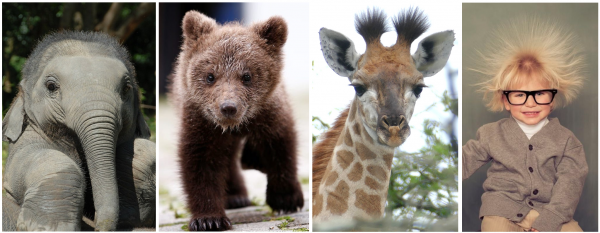
For the modern person, hair is no more than an element of visual self-identification, a part of their image and persona. Despite this, these keratin formations of the skin have several important biological functions: protection, thermoregulation, touch, etc. How strong are our hairs? It turns out they are significantly stronger than the hair of elephants or giraffes.
Today we will explore a study in which scientists from the University of California (USA) aimed to test how hair thickness correlates with its strength across different animal species, including humans. Whose hair turned out to be the strongest, what mechanical properties do the hairs of various species possess, and how can this research aid in the development of new types of materials? We'll find out in the scientists' report. Let's go.
The foundation of the research
Hair, primarily composed of the protein keratin, is a keratinous formation of mammalian skin. In fact, hair, fur, and coat are synonymous. Structurally, a hair consists of layers of keratin that overlap like fallen dominoes. Each hair has three layers: the cuticle – the outer protective layer; the cortex – the fibrous substance made of elongated dead cells (important for the strength and elasticity of the hair, determining its color due to melanin); and the medulla – the central layer of the hair, made up of soft keratin cells and air spaces, which participates in nutrient transfer to other layers.
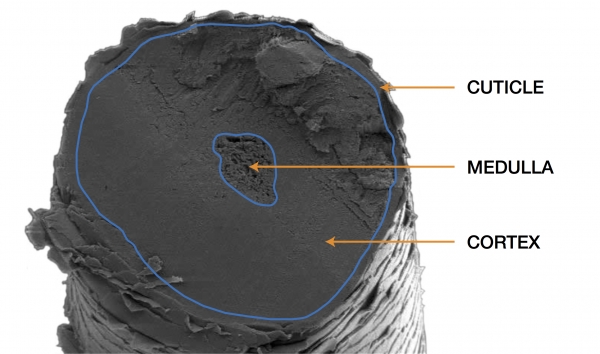
If we split the hair vertically, we obtain the epidermal part (shaft) and the subcutaneous part (bulb or root). The bulb is surrounded by a follicle, the shape of which determines the form of the hair itself: a round follicle results in straight hair, an oval follicle produces slightly wavy hair, and a kidney-shaped follicle leads to curly hair.
Many scientists suggest that due to technological progress, human evolution is changing. In other words, some organs and structures in our body are gradually becoming rudimentary — those that have lost their original purpose. Such body parts include wisdom teeth, the appendix, and body hair. In other words, scientists believe that over time, these structures will simply disappear from our anatomy. Whether this is true or not is hard to say, but for many people, wisdom teeth, for instance, are associated with a visit to the dentist for their inevitable extraction.
That being said, humans need hair; it may no longer play a crucial role in thermoregulation, but it remains an integral part of aesthetics. The same can be said for global culture. In many countries, hair has long been considered a source of strength, and cutting it was associated with potential health issues and even life failures. The sacred significance of hair has transitioned from shamanic rituals of ancient tribes to more modern religions, the works of writers, artists, and sculptors. Specifically, female beauty has often been closely linked to how the hair of lovely ladies looked or was depicted (for example, in paintings).
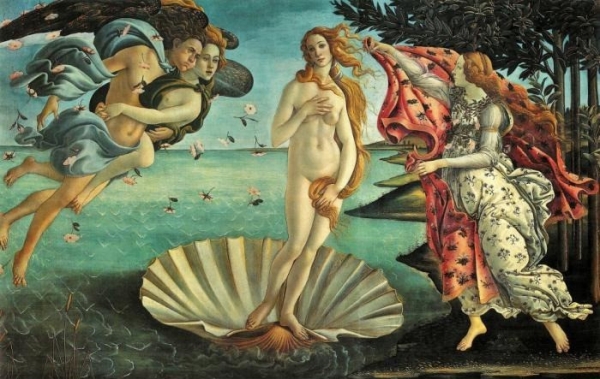
Note how detailed the hair of Venus is depicted (Sandro Botticelli, "The Birth of Venus", 1485).
Let’s set aside the cultural and aesthetic aspects of hair and move on to examining the researchers' investigation.
Hair, in one form or another, is present in many species of mammals. While it may no longer be as important biologically for humans, for other members of the animal kingdom, fur and hair are vital attributes. Moreover, in terms of basic structure, human hair and, for example, elephant hair are very similar, although there are differences. The most obvious of these is size, as elephant hair is much thicker than ours, but, as it turns out, not stronger.
Scientists have been studying hair and fur for quite some time. The results of this research have been implemented in both cosmetology and medicine, as well as in the light industry (or as the well-known Kalugina L.P. would say: 'light industry'), particularly in textiles. Additionally, the study of hair has significantly contributed to the development of biomaterials based on keratin, which was first isolated from animal horns using lime in the early last century.
The keratin obtained in this way was used to create gels that could be strengthened by the addition of formaldehyde. Later, they learned to extract keratin not only from animal horns but also from their fur and even from human hair. Substances created from keratin found their application in cosmetics, composites, and even in tablet coatings.
Today, the industry studying and producing strong and lightweight materials is rapidly developing. Hair, being such a natural material, inspires this type of research. The tensile strength of fur and human hair ranges from 200 to 260 MPa, which is equivalent to a specific strength of 150-200 MPa / mg m-3. This is nearly comparable to steel (250 MPa / mg m-3).
The main role in the formation of hair's mechanical properties is played by its hierarchical structure, resembling a matryoshka doll. The most important element of this structure is the inner cortex made up of cortex cells (diameter about 5 µm, length 100 µm), which consist of grouped macrofibrils (diameter around 0.2-0.4 µm), which in turn are made up of intermediate filaments (7.5 nm in diameter) embedded in an amorphous matrix.
The mechanical properties of hair, its sensitivity to temperature, humidity, and deformation are a direct result of the interaction between the amorphous and crystalline components of the cortex. Keratin fibers in human hair typically have high extensibility, with a break deformation of over 40%.
Such a high value is due to the unwinding of the structure a-keratin, and in some cases, its transformation into b-keratin, leading to an elongation (a full turn of the spiral 0.52 nm stretches to 1.2 nm in configuration. b). This is one of the main reasons why many studies have focused on keratin, attempting to recreate it synthetically. The outer layer of hair (the cuticle), as we already know, consists of scales that are 0.3–0.5 micrometers thick and 40–60 micrometers long.
Previously, scientists have conducted research on the mechanical properties of hair from different age and ethnic groups. This study, however, emphasizes the differences in the mechanical properties of the hair of various animal species, specifically: human, horse, bear, boar, capybara, peccary, giraffe, and elephant.
Research Results
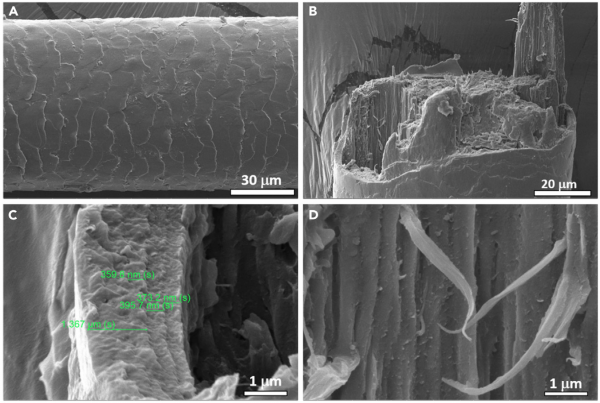
Image #1: morphology of human hair (A — cuticle; In — cortex fracture, showing fiber ends, C — surface of the fracture, showing the three layers; D — lateral surface of the cortex, displaying fiber stretching).
The diameter of an adult human hair is about 80-100 micrometers. With proper hair care, their appearance is quite intact (1A). The inner component of human hair is the fibrous cortex. After tensile testing, it was found that the cuticle and cortex of human hair broke differently: the cuticle typically fractured abrasively (crumbled), while the keratin fibers in the cortex were delaminated and pulled away from the overall structure (1B).
In the image 1C the fragile surface of the cuticle is clearly visible with a visualization of the layers, which are overlapping cuticle scales with a thickness of 350–400 nanometers. The observed delamination on the fracture surface, along with the fragile nature of this surface, indicates a weak interfacial bond between the cuticle and cortex, as well as among the fibers within the cortex.
Keratin fibers in the cortex were delaminated (1D). This indicates that the fibrous cortex is primarily responsible for the mechanical strength of the hair.
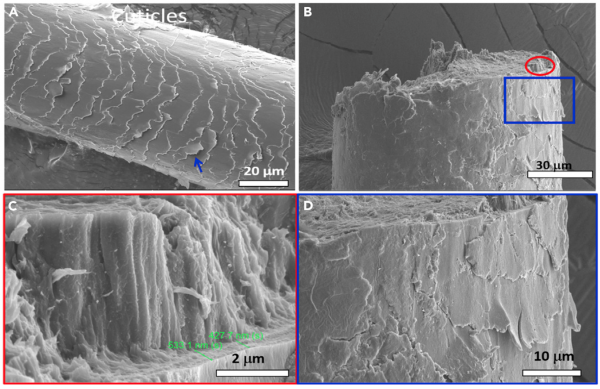
Image #2: morphology of horse hair (A — cuticle, some scales of which are slightly deviated due to lack of care; In — appearance of a break; C — details of the cortex break, showing the detached cuticle; D — details of the cuticle).
The structure of horse hair is similar to that of human hair, except for the diameter, which is 50% larger (150 micrometers). In the photo 2A Visible damage to the cuticle can be seen, where many plates are not as tightly bonded to the shaft as they are in human hair. The breakage of horse hair contains both typical fractures and hair splits (layering of the cuticle plates). 2B Both types of damage are visible. In areas where the plates have completely torn away, the interface between the cuticle and cortex can be seen (2C). Several fibers have been torn and delaminated at the interface. Comparing these observations with previous ones (human hair), similar destructions suggest that horse hair did not experience the same degree of stress as human hair when the fibers in the cortex were stretched and completely detached from the cuticle. It is also evident that some plates have detached from the shaft, which may be related to tensile stress (2D).
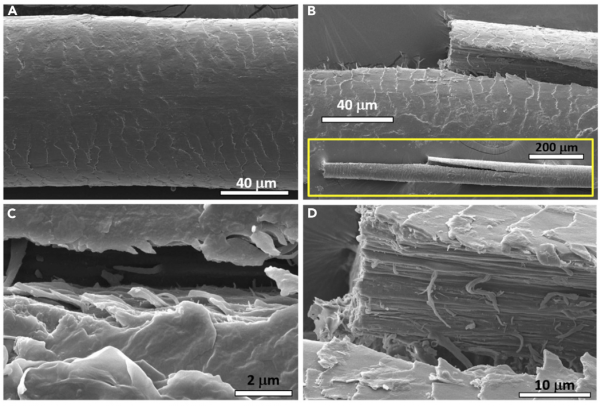
Image #3: morphology of bear hair (A — cuticle; In ) - damage at two points associated with the area of breakage; C ) - cracking of the cuticle with delamination of fibers in the cortex; D ) - details of the fiber structure, several elongated fibers are visible from the overall structure).
The thickness of bear hair is 80 µm. The cuticle plates are extremely tightly attached to each other (3A), and in some areas, it is even difficult to distinguish individual plates. This could be related to friction between the hair and neighboring ones. Under tensile stress, these hairs literally split, producing long cracks (inserted at 3B), indicating that with weak binding effects of the damaged cuticle, keratin fibers in the cortex easily delaminate. Delamination of the cortex leads to rupture in the cuticle, as confirmed by the zigzag pattern of the fracture (3C). This stress leads to the elongation of certain fibers from the cortex (3D).
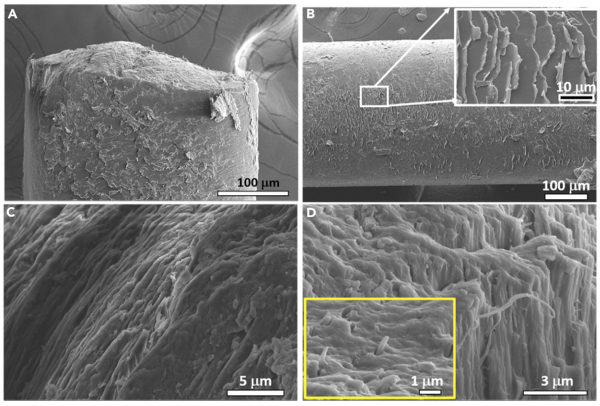
Image #4: morphology of boar hair (A ) - typical flat fracture of hair; In ) - the structure of the cuticle shows poor integrity (grouping) of the plates; C ) - details of the rupture at the interface between the cuticle and cortex; D ) - elongated fibers from the overall mass and protruding fibrils).
Boar hair is quite thick (230 mm), especially in comparison to bear hair. The breakage of boar hair during damage appears quite distinct (4A) perpendicular to the direction of stress during stretching.
Relatively small exposed cuticle plates were torn from the main body of the hair due to the stretching of their edges (4B).
The surface of the fracture zone clearly shows the delamination of fibers, and it is also evident that they were tightly bound together inside the cortex (4C). Only the fibers at the interface between the cortex and the cuticle were exposed due to separation (4D), revealing the presence of thick cortical fibrils (250 nm in diameter). Some of the fibrils slightly protruded outward due to deformation. It is suggested that they serve to strengthen the boar's hair.
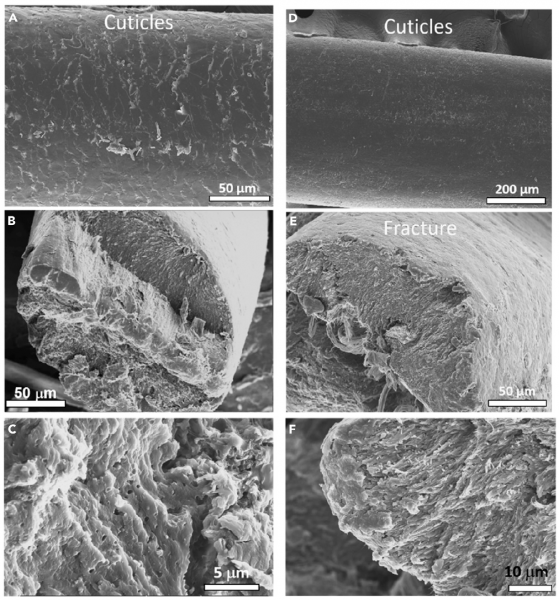
Image №5: morphology of elephant hair (A — C) and giraffe (D — F). A — cuticle; In — stepped breakage of the hair; C — voids inside the hair indicate where fibers were pulled out. D — cuticular plates; E — clean break of the hair; F — fibers pulled from the surface at the breakage area.
Baby elephant hairs can be about 330 μm thick, while adult hairs can reach 1.5 mm. The plates on the surface are difficult to distinguish (5A). Elephant hair is also prone to normal breaking, i.e. a clean fracture under tension. The morphology of the fracture surface demonstrates a stepped appearance (5B), possibly due to the presence of minor defects in the hair cortex. The fracture surface also shows some small holes where, before damage, reinforcing fibrils were likely located (5C).
Giraffe hairs are also quite thick (370 μm), although the arrangement of cuticle plates is less clear (5D). This is thought to be related to damage from various environmental factors (e.g. friction against trees while feeding). Despite the differences, the hair breakage in giraffes was similar to that in elephants (5F).
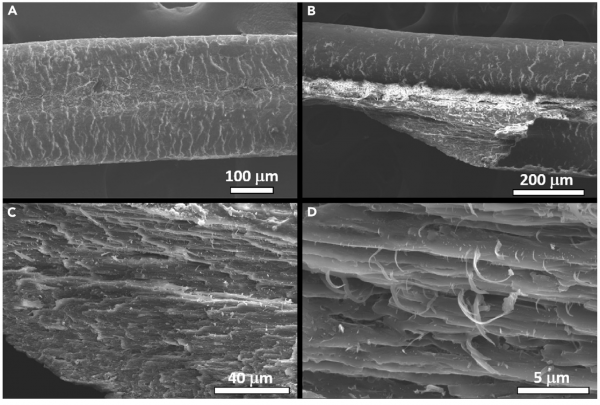
Image №6: morphology of capybara hair (A — double cuticular structure of plates; In — rupture of the double structure; C — fibers near the rupture boundary appear brittle and rigid; D — elongated fibers from the rupture zone of the double structure).
Cavy and peccary hairs differ from all other examined hairs. The main distinction for capybara is the presence of a double cuticle configuration and the oval shape of the hair (6A). The groove between the two mirrored parts of the hair is necessary for more efficient water removal from the animal's fur and better ventilation, allowing it to dry faster. When subjected to stretching, the hair splits along the groove, and each part breaks apart (6B). Many cortex fibers delaminate and stretch (6C and 6D).
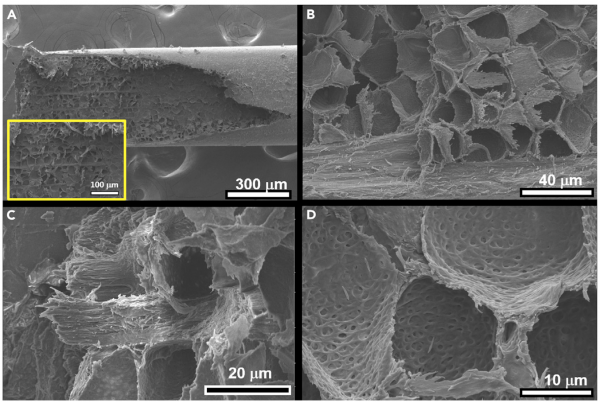
Image #7: morphology of the hair of a peccary (A — structure of the cuticle and point of rupture; In — morphology of cortex destruction and details of its structure; C — closed cells (20 microns in diameter), walls made of fibers; D — walls of the cells).
In peccaries (family Tayassuidae, i.e., peccaries), the hair has a porous cortex, and the cuticle layer lacks clear plates (7A). The cortex of the hair contains closed cells sized 10-30 microns (7B), the walls of which are made of keratin fibers (7C). These walls are sufficiently porous, and the size of a single pore is about 0.5-3 microns (7D).
As seen in the image 7A, without the support of the fibrous cortex, the cuticle cracks along the line of rupture, and the fibers stretch in some places. This structure of hair is necessary for the hairs to be more vertical, visually increasing the size of the animal, which could be a protective mechanism for the peccary. Peccary hairs are quite resistant to compression, but not to stretching.
Having understood the structural features of the hairs of different animals, as well as their types of damage due to tension, scientists began describing the mechanical properties.
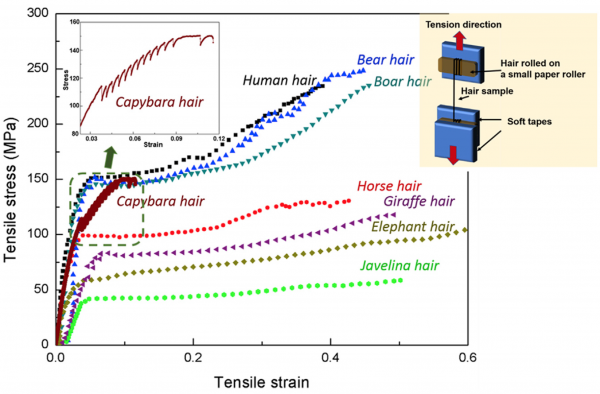
Image #8: deformation diagram for each hair type and a scheme of the experimental setup for obtaining data (strain rate 10-2 s-1).
As seen from the graph above, the reaction to stretching in the hairs of different species was quite varied. Thus, the hairs of humans, horses, wild boars, and bears showed a response similar to that of wool (not someone's, but a textile material).
With a relatively high elastic modulus of about 3.5–5 GPa, the curves consist of a linear (elastic) region followed by a plateau with slowly increasing stress up to a strain of 0.20–0.25, after which the rate of strengthening significantly increases to a failure strain of 0.40. The plateau region relates to unwinding. a-spiral structure of keratin intermediate filaments, which in some cases can (partially) transform into b-sheets (flat structures). Full unwinding, however, leads to deformation of 1.31, which is significantly higher than at the end of this stage (0.20–0.25).
The crystalline fibrous part of the structure is surrounded by an amorphous matrix, which does not transform. The amorphous part constitutes about 55% of the total volume, provided that the diameter of the intermediate fibers is 7 nm and that they are separated by amorphous material by 2 nm. Such precise values were derived in previously conducted studies.
During the deformation stage, characterized by hardening, sliding occurs between the cortical fibers and also between smaller structural elements such as microfibrils, intermediate fibers, and the amorphous matrix.
The hairs of the giraffe, elephant, and peccary demonstrate a relatively linear hardening response without a clear distinction between plateau and regions of rapid hardening (peaks). The elastic modulus is relatively low, approximately 2 GPa.
In contrast to other species, the hairs of the capybara exhibit a response characterized by rapid hardening, superimposed by successive stresses. This observation is associated with the unusual structure of the capybara's hair, specifically the presence of two symmetrical parts and a longitudinal groove between them.
Previous studies have indicated that the Young's modulus (modulus of longitudinal elasticity) decreases with increasing hair diameter across different animal species. These studies noted that the Young's modulus in the peccary is significantly lower than in other animals, which may be related to the porosity of its hair structure.
Interestingly, the peccary has both black and white areas on its hair (bicoloration). Breaks during stretching occur most frequently in the white part of the hair. The increased durability of the black area is explained by the presence of melanocytes, found exclusively in black hair.
All these observations are indeed unique, but the main question remains — do the dimensions of the hair play a role in its strength?
When describing fur in mammals, several key facts known to researchers can be highlighted:
- in most species, hair is thicker in the center and tapers toward the end; the fur of wild animals is thicker due to their habitat;
- changes in the diameter of hair of the same species show that the thickness of most hairs varies within the overall range of thickness for that animal species. The thickness of hairs can differ among individuals of the same species, but the reasons for these differences are still unknown;
- various species of mammals have different hair thickness (however banal this may sound).
Summarizing these publicly available facts and data obtained from experiments, scientists were able to correlate all results to establish dependencies of hair thickness and its strength.
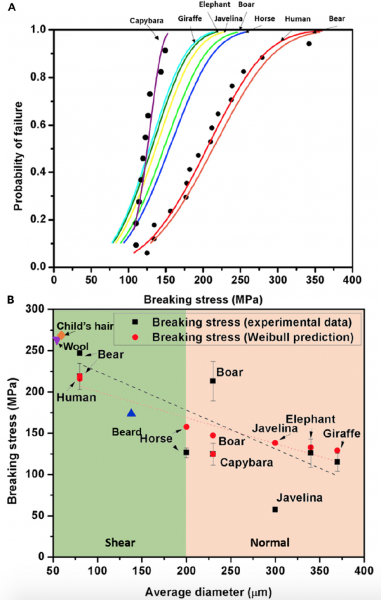
Image No. 9: the relationship between hair thickness and its strength in different animal species.
Due to differences in diameter and stretchability of hair, scientists decided to investigate whether they could predict rupture stresses based on Weibull statistics, which can specifically account for variations in sample size and resulting defect size.
It is assumed that the segment of hair with volume V consists of n volume elements, with each individual volume V0 having a similar defect distribution. Using the assumption of the weakest link, at a given stress level σ the probability P of maintaining the integrity of this hair segment with volume V can be expressed as the product of the additional probabilities of maintaining the integrity of each volume element, namely:
P(V) = P(V0) · P(V0)… · P(V0) = · P(V0)n
where the volume V contains n volume elements V0. As the stress increases, P(V) naturally decreases.
Using a two-parameter Weibull distribution, the probability of failure of the entire volume can be expressed as:
1 — P = 1 — exp [ —V/V0 · (σ/σ0)m]
where σ — applied stress, σ0 — characteristic (reference) strength, and m — the Weibull modulus, which is a measure of variability of properties. It is worth noting that the probability of failure increases with an increase in the sample volume V at constant stress σ.
On the graph 9A The Weibull distribution of experimental breaking stresses for human and capybara hair is shown. Curves for other species were predicted using formula No. 2 with the same value of m as for human hair (m = 0.11).
The average diameters used were: wild boar — 235 μm, horse — 200 μm, peccary — 300 μm, bear — 70 μm, elephant hair — 345 μm, and giraffe — 370 μm.
Based on the fact that breaking stress can be determined at P(V) = 0.5, these results show that breaking stress decreases with increasing hair diameter across different species.
On the graph 9B the predicted breaking stresses at 50% probability of failure (P(V) = 0.5) and the average experimental breaking stress for different species are shown.
It becomes clear that as the hair diameter increases from 100 to 350 mm, its breaking stress decreases from 200–250 MPa to 125–150 MPa. The simulation results based on the Weibull distribution agree well with the results of actual observations. The only exception is peccary hair, as it is extremely porous. The actual strength of peccary hair is lower than the predictions based on the Weibull distribution.
For a more detailed understanding of the nuances of the research, I recommend checking out the and related to it.
Epilogue
The main conclusion from the observations described above is that thick hair is not equivalent to strength. Indeed, as scientists themselves say, this statement is not a revelation of the millennium, as similar observations have been made in the study of metal wire. The issue here is not even physics, mechanics, or biology, but statistics — the larger the object, the greater the possibility of defects.
Scientists believe that the work discussed today will assist their colleagues in creating new synthetic materials. The main problem is that despite the advancement of modern technologies, they still cannot create anything similar to human or elephant hair. After all, producing something so small is already a challenge, not to mention its complex structure.
As we can see, this study has shown that not only spider silk deserves the attention of scientists as inspiration for future super-strong and super-light materials, but also human hair can astonish with its mechanical properties and remarkable strength.
Thank you for your attention, stay curious, and have a great work week, everyone. 🙂
A little advertisement 🙂
Thank you for staying with us. Do you enjoy our articles? Want to see more interesting content? Support us by placing an order or recommending us to your friends, , a unique entry-level server alternative that we have created for you: (options available with RAID1 and RAID10, up to 24 cores and up to 40GB DDR4).
Dell R730xd at half the price in the Equinix Tier IV data center in Amsterdam? Only with us in the Netherlands! Dell R420 — 2x E5-2430 2.2GHz 6C 128GB DDR3 2x960GB SSD 1Gbps 100TB — from $99! Read about how
Source: habr.com
