


Some time ago, 'My Circle' participated in a discussion organized by our friends from Index School, focused on the employment of beginner specialists. The organizers presented the participants with the following issue:
'The IT industry has long been suffering from a lack of professionals, and this is no news to anyone. It seems that the solution to this situation should come from the abundance of beginner specialists available in the market. However, in reality, employers are often unwilling to hire juniors, continuing the endless search for those elusive 'solid mid-levels'. Add to this the issue of 'older' juniors: the chances of finding a good job for those who entered the industry after 35 years old are practically zero. Each company tries to solve this problem in its own way, but the market situation indicates that all these steps have not yet significantly influenced the overall balance of power.'
The discussion was lively and further highlighted the issues raised. We decided to delve deeper into the topic of beginner IT specialists and conducted a survey among users of 'Habr' and 'My Circle'. We collected over 2000 responses, visualized them using diagrams, and are pleased to share the results today.
From the report, you will learn at least the following
- Almost half of those entering IT for the first time are still studying at universities.
- A third of specialists come to IT from completely different fields and, for the most part, not out of necessity, but out of a calling.
- Almost half of newcomers eventually change their first IT specialization.
- Capital cities gradually吸收部分专业人才培养于地方, while large private companies吸收 specialists培养于 small private or state companies.
- In the national market for beginner specialists, capital cities make the greatest contributions to analytics, HR, and sales; regions contribute to administration, full-stack development, and mobile development; million-plus cities contribute to marketing.
- 50% of beginner specialists find their first job in IT in less than a month, and 62% interview with only 1-2 companies.
- About 50% of entry-level professionals find jobs through job websites, while another 30% find opportunities through friends and acquaintances.
- 60% of newcomers start their careers in IT as entry-level specialists (juniors), with 33% starting as interns; paid internships are twice as common as unpaid ones.
- 75% of interns and 85% of juniors stay with their first company for more than six months, and nearly half of newcomers eventually shift to a different IT specialization.
- 60% of companies have no mechanisms for onboarding entry-level professionals, 40% do not have programs to attract them, and 20% do not work with interns or juniors at all.
- The main risk of working with entry-level specialists, according to most companies, is the difficulty in assessing the potential of future employees.
- When applying for their first job, newcomers often underestimate the importance of soft skills, which employers prioritize even above technical knowledge.
- While 60% of companies claim not to pay attention to the age of newcomers, another 20% indicate that they do not hire candidates for entry-level positions over a certain age.
Who participated in the survey
First, let's take a look at who exactly participated in the survey to understand the context in which we will interpret the responses. The sample was approximately the same as in all our previous surveys.
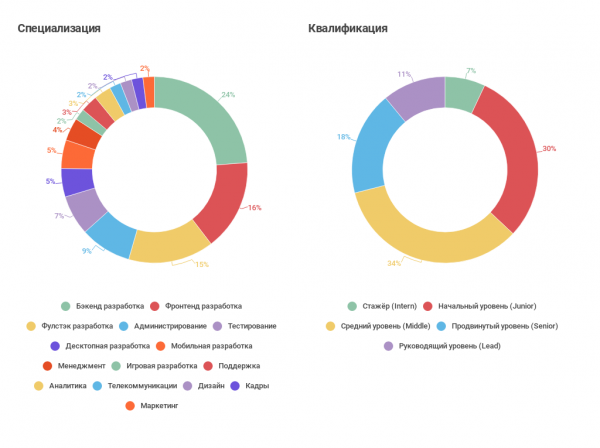
Two-thirds of respondents are developers. The only difference this time is that more juniors and interns participated in the survey. Usually, they make up a quarter of all respondents, but this time they accounted for over a third.
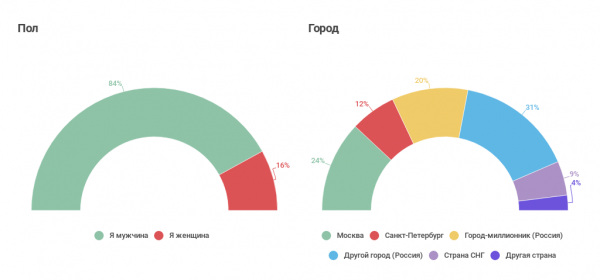
As always, there is one woman for every five men, every third respondent is from a non-million city, every fifth from a million city, every fourth from Moscow, and every tenth from St. Petersburg.
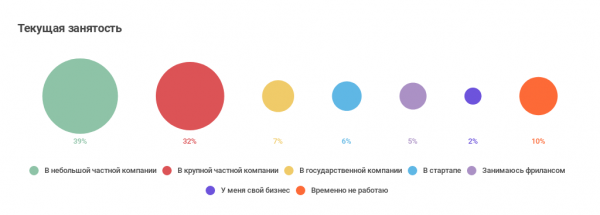
Most work in small private companies, while every tenth is temporarily unemployed. This time, there were slightly fewer freelancers participating in the survey and slightly more employees from large private companies than usual.
When you started working in IT, was this your first job?
Interestingly, more than a third of specialists entering IT for the first time come from other fields unrelated to IT. Among those entering HR, management, sales, and content, this figure exceeds fifty percent. In game and desktop development, that number is only one-fifth.
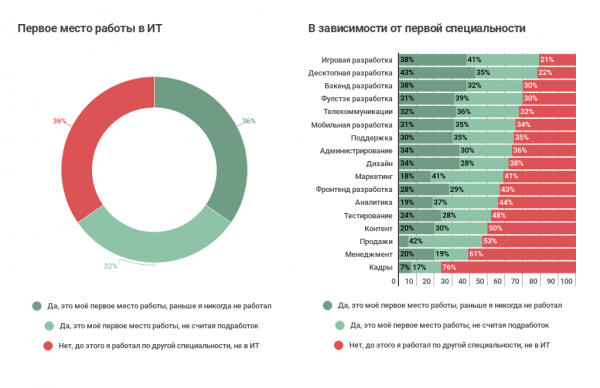
The highest number of engineers, managers, salespeople, workers, technicians, and educators transition into IT from other fields.

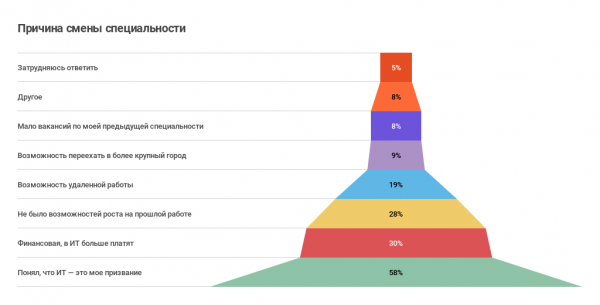
It turns out that individuals moving into IT from other sectors do so not out of necessity, but from a calling. For 58%, the main reason for retraining is a genuine interest in the IT field itself. Only 30% and 28% cited financial reasons or issues with career growth in their previous jobs, respectively. Only 8% noted difficulty finding work in their former profession.
Almost 20% highlighted the possibility of remote work as a reason for choosing IT.
What is your education level and its completion at your first job in IT?
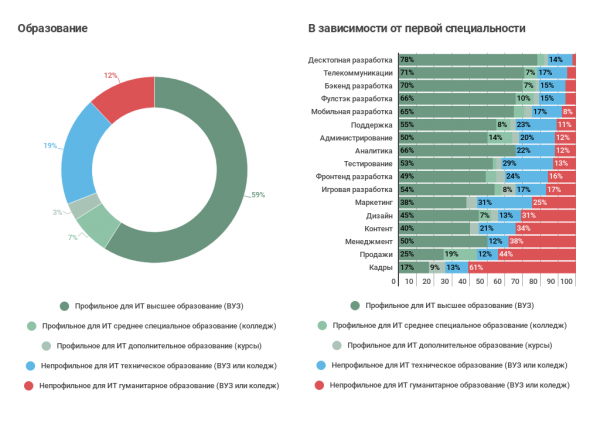
As we learned from , 85% of specialists working in IT have higher education. Among them, 59% have a degree relevant to IT, 19% possess non-related technical education, and 12% have non-technical humanities degrees.
The proportion of 'humanitarians' is highest in HR, sales, management, and content, as well as in design and marketing. Their share is the smallest in desktop, full-stack, and backend development, as well as in telecommunications. The share of 'technicians' with non-IT-related education is highest in marketing and testing.
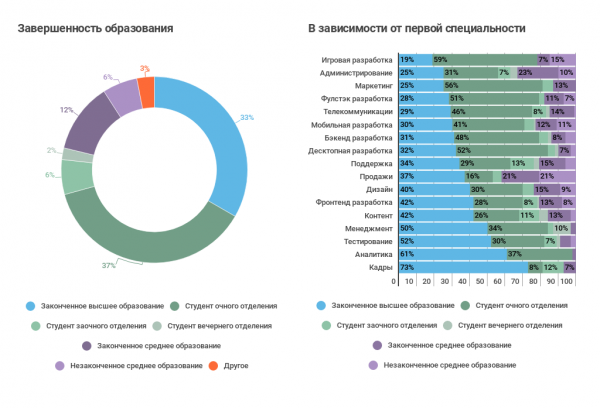
At the time of their first IT job, only 33% of specialists had completed higher education, while 45% were still studying at university. Among those entering HR, analytics, testing, and management, more than half had already finished their studies. In game development and full-stack development, as well as in marketing, more than half were still students.
Sales and administration have the highest share of newcomers lacking a higher education and not enrolled in universities, while analytics and management have the smallest share. In sales, the highest proportion are still in high school.
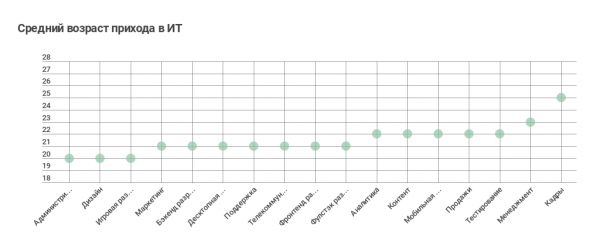
In administration, game development, and design, the average median age of entering IT is 20 years, in management it is 23, and in HR it is 25 years. In other specialties, it is 21-22 years.
Has your specialization changed since your first job in IT?
We compared responses to two independent questions — 'What is your current specialization?' and 'What was your first specialization in IT?' — and obtained an interesting diagram. It is noticeable that over time, the percentage of those working in backend and full stack development has significantly increased, while the proportion of those initially involved in desktop development, administration, and support has decreased.
This reflects the process of reskilling newcomers within the IT sector.
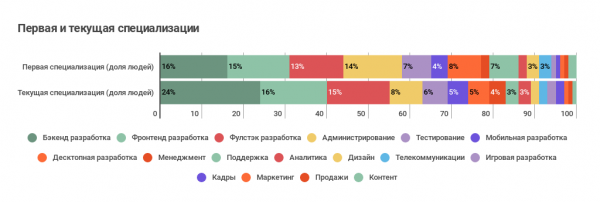
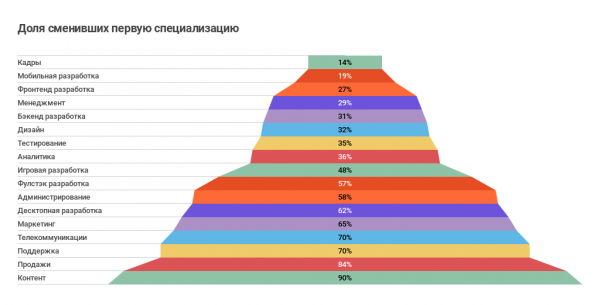
On average, one in two changes their first specialization in IT.
However, if we look at each specialization separately, we see that over two-thirds change their specialization most often if they initially came from desktop development, telecommunications, support, marketing, sales, or content. Conversely, less than a third change their specialization if they started in HR, mobile development, management, or frontend development.
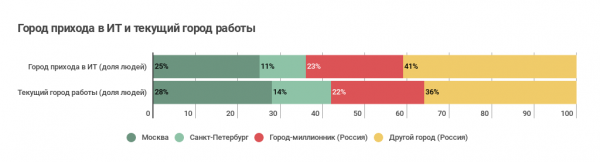
In which city and what was your first job specialization in IT?
As with the change of specialization, we also see a shift in region since the first job in IT. Over time, there has been a noticeable increase in the percentage of those working in Moscow and St. Petersburg, while the proportion working in smaller cities has decreased. The capital cities are attracting a portion of specialists raised in other regions.
This indicates the internal migration of IT specialists.
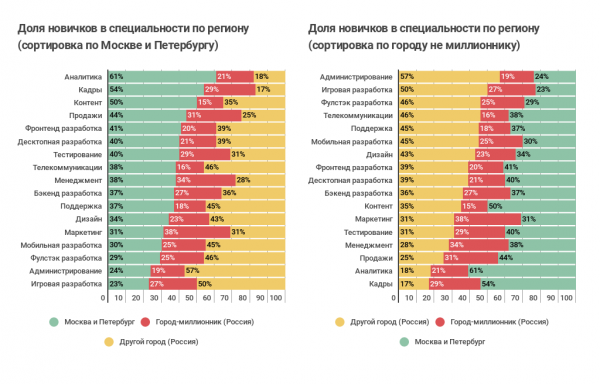
When examining each specialization separately, a more interesting picture emerges. Moscow and St. Petersburg provide the highest proportions among newcomers in analytics, HR, and sales; and the lowest in game development, administration, full stack, and mobile development. Conversely, in non-million cities, the picture is quite the opposite: the highest proportions among newcomers are in administration, full stack, and mobile development; and the lowest in analytics, HR, and sales. Million cities contribute the most newcomers in marketing, management, and sales.
There is a clear division of labor between the capitals and the regions: technical specialists are in the regions, while managers are in the capital.
In which company and what position did you start working in IT?
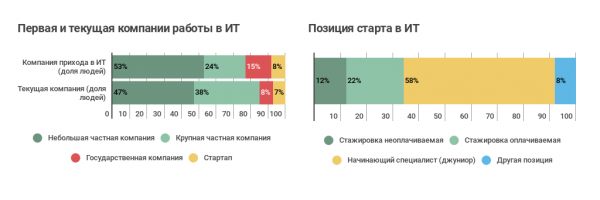
Similar to the cases of changing specialization or city since the first job, we observe a similar pattern with company changes. Over time, the proportion of those working in large private companies noticeably increases, while the share working in small private and public companies declines. Large private companies attract some specialists that the latter have trained.
58% of newcomers start in IT as junior specialists, while 34% begin as interns. Paid internships are almost twice as numerous as unpaid ones.
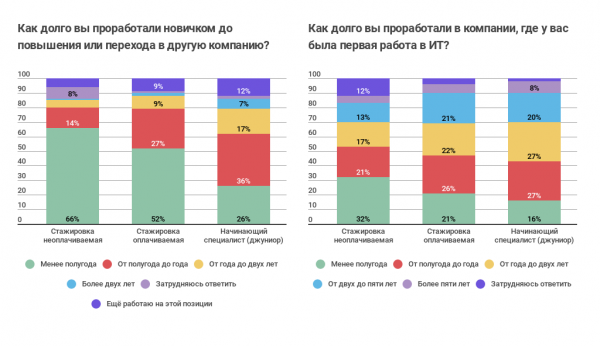
The higher the initial qualification of a newcomer, the longer, on average, they work before their first promotion. 66% of unpaid interns, 52% of paid interns, and only 26% of juniors work for less than six months before their first promotion.
About half of each group remains employed at their first company for more than six months.
How long and in what ways did you search for your first job in IT?
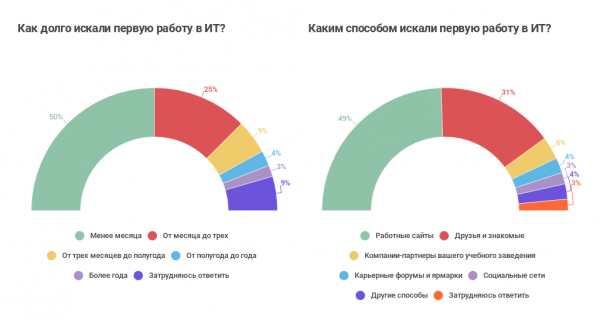
50% of junior specialists find their first job in IT in less than a month, while another 25% take no more than three months. Approximately 50% find work through job sites, and 30% through friends and acquaintances.
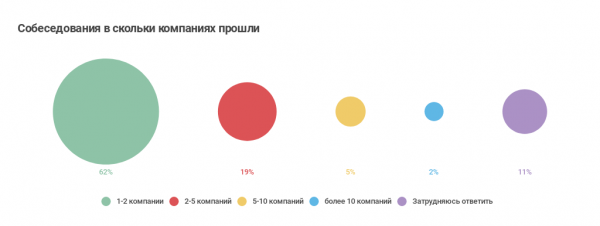
62% of junior specialists attend interviews at 1-2 companies and find their first job. Another 19% interview at no more than 5 companies.
What qualities did you think you needed to secure a job?
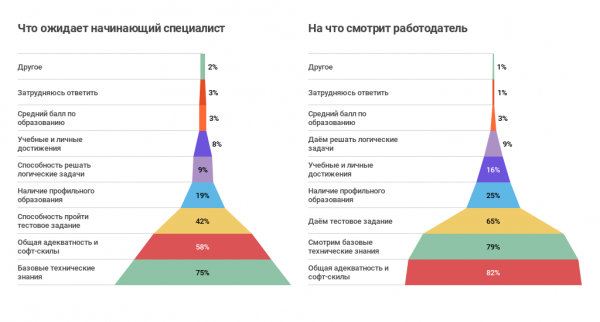
The overwhelming majority of both junior applicants and their employers consider basic technical knowledge, soft skills, and the ability to complete a test task as the most significant when seeking employment.
However, newcomers somewhat underestimate the role of soft skills: for employers, their importance is even slightly higher than that of technical skills. Newcomers should also pay more attention to their educational and personal achievements: employers value such accomplishments much more than the ability to solve logical problems.
Interestingly, having relevant education is not regarded as very significant by either party.
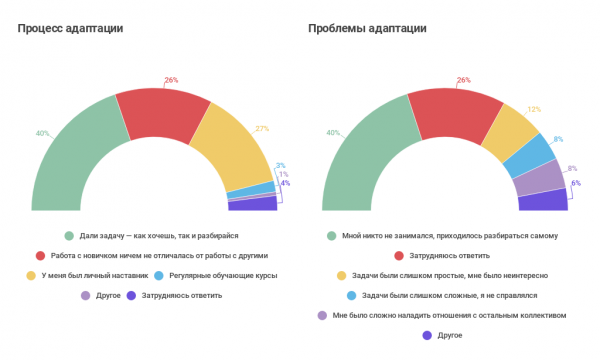
How was the adaptation process organized, and what difficulties did you face?
66% of newcomers report that they did not experience any onboarding process at the company. Only 27% had a personal mentor, and only 3% attended courses. Consequently, newcomers see the main problem with adaptation as the lack of proper attention given to them.
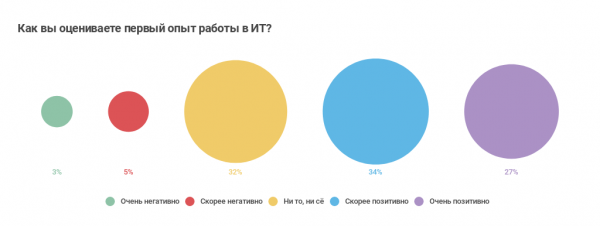
However, despite the mentioned difficulties, 61% of professionals rate their first experience working in IT as positive and only 8% as negative.
Do you have an interesting story about your first job in IT?
— It was my first job ever, and I was so scared that for the first month I didn't go to lunch during the workday (even though I was hungry) because I thought I had to always be at my desk and work nonstop 🙂
— Yes, the instructor thought I was developing mobile applications, but I was actually working on desktop ones. I was invited for an internship, given a complex task, after which I really had to learn mobile development.
— My first day at work and my first project on the frontend — 10 days, 20 pages of online store mockups — and I didn't know the difference between div and span. I managed, I'm really good at this, the project is still online, and its code is better than that of some large projects I encountered in Moscow.
— My first order was from a foreigner, and I wrote him a clumsy blog for $200 😀
— I slept at work, using the CPU case as a pillow. And I literally dropped it once. server, it was funny to call and explain to management: the server crashed, but it's still running 😉
— During my first week at work, I accidentally deleted about 400GB of data! Everything was restored later.
— After leaving the largest company in my industry in the region, they placed a 40-year-old driver in my position (Linux admin, Oracle DBA).
— The director's phrase "write something that can be sold" is genius!
— I came to the interview not knowing the required programming language, passed the test on another one, and was given two weeks to learn the needed language. On my first day, they asked me: "Did we hire you for Backend or Frontend?" I couldn't remember and didn't really understand the difference, so I answered – Backend, and that's what I write now.
— The first time I saw a Macbook in real life was at work 😀 (iOS developer).
— One time I was awarded a 1GB flash drive as a bonus for after-hours work before the New Year. And I also found my wife at my first job, in the neighboring department.
— The shortest interview in life: "Have you worked with COM ports? — No. — Will you? — I will."
— I came from a journalist position to a content manager vacancy in IT. After a couple of months, I was offered to be a project manager while a colleague was on vacation. A year later, I was promoted to head of the IT department, and a year after that to commercial director. A swift career advancement 🙂
If you have a similar interesting story, please share it in the comments!
Do you hire interns and junior specialists? How do you work with them?
Next, we asked whether the respondent participates in hiring, and directed further questions only to those who do.
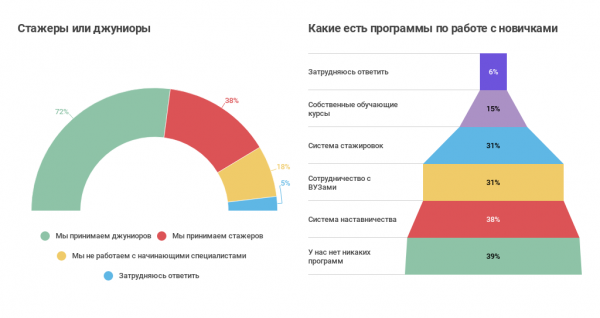
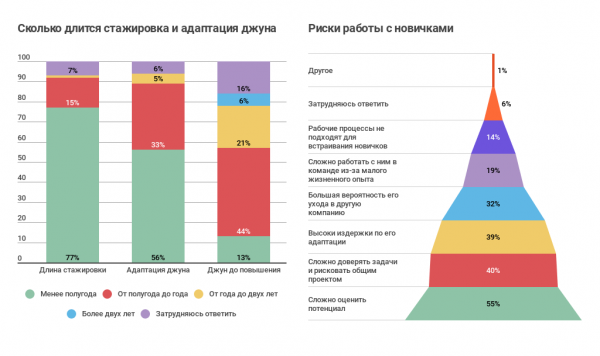
It turned out that 18% of companies do not hire beginners at all. In other cases, juniors are hired twice as often as interns.
Almost 40% of companies have no special programs for attracting and adapting newcomers. In 38% of cases, mentors help adapt newcomers. In 31% of cases, companies collaborate with universities or have an internship system. 15% of companies have their own training courses (schools).
The main risk of working with a beginner specialist is the difficulty in assessing their potential, noted by 55%. The second risk involves the trust placed in a newcomer with tasks and the complexity of their adaptation, at 40% and 39% respectively. Thirdly, there is the risk of a newly minted specialist leaving for another company, at 32%.
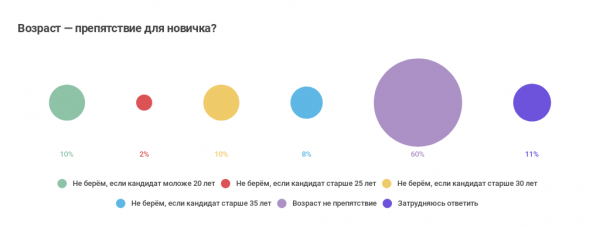
What age serves as a barrier to hiring a candidate as an intern or junior?
60% say they do not consider the age of a newcomer. However, another 20% say they do not hire candidates above a certain age.
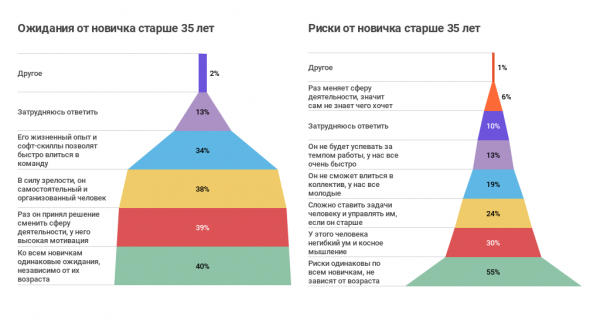
In 40% of cases, expectations for older newcomers are the same as for other beginners. However, in about 35-40% of cases, such specialists are expected to have good soft skills, independence, and high motivation.
In half of the cases, the risks expected from older newcomers are the same as for other beginners. However, 30% believe that such specialists have a rigid mindset, 24% see issues with managing them, and in approximately 15% of cases, consider that there will be problems integrating into a young team and the overall speed of the team's work.
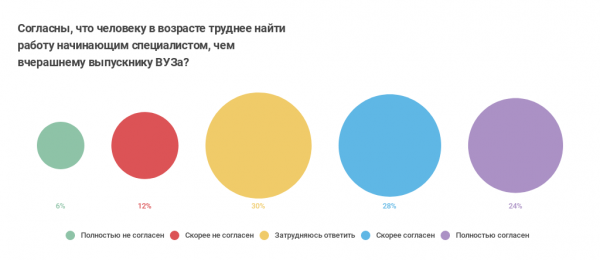
Although most people believe that age is not a barrier for newcomers, 52% agree that it is harder for older individuals to find a job as a beginner compared to recent graduates.
Have you had any successful cases in your practice of employing candidates over 35 as interns or juniors?
— One of the Android developers at my first job was a junior over 35, although prior to that he worked in a printing house, in a field far from development. Now he has moved permanently to Europe, has successfully found a job, and is a frequent participant in various Android development conferences.
— A man spent his whole life studying chemistry and teaching other students, became a coder in his 40s, and at nearly 65 is still working as a senior developer.
— In a neighboring department, a mathematics associate professor started his career as a junior 3D game developer at over 40 years old.
— Right across from me sits a guy over 40. He joined us like I did, from administration. He started as a junior. He quickly integrated into the team. Now he’s a solid mid-level developer.
— A guy came in, around 35–40, who self-taught Java and Android at home and wrote a training project. He initially developed under supervision, then independently created an application for a car-sharing service.
— Our average age in the company is 27. Once, a test task came up (for some reason out of the general queue, i.e., without a resume) and turned out to be very well executed. We invited him without hesitation — he stood out so much from the others for the junior position. It was surprising to meet and interview a 40-year-old man for such a position, considering that he had only known PHP for a month and had an IT background of no more than a year. He fit in well.
— Our tester is over 40; we took him because he is a science fiction writer and a good visionary, and on top of that, he became passionate about IT and testing. Additionally, he has vast experience in construction, which is our market.
— I came in as a newcomer from another company at the age of 40, and after six months I was promoted to mid-level front-end developer, and just six months later I advanced to team leader.
— While working at a tractor factory, a man created games in Flash and successfully sold them. No one taught him; it was hard for him to adapt due to his age, but he proved himself worthy as a specialist.
If you have a similar interesting story, please share it in the comments!
Source: habr.com
