

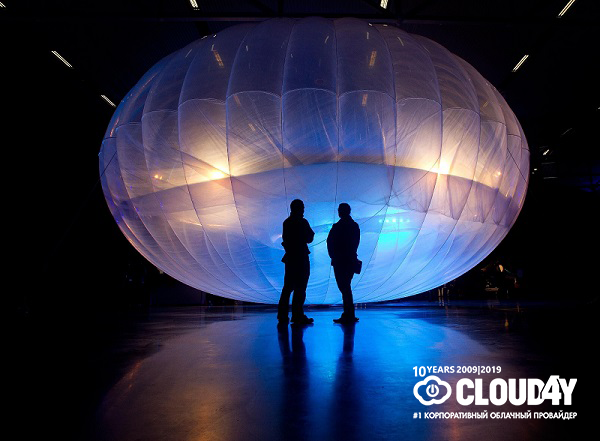
In 2014, a rural school on the outskirts of Campo Maior in Brazil was connected to the internet. A mundane event, if not for one 'but'. The connection was made via a stratospheric balloon. This event marked the first success of an ambitious project. , a subsidiary of Alphabet. Just five years later, the governments of countries affected by severe hurricanes and earthquakes turned to Loon with an official request for help in ensuring internet connectivity. Cloud4Y explains how Google's 'cloud connection' became a reality.
Project Loon is interesting because it aims to solve the problem of internet connectivity in regions that are, for some reason, cut off from civilization and the global economic system. This is not necessarily the result of a natural disaster. The issue may lie in geographical isolation or the inconvenient location of the region. Nevertheless, if a person has a smartphone, they will be able to connect to the network thanks to the balloons designed by Loon.
The quality of the connection is also impressive. In February 2016, Google announced the achievement of stable laser communication between two balloons at a distance of 62 miles (100 km). The connection remained stable for many hours, both during the day and at night, and a data transfer speed of 155 Mbps was recorded.
How it works
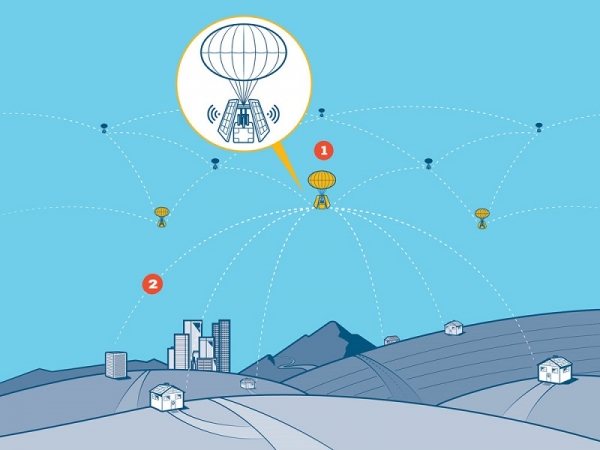
The idea may seem simple. Loon took the most vital components of a cell tower and redesigned them for transport on a balloon at an altitude of 20 km. This is significantly above airplanes, wildlife, and weather phenomena. Therefore, it is also safer. Loon's balloons are capable of withstanding harsh conditions in the stratosphere, where wind speeds can reach 100 km/h and temperatures can drop to -90 °C.
Each balloon has a special capsule — a module that manages the Loon system. All equipment on the balloon runs on renewable energy sources. Solar panels power the system during the day and charge the built-in battery for nighttime operation. The antennas on Loon balloons provide connectivity to ground stations through an extensive cellular network, allowing mobile device owners to be online without using any additional equipment. In case of an emergency and balloon failure, the hardware module weighing 15 kg descends on an emergency parachute.
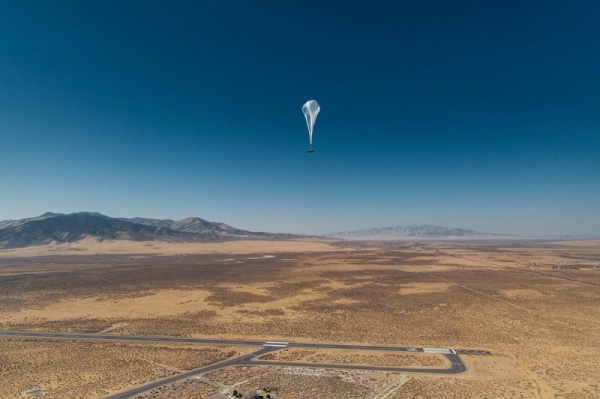
The flight altitude of the balloon can be adjusted by using an auxiliary balloon filled with helium from the main balloon to gain altitude. To descend, helium is pumped back from the auxiliary balloon to the main one. The maneuvering is so effective that in 2015, Loon was able to fly 10,000 kilometers, arriving at the desired location with an accuracy of 500 meters.
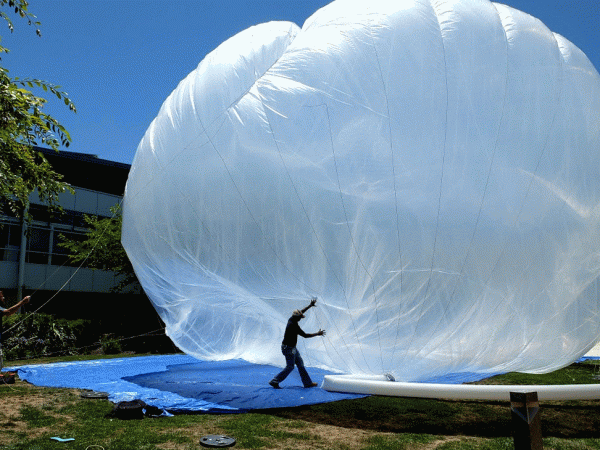
Each balloon, the size of a tennis court, is made from ultra-reliable flexible plastic and is designed for 150 days of flight. This durability is the result of extensive material testing for the balloon (the envelope of the balloon). This material must prevent helium leaks and withstand balloon damage in low-temperature conditions. In the stratosphere, where the balloons are deployed, regular plastic becomes brittle and easily damaged. Even a tiny hole measuring 2 mm can shorten the balloon's lifespan by several weeks. Finding a 2-mm hole on a balloon with an area of 600 sq.m. is quite a challenge.
During the material testing process, one of the project leaders realized that condom manufacturers face similar problems. In this industry, unexpected holes are also undesirable. Drawing on their experience, the Loon team conducted several specific tests that allowed the creation of new materials and a change in the structure of the balloons, resulting in an increased lifespan of the balloon. This summer, they achieved a 'run' of 223 days!
The Loon team emphasizes that they have created not just another balloon, but a "smart" device. Launched from a special launch platform, Loon balloons can reach any country in the world. Machine algorithms predict wind patterns and decide whether to move the balloon up or down in the layer of wind blowing in the desired direction. The navigation system operates autonomously, while human operators monitor the balloon's movement and can intervene if necessary.

Loon enables mobile network operators to expand coverage where it is needed. A group of Loon balloons creates a network that connects people in a specific area just like a group of towers on the ground forms a terrestrial network. The difference is that these aerial “towers” are constantly moving. The network created by the balloons can operate autonomously, efficiently routing connections between the balloons and ground stations while taking into account the balloon's movement, obstacles, and weather phenomena.
Where Loon balloons have already been used
You might ask, "In theory, everything looks good, but what about in practice?" There is practical evidence. In 2017, in collaboration with the Federal Communications Commission, the Federal Aviation Administration, FEMA, AT&T, T-Mobile, and other companies, basic communication was provided for 200,000 people in Puerto Rico after the devastation caused by Hurricane Maria. The balloons were launched from Nevada and quickly reached Puerto Rico. This allowed for testing some solutions, identifying errors, and demonstrating the viability of the idea.
Soon after, a natural disaster in Peru caused severe damage to the infrastructure. As soon as flooding occurred in northern Peru, the Loon team dispatched their balloons to the affected area. Over three months, users sent and received data amounting to 160 GB, which is equivalent to approximately 30 million SMS or two million emails. The coverage area reached 40,000 square kilometers.
At the end of May 2019, a devastating earthquake with a magnitude of 8.0 struck Peru again. In some regions, the internet was completely down, and thousands of people needed to know the status of their loved ones. To restore communication, the country's government and local telecom operator Tefónica turned to Loon for help, asking them to provide internet via their balloons. Internet service was restored within 48 hours.
The first tremors occurred on Sunday morning, and upon receiving a request for assistance, Loon immediately redirected its balloons from Puerto Rico to Peru. As usual, the balloons were moved by the power of the wind. They caught the air currents in the direction they needed to go. The devices took two days to cover more than 3,000 kilometers.
Loon's balloons spread across the northern part of Peru—each provided 4G internet to areas covering 5,000 square kilometers. Only one balloon was connected to the ground station, which communicated and relayed signals to other devices. Previously, the company demonstrated the ability to transmit signals between seven balloons, but this time the number reached ten.
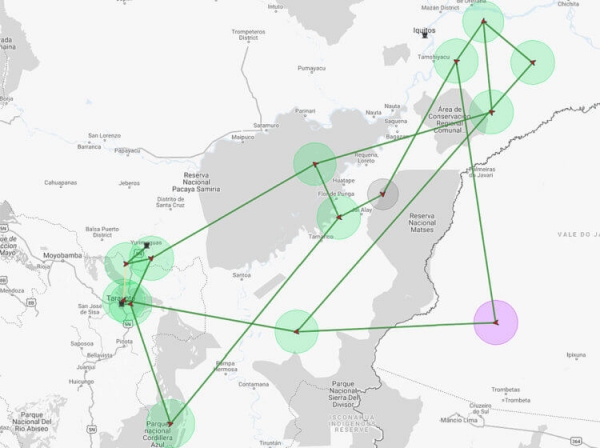
Location of Loon Balloons in Peru
The company was able to provide the residents of Peru with a basic communication package: SMS, email, and access to the internet at minimal speed. In the first two days, around 20,000 people used the internet provided by Loon's balloons.
As a result, on November 20, 2019, Loon signed a commercial agreement to provide services to parts of the Amazon rainforest in Peru, reaching an agreement with (IpT), a rural mobile service operator. This time, Loon's balloons will be used as a permanent solution for internet connectivity instead of a temporary fix after a natural disaster.
The agreement between IpT and Loon is still pending approval from the Ministry of Transport and Communications of Peru. If all goes well, Loon and IpT hope to provide mobile internet services starting in 2020. The initiative will focus on the Loreto region of Peru, which makes up nearly one-third of the country and is home to many of its indigenous peoples. Initially, Loon will cover 15 percent of the Loreto territory, potentially reaching almost 200,000 residents. However, the company has already announced its intention to connect 6 million people in rural Peru by 2021.
The successful use of balloons in Peru for an extended period may open doors to other countries as well. Meanwhile, the company has signed a preliminary contract in Kenya with Telkom Kenya and is now awaiting final regulatory approval to commence its first commercial trial in that country.
A small detailIt should be noted that not everything is rosy with the technology. Here is a list of incidents involving Loon balloons:
- On May 29, 2014, a Loon balloon collided with power lines in Washington, USA.
- On June 20, 2014, New Zealand officials called emergency services upon witnessing a balloon falling.
- In November 2014, a South African farmer discovered a crashed balloon in the Karoo desert between Struisbaai and Britstown.
- On April 23, 2015, a balloon crashed in a field near the town of Bragg, Missouri.
- On September 12, 2015, a balloon crashed on a lawn in front of a home in Rancho Hills, California.
- On February 17, 2016, a balloon crashed during testing in the tea region of Gampola, Sri Lanka.
- On April 7, 2016, a balloon made an unscheduled landing on a farm in Dundee, KwaZulu-Natal, South Africa.
- On April 22, 2016, a balloon crashed in a field in the Siembuku department, Paraguay.
- On August 22, 2016, a balloon landed on a ranch in Formosa, Argentina, about 40 km west of the capital.
- On August 26, 2016, a balloon landed northwest of Madison, South Dakota.
- On January 9, 2017, a balloon crashed in Seiki, near Changwinole, Bocas del Toro province, Panama.
- On January 8, 2017, and January 10, 2017, two Loon balloons landed 10 km east of Cerro Chato and 40 km northwest of Mariscala, Uruguay.
- On February 17, 2017, a Loon balloon crashed in Buriti dos Montes, Brazil.
- On March 14, 2017, a Loon balloon crashed in San Luis, Tolima, Colombia.
- On March 19, 2017, a balloon crashed in Tacuarembó, Uruguay.
- On August 9, 2017, a balloon crashed in a reed thicket in Olmos, Lambayeque, Peru.
- On December 30, 2017, a balloon crashed in Ntambiro, Central Igembe, Meru County, Kenya.
So there are definitely risks. However, the benefits of Loon balloons do outweigh the drawbacks.
UPD: you can check the location of the balloons (searching in South America). Thank you for the clarification
What else is useful to read in the blog
→
→
→
→
→
Subscribe to our -channel, so you don’t miss another article! We write no more than twice a week and only when necessary. We also remind you that the corporate cloud provider Cloud4Y has launched a promotion ‘Cloud FZ-152 at the price of regular’. You can apply already .
Source: habr.com
