

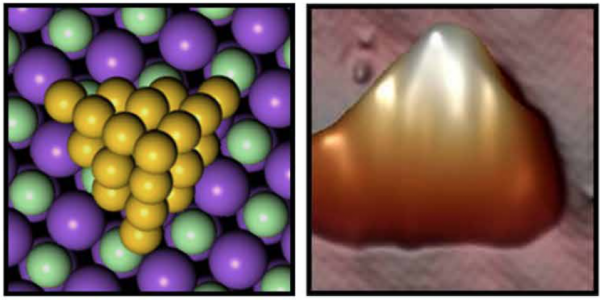
The world around us is a collective result of numerous phenomena and processes from various sciences, making it virtually impossible to single out the most important one. Despite a degree of rivalry, many aspects of different sciences share similar characteristics. Take geometry as an example: everything we see has a certain shape, one of the most common in nature being the circle, sphere, ball (the trend is evident). The tendency to be spherical manifests in both planets and atomic clusters. But there are always exceptions to the rules. Scientists from Leuven University (Belgium) found that gold atoms form not spherical but pyramidal clusters. What accounts for this unusual behavior of gold atoms, what properties do these precious pyramids possess, and how can this discovery be applied in practice? We will find out from the scientists' report. Let's go.
The foundation of the research
The existence of unusual clusters of gold atoms has been known for quite some time. These structures exhibit non-standard chemical and electronic properties, which has only increased interest in them over the years. Most studies have focused on investigating size dependencies, but such studies require controlled synthesis and high-precision measurements.
Naturally, clusters vary in types, but the most studied has become Au20, a cluster of 20 gold atoms. Its popularity is due to its highly symmetric tetrahedral* structure and its surprisingly large HOMO-LUMO (HL) gap (discrepancy)*.
Tetrahedron* is a polyhedron with four triangles as faces. If one of the faces is considered the base, the tetrahedron can be referred to as a triangular pyramid.
HOMO-LUMO gap (discrepancy)* HOMO and LUMO are types of molecular orbitals (mathematical functions describing the wave behavior of electrons in a molecule). HOMO stands for highest occupied molecular orbital, while LUMO stands for lowest unoccupied molecular orbital. Electrons in the ground state of a molecule fill all orbitals with the lowest energies. The orbital with the highest energy among the filled orbitals is called HOMO. Conversely, LUMO is the orbital with the lowest energy. The energy difference between these two types of orbitals is known as the HOMO-LUMO gap.
Photoelectron spectroscopy of Au20 showed that the HOMO-LUMO gap is 1.77 eV.
Modeling based on density functional theory (a method for calculating the electronic structure of systems) showed that such an energy difference can only be achieved through a tetrahedral pyramid of Td symmetry, which is the most stable geometry for the Au20 cluster.
Scientists note that previous studies of Au20 provided extremely inaccurate results due to the complexity of the process. A scanning transmission electron microscope was previously used, but its high energy beam distorted the observational results: a constant fluctuation of Au20 between various structural configurations was observed. In 5% of the obtained images, the Au20 cluster was tetrahedral, while in others its geometry was completely disordered. Therefore, the existence of a tetrahedral structure of Au20 on a substrate of, for example, amorphous carbon cannot be said to be definitively proven.
In the current study, scientists decided to employ a more gentle method of studying Au20, specifically scanning tunneling microscopy (STM) and scanning tunneling spectroscopy (STS). The observations focused on Au20 clusters on ultra-thin films of NaCl. STM confirmed the triangular symmetry of the pyramidal structure, while STS data allowed the calculation of the HOMO-LUMO gap, which amounted to a solid 2.0 eV.
Preparation for the study
The NaCl layer was grown on an Au(111) substrate using chemical vapor deposition at 800 K in the STM chamber under ultra-high vacuum conditions.
Cluster ions Au20 were obtained through magnetron sputtering and selected by size using a quadrupole mass filter. The sputtering source operated continuously and produced a significant fraction of charged clusters, which were subsequently fed into the quadrupole mass filter. The selected clusters were deposited on a NaCl/Au(111) substrate. For low-density deposition, the cluster flux was 30 pA (picoamperes) and the deposition time was 9 minutes; for high-density deposition, it was 1 nA (nanoamperes) and 15 minutes. The pressure in the chamber was 10-9 mbar.
Research Results
The mass-selected anionic clusters Au20 with very low coverage density were deposited at room temperature on ultrathin NaCl islands, including 2L, 3L, and 4L (atomic layers).
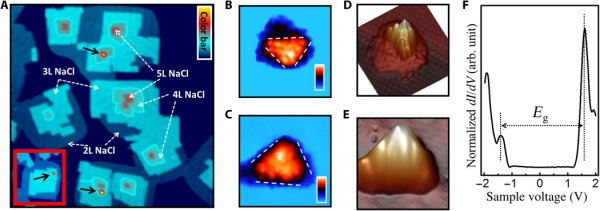
Image No. 1
At 1A It is evident that most of the grown NaCl has three layers, while areas with two and four layers occupy a smaller area, and 5L regions are virtually absent.
Clusters of Au20 were found on areas with three and four layers, but none on 2L. This can be explained by the fact that Au20 can pass through 2L NaCl, but in the case of 3L and 4L NaCl, they are retained on their surface. At low coverage density in the area of 200 x 200 nm, there were between 0 and 4 clusters without any signs of agglomeration.
Due to the excessively high resistance of 4L NaCl and instability when scanning a single Au20 on 4L NaCl, the researchers focused on studying clusters on 3L NaCl.
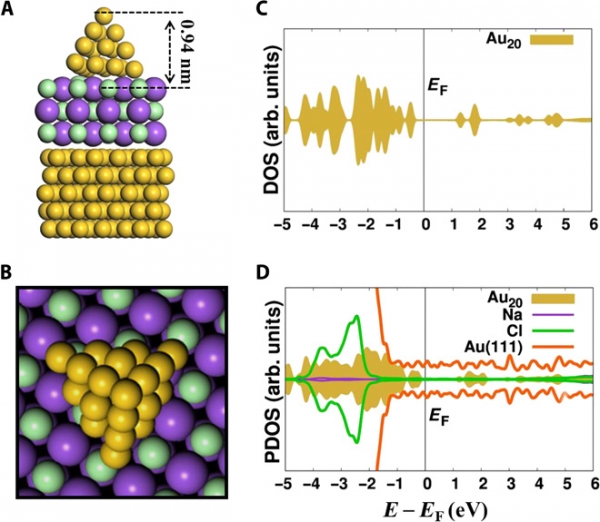
Image #2
Microscopy of clusters on 3L NaCl showed that their height is 0.88 ± 0.12 nm. This measurement corresponds excellently with simulation results that predicted a height of 0.94 ± 0.01 nm (2A). Microscopy also showed that some clusters have a triangular shape with a protruding single atom at the top, which practically confirms theoretical studies regarding the pyramidal shape of the Au20 structure (2B).
Researchers note that when visualizing extremely small three-dimensional objects, such as Au20 clusters, it is very difficult to avoid certain inaccuracies. To obtain the most accurate images (both from an atomic and geometric perspective), it was necessary to use a perfectly atomically sharp Cl-functionalized microscope tip. The pyramidal shape was identified in two clusters (1B and 1C), three-dimensional images of which are shown on 1D and 1E, respectively.
Although the triangular shape and height distribution indicate that the deposited clusters maintain a pyramidal form, STM images (1B and 1C) do not exhibit perfect tetrahedral structures. The largest angle in the image 1B is approximately 78°. This is 30% greater compared to 60° for a perfect tetrahedron with Td symmetry.
There could be two reasons for this. First, it is the inaccuracies in the visualization itself, caused by the complexity of the process and the fact that the microscope needle tip is not rigid, which can also distort the images. The second reason is related to the internal distortion of the supported Au20. When Au20 clusters with Td symmetry land on a square NaCl lattice, the symmetry mismatch distorts the ideal tetrahedral structure of Au20.
To determine the cause of such deviations in the images, the researchers conducted an analysis of the symmetry data of three optimized Au20 structures on NaCl. It was found that the clusters are only slightly distorted from the ideal tetrahedral structure with Td symmetry, with a maximum deviation in atom positions of 0.45. Consequently, the distortions in the images are a result of inaccuracies in the visualization process itself, rather than any deviations in the deposition of clusters on the substrate and/or interactions between them.
Not only are the topographic data clear indicators of the pyramidal structure of the Au20 cluster, but there is also a sufficiently large HL gap (about 1.8 eV) compared to other Au20 isomers* with lower energy (theoretically below 0.5 eV).
Isomers* are structures that have the same atomic composition and molecular mass but differ in their architecture or arrangement of atoms.
The analysis of the electronic properties of the clusters deposited onto the substrate using scanning tunneling spectroscopy (1F) allowed for obtaining the differential conductance spectrum (dI/dV) of the Au20 cluster, which shows a significant forbidden zone (Eg) of 3.1 eV.
Since the cluster is electrically split by insulating films of NaCl, a double barrier tunnel junction (DBTJ) is formed, which induces single electron tunneling effects. Consequently, the gap in the dI/dV spectrum is a result of the interplay between the quantum HL gap (EHL) and classical Coulomb energy (Ec). Measurements of the gaps in the spectrum showed values from 2.4 to 3.1 eV for seven clusters (1F). The observed gaps are larger than the HL gaps (1.8 eV) in the gas phase of Au20.
The variability of the gaps across different clusters is influenced by the measurement process itself (the position of the tip relative to the cluster). The largest gap measured in the dI/dV spectra was 3.1 eV. In this case, the tip was positioned far from the cluster, resulting in a lower capacitance between the tip and the cluster compared to that between the cluster and the Au(111) substrate.
Subsequently, calculations were conducted for the HL gaps of free Au20 clusters and those situated on 3L NaCl.
Figure 2C displays the curve of the modeled density of states for the gas-phase tetrahedron Au20, whose HL gap is 1.78 eV. When the cluster is positioned on 3L NaCl/Au(111), there is an increase in distortions and a decrease in the HL gap from 1.73 to 1.51 eV, which is comparable to the experimentally measured HL gap of 2.0 eV.
Previous studies have established that isomers of Au20 with Cs-symmetric structures possess an HL gap of about 0.688 eV, while structures with amorphous symmetry exhibit 0.93 eV. Considering these observations and the results of the measurements, scientists concluded that a larger forbidden zone is only possible under tetrahedral pyramid structural conditions.
The next stage of the research involved studying cluster-cluster interactions, for which more Au20 was deposited onto the 3L NaCl/Au(111) substrate (increased density).
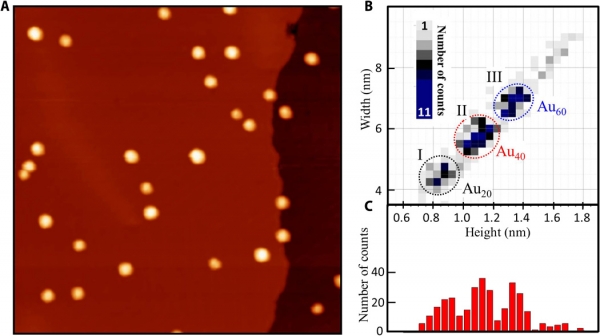
Image #3
In the image 3A A topographic STM image of the deposited clusters is shown. In the scanning area (100 nm x 100 nm), about 30 clusters are observed. The sizes of the interacting clusters on 3L NaCl either exceed or are equal to those examined in experiments with single clusters. This can be explained by diffusion and agglomeration on the NaCl surface at room temperature.
The aggregation and growth of clusters can be explained by two mechanisms: Ostwald ripening (recondensation) and Smoluchowski ripening (island growth). In the case of Ostwald ripening, larger clusters grow at the expense of smaller ones, as the atoms of the latter detach from them and diffuse into the neighboring ones. In Smoluchowski ripening, larger particles are formed as a result of the migration and agglomeration of entire clusters. One can distinguish between the two types of ripening as follows: during Ostwald ripening, the cluster size distribution broadens and is continuous, while during Smoluchowski ripening, the size distribution is discrete.
In the graphs 3B and 3C , the results of the analysis of over 300 clusters are shown, i.e., the distribution by size. The range of observed cluster heights is quite broad; however, three groups of the most common can be identified (3C): 0.85, 1.10, and 1.33 nm.
As seen in the graph 3B, there is a correlation between the height and width of the cluster. The observed cluster structures exhibit characteristics of Smoluchowski ripening.
There is also a correlation between clusters in experiments with high and low deposition densities. Thus, the group of clusters with a height of 0.85 nm corresponds to an individual cluster with a height of 0.88 nm in low-density experiments. As a result, the clusters from the first group were assigned the value Au20, while the clusters from the second (1.10 nm) and third (1.33 nm) groups were assigned values Au40 and Au60, respectively.
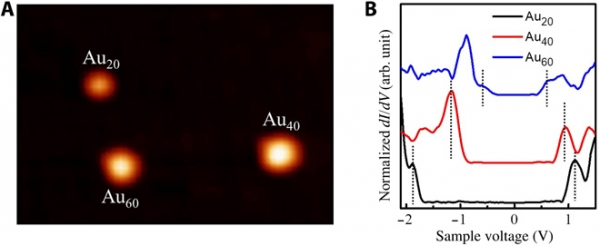
Image No. 4
In the image 4A we can see visual differences among the three categories of clusters, the dI/dV spectra of which are shown in the graph 4B.
As Au20 clusters merge into larger ones, the energy gap in the dI/dV spectrum decreases. Thus, the following gap values were obtained for each group: Au20 — 3.0 eV, Au40 — 2.0 eV, and Au60 — 1.2 eV. Considering this data, as well as the topographic images of the studied groups, we can assert that the geometry of the cluster agglomerates is closer to spherical or hemispherical.
To estimate the number of atoms in clusters of spherical and hemispherical shapes, one can use Ns = [(h/2)/r]³ and Nh = 1/2 (h/r)³, where h and r represent the height of the cluster and the radius of a single Au atom. Considering the Wigner-Seitz radius for a gold atom (r = 0.159 nm), we can calculate their number for the spherical approximation: the second group (Au40) has 41 atoms, and the third group (Au60) has 68 atoms. In the hemispherical approximation, the estimated number of atoms is 166 and 273, which is significantly larger than in the spherical approximations of Au40 and Au60. Therefore, it can be concluded that the geometry of Au40 and Au60 has a spherical, rather than hemispherical, shape.
For a more detailed understanding of the nuances of the study, I recommend checking out and related to it.
Epilogue
In this study, the researchers combined scanning tunneling spectroscopy and microscopy, allowing them to obtain more accurate data regarding the geometry of gold atom clusters. It was found that the Au20 cluster, applied to a 3L NaCl / Au (111) substrate, maintains its gas-phase pyramidal structure with a large HL gap. Additionally, it was established that the primary mechanism for the growth and clustering of these groups is the Smoluchowski maturation.
One of the main achievements of their work, the scientists say, is not so much the results of their studies on atomic clusters, but rather the method used to conduct these studies. Previously, a transmission electron microscope was used, which, due to its properties, distorted the results of observations. However, the new method described in this work allows for accurate data acquisition.
Furthermore, studying cluster structures allows us to understand their catalytic and optical properties, which is crucial for their application in cluster catalysts and optical devices. Currently, clusters are already being used in fuel cells and carbon capture. However, according to the scientists themselves, this is just the beginning.
Thank you for your attention, stay curious, and have a great work week, everyone. 🙂
A little advertisement 🙂
Thank you for staying with us. Do you enjoy our articles? Want to see more interesting content? Support us by placing an order or recommending us to your friends, , a unique entry-level server alternative that we have created for you: (options available with RAID1 and RAID10, up to 24 cores and up to 40GB DDR4).
Dell R730xd at half the price in the Equinix Tier IV data center in Amsterdam? Only with us in the Netherlands! Dell R420 — 2x E5-2430 2.2GHz 6C 128GB DDR3 2x960GB SSD 1Gbps 100TB — from $99! Read about how
Source: habr.com
