

Other articles in the series:
- The History of Relays
- The History of Electronic Computers
- The History of the Transistor
- The History of the Internet
The telephone was invented by chance. If due to a century of research into the possibilities of message transmission using electricity, then people stumbled upon the telephone in search of an improved telegraph. Thus, it is quite easy to assign a plausible, though not entirely undisputed, date to the invention of the telephone – the year of the centenary of the founding of the USA, 1876.
And it cannot be said that the telephone had no predecessors. Since 1830, researchers have been seeking ways to convert sound into electricity and electricity into sound.
Electric Sound
In 1837 , a physician and experimenter in the field of electromagnetism from Massachusetts, stumbled upon a strange phenomenon. He placed an insulated spiral wire between the ends of a permanent magnet, then submerged each end of the wire into vessels of mercury connected to a battery. Each time he opened or closed the circuit by lifting the end of the wire out of the vessel or lowering it back in, the magnet emitted a sound audible from a distance of one meter. Page called this galvanic music and hypothesized that it was all due to "molecular disorder" occurring in the magnet. Page initiated a wave of research devoted to two aspects of this discovery: the strange property of metals to change shape when magnetized, and the more obvious generation of sound by electricity.
We are particularly interested in two studies. The first was conducted by Johann Philipp Reis. Reis taught mathematics and the sciences to students at the Garnier Institute near Frankfurt, but in his free time, he engaged in electricity research. By that time, several electricians had already created new versions of galvanic music, but Reis was the first to master the alchemy of bidirectional conversion of sound to electricity and back.
Reis realized that a diaphragm, resembling the human eardrum, could close and open an electric circuit when vibrated. The first prototype of the device 'telephon' [‘long speaker’], built in 1860, consisted of a carved wooden 'ear' with a membrane stretched over it, made from a pig's bladder. A platinum electrode was attached to the lower part of the membrane, which opened and closed the circuit with the battery when vibrating. The receiver was a coil of wire wound around a knitting needle secured to a violin. The body of the violin amplified the vibrations of the changing needle shape as it was alternately magnetized and demagnetized.
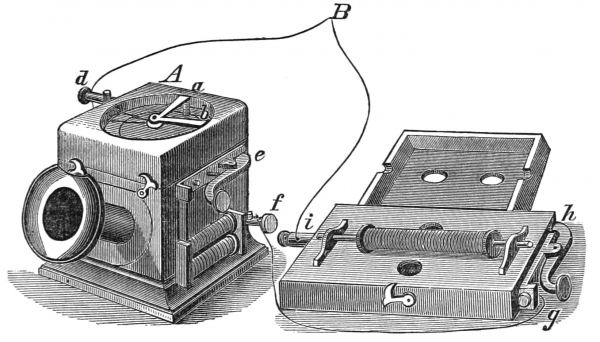
Later model of Reis's telephone
Reis devised numerous enhancements for the early prototype, and together with other experimenters, discovered that singing or humming into it made the transmitted sound recognizable. Distinguishing words was more challenging, and they often became distorted and unclear. Many reports of successful voice transmission used common phrases like 'good morning' and 'how are you,' which could be easily guessed. The main issue remained that Reis's transmitter only opened and closed the circuit, without modulating the sound's strength. As a result, only frequencies with a fixed amplitude could be transmitted, which could not mimic all the nuances of the human voice.
Reis believed his work should be recognized as science, but he never achieved this. His device was a popular curiosity among the scientific elite, with copies appearing in most centers of this elite: in Paris, London, and Washington. However, his scientific work was rejected by Professor Poggendorff's journal 'Annalen der Physik' [‘Annals of Physics’] – one of the oldest scientific journals and the most influential journal of that time. Reis's attempts to promote the telephone through telegraph companies also failed. He suffered from tuberculosis, and his worsening illness prevented him from further serious research. Ultimately, in 1873, the disease took his life and ambitions. And this was not the last time this illness would hinder the development of the telephone's history.
While Reis improved his telephone, was making the final touches to his fruitful research on auditory physiology: "On the Sensations of Tone as a Physiological Basis for the Theory of Music" [Die Lehre von den Tonempfindungen als physiologische Grundlage für die Theorie der Musik], published in 1862. Helmholtz, then a professor at Heidelberg University, was a giant of 19th-century science, working on the physiology of vision, electrodynamics, thermodynamics, and more.
Helmholtz's work only tangentially relates to our story, but it would be a shame to miss it. In "On the Sensations of Tone," Helmholtz did for music what Newton did for light – he showed how what seems to be a single sensation can be broken down into constituent parts. He proved that the differences in timbres, from the violin to the bassoon, arise solely from differences in the relative strength of their overtones (tones at double, triple, and so on frequencies in relation to the fundamental note). But what is most interesting in his work for our story is the remarkable instrument he developed for demonstration:
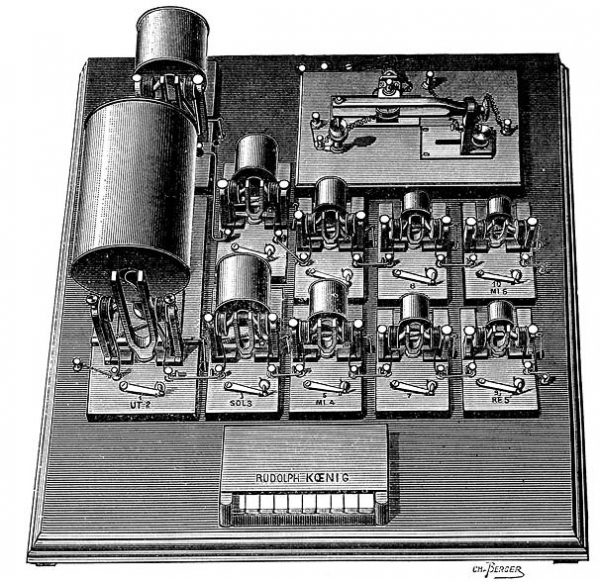
The Helmholtz Synthesizer
The first device Helmholtz commissioned was built in a workshop in Cologne. Simply put, it was a synthesizer capable of producing sounds based on the composition of simple tones. Its most astonishing capability was its inexplicable ability to reproduce vowel sounds, which everyone had become accustomed to hearing only from the human mouth.
The synthesizer operated from the beating of a fundamental tuning fork, vibrating at the base note, closing and opening the circuit, immersing a platinum wire in a container of mercury. Eight magnetized tuning forks, each vibrating with its own overtone, rested between the ends of an electromagnet connected to the circuit. Each closure of the circuit energized the electromagnets, keeping the tuning forks in a vibrating state. Adjacent to each tuning fork was a cylindrical resonator capable of amplifying its hum to a audible level. In normal operation, the lid on the resonator was closed, muffling the sound of the tuning fork. If the lid was pushed aside, this overtone could be heard, thus "playing" the sound of a trumpet, piano, or the vowel "o."
This device will play a small role in the creation of a new kind of telephone.
Harmonic Telegraph
One of the attractions for inventors in the latter half of the 19th century was the multi-telegraph. The more telegraph signals that could be crammed into one wire, the more efficient the telegraph network became. By the early 1870s, several different methods for organizing duplex telegraphy (the simultaneous sending of two signals in opposite directions) were known. Shortly after this, Thomas Edison improved them, creating the quadruplex by combining duplex and diplex (the simultaneous transmission of two signals in one direction), allowing the wire to be used four times more effectively.
But could the number of signals be further increased? Could some kind of octoplex, or even more, be organized? The fact that sound waves could be converted into electric current and back presented an interesting possibility. What if different pitch tones were used to create an acoustic, harmonic, or poetically speaking, musical telegraph? If physical vibrations of different frequencies could be translated into electrical ones and then reassembled into their original frequencies on the other side, it would be possible to send multiple signals simultaneously without mutual interference. The sound itself would then merely be a means to an end, an intermediate medium shaping currents so that several signals could exist in one wire. For simplicity, I will refer to this concept as harmonic telegraphy, although various terms were used at that time.
This was not the only way to create multiplex signals. In France, [in honor of whom the unit of symbol rate – baud / note by the translator] by 1874 had devised a machine with a rotating distributor that alternately gathered signals from several telegraph transmitters. Today we would call this time-division multiplexing, rather than frequency division. However, this approach had a drawback – it would not lead to the development of telephony.
By that time, Western Union dominated American telegraphy, formed in the 1850s in an attempt to eliminate the unprofitable competition among several large telegraph companies – before the advent of antitrust legislation, such explanations could be freely used to justify such mergers. One of the characters in our story described it as "probably the largest corporation that ever existed." With thousands of kilometers of wires and spending vast amounts on building and maintaining networks, Western Union closely followed developments in multiplex telegraphy.
Another player was waiting for breakthroughs in telegraphy. , a Boston lawyer and entrepreneur, was one of the main advocates for placing American telegraphy under federal government control. Hubbard believed that telegrams could be as cheap as letters and was determined to undermine what he considered the cynical and extortionate monopoly of Western Union. Hubbard's bill did not propose to fully nationalize the existing telegraph companies, as nearly all European powers did, but would establish a government-sponsored telegraph service under the auspices of the postal ministry. However, the outcome would likely have been the same, and Western Union would have exited that business. By the mid-1870s, progress on the legislation had stalled, but Hubbard was confident that control over a critical new telegraph patent could give him an advantage in pushing his proposal through Congress.
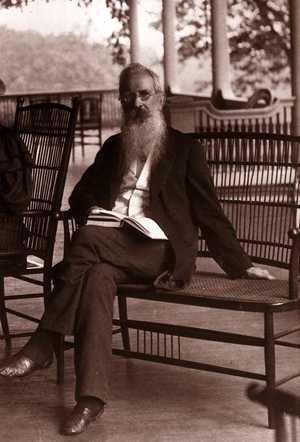
Gardiner Greene Hubbard
In the U.S., there were two unique factors: first, the continental scale of Western Union. No European telegraph organization had such extensive lines, and therefore, no incentive to develop multiplex telegraphy. Second, there was the unresolved issue of government control over the telegraph. The last European stronghold was Britain, which nationalized telegraphy in 1870. After that, there were no longer places outside the U.S. where the enticing prospect of making a technological breakthrough and undermining the monopoly lingered. Perhaps this is why much of the work on the harmonic telegraph was conducted in the U.S.
Three individuals primarily contended for the prize. Two of them were already established inventors - and . The third was a professor of rhetoric and a teacher for the deaf, by the name of Bell.
Gray
Elisha Gray grew up on a farm in Ohio. Like many of his contemporaries, he tinkered with telegraphy in his youth, but at 12, following his father's death, he began to seek a profession that could sustain him. He worked for a time as an apprentice blacksmith, then as a shipwright, and at 22, he discovered that he could receive an education at Oberlin College while still working as a carpenter. After five years of study, he embarked on a career as an inventor in the field of telegraphy. His first patent was a self-adjusting relay that eliminated the need to adjust the relay's sensitivity based on the current in the circuit by using a second electromagnet instead of a spring to return the anchor.
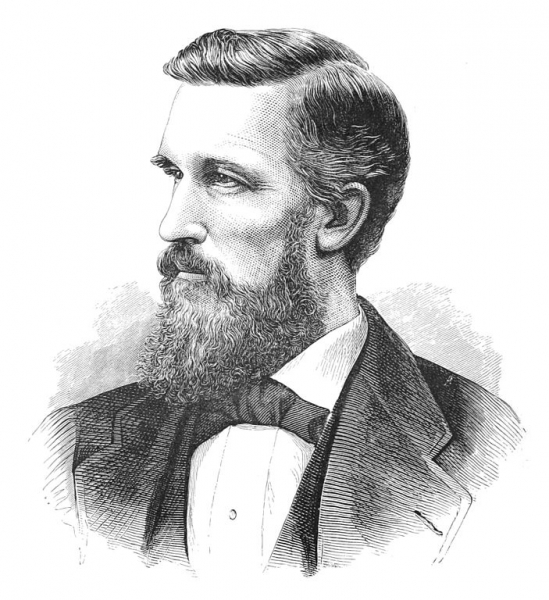
Elisha Gray, circa 1878
By 1870, he was already a partner in a company producing electrical equipment and worked there as the chief engineer. In 1872, he and his partner moved the company to Chicago and renamed it the Western Electric Manufacturing Company. Soon, Western Electric became the main supplier of telegraph equipment for Western Union, leaving a significant mark in the history of telephony.
In early 1874, Gray heard a strange sound coming from his bathroom. It sounded like the howling of a vibrating reotome, only much stronger. The reotome (literally 'current breaker') was a well-known electrical device that used a metal tongue to quickly open and close a circuit. Peeking into the bathroom, Gray saw his son holding an induction coil connected to the reotome in one hand and brushing the zinc coating of the bathtub with the other hand, which buzzed at the same frequency. Intrigued by the emerging possibilities, Gray stepped away from his daily work at Western Electric to return to inventing. By summer, he developed a full-octave musical telegraph that could reproduce sounds on a diaphragm made from a metal basin by pressing the keys on a keyboard.
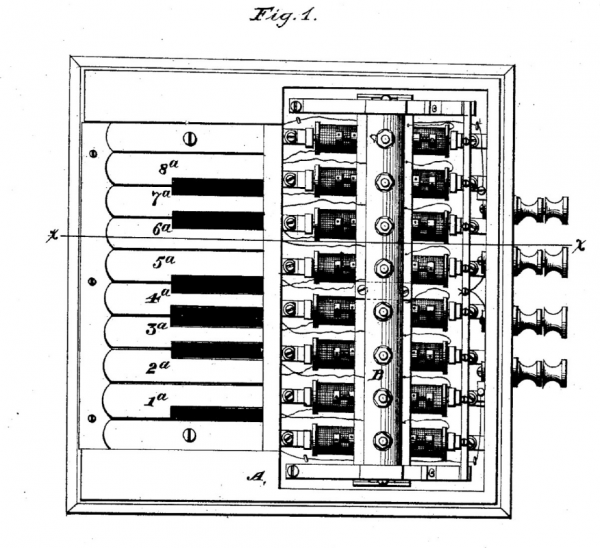
Transmitter
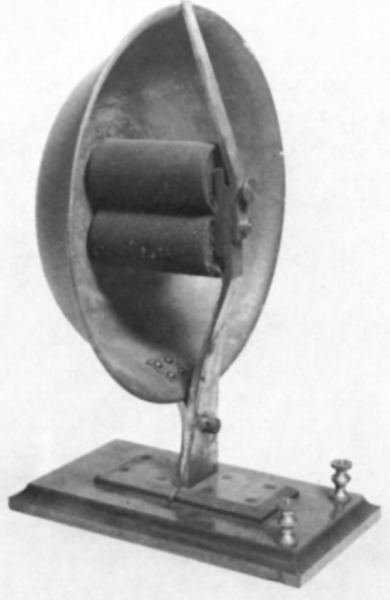
Receiver
The musical telegraph was a novelty without obvious commercial value. However, Gray realized that the ability to transmit sounds of varying pitches over a single wire provided him with two opportunities. With a transmitter of a different design capable of capturing sound from the air, it would be possible to create a voice telegraph. With another receiver that could separate the combined signal into its components, a harmonic telegraph could be made — that is, a multiplex telegraph based on sound. He decided to focus on the second option, as the telegraph industry had clear demands. He solidified his choice upon learning about Reys' phone, which seemed to be a simple philosophical toy.
Gray constructed the harmonic telegraph receiver from a set of electromagnets connected to metal strips. Each strip was tuned to a specific frequency and sounded when the corresponding button was pressed on the transmitter. The transmitter operated on the same principle as the musical telegraph.
Gray improved his apparatus over the next two years and took it to an exhibition. Officially, the event was called "". This was the first world’s fair held in the USA, coinciding with the centennial celebration of the nation, for which the so-called "Centennial Exhibition" was presented. It took place in Philadelphia in the summer of 1876. There Gray demonstrated the "octoplex" connection (i.e., transmitting eight messages simultaneously) on a specially prepared telegraph line from New York. This achievement was highly appreciated by the exhibition judges, but it was soon overshadowed by an even greater wonder.
Edison
, president of Western Union, quickly learned about Gray's progress, which made him quite anxious. At best, if Gray succeeded, the situation would result in very expensive patent licensing. At worst, Gray's patent would become the basis for creating a competing company that could undermine Western Union's dominance.
In July 1875, Orton pulled a trump card from his sleeve, specifically Thomas Edison. Edison was raised alongside telegraphy, spent several years working as a telegraph operator, and then became an inventor. His crowning achievement at that time was the quadraplex communication, developed with funding from Western Union a year earlier. Now, Orton hoped that he would improve on his invention and surpass what Gray had accomplished. He provided Edison with a description of Reis's telephone; Edison also studied Helmholtz's work, which had recently been translated into English.
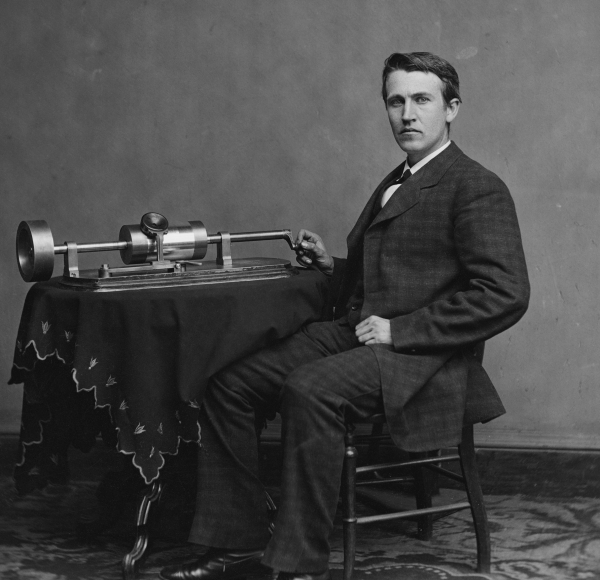
Edison was on top of his game, and innovative ideas poured out of him like sparks from an anvil. In the following year, he demonstrated two different approaches to acoustic telegraphy – the first was similar to Gray's telegraph and used tuning forks or vibrating reeds to create or perceive the required frequency. However, Edison couldn't get such a device to work at an acceptable level.
The second approach, which he called the "acoustic transmitter," was entirely different. Instead of using vibrating reeds to transmit various frequencies, he used them to convey pulses at different intervals. He shared the use of the wire between transmitters temporally, rather than by frequency. This required perfect synchronization of vibrations in each receiver-transmitter pair so that the signals wouldn't overlap. By August 1876, he had a quadraplex working on this principle, although at distances greater than 100 miles the signal became worthless. He also had ideas on improving Reis's telephone, which he temporarily set aside.
Then Edison heard of the sensation created at the Centennial Exhibition in Philadelphia by a man named Bell.
Bell
born in Edinburgh, Scotland, and raised in London under the careful guidance of his grandfather. Like Gray and Edison, he showed an early interest in the telegraph, but then followed in the footsteps of his father and grandfather, making human speech his main passion. His grandfather, Alexander, made a name for himself on stage and later taught public speaking. His father, Alexander Melville, was also a teacher and even developed and published a phonetic system he called 'visible speech.' The younger Alexander (Alec, as his family called him) chose to dedicate himself to teaching the deaf to speak.
By the end of the 1860s, he was studying anatomy and physiology at University College London. He was engaged to a fellow student, Mabel Ecleston, but then he withdrew both from his studies and from love. Two of Alec's brothers died of tuberculosis, and Alec's father insisted that he emigrate to the New World with the rest of the family to preserve the health of his only son. Bell complied, although he resisted and raged against it, and set sail in 1870.
After a brief stint in Ontario, Alexander, leveraging his father's connections, found a job as a teacher at a school for the deaf in Boston. There, the threads of his future began to intertwine.
Initially, he had a student, Mabel Hubbard, who lost her hearing at the age of five due to scarlet fever. Bell continued to tutor privately even after becoming a professor of vocal physiology and public speaking at Boston University, and Mabel was among his first pupils. At the time of her studies, she was just under 16, ten years younger than Bell, and within a few months he fell in love with her. We will return to her story later.
In 1872, Bell rekindled his interest in telegraphy. A few years earlier, while still in London, Bell had learned about Helmholtz's experiments. However, Bell misunderstood Helmholtz's achievement, believing that he not only created but also transmitted complex sounds using electricity. This led Bell to become fascinated with the harmonic telegraph - simultaneously using a wire to transmit multiple signals at different frequencies. Perhaps inspired by news that Western Union acquired the duplex telegraph idea from Joseph Stearns, his fellow Bostonian, Bell revisited his concepts and, like Edison and Gray, began to work on realizing them.
Once while visiting Mabel, he touched upon the second thread of his fate – standing next to the piano, he showed her family a trick he had learned in his youth. If you sing a pure note into the piano, the corresponding string will resonate and play it back to you. He told Mabel's father that a tuned telegraph signal could achieve the same effect and explained how it could be used in multiplex telegraphy. And Bell couldn't have found a better listener for his story: he resonated with excitement and instantly grasped the main idea: 'the air is the same for everyone, and only one wire is needed,' meaning that the wave propagation of current in a wire can miniaturely replicate the propagation through the air of waves generated by complex sounds. Bell's listener was Gardiner Hubbard.
Phone
And now the story becomes quite tangled, so I fear I might test the readers' patience. I will try to track the main trends without getting bogged down in details.
Bell, supported by Hubbard and the father of one of his students, diligently worked on the harmonic telegraph, keeping his successes secret. He alternated intense work with periods of rest when his health let him down, all while attempting to fulfill his university duties, promote his father's 'visible speech' system, and work as a tutor. He hired a new assistant, , the experienced mechanic from Charles Williams' Boston mechanical workshop – where those interested in electricity gathered. Hubbard pressured Bell and even went so far as to use his daughter's hand as motivation, refusing to allow her to marry until Bell perfected his telegraph.
In the summer of 1874, while vacationing near his family home in Ontario, Bell experienced a revelation. Several thoughts that had been simmering in his subconscious merged into one – the telephone. His thoughts were influenced in no small part by – the world's first sound recording device, which drew sound waves on smoked glass. This convinced Bell that any sound, no matter how complex, could be reduced to movements of a point in space, similar to the flow of current through a wire. We won't linger on the technical details, as they are unrelated to the actual phones created and their practical application is questionable. But they directed Bell's thinking in a new direction.
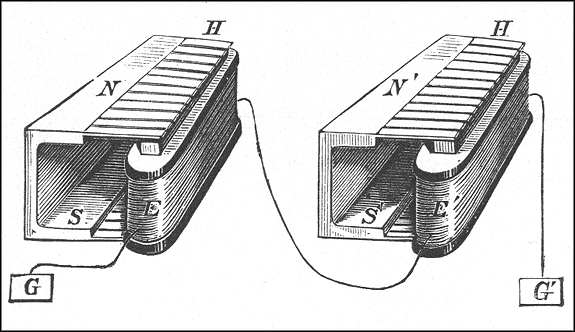
A sketch of the initial concept of Bell's telephone with 'harmonics' (not constructed)
Bell set this idea aside to pursue, as his partners expected, the goal of creating a harmonic telegraph.
However, he soon grew tired of the routine of precisely adjusting the instruments, and his heart, weary from the numerous practical obstacles between a working prototype and a practical system, increasingly leaned towards the telephone. The human voice was his first passion. In the summer of 1875, he discovered that vibrating reeds could not only quickly close and open the circuit like a telegraph key but also generate a continuous undulating current while moving in a magnetic field. He shared his telephone idea with Watson, and together they built the first model of the telephone based on this principle – a diaphragm vibrating in the electromagnetic field excited an undulating current in the magnet's circuit. This device was capable of transmitting some muted sounds of the voice. Hubbard was not impressed with the device and ordered Bell to return to practical tasks.
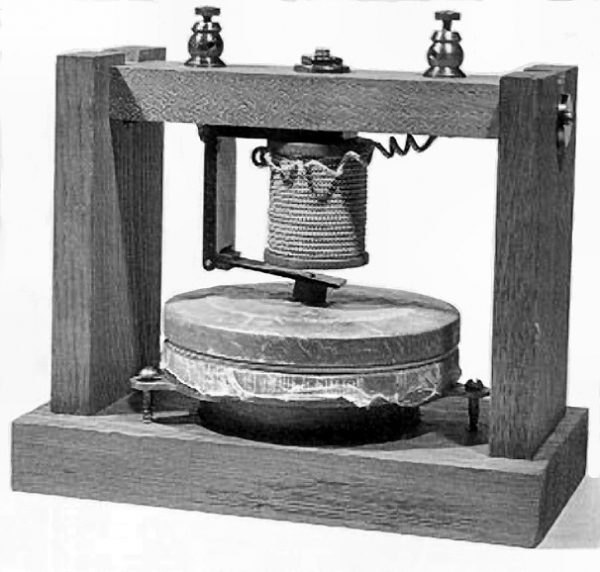
Bell's rudimentary 'gallows' telephone from the summer of 1875
However, Bell managed to convince Hubbard and the other partners that the idea should be patented, as it could be used in multiplex telegraphy. And if they were going to file for a patent, there was no reason not to mention the possibility of using the device for voice communications. Then in January, Bell added a new mechanism for generating wave current to the draft patent: variable resistance. He wanted to connect a vibrating diaphragm that received sound to a platinum contact that moved up and down in a container with acid, where another stationary contact was located. As the moving contact submerged deeper, a larger surface area came into contact with the acid, which reduced the resistance of the current flowing between the contacts—and vice versa.
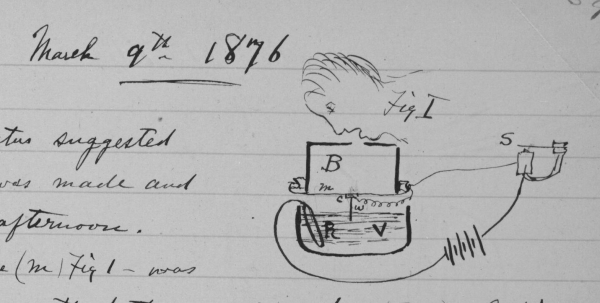
Bell's sketch of the transmitter concept with liquid variable resistance
Knowing that Gray was hot on Bell's heels, Hubbard submitted the wave current patent application to the patent office on the morning of February 14, without waiting for final confirmation from Bell. Later that same day, Gray's lawyer arrived with his patent. It also included a proposal for generating wave current using liquid variable resistance. It mentioned the applications of the invention for both telegraphy and voice transmission. But he was a few hours too late to block Bell's patent. Had the order of arrival been different, long hearings about priorities would have been required before granting the patent. As a result, on March 7, Bell was granted patent number 174,465, for 'Improvements in Telephony', which laid the cornerstone for the future dominance of Bell's system.
Yet, in this dramatic story, there is some irony. For on February 14, 1876, neither Bell nor Gray had built a working model of the telephone. No one had even attempted to do so, aside from a brief attempt by Bell the previous July, which did not involve any variable resistance. Thus, patents should not be seen as milestones in the history of technology. This critical moment in the evolution of telephony as a business enterprise was virtually unrelated to the telephone as a device.
Only after Bell and Watson submitted their patent did they have the opportunity to return to the telephone, despite Hubbard's constant demands to continue working on the multiplex telegraph. Bell and Watson spent several months trying to make the idea of liquid variable resistance work, and the telephone based on this principle was used to transmit the famous phrase: "Mr. Watson, come here, I want to see you."
However, the inventors continually faced reliability issues with these transmitters. Therefore, Bell and Watson began working on new transmitters using the magneto principle, which they had experimented with in the summer of 1875 – utilizing diaphragm movement in a magnetic field to directly induce current. The advantages were simplicity and reliability. The drawback was that the low power of the telephone signal resulted from the air vibrations created by the speaker's voice. This limited the effective working distance of the magneto transmitter. A device with variable resistance modulated the current generated by the battery, which could be made as strong as needed.
The new magnetos performed much better than those from the previous summer, and Gardiner decided there might be something to the idea of the telephone after all. Among other interests, he was involved in the Massachusetts committee for education and scientific exhibitions at the upcoming Centennial Exposition. He used his influence to give Bell a spot at the exhibition and in the competition, where judges evaluated electrical inventions.
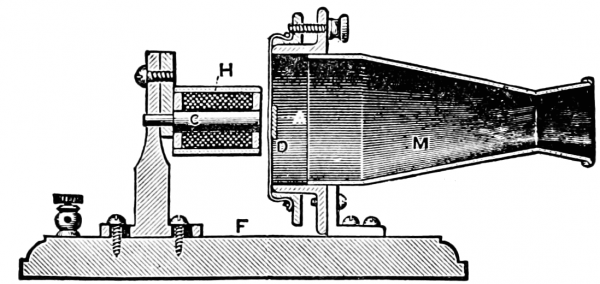
Bell/Watson magneto transmitter. The vibrating metal diaphragm D moves in the magnetic field of magnet H, inducing current in the circuit.
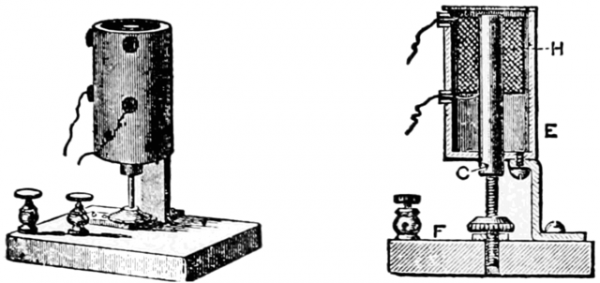
Receiver
The judges approached Bell right after studying Gray's harmonic telegraph. He left them at the receiver and walked over to one of the transmitters located a hundred meters further down the gallery. Bell's companions were astonished to hear his singing and words coming from a small metal box. One of the judges was Bell's fellow countryman, a Scotsman. (to whom the title Lord Kelvin was later bestowed). He ran excitedly to the other end of the hall to Bell to inform him that he had heard his words, and later declared the telephone "the most amazing thing he had seen in America." Also present was the Emperor of Brazil, who initially held the box to his ear and then sprang up from his chair exclaiming, "I hear, I hear!"
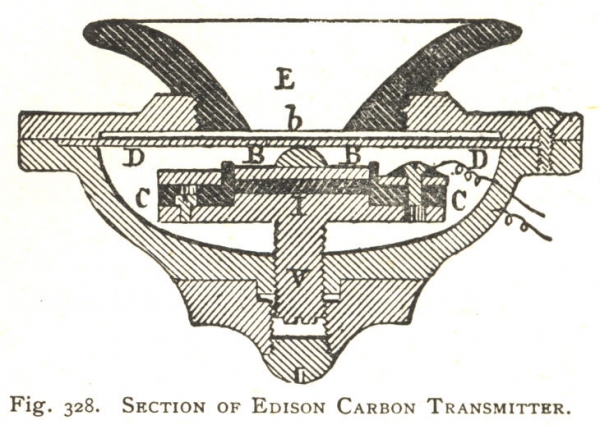
The buzz generated by Bell at the exhibition prompted Edison to revisit his earlier ideas about telephone transmission. He immediately focused on the main flaw of Bell's device – the feeble magneto transmitter. From his experiments with the quadrupole, he knew that the resistance of carbon granules changed with varying pressure. After numerous experiments with different configurations, he developed a variable resistance transmitter based on this principle. Instead of a wave of pressure in liquid contacts, the speaker's voice would compress a carbon 'button,' altering its resistance, and thus the current in the circuit. This was much more reliable and simpler to implement than the liquid transmitters conceived by Bell and Gray and became a crucial contribution to the long-term success of the telephone.
Yet Bell was the first to create the telephone, despite the obvious advantages in experience and skills held by his competitors. He was the first not because he experienced a revelation that others did not reach — they too had considered the telephone but deemed it insignificant compared to the improved telegraph. Bell was the first because he preferred the human voice to the telegraph, so much so that he resisted the desire of his partners until he was able to prove the functionality of his telephone.
But what about the harmonic telegraph, on which Gray, Edison, and Bell spent so much effort and thought? So far, nothing has come of it. Keeping mechanical vibrators at both ends of the wire perfectly tuned proved to be very difficult, and no one knew how to amplify the combined signal for long-distance transmission. It wasn't until the mid-20th century, after electric technologies, starting with radio, allowed for precise frequency tuning and low-noise amplification, that the idea of superimposing multiple signals for transmission over a single wire became a reality.
Farewell to Bell
Despite the success of the phone at the exhibition, Hubbard was not interested in building a telephone system. The following winter, he offered William Orton, president of Western Union, to purchase all rights to the phone under Bell's patent for $100,000. Orton declined, influenced by a combination of dislike for Hubbard and his postal telegraph schemes, confidence in his own abilities and Edison’s work on the phone, as well as a belief that the phone meant very little compared to the telegraph. Other attempts to sell the phone idea were unsuccessful, mainly due to fears of enormous costs in litigation over patent rights if commercialized. Thus, in July 1877, Bell and his partners founded the Bell Telephone Company to organize the phone service themselves. In the same month, Bell finally married Mabel Gardiner in her family's home, having become successful enough to win her father's blessing.
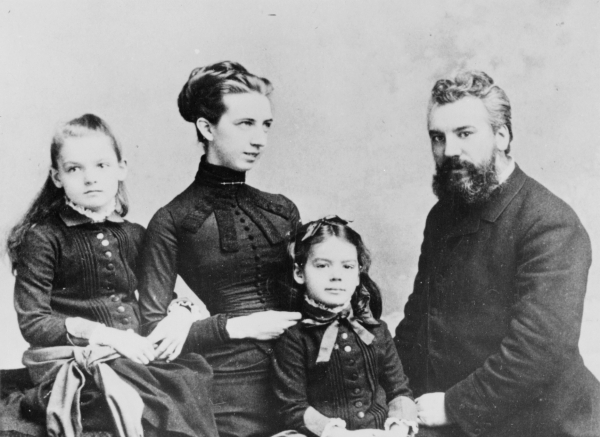
Alex with his wife Mabel and two surviving children – two of his sons died in infancy (around 1885)
The following year, Orton changed his attitude towards the telephone and founded his company, American Speaking Telephone Company, hoping that the patents of Edison, Gray, and others would protect the company from legal attacks by Bell. It became a serious threat to Bell's interests. Western Union had two main advantages. Firstly, substantial financial resources. Bell's company needed money, as it was leasing its equipment to clients, which delayed its profitability for many months. Secondly, access to Edison’s improved transmitter. Anyone comparing his transmitter with Bell's device could not miss the clearer and louder voice quality of the former. Bell's company had no choice but to sue its competitor for patent infringement.
If Western Union had unequivocal rights to the only available high-quality transmitter, it would have had powerful leverage to reach an agreement. However, Bell's team unearthed an earlier patent for a similar device obtained by a German immigrant, , and bought it. Only many years of legal battles later was Edison’s patent prioritized. Seeing that the litigation was not yielding success, in November 1879, Western Union agreed to transfer all patent rights to the telephone, equipment, and the existing subscriber base (55,000 people) to Bell's company. In return, they only requested 20% from the rental of telephones for the next 17 years, as well as that Bell stay out of the telegraph business.
Bell's company quickly replaced Bell's devices with improved models, initially based on Berliner’s patent and later on patents acquired from Western Union. By the time the litigation ended, Bell's main activity had become testifying in patent disputes, of which there were many. By 1881, he had completely stepped away from the business. Like Morse, and unlike Edison, he was not a system creator. Theodore Vail, the energetic manager whom Gardiner poached from the postal service, took the company into his hands and led it to a dominating position in the country.
Initially, the telephone network grew in a completely different manner than the telegraph network. The latter developed in leaps from one commercial center to another, covering 150 km at a time, seeking out points of the highest concentration of valuable customers, and only then complementing the network with connections to smaller local markets. Telephone networks grew like crystals from small growth points, from several customers located in independent clusters in each city and its surroundings, and slowly, over decades, merged into regional and national structures.
There were two major obstacles to large-scale telephony. First, there was the issue of distance. Even with the enhanced transmitters created based on Edison’s idea, the operational range of the telegraph and telephone was not comparable. The more complex telephone signal was more susceptible to noise, and the electrical properties of fluctuating currents were less understood than the properties of the direct current used in the telegraph.
Secondly, there was the issue of connectivity. Bell's telephone was a one-on-one communication device; it connected two points with one wire. This was not an issue for the telegraph. One office could serve multiple customers, and messages could easily be redirected from the central office over another line. But there was no simple way to transmit a telephone conversation. In the initial implementation of the telephone, a third party could connect to the two conversing individuals only through what would later be called a 'party line'. That is, if all subscriber devices were connected to one line, each of them could speak (or eavesdrop) with the others.
We will return to the issue of distance in due time. In , we will delve into the issue of connections and its consequences that influenced the development of relays.
What to Read
- Robert V. Bruce, Bell: Alexander Graham Bell and the Conquest of Solitude (1973)
- David A. Hounshell, “Elisha Gray and the Telephone: On the Disadvantages of Being an Expert”, Technology and Culture (1975).
- Paul Israel, Edison: A Life of Invention (1998)
- George B. Prescott, The Speaking Telephone, Talking Phonograph, and Other Novelties (1878)
Source: habr.com
