

Vasya Pupkin is currently writing: articulating his stream of thoughts in a block notebook. But here, Vasya encountered a problem: the page ran out. And it happened to be on the right page of the spread, which is very unfortunate. This means that if Vasya needs to write the next part of his thoughts while having the previous step in front of him, he will have to flip the sheet of paper back and forth.
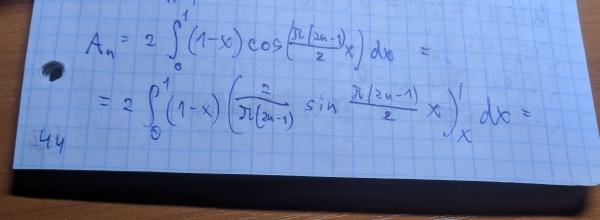
Familiar situation? Oh, the challenges of transferring the equal sign between spreads... This is exactly the issue I want to discuss, and how to ensure that the treacherous notebook never disrupts your flow of thoughts again.
Terminology
A node with no children will be called a leaf of the tree. In the example, the leaves will be nodes D, E, F, G, I, J, K. — a standard physical sheet of paper.
Page — the sheet has two sides, each of which we will refer to as a page.
Spread — consists of two pages lying before you, each of which belongs to its own sheet (thus, it can also be said that a spread consists of two sheets).
Turning the page to the right — taking the right sheet of the spread and flipping it over, thus making it the left sheet of the next spread.
Turning the page to the left — the same thing, only the left sheet is flipped.
All subsequent words that carry the meaning of the introduced terms will be emphasized. Additionally, new terms introduced along the way will be highlighted in bold.
Prerequisites
Let's denote the assumptions within which we are working: Vasya Pupkin is a very rational student, so he writes in a block notebook. Moreover, when Vasya writes, he removes sheets from the notebook because the rings get in the way of writing. Also, since Vasya is a rational person, all pages are numbered (in case they fall and scatter).
How it is commonly written
Typically, people write from left to right. And within the framework of a spread the left side is filled in first spread, then the right. When the spread ends, the person moves to the next spread (by turning the page to the right). This can be schematically represented as follows:
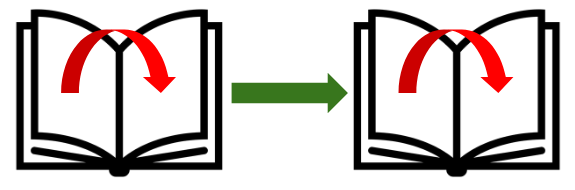
Here, the red arrow signifies the transition from left pages spread to right, while the green arrow represents turning the page to the right.
General reflections
Here are some general thoughts regarding the problem at hand, which help to understand that the solution ultimately proposed is rationally correct. If you wish, you can immediately proceed to read the next section describing the correct solution.
It is obvious that writing should be done in such a way that each subsequent page is located on a page different from the previous one; otherwise, we will experience that back-and-forth flipping of the page from side to side. And if each subsequent page is placed on a page a different page from the previous one, we can simply put the previous page in front of us at the right moment without interrupting our thought. This requirement imposed on the solution will be called the main one.
Version 1.0
One of the first solutions that comes to mind: let's write only on the right pages. spreadThis way, we don't even have the concept of spread. We have a stack of pages, where we write only on one side of all pages.
Drawbacks: resource waste. We could write twice as much with the same amount of paper.
Version 1.1
Let's improve the solution 1.0. We will continue to write only on one side. of the pageBut when we need to write something different, we use the same sheets, but now we write exclusively on the other side (math lectures on the left pages, algebra lectures on the right). spreadDrawbacks: there is no monolithic structure, i.e., one
contains materials that have no logical connection to each other. This is fraught with the consequence that if you need to share math lecture notes with a classmate, you automatically give them algebra notes as well (and what if you have an algebra exam tomorrow, and you need those notes right now! Ugh). Additionally, with unequal volumes of material on algebra and math, we again face a resource waste situation. a page Version 2.0
The model with a stack of papers has shown itself in a poor light. Let's return to the model with
flips: What if we alternate writing directions within theflip, left to right on the first, right to left on the second, and again left to right on the third… spread? Т.е. на первом The main condition is satisfied by the solution. Drawbacks: the linearity is disrupted

('this way, then that way'). This is very inconvenient. One must remember which direction we were writing in last time. linearity (“one way or another”). This is very inconvenient. We need to remember which direction we wrote in last time The mainUltimately, we will make a mistake someday (and it will happen, Murphy's Law, at exactly the moment we need to shift the equal sign between What if we alternate writing directions within the).
Version 2.1
But why complicate the memorization of how we wrote? Let's just fill in spread the right side first and then the left? Again, the main requirement holds.

Hmm. And this solution actually works! Your humble servant has been writing this way for about a year or so.
The downside isn’t exactly obvious and only revealed itself during the use of this method: when you send scanned/photos of sheets the notes, you constantly have to explain to people what the heck is going on with the pages.Fortunately, we number pages (see preconditions) and this makes things easier, but unaccustomed people get confused. Generally speaking, I didn’t consider this downside a downside, as the method solved the problem presented regardless of the inconvenience for outsiders.
It’s clear that you can keep going over writing versions indefinitely. Speaking within the framework of turns,considering the requirement of linearity,we have only two levers we can apply pressure on: the writing direction within spread, and the page-flipping direction. That is, only 4 variations... Wait, page-flipping direction?Solution (version 2.2)
And that’s where we arrive at the rationally correct solution that I have been practicing for a year and am completely satisfied with.
Here, the blue arrows indicate

page flipping to the left. In other words, the layout is filled in as usual from left to right, while the flippinggoes in the opposite direction from what is customary. That is, only 4 variations... Wait, page-flipping direction? When the situation arises that you need to keep the previous
, within the extension's pageit is clear, but if this unfortunate need strikes us between spread , it means we have now switched to a new What if we alternate writing directions within theand are about to write on the left side, spread while the previous spreadis located right under page the page , which is currently the right side,, and it simply needs to be set aside to gain access to the coveted information. spread, and it should just be set aside to access the elusive information.
During a year of beta testing this method, no significant drawbacks have been found. Compared to version 2.1, it's even better: you can scan entries, read them later, and not even suspect that the paging occurred in the opposite direction. It has also been noted that this method is easier to grasp for both your own brain and the brains of those around you when you explain it the first time.
Conclusion
— So what now? Do I have to change my writing habit?
— If you consider yourself a rational person, then yes! There are no downsides compared to the usual way (only in some specific situations, possibly), but there is a benefit.
Source: habr.com
