

(If you've already read the previous parts of this lecture's translation, skip to )
[Hemming occasionally speaks very unclearly, so if you have suggestions for improving the translation of specific fragments, please message me.]
This lecture was not in the schedule, but it had to be added to avoid a gap between classes. The lecture essentially focuses on how we know what we know, if indeed we actually know it. This topic is as old as time – it has been discussed for the last 4000 years, if not longer. In philosophy, a special term has been created to denote it – epistemology, or the science of knowledge.
I would like to start with the primitive tribes of the distant past. It is noteworthy that each of them had a myth about the creation of the world. According to one ancient Japanese belief, someone stirred the mud, and from the splashes, islands appeared. Similar myths existed among other peoples: for instance, the Israelites believed that God created the world in six days and then rested, completing the creation. All these myths are similar – although their plots are quite diverse, they all attempt to explain why this world exists. I will refer to this approach as theological, as it provides no explanations other than 'it happened by the will of the gods; they did what they deemed necessary, and thus the world came into being.'
Around the 6th century BC, philosophers of ancient Greece began to ask more specific questions – what is this world made of, what are its parts, and they tried to approach them more rationally than theologically. As is known, they identified the elements: earth, fire, water, and air; they had many other concepts and beliefs, and slowly but surely all this transformed into our modern understanding of what we know. Nevertheless, this topic has puzzled people throughout all times, and even the ancient Greeks wondered how they knew what they knew.
As you may recall from our discussion about mathematics, the ancient Greeks believed that the geometry that limited their mathematics was reliable and absolutely indisputable knowledge. However, as Maurice Klein, author of the book "Mathematics: The Loss of Certainty," has shown, which most mathematicians would agree with, mathematics contains no truths. Mathematics only provides consistency given a set of reasoning rules. If these rules or the assumptions used are changed, mathematics will be entirely different. There is no absolute truth, except maybe the Ten Commandments (if you are a Christian), but sadly nothing regarding the subject of our discussion. This is unpleasant.
However, some approaches can be applied to derive various conclusions. Descartes, considering the assumptions of many philosophers before him, took a step back and asked, "What can I be certain of, no matter how small?"; in response, he chose the assertion, "I think, therefore I am." From this assertion, he attempted to derive philosophy and gather a wealth of knowledge. This philosophy was not sufficiently justified, so we did not gain any knowledge. Kant claimed that everyone is born with a firm understanding of Euclidean geometry and many other things, meaning there is innate knowledge given, if you will, by God. Unfortunately, just as Kant was articulating his thoughts, mathematicians were developing non-Euclidean geometries that were just as consistent as their prototype. Thus, Kant's words amounted to nothing, just like almost everyone who has tried to reason about how they know what they know.
This is an important topic, as science is often called upon for justification: one can frequently hear that science has shown this or that, proved that it will be like this; we know this, we know that – but do we really know? Are you sure? I intend to examine these questions more closely. Let’s recall a rule from biology: ontogeny recapitulates phylogeny. This means that the development of an individual, from a fertilized egg to a student, schematically mirrors the entire preceding process of evolution. Thus, scientists claim that during the development of the embryo, gill slits appear and disappear again, and therefore they suggest that our distant ancestors were fish.
Sounds good if you don’t think about it too seriously. It provides a decent understanding of how evolution occurs, if one believes in it. But I'll go a bit further and ask: how do children learn? How do they acquire knowledge? Perhaps they are born with predetermined knowledge, but that sounds a bit unconvincing. To be honest, extremely unconvincing.
So, what do children do? They have certain instincts, and by following these instincts, children start making sounds. They produce all these sounds that we often call babbling, and this babbling apparently does not depend on the child's place of birth – in China, Russia, England, or America, children will babble in largely the same way. However, depending on the country, the babbling will develop differently. For example, when a Russian child says the word 'mama' a couple of times, they receive a positive response and thus will repeat those sounds. By trial and error, they discover which sounds help achieve the desired outcome and which do not, thereby learning many things.
Let me remind you of what I have said several times – there is no first word in the dictionary; each word is defined through others, meaning the dictionary is circular. Similarly, when a child tries to construct a coherent sequence of things, they encounter difficulties when faced with inconsistencies which they must resolve, as there is no first thing for the child to learn, and 'mama' does not always work. Confusion arises, for instance, like the one I am about to illustrate. Here’s a well-known American joke:
The words of a popular song (gladly the cross I’d bear)
and how children hear it (gladly the cross-eyed bear)
(In Russian: violin-fox/wheel creak, I’m a master emerald/core — a pure emerald, if you want bull plums/if you want to be happy, damn ass/back a hundred steps.)
I’ve also experienced such difficulties, not in this specific case, but there are several instances in my life that I can recall when I thought I was reading and speaking probably correctly, but those around me, especially my parents, understood something entirely different.
Here, serious errors can be observed, as well as how they occur. A child faces the need to make guesses about what words of a language mean and gradually learns the correct options. Nevertheless, correcting such errors can take a long time. One cannot be sure that they are completely fixed even now.
You can go very far without understanding what you’re doing. I’ve already talked about my friend, a Ph.D. in mathematics from Harvard University. When he finished Harvard, he said he could calculate derivatives by definition, but he doesn’t truly understand it; he just knows how to perform it. This is true for many things we do. For riding a bike, skateboarding, swimming, and many other things, we don’t necessarily have to know how to do them. It seems that knowledge is something greater than can be expressed in words. I wouldn’t dare claim that you can’t ride a bike, even if you can’t tell me how to do it, but you ride past me on one wheel. Therefore, knowledge can take many forms.
Let’s summarize what I’ve said. There are people who believe that we have innate knowledge; if you consider the situation as a whole, you might agree with this, considering, for example, that children have an innate tendency to produce sounds. If a child is born in China, he will learn to produce many sounds to achieve what he wants. If he is born in Russia, he will also produce many sounds. If he is born in America, he will still produce many sounds. The language itself is not that important here.
On the other hand, a child has an innate ability to learn any language, just like any other. They memorize sequences of sounds and understand what they mean. They have to assign meaning to these sounds themselves, as there is no initial part for them to remember. Show the child a horse and ask them: 'Is the word "horse" the name of the horse? Or does it mean that it has four legs? Perhaps it refers to its color?' If you try to explain to the child what a horse is by showing it, the child will not be able to answer this question, but that’s what you mean. The child won’t know which category to assign this word. Or, for example, take the verb "run." It can be used when you engage in quick movement, but you can also say that colors have run on the shirt after washing, or complain about the time rushing by.
A child experiences great difficulties, but sooner or later, they correct their mistakes by recognizing that they misunderstood something. As years go by, children become less capable of this, and when they grow up enough, they can no longer change. Obviously, people can be mistaken. Think, for instance, of those who believe they are Napoleon. No matter how much evidence you present to such a person that it is not true, they will continue to believe. You know, there are many people with strong beliefs that you do not share. While you might consider their beliefs to be insane, saying that there is a foolproof way to acquire new knowledge is not entirely accurate. You might say, 'But science is very precise!' Let's examine the scientific method and see if that’s really the case.
Thank you for the translation, Sergey Klimov.
10-43: Some say: "A scientist knows science like a fish knows hydrodynamics." There is no definition of Science here. I discovered (I think I told you about this before) somewhere in high school, different teachers told me about various subjects, and I could see that different teachers talked about the same subjects in different ways. Moreover, at the same time I was looking at what we were doing, and that was again something different.
Now, you probably said: "We do experiments, you look at the data and formulate theories." This is likely nonsense. Before you can gather the right data, you must have a theory. You can't just gather a random set of data: the colors in this room, the type of the next bird you see, etc., expecting that they carry some meaning. You must have some theory before collecting data. Furthermore, you cannot interpret the results of experiments you might conduct without a theory. Experiments are a theory that has gone the whole way from start to finish. You have biases, and you must interpret events with that in mind.
You acquire a tremendous amount of biases from cosmogony. Primitive tribes tell different stories around the campfire, and children hear them and learn the customs and traditions (Ethos). If you are in a large organization, you learn the rules of behavior largely by observing the behavior of others. As you grow older, you can't always stop. I tend to think that when I look at women my age, I can see a reflection of what dresses were in fashion during the days when those women were in college. I may be fooling myself, but I tend to think that way. You've all seen old Hippies who still dress and behave in the way that was acceptable back when their personalities were being formed. It's amazing how much you acquire this way, without even realizing it, and how hard it is for older ladies to relax and let go of their habits, acknowledging that they are no longer considered common behavior.
Knowledge is a very dangerous thing. It comes with all the prejudices you've previously heard. For example, you may have the bias that A precedes B and A is the cause of B. Well. Day inevitably follows night. Is night the cause of day? Or is day the cause of night? No. And another example that I really like. The level of the Potomac River correlates very well with the number of phone calls. Phone calls cause the river level to rise, which is why we get upset. Phone calls do not cause the river level to rise. It rains, and for this reason people tend to call taxi services more often and for other related reasons, such as informing loved ones that they will be delayed due to the rain or something like that, and the rain causes the river level to rise.
The idea that you can name cause and effect just because one precedes the other can be misleading. This requires some caution in your analysis and thinking and can lead you down the wrong path.
In prehistoric times, people seemingly personified trees, rivers, and stones, all because they could not explain the events occurring. But Spirits, you see, have free will, and thus the events were explained. However, over time we tried to limit the spirits. If you made the appropriate air passes with your hands, then the spirits would do this or that. If you recited the correct incantations, the spirit of the tree would do this or that, and everything would repeat itself. Or, if you planted crops on a full moon, the harvest would be better or something like that.
Perhaps these representations still weigh heavily on our religions. We have quite a few of them. We act rightly towards the gods, or the gods grant us the blessings we ask for, provided, of course, that we act rightly towards our loved ones. Thus, many ancient gods became one God, despite the existence of the Christian God, Allah, the one Buddha, although now they have a series of Buddhas. A greater or lesser part merged into one God, but we still have quite a bit of black magic around. We have much black magic in the form of words. For example, you have a son named Charles. You know that if you stop and think, Charles is not the child himself. Charles is the name of the child, but it is not the same. Nevertheless, black magic is often associated with the use of a name. I write down someone's name and burn it or do something else, and somehow this is supposed to affect the person.
Or we have sympathetic magic, where one thing looks similar to another, and if I take this and eat it, certain events will occur. A significant part of medicine in early days was indeed homeopathy. If something looks like another, it will behave differently. Well, you know that doesn't work very well.
I mentioned Kant, who wrote an entire book, "Critique of Pure Reason," which he undertook in a large, thick volume in difficult-to-comprehend language, about where we know what we know and what we leave this subject unattended. I do not think this is a very popular theory on how you can be sure of something. I will give an example of a dialogue I have used several times when someone said they were certain about something:
--- I see that you are absolutely sure?
--- No doubts.
--- No doubts, good. We can write down on paper that if you are wrong, you will, firstly, give up all your money, and secondly, you will commit suicide.
Surprisingly, they do not want to do that. I say: but you were sure! They start babbling nonsense and, I think, you can see why. If I ask about something you were absolutely sure of, then you say: "Okay, okay, maybe I'm not 100% sure."
You may be familiar with some religious sects that believe the end is near. They sell all their possessions and head to the mountains, yet the world continues to exist, and they come back and start all over again. This has happened many times and several times in my lifetime. Various groups that have done this were convinced that the world was coming to an end, but it did not happen. I try to convince you that absolute knowledge does not exist.
Let's take a closer look at what science does. I told you that, in fact, before starting measurements, a theory needs to be formulated. Let's see how it works. Some experiments are conducted, and certain results are obtained. Science attempts to formulate a theory, usually in the form of a formula that covers these cases. However, none of the latest results can guarantee the next one.
In mathematics, there is a concept known as mathematical induction, which, if you make a series of assumptions, allows you to prove that a certain event will always occur. But first, it is necessary to accept many different logical and other assumptions. Yes, mathematicians can prove correctness in this extremely artificial situation for all natural numbers, but you cannot expect that a physicist can also prove that it will always happen. It doesn't matter how many times you drop a ball; there is no guarantee that the next physical object you drop will behave better than the previous one. If I hold a balloon and let it go, it will rise. But you will immediately have an alibi: "Oh, but everything falls except for this. You have to make an exception for this object.
Science has plenty of such examples. And this is a problem whose boundaries are not easy to define.
Now that we have tried and examined what you know, we are faced with the necessity of using words to describe it. And these words can have meanings different from those you assign to them. Different people can use the same words with different interpretations. One way to eliminate such misunderstandings is when there are two people in the lab arguing about a subject. Misunderstanding halts them and forces them to clarify what they mean when they speak about different things, to a greater or lesser extent. You may often find that they do not mean the same thing.
They argue over different interpretations. Then the arguments shift to what it means. After clarifying the meanings of the words, you understand each other much better and can debate the meaning — yes, the experiment says one thing if you understand it that way, or the experiment says another if you understand it differently.
But at that point, you understood only two words. Words serve us poorly.
Thanks for the translation, Artem Nikitin
20:10… Our languages, as far as I know, generally emphasize 'yes' and 'no', 'black' and 'white', 'truth' and 'falsehood'. But there is also a golden mean. Some people are tall, some are short, and some are of average height between tall and short; that is, for some, they may be considered tall, and vice versa. They are average. Our languages are so awkward that we tend to argue about the meanings of words. This leads to a problem in thinking.
There have been philosophers who argued that you can only think in terms of the concepts of words. That's why we have dictionaries that we've known since childhood, with various meanings of the same words. And I suspect everyone has had the experience that while learning new knowledge, you couldn't express something in words (you couldn't find the right words to express it). In reality, we don't think in words; we just try to do, and what actually happens is what happens.
Let's say you were on vacation. You come home and tell someone about it. Gradually, the vacation you had becomes what you talk about to someone. Words usually replace the event and freeze it.
Once, during a vacation, I talked to two people, giving them my name and address, and we went shopping with our wives, then we went home, and later, without discussing it with anyone, I wrote down what I could about the events that occurred today. I wrote everything that I thought, and looked at the words that became the event. I tried very hard for the event to take on words. Because I know very well the moment when you want to say something but can't find the right words. It seems that everything happens as I said; that your vacation becomes exactly like the words described it. Much more so than you could have been sure. Sometimes you should just chat about the conversation itself.
Another thing that came up in the collection on quantum mechanics is that even if I have a bunch of scientific data, they can have completely different explanations. There are three or four different theories of quantum mechanics that more or less explain the same phenomenon. Just as non-Euclidean geometry and Euclidean geometry study the same thing but are used differently. There is no way to derive a unique theory from a set of data. And since the data is finite, you're stuck with it. You won't have that unique theory. Never. If for everyone 1+1=2, then the same expression in Hamming code (the most famous of the first self-checking and self-correcting codes) would be 1+1=0. There is no definite knowledge that exists when you would like to have it.
Let's talk about Galileo (the Italian physicist, mechanic, and astronomer of the 17th century), from whom quantum mechanics began. He suggested that falling bodies fall equally, regardless of constant acceleration, friction, and air influence. Ideally, in a vacuum, everything falls at the same speed. But what if one body touches another as they fall? Will they fall at the same speed because they became one? If touch is not considered, what if the bodies are tied together with a string? Two bodies tied by a string will fall as one mass or continue falling as two different masses? What if they're tied with a rope instead of a string? What if they are glued together? When can two bodies be considered as one? And at what speed will this body fall? The more we think about this, the more 'silly' questions arise. Galileo said: 'All bodies will fall at the same speed, otherwise, I will ask a 'silly' question: how do these bodies know how heavy they are?' Before him, it was believed that heavy bodies fall faster, but he asserted that the speed of falling does not depend on mass and material. Later, we will experimentally confirm that he was right, but we do not know why. This law of Galileo can actually be called not a physical law but rather a verbal-logical one. It is based on the fact that you do not want to ask the question: 'When do two bodies become one?' It doesn't matter how much the bodies weigh if they can be considered as one unified body. Therefore, they will fall at the same speed.
If you read classic works on relativity, you will find that a lot is devoted to theology and little to what is commonly referred to as active science. Unfortunately, that is the case. Science is a very strange thing, to say the least!
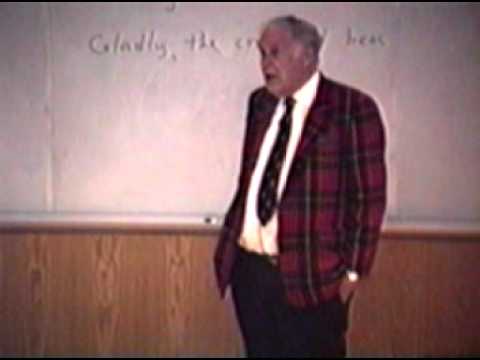
As I mentioned in the lectures about digital filters, we always see things through a "window." This window is not only a material concept but also an intellectual one, through which we "see" certain meanings. We are limited to perceiving only certain ideas, which is why we sometimes find ourselves at an impasse. However, we understand well how it could be otherwise. I suppose that the process of belief in what science is capable of is somewhat similar to how a child learns a language. A child makes guesses about what they hear but later makes corrections and arrives at different conclusions (the writing on the board: "Gladly the cross I’d bear/Gladly, cross eyed bear. A play on words: like 'Happy to bear my cross/Happily, bear with crossed eyes'"). We conduct some experiments, and when they don't work, we reinterpret what we see. Just as a child navigates rational life and the language being learned. Similarly, experimenters who excel in theories and physics hold a certain viewpoint that explains something but is not guaranteed to be true. I present to you a very obvious fact: all the previous theories we have had in science turned out to be incorrect. We have replaced them with current theories. It is reasonable to think that we are now arriving at a point where we need to rethink all of science. It is hard to imagine that almost all the theories we currently have will, in some sense, turn out to be false. In the sense that classical mechanics ended up being incorrect compared to quantum mechanics, yet at the medium level we tested, it still proved to be the best tool we had. But our philosophical perspective on things is completely different. Thus, we make strange progress. But there is one more thing that is not considered: logic, because you aren't given much logic.
I believe I mentioned that the average mathematician, upon receiving their doctorate early on, soon finds that they need to refine the proofs of their thesis. For example, this was the case with Gauss and his proof for the root of a polynomial. Gauss was a great mathematician. We raise the standard of rigor in proofs. Our perspective on rigor changes. We begin to realize that logic is not as safe as we once thought. It has as many pitfalls as everything else. The laws of logic are how you tend to think as you prefer: "yes" or "no", "either-or" and "either this or that". We are not on stone tablets that Moses brought down from Mount Sinai. These are assumptions that work quite well many times, but not always. And in quantum mechanics, you cannot say with certainty whether particles are particles or whether particles are waves. At the same time, are they both or neither?
We would have to sharply depart from what we strive for, yet continue what we must. Currently, science should adhere to this rather than to confirmed theories. However, such workarounds can be quite lengthy and exhausting. And people who understand the matter quite well know that we don't do this and never will, but we can, like a child, become better and better over time, eliminating more contradictions. But will this child fully understand everything they hear and not be confused by it? No. Considering how many assumptions can be interpreted very differently, this is not surprising.
Now we live in an era where science nominally dominates, but in reality, it does not. Most newspapers and magazines, particularly the magazine "Vogue" (a women’s fashion magazine), publish astrological forecasts based on zodiac signs every month. I think almost all scientists reject astrology, although at the same time, we all know how the Moon affects the Earth, causing tides.
30:20
At the same time, we wonder whether a newborn will be right-handed or left-handed, depending on the position of the star in the sky that is located 25 light-years away from us. Although we have observed many times that people born under the same star grow up differently and have different fates. So whether the stars influence people, we do not know.
We have a society that largely depends on science and engineering. Perhaps too much depended on it when Kennedy (the 35th president of the USA) announced that we would be on the Moon within ten years. There were many great strategies to achieve at least one. One could donate money to the church and pray. Or spend money on psychics. People could devise their own ways to the Moon through various other methods, such as pyramidology (pseudoscience). Like, let's build pyramids to harness their energy and reach that goal. But no. We depend on good old engineering. We did not know that the knowledge we thought we had was merely an illusion. But damn it, we made it to the Moon and back. We rely on success to a much greater extent than on science itself. But that's all irrelevant. We have more significant matters than engineering. It's the well-being of humanity.
And today we have a host of topics to discuss, like UFOs and the like. I'm not claiming that the CIA orchestrated Kennedy's assassination, or that the government blew up a bomb in Oklahoma to incite panic. But people always cling to their beliefs even in the face of evidence. We see this time and again. Now, choosing who to label as a fraud and who not is not so easy.
I have several books on the topic of separating genuine science from pseudoscience. We have witnessed several modern pseudoscientific theories. We have experienced the phenomenon of "polywater" (a hypothetical polymerized form of water that might form due to surface phenomena and possess unique physical properties). We have encountered cold fusion (the proposed possibility of achieving a nuclear fusion reaction in chemical systems without significantly heating the working substance). Bold claims are made in science, and only a small part of this is true. An example can be drawn from artificial intelligence. You constantly hear about what machines with artificial intelligence will do, yet you see no results. But no one can guarantee that this won’t happen tomorrow. Since I claim that no one can prove anything in science, I must confess that I can prove nothing myself. I cannot even prove that I cannot prove anything. A closed circle, isn’t it?
There are very large limitations that we consider inconvenient in order to believe anything, but we need to come to terms with this. In particular, about what I have repeated to you several times and illustrated with the example of the Fast Fourier Transform (an algorithm for computing the discrete Fourier transform that is widely used for signal processing and data analysis). I apologize for my immodesty, but I was the first to put forward the ideas fundamentally. I concluded that implementing the "Butterfly" (an elementary step in the Fast Fourier Transform algorithm) would be impractical with the equipment I had (programmable calculators). Later, I remembered that technology has changed and there are special computers with which I can complete the implementation of the algorithm. Our capabilities and knowledge are constantly changing. What we cannot do today, we may be able to do tomorrow, but at the same time, if you look closely, "tomorrow" does not exist. It’s a paradoxical situation.
Let's return to science. For about three hundred years, from 1700 to the present, science has begun to dominate and evolve in many areas. Today, the foundation of science is what is known as reductionism (a methodological principle stating that complex phenomena can be fully explained by the laws typical of simpler phenomena). I can divide the body into parts, analyze the parts, and draw conclusions about the whole. Previously, I mentioned that most religious people would say, 'You cannot divide God into parts, study His parts, and understand God.' Supporters of gestalt psychology would say, 'You must look at the whole as a whole. You cannot divide the whole into parts without destroying it in the process. The whole is something more than the sum of its parts.'
If one law applies in one area of science, it may not work in a subdivision of that same field. Three-wheeled techniques are not applicable in many areas.
Consequently, we must consider the question: 'Can all of science be considered largely exhaustive, relying on results obtained from the core areas?'
The ancient Greeks contemplated ideas such as Truth, Beauty, and Justice. Has science added anything to these ideas over all this time? No. We currently possess no more knowledge on these concepts than the ancient Greeks did.
The King of Babylon Hammurabi (who ruled approximately from 1793 to 1750 BC) left behind a Code of Laws, which included laws such as "Eye for an eye, tooth for a tooth." This was an attempt to express Justice in words. When comparing this to what is happening now in Los Angeles (referring to the racial riots of 1992), it is not justice but legality. We are unable to articulate Justice in words, and attempts to do so only yield legality. We are also unable to articulate Truth. I try to do this as best as I can in these lectures, but in reality, I cannot. The same goes for Beauty. John Keats (a poet of the younger generation of English romantics) said: "Beauty is truth, and truth is beauty, and that is all you know, and all you need to know." The poet identified Truth and Beauty as one and the same. Scientifically speaking, such a definition is unsatisfactory. Yet science does not provide a clear answer either.
I want to summarize the lecture before we part ways. Science does not simply produce certain knowledge that we desire. Our main issue is that we wish to have certain truths, which is why we assume that we possess them. Accepting the desired as real is a tremendous curse for mankind. I observed this when I worked at Bell Labs. The theory looks plausible, research provides some confirmations, but further studies do not yield any new confirmations to this. Scientists begin to think that they can do without new evidence for the theory. And they start to be believed. Essentially, they just keep saying more and more, and their desire makes them firmly believe that it is true as they say. This is a characteristic of all people. You give in to the desire to believe. Because you want to believe that you will obtain the truth, you ultimately receive it continually.
Science really has little to say about the things that concern you. This is true not only for Truth, Beauty, and Justice, but also for all other matters. Science is capable of very little. Just yesterday, I read that some geneticists achieved certain results in their research, whereas other geneticists obtained results that contradict those of the first.
Now, a few words about this course. The last lecture is titled , but it would be better to call it simply “You and Your Life.” I want to give the lecture “You and Your Research” because I have spent many years studying this subject. In a sense, this lecture will summarize the entire course. It is an attempt to articulate the best way to do what you must do going forward. I arrived at these conclusions independently; no one told me about them. And in the end, after I tell you all that you need to do and how to do it, you will be able to achieve more and better than I have. Goodbye!
Thanks for the translation, Tilek Samiev.
Who wants to help with — write in private messages or to the email magisterludi2016@yandex.ru
By the way, we have also launched the translation of another cool book — )
Table of contents and translated chapters
- Intro to The Art of Doing Science and Engineering: Learning to Learn (March 28, 1995)
- “Foundations of the Digital (Discrete) Revolution” (March 30, 1995)
- “History of Computers — Hardware” (March 31, 1995)
- “History of Computers — Software” (April 4, 1995)
- “History of Computers — Applications” (April 6, 1995)
- “Artificial Intelligence — Part I” (April 7, 1995)
- “Artificial Intelligence — Part II” (April 11, 1995)
- “Artificial Intelligence III” (April 13, 1995)
- “n-Dimensional Space” (April 14, 1995)
- “Coding Theory — The Representation of Information, Part I” (April 18, 1995)
- “Coding Theory — The Representation of Information, Part II” (April 20, 1995)
- «Error-Correcting Codes» (April 21, 1995)
- «Information Theory» (April 25, 1995) Done, just need to publish
- «Digital Filters, Part I» (April 27, 1995)
- «Digital Filters, Part II» (April 28, 1995)
- «Digital Filters, Part III» (May 2, 1995)
- «Digital Filters, Part IV» (May 4, 1995)
- «Simulation, Part I» (May 5, 1995)
- «Simulation, Part II» (May 9, 1995)
- «Simulation, Part III» (May 11, 1995)
- «Fiber Optics» (May 12, 1995)
- «Computer Aided Instruction» (May 16, 1995)
- «Mathematics» (May 18, 1995)
- «Quantum Mechanics» (May 19, 1995)
- «Creativity» (May 23, 1995). Translation:
- «Experts» (May 25, 1995)
- «Unreliable Data» (May 26, 1995)
- «Systems Engineering» (May 30, 1995)
- «You Get What You Measure» (June 1, 1995)
- (June 2, 1995) translating in 10-minute segments
- Hamming, «You and Your Research» (June 6, 1995).
Who wants to help with — write in private messages or to the email magisterludi2016@yandex.ru
Source: habr.com
