

Recently, we published . You can find essential information about the console and the developer through the link, get acquainted with features for different user groups, and the interface for the site administrator. In this article, we will discuss the new version of the panel, which was recently released — , and the license can be obtained for free with your order of .
Plesk continues to evolve from a basic functional web console into a powerful management platform, proven on servers, websites, applications, hosting, and cloud businesses. Plesk Obsidian allows web specialists, resellers, and service providers to intelligently manage, secure, and launch servers, applications, websites, and hosting companies of any size at a professional level.
At Plesk, they believe that the industry is currently undergoing rapid changes:
"Digital transformation is no longer just a distinguishing characteristic; it is a business imperative. We want to not only track, understand, and anticipate this change but also influence it. The digitization of processes and tasks is changing how servers, applications, and websites are managed in the cloud... Shared hosting has become a commodity, and bare infrastructure is not sufficient to help your clients advance in the modern web stack. An ever-growing number of clients are willing to pay for additional services such as managed WordPress, managed backups, enhanced security, increased speed and performance of websites, application hosting, and much more. Simply put, the biggest challenge for companies of any size today is understanding the potential of digital technologies, which areas of their business can benefit from digital transformation, and how easily they can be implemented and managed. Specifying bare infrastructure is no longer a priority... Therefore, the new Plesk Obsidian panel now utilizes artificial intelligence, machine learning, and automation technologies to empower [administrators and website owners] and assist hosting businesses worldwide in effectively managing digital transformations."
And, actually, about what's new in the Plesk Obsidian panel within the framework of digital transformation ().
New key features of Plesk Obsidian
▍Modern web stack for rapid application and website development
With Plesk Obsidian — it's an optimized web stack 'out of the box' and ready-to-code innovative platform with all deployment capabilities and convenient tools for developers (Git, Redis, Memcached, Node.js, etc.).
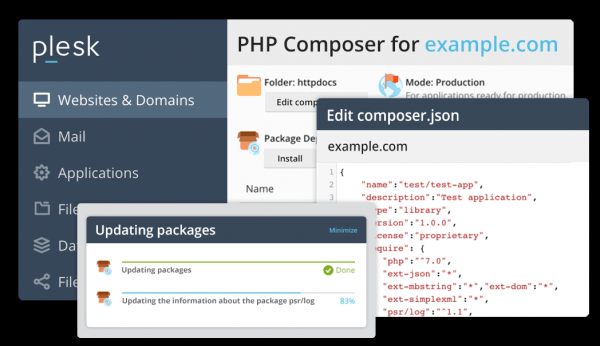
PHP Composer — a dependency manager for PHP
One of the many challenges faced by web developers concerns dependencies. Integrating new packages into a project often brings more headaches than benefits. This is especially true for PHP developers. Quite often, programmers build modules from scratch, and achieving data consistency across web pages is a pain that grows with the number of variables. As a result, good developers spend a lot of time and resources on redundant tasks while wanting to be productive and quickly release new code. This is where Composer in Plesk Obsidian comes in — a sleek and simple dependency manager for PHP that makes it easy to manage dependencies for a PHP project (the extension is installed manually).
Docker NextGen — a feature for convenient service delivery in Docker
Running applications in containers instead of virtual machines is gaining traction in the IT world. This technology is regarded as one of the fastest-growing in the recent history of the software industry. At its core is Docker — a platform that allows users to easily package, distribute, and manage applications within containers. With the Docker NextGen feature, utilizing Docker-based solutions 'turnkey' (Redis, Memcached, MongoDB, Varnish, etc.) has become simpler, without delving into the Docker technology itself, which is convenient. Auxiliary services for websites can be deployed with a single click. Plesk configures the services and then easily integrates them with your website automatically. (Coming soon).
MongoDB — a flexible, versatile, and easy-to-use database
And the most in-demand, according to , the largest developer survey in the world with over 100,000 respondents. Plesk Obsidian sets up the MongoDB service. Managing MongoDB instances, like any other database, can be done locally or remotely. And seamlessly integrating them into the development workflow. (Coming soon).
Restricted Access Mode
Server-side operation restrictions provide administrators with greater control over which operations Plesk users can and cannot perform. The new restricted access mode can be applied to both the control panel administrator (service provider) and site administrators (panel administrators).
→
When the limited access mode is enabled, you can:
- see which services and resources are available to the administrator in 'Expert' mode
- grant clients' admins access rights in Plesk, controlling their access to potentially risky operations: managing updates, rebooting, shutting down, etc.
- discover which tools and options are available to the administrator in 'Expert' and 'Service Provider' modes for server management and web hosting management (in the 'Administration Tools' and 'Hosting Tools' tabs respectively).
Safer, more useful, and reliable tools for developers
- Several improvements in PHP-FPM and Apache services. Restarting Apache is now reliable enough to set it as the default to minimize site downtime.
- Reduced disk space required to restore individual objects from backups stored in remote storage.
- The PHP engines shipped with Plesk Obsidian include popular PHP extensions (odium, exif, fileinfo, etc.).
- The PageSpeed module is now precompiled with NGINX.
Comprehensive security with Plesk Security Core
Top-notch server-to-site protection activated by default against the most common website attacks and malicious users.
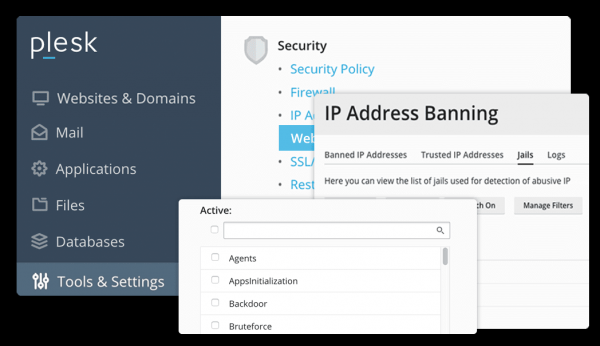
Good hosting by default
- Mod_security (WAF) and fail2ban are active out of the box.
- By default, systemd now automatically restarts failed Plesk services within 5 seconds.
- On newly created websites, HTTP>HTTPS redirection is enabled by default, optimized for SEO.
- On a system-wide basis in Linux (CentOS 7, RHEL 7, Ubuntu 16.04/18.04, and Debian 8/9), emergency Plesk services are now restarted automatically.
- The PHP-FPM limit, often called max_children, is a setting for the maximum number of parallel PHP-FPM processes running on the server (previously it was 5).
- SPF, DKIM, and DMARC are now enabled by default for incoming and outgoing email.
Improvements in email
- Mail users now receive email notifications when more than 95% of their mailbox disk space is used.
- Email users can also view mailbox disk space information, its usage and limitations in the Horde and Roundcube webmail clients.
- The Plesk mail server and webmail are now available via HTTPS by default: they are secured with a standard SSL/TLS certificate that protects Plesk itself.
- The Plesk administrator can now change client, reseller, and additional user passwords by automatically sending them an email with a password reset link. Mail users and additional users can now specify an external email address to be used for password recovery in case they lose access to their primary email address.
- Mail autodiscovery is enabled by default in panel.ini so Plesk can easily support the most popular mail, desktop, and mobile mail clients. This new feature allows automatic configuration of mail for Exchange Outlook and Thunderbird mail clients. .
Backup Optimization
- The free disk space on the server required for creating and restoring backups in cloud storage (Google Drive, Amazon S3, FTP, Microsoft One Drive, etc.) has been significantly reduced. This saves on storage costs.
- The time for operations with backups stored remotely has been reduced. For example, backups stored in cloud storage can now be deleted four times faster than before.
- To restore a single subscription from a full server backup, you now only need additional free disk space equal to the space occupied by that specific subscription, rather than the entire server backup.
- For server backups to cloud storage, additional free disk space is now required equal to the space occupied by two subscriptions, rather than the entire server.
- Plesk Obsidian comes with a Repair Kit — a powerful diagnostics and self-recovery tool that allows your clients to troubleshoot potential issues anytime, anywhere, even when Plesk is unavailable. It addresses problems with: mail server, web server, DNS server, FTP server, the Plesk database Microsoft SQL Server, or the Plesk file system itself — MySQL.
→
User Experience, UX
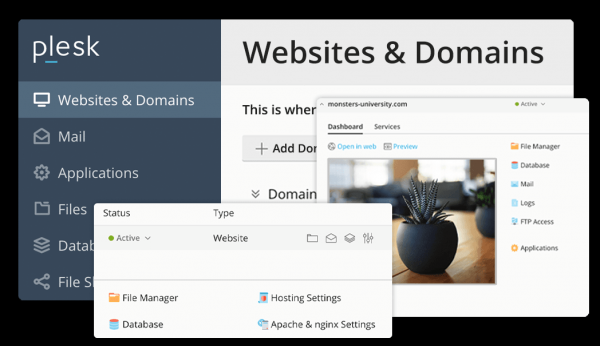
Simplified server and website management
Plesk Obsidian features a completely new, revamped user interface that makes server management even easier. Now your clients can comfortably work with all websites on one screen: view them in detail, select bulk management, or manage them individually in a list or group format, using appropriate features and controls of the selected CMS.
The interface is now more user-friendly, lighter, and visually appealing. Colors and font sizes have been optimized, and all elements are aligned to a grid. For greater efficiency, the left menu can be collapsed. The global search is now more prominent.
Moving domains between subscriptions
Previously, this was a challenging manual task requiring an advanced skill set of a server administrator. Plesk Obsidian allows for easy domain movement to another subscription along with its content, configuration files, log files, PHP settings, APS applications, as well as subdomains and domain aliases (if any). This can also be done via the command line.
→
Notification panel
Important notifications in a visually appealing HTML format are now displayed directly in the Plesk user interface. This feature ensures that critical issues are brought to attention and addressed promptly, saving your clients precious time and money. Notifications in the panel (mobile notifications are planned for the future) currently generate events such as: 'tracked parameter has reached the RED level'; 'Plesk update available / was installed / failed to install'; 'ModSecurity rule set installed'. .
Enhanced file manager
The File Manager now features bulk upload and file search capabilities, allowing for increased productivity. Read about the previous version in .
What's new:
- Uploading and extracting RAR, TAR, TAR.GZ, and TGZ archives.
- Search for files by filename (or even part of the name) or content.
Coming soon:
- Quick preview of images and text files without opening new file manager screens through the preview panel.
- The file manager will save queries and suggest them for autofill while typing.
- Accidentally deleted the wrong file or folder through File Manager? Restore it via the File Manager user interface, even if you do not have a backup.
- If you disrupt your website's functionality by changing file permissions or the file directory structure, fix it using the Plesk restoration feature through the file manager user interface.
Other panel improvements
Extensions and applications
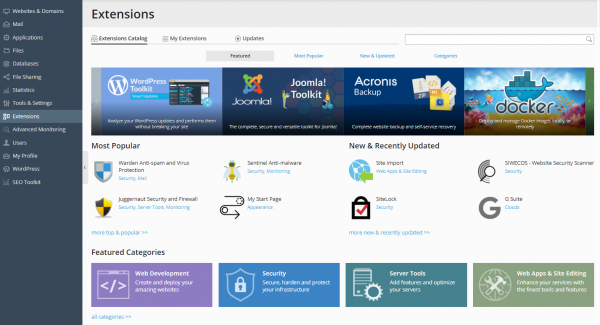
The extensions catalog is now integrated into Plesk Obsidian. This technology is necessary for quickly and flexibly addressing client issues. It allows you to add additional products and services to your client storefront with minimal effort. .
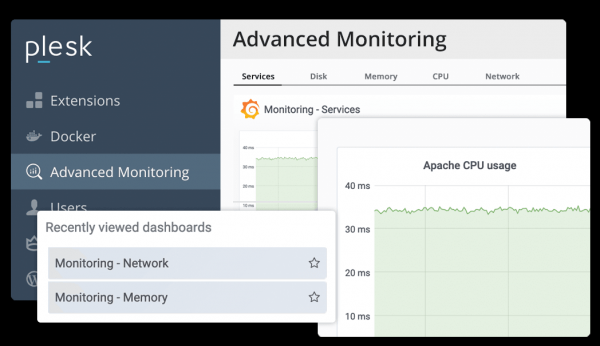
Advanced monitoring
Replaces the existing tool a new . It allows tracking server and website availability and setting up alerts to notify owners of resource consumption issues (CPU, RAM, disk I/O) via email or in the Plesk mobile app. .
Managed services
Managed hosting services can range from simple OS updates and one-click panel installations just for WordPress to fully managed infrastructure, including OS, applications, security, 24x7x365 support (even at the WordPress application level), appropriate backup and recovery strategy, performance monitoring tools, WordPress optimization, SEO enhancements, and much more.
By the way, WordPress remains the content management system holding 60% of the global CMS market. Today, around 75 million websites are built on WordPress. The lifeblood of any managed WordPress hosting in Plesk remains It was created in collaboration with WordPress experts for users of all skill levels. Plesk works closely with the WordPress community, and we continuously update the WordPress Toolkit based on feedback from community members. The WordPress Toolkit, combined with is currently the only comprehensive solution for managing WordPress available on the market, allowing you to innovate once again and instantly compete with leading players in the specialized WordPress hosting market.
Conclusion
Since the early 2000s, Plesk has made life easier for web professionals, small and medium-sized businesses, and continues to benefit many cloud services. Based in Switzerland, Plesk operates on 400,000 servers worldwide, powering over 11 million websites and 19 million mailboxes. Plesk Obsidian is available in 32 languages, and many leading cloud and hosting service providers partner with Plesk — including us. By the end of the year, all new RUVDS clients purchasing a virtual server can the Plesk Obsidian panel for free!
Source: habr.com
