

The IT sphere is an ungrateful one, and the forecasts here are just as uncertain as last summer's weather; you'll either freeze, get soaked, or suffer from a heatstroke. Yet, as it turned out, our predictions for 2019 were quite good, so we decided to share our vision of CRM trends for 2020, particularly for small and medium-sized businesses. We ended up identifying 11 trends, not that symbolism or foresight play much of a role in engineering work. Everything we consider a trend according to our team is based on 14 years of experience in the CRM market, current industry developments, and our clients' requests. Overall, we stand by our forecasts.
This winter, the weather can only be determined this way 🙁
Important! This forecast pertains to the Russian market and the automation of companies in Russia and the CIS; completely different trends and dynamics exist in Western markets and the USA at this time.
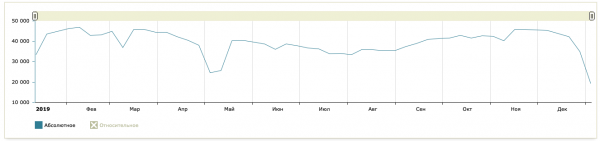
For now, interest in CRM only dips during holidays, 2018-2019, Russia+CIS, Yandex
CRM will finally extend beyond sales
CRM system developers continue to promote the idea that 'implementing CRM means a 50% increase in sales,' because a pattern has taken root in users' minds that they can expect sales growth from a CRM system. However, this understanding of CRM is outdated: most systems have long since become universal solutions for comprehensive business automation, catering to everyone from secretaries to CEOs, including logistics professionals, manufacturers, marketers, and salespeople.
Currently, all prerequisites are in place for businesses to realize the full functional power of . There are several points we'd like to emphasize in 2020 and instill in the minds of CRM system users.
- Business processes need to be automated in every company, regardless of industry or size. Automating routine tasks and clearly delineating stages and responsibilities save the company money and free up labor resources (which should not be reduced but effectively utilized).
- A CRM system should be the center of individual and collective planning, allowing management and colleagues to monitor time across the team. And believe me, planners in some CRM systems are significantly better than everyone's favorite Google Calendar (and more secure!).
- CRM should be seen by businesses not just as a sales tool, but as a security tool, since it holds records of all customers (the client database), deals, and most transactions. The ability to assign access rights for each employee is also important (although rarely utilized, which is a mistake). You don’t need to hunt down every employee — just set up security measures for one CRM system, and the business leader will sleep a little easier.
Try to look at CRM from a broader perspective. By the way, you can download the manual for our and see what a single system is capable of — nearly 400 pages describing the system’s capabilities are far from just sales (). By 2020, we aimed to create a system with all the most important and, crucially, usable business functions without AI and pulse sensors. We are all about business.
Small businesses will dive into omnichannel communication.
Just 3-5 years ago, the main communication channels between businesses and clients were the phone (IP telephony) and email. Today, things are different: clients and website visitors can come from the site chat, Telegram, Yandex chat, and social media (more relevant for B2C). The CRM system, as the main software for a company’s commercial activities, faces the task of collecting, processing, and storing information about all significant dialogues. This can be done separately for each channel, or you can, for instance, collect everything in email and website chat, and then integrate them into the CRM. Such a solution is optimal in terms of security and data organization: fewer external connections, lower risk of unconventional hacking and intrusion into the system.
Omnichannel communication will continue to develop so that clients communicate in the way that is convenient for them, rather than how your software dictates. Why should you consider this?
- You won’t lose a single customer or interested website visitor.
- You will have more data at the initial stage.
- New advertising opportunities open up for you, targeted at the communication channel (however, this is a quite controversial type of advertising message, so assess how relevant and ethical it is to "chase" clients in what is essentially their personal space).
- You will find it easy to communicate with users who avoid calls and verbal interaction with salespeople, engineers, and support. Moreover, during written communication, company managers have more time to think through their part of the dialogue, significantly improving the quality of the information provided.
Analytics — in the hands of small businesses
This trend has been around for many years, existing since the creation of the very first CRM systems. Nevertheless, small businesses have only recently begun to adopt analytics. This delayed adoption is due to two factors: 1) businesses did not require analytics, focusing primarily on sales; 2) there was no widespread business culture of data usage. The situation has changed: 1) in an environment of non-price competition, a deep understanding of each client is truly enriching; 2) analytics has entered small businesses through Yandex.Metrica and Google Analytics — these digital data have prompted small businesses to reflect on metrics, analyze, and adapt. However, unfortunately, this is still not a reality, but merely a trend that will continue into 2020.
A properly implemented CRM is the ideal knowledge base about each client, providing enormous opportunities for impressive service and post-sales support. And that translates into revenue. It is evident that 2020 will not be a calm and quiet year in terms of economic conditions, meaning the battle for each client will intensify. Do you want to survive? Embrace analytics in your CRM system; the results will be quick and satisfying. Even if you don't build a super analytical system, but instead work with the numbers in a casual manner and draw conclusions.
Comprehensive services will grow — unfortunately.
I'll be honest — we are not fond of this trend, but it emerged recently and will only grow. Today, there are aggregators for CRM systems that don't just sell; hosting providers are actively offering not just hosting but VDS with CRM, 1C, and office solutions included. From the perspective of an average manager, executive, or accountant, this is great: quick deployment, no contracts with IT services, payments classified as operational costs, everything is handled by third-party admins, and no hassle. Most importantly, it’s profitable, and you only need to work with one company. This is a sad trend — and here's why.
- The risks are not distributed: in case of technical or commercial problems with the hosting, you will lose everything at once and experience downtime in your operations, which is practically beyond your control.
- In systems pre-installed on remote servers, there are often limitations on configuration changes, settings, expansion, etc.
- The subscription fee for such services (which is always a subscription fee) will quickly exceed the cost of purchasing software licenses (CRM or 1C); the cost of ownership will be quite significant, especially for a small company.
- You can never be sure about the security of your data and the existence of up-to-date backups — both the possibility of an attack and human error should not be ruled out.
Be cautious when choosing such services.
Micro CRM — not for everyone, but necessary
CRM systems are becoming increasingly complex and universal. We have been engaged in continuous and active development for many years and see this growth as a result. This is why we had to differentiate the editions and offer a version for each business (although everyone particularly loved ). However, there are companies that cannot even use the lower editions of CRM systems available on the market. All they need is to record a single customer inquiry, follow up with a call, 'guide' them to a sale, and close the deal. This is micro and small businesses that are not yet ready to pay for analytics, initial data, complex deal forms, business processes, and everything else.
Companies like these need micro CRMs — very simple cloud solutions that can address basic business issues without complicated implementation, training, and preferably at a low cost. Thus, businesses are looking for simple CRMs. Previously, we did not notice this demand because we were heavily involved with powerful functional CRMs. The realization came when we launched our : clients showed interest in it specifically as a very simple CRM (a deal as a request, telephony, work costs, statuses — this is sufficient for some clients from small and micro businesses).
This is a positive trend: from such 'small' automation, businesses will eventually move to larger systems and be able to derive the same benefits as larger companies, meaning they can grow based on analytics, work with KPIs, and manage business processes. One of the best trends we've noticed.
Low code — a trap for managers
In 2019, the concept of low code returned to the CRM world. Essentially, these are the same platforms as before, but they finally gained a catchy marketing name. A process designer with BPMN notation support? — That's low code! A visual UI editor? — Low code. In general, a visual business process editor in our RegionSoft CRM or setting up a questionnaire in the ticketing system ZEDLine Support — this is all low code. By the way, there is another synonym for this term — NO-code.
I am sure this topic will continue to develop in 2020. By the way, if you want to see real low-code, check out the Pega BPM platform, along with its pricing, and assess whether your employees can handle this low code. In some cases, it's easier to learn a programming language 🙂
Low code development implies the ability to change the information system on the client side without stopping the workflow without using programming code (through visual 'development'). In simpler terms, this is the same story where the vendor sells a CRM/ERP with the motivation: 'managers can modify the system themselves without programming skills.' Have you tried to build something more complicated than a linear process in BPMN? Do you like UML diagrams? Well, not every IT specialist is mentally prepared to deal with that, let alone ordinary managers, for whom software is launched with a 'click on the pentagram 1C'.
Why low code is not the trend you need?
- To tackle the configuration of low code, a manager needs to understand at least the logic (as a subject, not as a mindset) and have skills in process management. Simply put, a low code developer must think like a developer. Otherwise, it will take a lot of time to make mistakes and learn this builder.
- It won't be enough to just 'assemble' a business process, report, or module — it's important to integrate it properly into the logic of the system you are customizing.
- There's a high probability that you will encounter paid technical support from the vendor because you'll have questions about working with the low code platform, and they will gladly answer — for an additional fee.
- Your employees will spend working hours learning the platform and the 'low code development' itself, and this time will be taken away from their primary tasks. It's easier to spend money on vendor enhancements and not distract employees from their responsibilities. Even if you're firmly decided to switch to a low code platform, the best solution would be to hire or allocate a dedicated person to work with it.
- The low code platform is nothing more than a builder, which has a limited set of blocks, pieces, wheels, and figures. If you want to create a fundamentally new function necessary for your business requirements, you'll need to write real code (or most likely, turn to the vendor).
- Platforms have many limitations regarding integrations, APIs, email handling, etc. You will have to address these issues outside the capabilities of low code.
I don't rule out that low code platforms, under a certain marketing gloss, will prove to be a lasting trend for corporate CRMs, but you shouldn't expect them to be an explosive breakthrough or a cure-all. Most likely, they would be beneficial for small projects without scaling and complex business requirements, or, when looking at expensive solutions, for companies that have the budget to show off a team of developers (builders) for the low code platforms.
Don't cry, Alice, your time hasn't come yet.
In our 2019 forecast, we suggested that speech technologies would make their way into CRM systems, but in the form of: ‘Alice, call Sergey Mikhailov from LLC ‘Istok’. The prediction came true in a disappointing way: voice assistants did indeed reach domestic CRM systems, but for now, they can only create tasks — a significantly less intelligent feat than making a voice call. We still hold to our opinion: for now, a voice assistant in a CRM system is more of a marketing gimmick and a novelty, with no clear business value in sight.
Features for the sake of features will increase CRM costs.
In the commercial realm of IT companies, you may encounter the concept of business functions (useful functionality included in a release) and product gimmicks (not particularly necessary items easily fed to the audience in the form of press releases and news on industry websites). For instance, a business process builder or planner is an important business function, whereas a pulse measurement tool or a pedometer in the mobile version of CRM is a product gimmick. Under certain conditions, AI, VR, or gamification could be seen as gimmicks—if they are not applicable to the target clients' business. Unfortunately, in 2018-2019, there was a literal surge of such gimmicks: various CRMs started offering marketing features (albeit understandable!), calling in well-known business trainers as partners, and engaging in strange collaborations. All of this costs companies money and obviously leads to increased costs for the end user.
This approach will become trendy, as it significantly simplifies commercial tasks, allows for entry into a wide range of media, and despite its lack of substance, appeals to consumers. Therefore, there will be no advice — just remember that for every gimmick that made you smile or 'went viral', it will be you who pays. Well, this isn't new for us — do we not pay for such things in gadgets, apps, and even in development tools? 🙂
Clouds will continue to grow. The risks too.
The euphoria of the convenience and accessibility of cloud technologies is being overshadowed by security issues: data retention, configurations, and cloud infrastructure are increasingly influenced by external attacks, force majeure events, and even corporate conflicts among hosting providers and data centers. Thus, a third party, silently present in the business that utilizes cloud software within its infrastructure, gains significance and becomes a tangible and real threat to the company's information security.
Abandoning cloud technologies in 2020 is at least strange, so it's time to adopt a risk diversification strategy in information security: keep 2-3 backup copies on different servers; for storing customer databases and transaction records, prefer desktop CRMs (which are hosted on your server), and monitor access security. If handling this yourself is challenging, consider asking an outsourcing company or your visiting system administrator to set up a security system. Don't skimp on security—it will ultimately cost you more in the long run.
Ratings will continue to deceive.
Unfortunately, in 2019 at least two ordered studies came out that labeled a certain CRM system as number 1 or a leading market player. Numerous such ratings and reviews emerged, and a grand award was established for handing out elephants. It seems this trend has returned and will remain very much alive. By the way, we wrote about why So test CRMs, choose for yourself, and don’t rely on information written by dead VK accounts or cleverly manipulated by another research organization.
There are still a few specific trends that will impact the CRM system market in Russia: the question of artificial intelligence and its demand remains open, the market is flooded with ‘one-day’ CRM systems that are trying to establish themselves independently or through partner networks, the contraction of these very partner networks, a low level of automation in companies (estimated at about 8% in Moscow and even lower in the regions), low user awareness, etc. However, these are not just events from 2020, but rather trends that we all have to live with.
Overall, the CRM market is vibrant, companies are showing interest in automation, understanding its benefits, searching for alternatives, comparing, and contemplating. This automation increasingly resembles a necessity rather than a trend or just something to do. We continue to work.
Source: habr.com
