

In the animal kingdom, which includes humans, there are many methods of conveying information to one another. This can be an energetic dance, like that of paradise birds, indicating a male's readiness to reproduce; it can be bright coloration, like that of Amazon tree frogs, signaling their toxicity; or it can be scent, as in dogs, marking territorial boundaries. However, the most common method for most advanced animals is acoustic communication, that is, the use of sounds. We even teach our children from infancy who says what: cow — moo-moo-moo, dog — woof-woof, and so on. For us, verbal, or acoustic communication, is an integral aspect of socialization. The same can be said for other representatives of the fauna. Scientists at Hainan University (China) decided to look into the past to understand the evolution of acoustic communication. How widespread is acoustic communication among animals, when did it originate, and why did it become the dominant method of conveying information? We will learn about this from the researchers' report. Let's go.
The foundation of the research
At this stage of evolutionary development, many representatives of fauna have fully integrated acoustic signals into their life rhythm. Sounds made by animals are used to attract a mate (birdsong, frog croaking, etc.), to detect or disorient an enemy (the jay's call, which warns a predator that it has been spotted and the ambush will not work, so it would be better to retreat), to convey information about the presence of food (hens, upon finding food, produce a characteristic sound to attract the attention of their offspring), and so on.
Interesting fact:
The male of the white bellbird (Procnias albus) produces a mating call at 125 dB (a jet engine produces 120-140 dB), making it the loudest bird on the planet.

The study of acoustic signals and their evolution has been conducted for quite some time. The data obtained from such efforts contribute to a better understanding of how humans use sounds and, consequently, how various languages were formed in different regions of the planet. However, these studies have not addressed the very emergence of acoustic communication as a phenomenon. One of the fundamental questions that remains unanswered is why acoustic communication arose.
There are many questions that require answers. Firstly, what specific ecological factors influenced the emergence and formation of this type of information transmission? Secondly, was acoustic communication linked to speciation, i.e., does it aid in the species' proliferation and prevent its extinction? Thirdly, is the presence of acoustic communication evolutionarily stable after its development? Finally, did acoustic communication develop in parallel across different animal groups, or does it have a common ancestor for all beings?
According to the scientists themselves, answers to these questions are important not only for understanding acoustic communication per se, but also for grasping evolution and behavioral changes in animals. For instance, there is a theory that habitat strongly influences sexual selection and communication in certain animal species. Whether this theory applies to the formation of signals is still difficult to say, but it is certainly plausible. Scientists also remind us that Darwin noted the important role of sound signals in the formation of pairs in certain species. Therefore, acoustic signals have an impact on speciation.
In this study, researchers aimed to examine the evolution of sound signals among quadrupeds using a phylogenetic approach (identifying relationships between different species). The main focus was on the origin of acoustic communication rather than its form or functions. Data from 1,799 different species were used, and the factor of daily behavior (species with diurnal and nocturnal activity) was also considered. Additionally, a study was conducted on the relationship between acoustic communication and the degree of species diversification, i.e., their prevalence, via a speciation-extinction model. Phylogenetic conservatism was also tested in the presence of acoustic communication between species.
Research Results
Among quadrupeds, most amphibians, mammals, birds, and crocodilians possess acoustic communication, while most reptiles and turtles do not. Among amphibians, this type of information transmission is absent in caecilians (Caecilian), but present in some species of salamanders and in most frogs (in 39 out of 41 considered species). Acoustic communication is also absent in snakes and all lizard families except two – Gekkonidae (geckos), Phyllodactylidae. In the order of turtles, only 2 out of 14 families have acoustic communication. Unsurprisingly, all of the 173 bird species studied exhibited acoustic communication. 120 out of 125 mammal families also demonstrated the presence of this feature.
Interesting fact:
Salamanders have remarkable regeneration abilities and can regrow not only their tails but also their limbs; unlike many of their relatives, salamanders do not lay eggs but are live-bearing; one of the largest salamanders – the Japanese giant salamander – weighs 35 kg.

Summarizing this data, it can be said that acoustic information transmission is present in 69% of quadruped representatives.
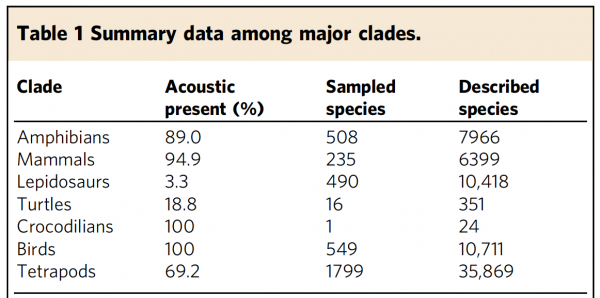
Table No. 1: Percentage of acoustic information transmitters among the studied quadruped species.
Having established the approximate distribution of acoustic communication among species, it was necessary to understand the relationship between this ability and animal behavior (nocturnal or diurnal).
Among several models describing this relationship for each species, a model suitable for a generalized description of the relationship between acoustics and behavior for all species was selected. This model (Table No. 2) shows all the possible advantages and disadvantages of such a skill for both behavioral options of the animal.
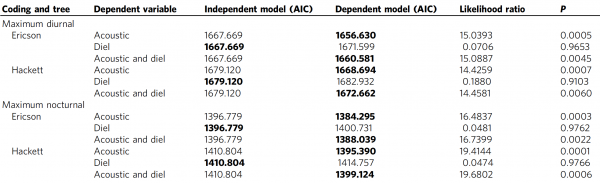
Table No. 2: Analysis of the relationship between acoustic communication and animal behavior (diurnal/nocturnal).
A clear dependency of acoustic communication on behavior was established, alongside a balanced interdependence. However, interestingly, no reverse dependency was found—behavior on acoustic communication.
Phylogenetic analysis showed a close correlation between acoustics and nocturnal lifestyle (Table No. 3).

Table No. 3: Phylogenetic analysis of the relationship between acoustic communication and diurnal/nocturnal lifestyle.
Data analysis also showed that the presence of acoustic communication had no effect on the rate of diversification in the phylogeny of quadrupeds. Thus, the average diversification metrics (speciation-extinction; r = 0.08 events per million years) were the same for both lines of species with acoustic communication and those without this skill. Therefore, it can be assumed that the presence/absence of acoustic communication had virtually no impact on the prevalence of any species or events related to its formation or extinction.
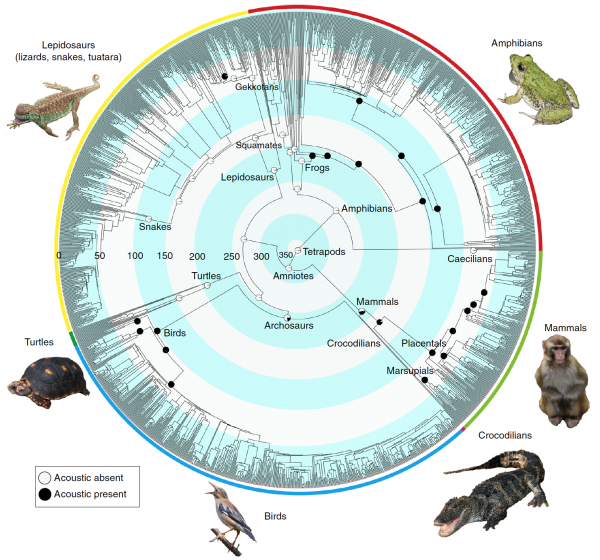
Image No. 1: Evolution of acoustic communication among various quadrupeds.
Scientists suggest that acoustic communication likely developed independently in each major group of quadrupeds, but its origin was ancient in many major clades (~ 100–200 million years ago).
For example, acoustic communication developed quite early in the phylogeny of the order Anura (Anura), but is completely absent in the sister group for all other currently living frogs from the clades containing the families Ascaphidae (tailed frogs) and Leiopelmatidae (leiopelmas).
Interesting fact:
Leiopelmas are endemic to New Zealand and are considered long-lived among frogs—the males live up to 37 years, while the females live up to 35 years.
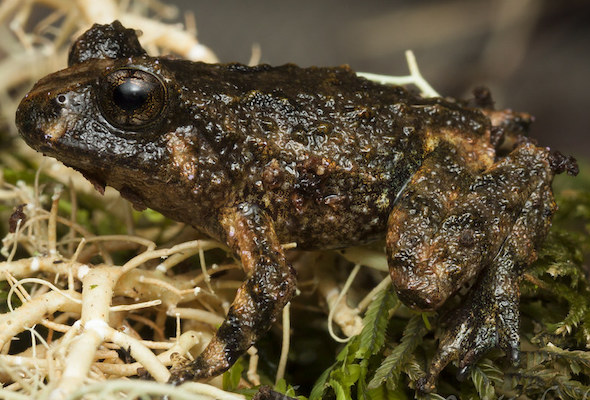
In mammals, as well as in frogs, acoustic communication emerged around 200 million years ago. Some species have lost this skill during evolution; however, the overwhelming majority have retained it to the present day. An exception can be made for birds, which appear to be the only ones that have maintained acoustic communication throughout their entire evolutionary history.
It has been established that acoustic communication was present in the most recent ancestor of today's birds as well as in the most ancient ancestor of today's crocodiles. Each of these ancestors existed about 100 million years ago. It can be assumed that acoustic communication was also present in the common ancestor of these two clades, which existed around 250 million years ago.
Interesting fact:
Some species of gecko-like lizards are capable of producing the most unexpected sounds for lizards—barking, clicks, chirping, etc.

In scaly reptiles, acoustic communication is quite rare, which may be related to its more narrowly focused emergence exclusively in nocturnal creatures, such as gecko-like lizards (Gekkota). Relatively recent evolutionary changes have led to the emergence of acoustic communication in some phylogenetically isolated species of salamanders and turtles.
For a more detailed understanding of the nuances of the study, I recommend checking out and related to it.
Epilogue
Summarizing all of the above results, one can assert with almost complete confidence that the development of acoustic communication is in one way or another related to a nocturnal lifestyle. This supports the theory of the influence of ecology (habitat) on the evolutionary traits of a species. Nevertheless, the presence of acoustic communication has virtually no impact on the diversification of a species over a large time scale.
Researchers have also determined that sound communication appeared about 100-200 million years ago, and some species of quadrupeds have carried this ability through all this time with virtually no changes.
It is worth noting that the presence of acoustic communication for nocturnal creatures, although clearly an advantage, does not have a negative impact when transitioning to a daytime lifestyle. This simple fact is confirmed by the observation that many previously nocturnal species, upon shifting to a daytime lifestyle, did not lose this ability.
Communication through sounds, according to this research, can be considered the most enduring evolutionary trait. When this ability emerged, it almost never disappeared during evolution, unlike other types of signal transmission, such as bright coloring or unusual body shapes, plumage or fur.
According to researchers, their analysis of the relationship between acoustic communication and the environment can also be applied to other evolutionary traits. It was previously thought that the ecological impact on signaling methods was limited to differences between closely related species. However, based on the aforementioned work, it can be confidently stated that fundamental types of signal transmission also change in response to changes in the animal's habitat.
Friday off-topic:

An excellent demonstration of the incredible variety of sounds produced by different bird species.
Off-topic 2.0:

Sometimes animals produce very unusual and amusing sounds.
Thank you for your attention, stay curious, and have a great weekend, everyone! 🙂
A little advertisement 🙂
Thank you for staying with us. Do you enjoy our articles? Want to see more interesting content? Support us by placing an order or recommending us to your friends, , a unique entry-level server alternative that we have created for you: (options available with RAID1 and RAID10, up to 24 cores and up to 40GB DDR4).
Dell R730xd at half the price in the Equinix Tier IV data center in Amsterdam? Only with us in the Netherlands! Dell R420 — 2x E5-2430 2.2GHz 6C 128GB DDR3 2x960GB SSD 1Gbps 100TB — from $99! Read about how
Source: habr.com
