

In the Telegram chat I often see questions about how to save on purchasing a Mikrotik license or even using RouterOS for free. Surprisingly, there are legal methods available.


In this article, I will not address the licensing of Mikrotik hardware, as they come with the maximum license their hardware can support right from the factory.
Where did Mikrotik CHR come from?
Mikrotik produces various networking equipment and installs a universal operating system of its own production — RouterOS. This operating system has extensive functionality and an understandable administration interface, and the equipment on which it is applied is very affordable, explaining its widespread adoption.
To use RouterOS outside of their hardware, Mikrotik released an x86 version that could be installed on any PC, allowing older hardware to have a second life. However, the license was tied to the hardware number of the device on which it was installed. This means if the HDD failed, you would also have to say goodbye to the license...
of hardware and RouterOS x86 has 6 levels and contains a bunch of parameters:
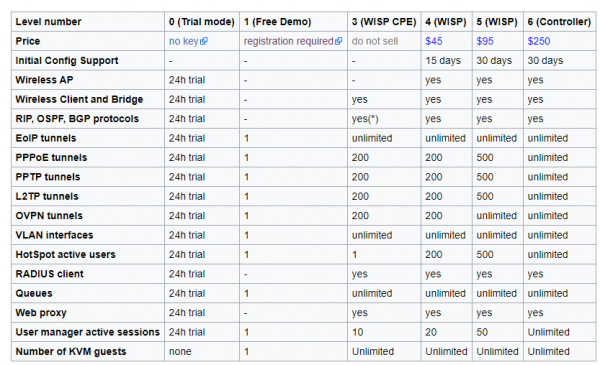
The x86 version also had another issue — it did not play well with hypervisors as a guest system. But if high loads were not expected, it was still a decent version.
Legal RouterOS x86 can only work fully for 24 hours in trial mode, while the free version has a lot of limitations. No system administrator can fully assess all the functionality of RouterOS in just 24 hours...
It was easy to download a virtual machine image with RouterOS x86 pre-installed from a pirated resource, albeit with its own issues, but for me, for example, it was enough.
"If you can't beat the crowd — lead it"
Over time, the competent management of Mikrotik decided that fighting piracy was impossible and that it needed to make stealing their operating system unprofitable.
Thus, a branch of RouterOS emerged — the "Cloud Hosted Router," also known as This system is optimized specifically for operation on a virtualization system. You can download the image for all common virtualization platforms: VHDX image, VMDK image, VDI image, OVA template, Raw disk image. The last virtual disk can be deployed on almost any platform.
The licensing system has also changed:
The limitation only concerns the speed of network ports. In the free version, it is set to 1 Mbps, which is sufficient for building virtual stands (for example, on )
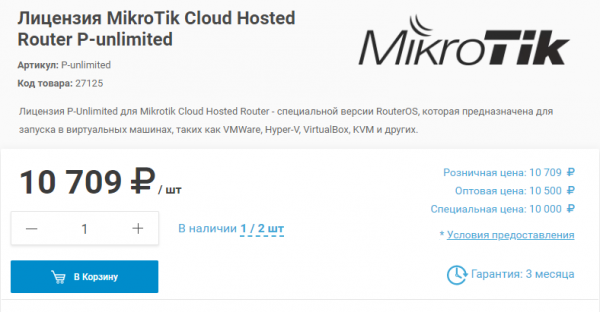
The paid version on the official website is quite expensive, but it can be purchased a bit cheaper from official dealers:
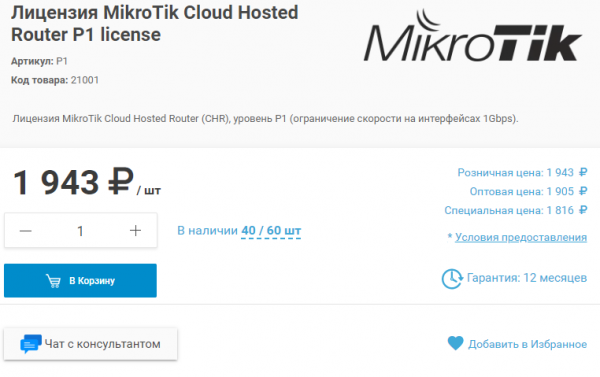
And if you are okay with a speed of 1 Gbps on the ports, you will only need the P1 license:
What is CHR needed for? My examples.I often hear the question: what is the point of this virtual router? Here are a couple of examples of how I personally use it. Please do not debate these solutions, as they are not the topic of this article. This is just an example of application.
Central router for connecting offices
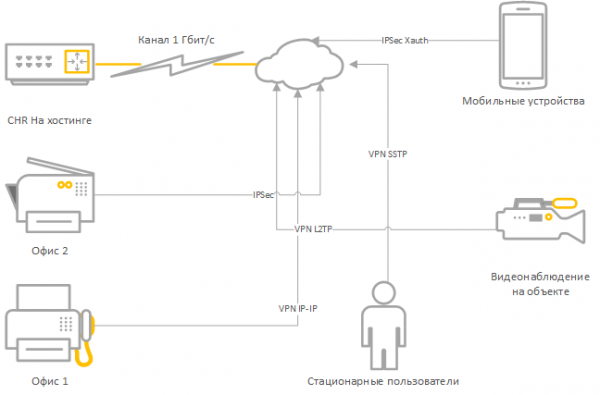
Sometimes, it is necessary to connect several offices into one network. There is no office with a high-speed internet connection and a public IP. It’s possible that everyone is using Yota, or the connection is at 5 Mbps. Additionally, the provider might filter certain protocols. For instance, I have noticed that L2TP does not establish a connection through the St. Petersburg provider "Komfortel"...
In this case, I set up CHR in a data center where they provide a fat stable channel on one VDS (of course, I tested it from all offices). There, the network rarely completely disconnects, unlike "office" providers.
All offices and users connect to CHR via a VPN protocol that is the most optimal for them. For example, mobile users (Android, iOS) feel great on IPSec Xauth.
At the same time, if a database of several dozen gigabytes is synchronized between Office 1 and Office 2, the user watching cameras on-site will not notice this, as the speed will be limited by the bandwidth of the endpoint device, not by the CHR channel.
Gateway for the hypervisor
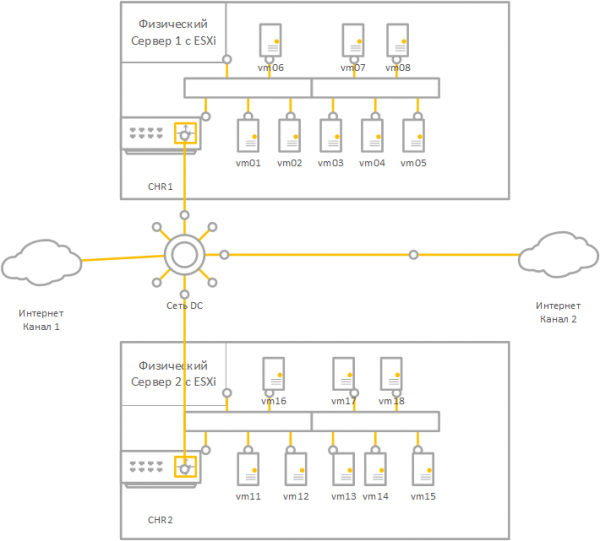
By renting a small number of servers in the data center for several tasks, I use VMWare ESXi virtualization (any other can be used, the principle remains the same), which allows me to flexibly manage the available resources and allocate them to the services running in guest systems.
I trust CHR to manage the network and security as a full-fledged router, where I control all network activity both of containers and the external network.
By the way, after installing ESXi, the physical server does not have a public ipv4. The most that may appear is an ipv6 address. In such a situation, discovering the hypervisor with a simple scanner and taking advantage of the "new vulnerability" is simply unrealistic.
A second life for an old PC
It seems I've said this before :-). Without buying an expensive router, you can still deploy CHR on an old PC.
Full-featured CHR for free
Most often, I find that people look for free CHR to set up proxies on foreign VDS hosting. They don't want to pay 10,000 rubles for a license from their salary.
Less frequently but still seen: extremely greedy management forcing admins to build infrastructure out of scraps.
60-day trial
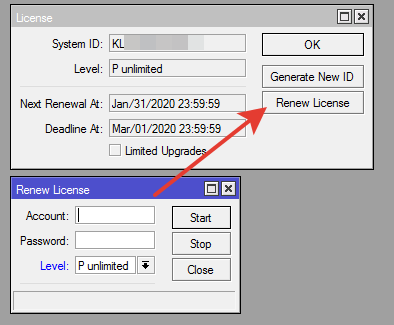
With the advent of CHR, the trial increased from 24 hours to 60 days! A prerequisite for its provision is to authorize the installation under the same login and password as you have on
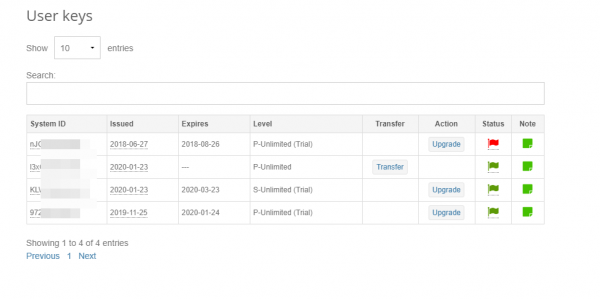
A record of this installation will appear in your account on the website:
And the trial will end? What happens next???
Nothing!
Ports will work at full speed and all functions will continue to operate…
Only updating the firmware will stop, which isn't critical for many. If enough attention is paid to security during setup, accessing it may not be necessary for years. I wrote about what to pay special attention to in this article
And if you still need to update the firmware after the trial ends?
We reset the trial in the following way:
1. Make a backup.

2. Save it to your computer.
3. Completely reinstall CHR on the VDS.
4. Log in
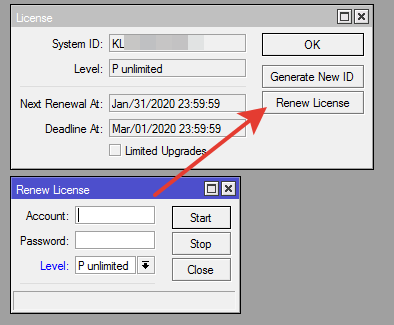
Thus, information about another CHR installation will appear in the personal account on the Mikrotik website.
5. Restore the backup.

Settings restored and 60 days are back in stock!
You don't have to reinstall
Imagine you have a hundred stores where an old PC with CHR is used as a router. You keep an eye on CVEs and try to respond promptly to discovered vulnerabilities.
Reinstalling CHR at all locations every two months is a waste of admin resources.
However, there is a way that requires at least one purchased CHR P1 license. 2 thousand rubles can be found by practically any company, and if they can't, it's time to run away ^_^.
The idea is to legally transfer the license through the personal account on mikrotik.com from device to device!
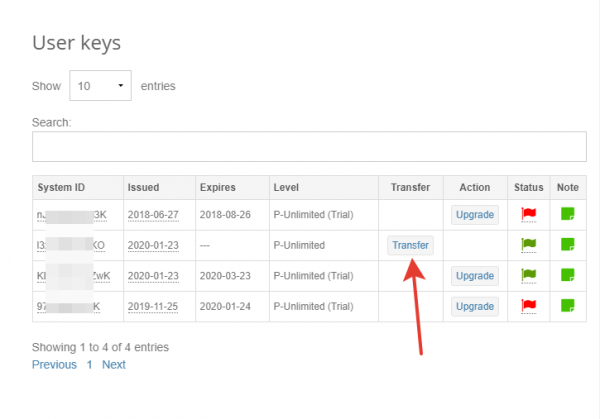
We select the 'System ID' of the router.
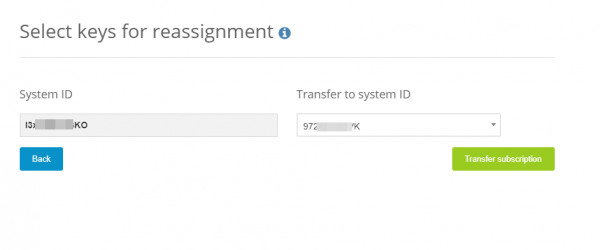
And press 'Transfer subscription'.
The license has 'moved' to the new device, and the old device, deprived of its license, received a new 60-day trial without any reinstallations or additional hassle!
This means that with just one license, you can manage a huge park of CHR!
Why did Mikrotik relax its licensing policy so much?
Thanks to the availability of CHR, Mikrotik has created a huge community around its products. An army of specialists and enthusiasts tests their product, reports discovered bugs, generates a knowledge base for various cases, etc., behaving like a successful open-source project.
Thus, not just a pool of chaotic knowledge is built in the virtual environment, but specialists are prepared who have sufficient experience with a specific system, and as a result, prefer the equipment of a particular vendor. Business leaders tend to listen to the specialists working for them.
What’s more, the accessible training and the conferences conducted by MUM!higher level of isolation, as if one controller is broken, the problem is confined to that specific context).A specialized community in Telegram currently has more than 3000 members, where specialists discuss solutions to various tasks. But these are topics for separate articles. Thus, the main income for Mikrotik comes from equipment sales, not from licenses for $45.
Here and now we are witnessing the rapid growth of an IT giant that appeared relatively recently—in 1997 in Latvia.
I wouldn’t be surprised if in 5 years, D-Link announces the release of another router running RouterOS from Mikrotik. This has happened before in history. Just think about when Apple abandoned its own PowerPC in favor of Intel processors.
I hope this article has dispelled some of your doubts about using Mikrotik products.
How to Overcome Fear and Start Using Azure Machine Learning
Source: habr.com
