

first release of the project , aimed at creating an open implementation of the standard , which defines a universal API for creating applications in virtual and augmented reality, as well as a set of layers for interacting with hardware, abstracting the specifics of particular devices. The standard is prepared by the Khronos consortium, which is also developing standards such as OpenGL, OpenCL, and Vulkan. The project's code is written in C and under a GPL-compatible free license, Boost Software License 1.0, based on BSD and MIT licenses, but does not require attribution when distributing derivative work in binary form.
Monado provides a runtime fully compliant with OpenXR requirements, which can be used to organize work with virtual and augmented reality on smartphones, tablets, PCs, and any other devices. Several basic subsystems are being developed within the project:
- Spatial awareness engine (object tracking, surface detection, mesh reconstruction, gesture recognition, eye tracking);
- Character tracking engine (gyrostabilizer, movement prediction, controllers, optical motion tracking via camera, position tracking based on data from the VR headset);
- Composite server (direct output mode, video pass-through, lens correction, compositing, workspace setup for simultaneous use of multiple applications);
- Interaction engine (simulation of physical processes, a set of widgets, and a toolkit for virtual reality applications);
- Toolset (hardware calibration, setup ).
The first release is considered experimental and aimed at introducing developers to the platform. In its current state, Monado allows creating applications and tracking rotation on supported devices using , as well as providing the ability for direct display () for output to virtual reality devices bypassing the operating system's graphical stack.
Currently, only Linux is supported (support for other OSes is expected in the future).
Main Features:
- Availability of drivers for virtual reality headsets (OSVR Hacker Developer Kit) and
, as well as for PlayStation Move controllers and . - The ability to use , supported by the project .
- Driver for augmented reality glasses .
- Driver for the Intel RealSense T265 position tracking system.
- for configuring access to virtual reality devices without obtaining root privileges.
- Motion tracking components with a framework for filtering and streaming video.
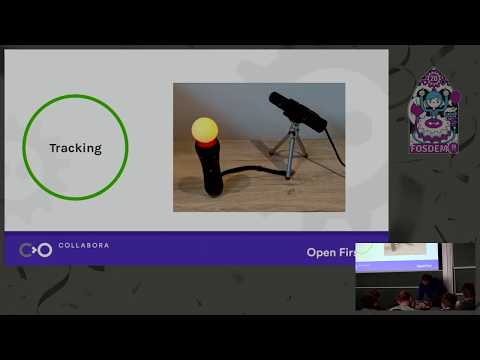
- Character tracking system with six degrees of freedom (6DoF, forward/backward, up/down, left/right, yaw, pitch, roll) for PSVR and PS Move controllers.
- Modules for integration with graphic APIs Vulkan and OpenGL.
- Headless mode.
- Spatial interaction and viewpoint control.
- Basic support for frame synchronization and information (action) input.
- Ready composite server supporting direct output to the device, bypassing the system X server. Shaders for Vive and . Support for projection layers is available.
Source: opennet.ru
