

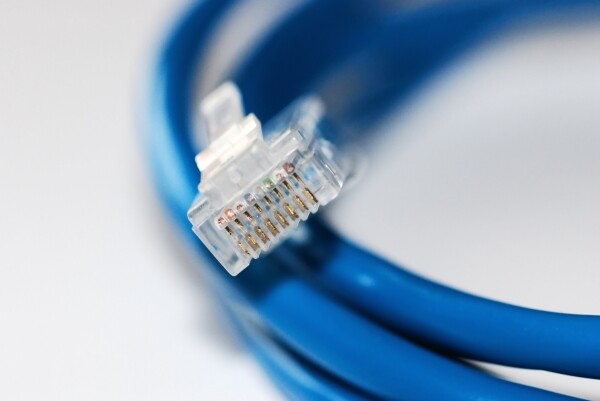
This article presents key points about using Power over Ethernet (PoE) in a popular Q&A format. It explains the differences between standards, provides information on protecting devices from power surges, and covers other useful topics.
What is PoE?
PoE (Power over Ethernet) is a technology for supplying power to a client device through a twisted pair of Ethernet standard (typically using a cat.5 cable with RJ45 connectors). The same cable is used for data transmission and powering the device.
Which devices are supported?
Powering devices can include:
- switches,
- routers,
- and other network equipment.
Client devices can include:
- wired phones,
- cameras,
- access points,
- various sensors, and other peripheral equipment.
There are also devices for integration with equipment that does not support
PoE.
What is it needed for?
As the poet Vladimir Mayakovsky said, "If the stars are lit, it means someone needs them." Below are the advantages of using this technology.
Connecting devices in hard-to-reach places
For instance, at a user's workstation, there may only be two outlets available: one for the monitor and one for the CPU. Often, such requirements arise not from planning errors but are dictated by industry, regional, and other IT security standards, fire safety, occupational health and safety, and so on.
Another example is if a camera or access point is mounted on the ceiling, it can be challenging to run a power cable there as well.
Power management
Another benefit is that PoE allows remote management of the device’s power, such as temporarily turning it off, turning it on, or rebooting (in cases of freezing, updating, or other needs).
This is convenient, especially when working remotely or when devices are located in hard-to-reach areas.
This is particularly useful when working with access points that may be at a considerable distance or hidden somewhere above a false ceiling.
Note. Almost all modern access points from Zyxel support PoE.
including new models with Wi-Fi 6 support: like the most "budget-friendly" as well as more advanced ones and
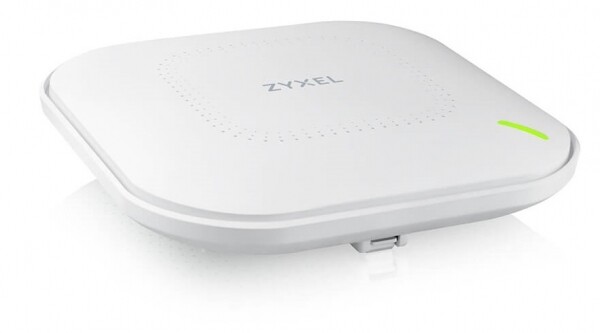
Figure 1. Dual-band access point 802.11ax (Wi-Fi 6) NWA110AX.
Simplifying maintenance
In addition to operational convenience, the use of PoE alleviates the headache of purchasing and repairing power adapters, ensuring users have access to outlets, for example, through the purchase of PDUs (in simpler terms, "extension cords-splitters"). Fewer nodes mean fewer points of failure and fewer calls to technical support.
Electrical safety
Whatever anyone says, 220 volts is a lot. It can hurt, it can kill. But 57 volts, which is the maximum for PoE, is also unpleasantly dangerous, yet not as severe. In some organizations, for a system administrator to also perform electrical work, a special permit is required. This is regulated by the same industry and regional standards. But with PoE, there has never been such a requirement. Low-voltage is still low-voltage.
Aesthetics
What does technical staff need first and foremost? Just for it to work. But some especially advanced "comrades" want it to look "nice" too. For instance, to prevent "extra" wires from hanging down. Or to have everything in one color. PoE eliminates these "superfluous" wires. Various inspectors, commissions, and "big bosses" are particularly sensitive to this.
What are the downsides of PoE?
Higher cost of devices
Indeed, it costs more. Especially if you opt for more or less tried-and-true equipment rather than relying on chance by buying "cheap NoName solutions."
On the other hand, the principle "more expensive means better" doesn't always hold true. Therefore, pursuing an expensive brand makes sense only if there are additional requirements (there is a list of "approved equipment").
But even with the higher price of PoE equipment, it could be much lower than the cost of an organization building a completely new branched cabling system for powering remote devices from scratch.
Power drop
When transmitting a low-voltage signal through thin wires, the efficiency will not be very high, to put it mildly. The farther from the power source, the less electrical power will remain for the consumers. The rest is lost to resistance and heat in the wires. With local power (not PoE), it’s simpler: just plug the power supply into the outlet, and the energy flows…
However, such distance problems can be addressed using special switches with increased signal power, such as Zyxel series [GS1300] () and .
Staff qualification requirements
Let’s say that while using PoE does not require extensive knowledge, some details
need to be mastered. Information on this topic can be found quite easily, although if someone has never worked with this technology before, they will encounter a certain disjointedness and fragmentation of learning materials.
PoE Standards
For beginners, there may be some confusion. There are three generations
of the standard:
The first generation of PoE (IEEE 802.3af standard) provides up to 15.4 W of DC power to each connected device.
The second generation, IEEE 802.3at standard, also known as PoE+, can deliver up to 30 W to each device. This standard is used to power more 'power-hungry' consumers, such as Pan-Tilt-Zoom (PTZ) surveillance cameras and wireless access points 11n.
For clarity, the main differences are summarized in the table:
Parameters
PoE
PoE+
DC voltage at the powered device
from 36 to 57 V (nominal 48V)
from 42.5 to 57 V
Voltage supplied by the source
from 44 to 57 V
from 50 to 57 V
Maximum power of the PoE source
15.4 W
30 W
Maximum power received by the PoE consumer
12.95 W
25.50 W
Maximum current
350 mA
600 mA
Maximum cable resistance
20 Ohms (for cat.3)
12.5 Ohms (for cat.5)
Power classes
0-3
0-4
The third generation is described by the IEEE 802.3bt standard.
Devices of the third generation PoE allow for powering capability up to 51 W over a single cable.
Note. For powering devices using the IEEE 802.3bt standard, all eight conductors of modern twisted pair cables (cat. 5 and above) are used, while the first two generations could work with just four.
When it comes to compatibility, PoE devices are backward compatible — a more powerful power source device of the 802.3bt standard can be used for older PoE and PoE+ consumers (802.3af and 802.3at).
Terminology: End-span and Mid-Span
End-span — a device providing power supply from the beginning of the cable line.
A classic example: an IP telephony switch provides power to a small network of stationary phones within an office.
Another example is a video surveillance system in a small warehouse, where cameras receive power from the switch via PoE.
Typically, these systems do not include additional devices to amplify the power signal.
Mid-span
— when the power device connects not from the beginning of the cable line but additionally between the switch and the end device. For example, powering a camera via an injector connected after the switch in an intermediate patch cabinet. A bit more terminology:
PSE (Power Source Equipment)
- — power equipment. PD (Powered Device)
- — powered device. Can the power device determine what client device is connected: with PoE or without?
When it comes to End-span, for example, a switch, everything happens not just simply, but very simply. The power source, such as a switch with PoE ports, supplies power for this port only if the connected device (e.g., an access point) supports PoE technology.
How does it work?
Initially, a check is performed: does the client device support power via PoE? A voltage of 2.8 to 10 volts is supplied, and the input resistance is determined. If the results obtained are satisfactory for powering via PoE, the power device proceeds to the next stage.
- The power device determines the required power to supply the client device for further management of this power. Depending on the consumption level, a class is assigned to the devices: from 0 to 4.
- The power supply unit determines the required power to power the client device for subsequent power management. Depending on the consumption level, a class is assigned to the devices: from 0 to 4.
However, when it comes to inexpensive Mid-Span devices that plug in after regular network equipment (without PoE), things aren't so bright. In such cases, a constant power supply with fixed parameters is usually fed to the line, and there is no check for: "What device is on the other end of the line?"
What do you do when you need to connect devices that do not support PoE, and outlets for power adapter connections are not available?
For such situations, there is Passive PoE using PoE splitter.
In this case, the power source does not query the connected device and does not negotiate its power. Power is simply supplied through the spare conductors of the twisted pair using a PoE splitter.
The PoE splitter separates the incoming twisted pair signal into data and power (12V-24V). This makes it possible to supply power and integrate a non-PoE device into the existing infrastructure. With this connection method, it's essential to carefully select the power source's capacity and its consumer.
But what if it's the other way around? You need to connect a PD (Power Device with PoE) to regular network equipment?
To power client devices with PoE, you can use a PoE injector, which is designed to supply additional electrical power through the network cable.
The PoE injector has an RJ45 input port and a connector for connecting to a power source. On the output, it has a single RJ45 port with PoE.
The PoE injector accepts a standard network signal and injects electrical power into the line for network connection, allowing a PoE device to be connected at the output.
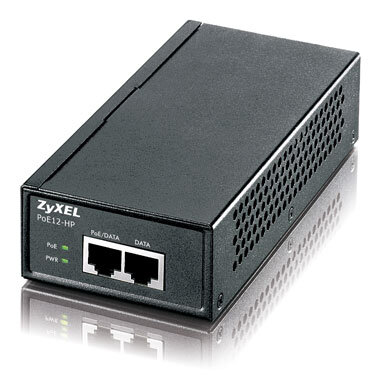
Figure 2. Zyxel PoE injector
What are the cable requirements?
For PoE power connection, a twisted pair of at least cat.5e is used.
Important. The conductors must be copper, not copper-plated, with a thickness of at least 0.51 mm (24 AWG). The resistance in the conductors should not exceed 9.38 Ω/100 m.
In practice, it is usually recommended not to use cables longer than 75m, although the 802.3af and 802.3at standards claim support for 100m. In the case of Passive PoE, practical recommendations are even more pessimistic — the real cable length for normal operation should not exceed 60m.
However, special switches, for example, managed can support devices at a distance of 250m at a speed of 10Mb/s.
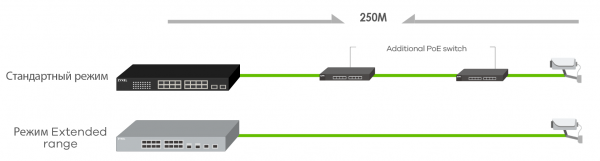
Figure 3. Illustration of Extended Range operation.
What are surge protection devices (SPD)?
In any long electrical circuit, there is a threat of short-term surges caused by charge accumulation (increase in voltage difference — overvoltage) followed by discharge. Below are the causes of short surge events.
- A lightning strike nearby an object, including on a lightning rod, generates an electrical impulse and electromagnetic disturbance, which creates induced EMF in the cable.
- The accumulation of static electricity caused by air ionization and other external phenomena leads to the occurrence of static voltage pulses that can damage equipment.
- Overvoltages resulting from switching and toggling of equipment, for instance, switching patch cords in a patch panel, connecting additional power devices, and switching on and off high load can cause transient processes in electrical circuits with sharp voltage spikes of an impulsive nature, which may result in equipment failure.
Note. For several reasons: a lightning strike nearby an object during a storm, as well as air ionization and accumulation of atmospheric electricity before the storm, this type of protection is sometimes referred to as 'lightning protection.' This term should not be confused with 'lightning strike protection' — that is, protection against direct lightning strikes.
To prevent such threats, surge protection devices (SPD) are used. There are two options for protection (SPD): purchasing and installing external devices, and embedding protection in PoE devices.
And finally, an answer to the question: which devices to choose?
Choosing a power device
When discussing the choice of a power source device for PoE, it usually refers to end-span, and typically this is a switch. Switches are the most commonly used option; they are applied in IP telephony, video surveillance, in hanging access points, and in the arrangement of various security sensors, access control system controllers, and so on.
It is important to consider several factors:
- Downward compatibility. This means that a more modern device supporting the latest IEEE 802.3bt standard can be used to connect and power older devices. However, the reverse is not true.
- Distance to the PD (Powered Device). In addition to the current length, it's worth considering the future. For example, if the warehouse area is set to expand, or if an office move is planned. It's better to allow for some margin in the specifications 'for the future'.
- Device management. Besides the option to 'log into' the switch and manually switch the power on and off, there are other management options, such as for cameras.
- Surge protection (SPD) and other harmful factors.
Zyxel has switches that meet all the above requirements. These are the new GS1350 series models. We have already This series was initially positioned as However, they can be easily applied to other cases as well, such as powering phones, access points, and other PoE devices.
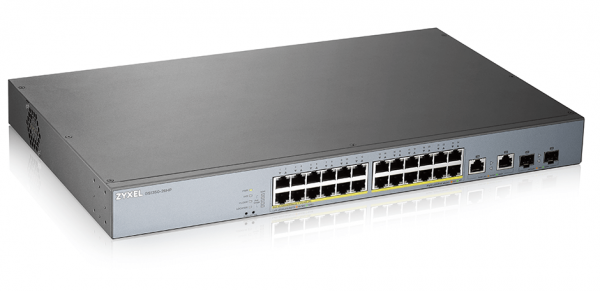
Figure 4. Specialized managed PoE switch GS1350-26HP.
Unmanaged switches of the series are also a good choice. A selection of specialized switches from Zyxel can be viewed in Figure 5.
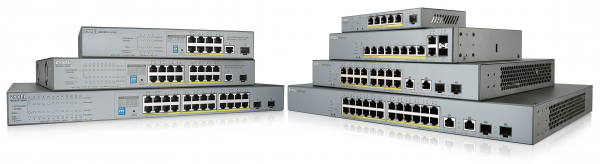
Figure 5. Range of managed and unmanaged switches with PoE support from Zyxel.
Choosing a powered device
Usually, when selecting end devices, focus is on their consumer characteristics, such as image quality when choosing a camera, support for Wi-Fi standards when selecting access points, and so on.
However, power supply also has its impact. It makes sense to consider the following factors:
- Energy efficiency of the device.
- Management capabilities.
- Price and quality.
Important! Despite the claimed compatibility, one should not rely 100% on this feature. In a good project, the power supply and consumers should adhere to the same standard, preferably the most current one, have full compatibility, and be designed for implementing new technologies, such as Wi-Fi 6. Overhauling an entire piece of infrastructure, proudly called 'modernization,' often costs more than some additional investments at the implementation stage.
Useful links
Wi-Fi 6 Access Points: ,
and
Special managed switches series and unmanaged on the Zyxel website
Source: habr.com
