

Whether a modern desktop system needs 32 GB of RAM is a question that is difficult to answer definitively. Tests , show that the vast majority of gaming applications do not require such a large amount of RAM, especially if the platform is equipped with a graphics card that has sufficient video memory and a high-performance solid-state drive. Therefore, the "gold standard" for modern desktop systems typically includes a DDR4 SDRAM kit consisting of two 8 GB modules.
However, many users still lean towards installing 32 GB of memory in their systems, and this approach certainly has its merits. Even if current games and applications run perfectly fine with 16 GB of memory, it doesn’t mean this will always be the case. It cannot be said that in systems equipped with 32 GB of memory, a significant portion will remain unused permanently. Many current games can utilize 16 GB of memory almost to its full capacity. Thus, it’s easy to imagine that some anticipated projects set to launch this year or next might be slightly more demanding on hardware resources and may require more than 16 GB of memory to ensure optimal performance.
Additionally, many users actively engage in multitasking, create virtual RAM drives, work with multiple resource-intensive applications simultaneously, or, for instance, enjoy "collecting" open tabs in their browser. In these cases, having 32 GB of memory in the system can become a conscious necessity, without which computer usability would suffer noticeably.
In previous articles, we mentioned that the need for 32, rather than 16 GB of memory is something users will likely feel without external prompting. A lack of memory in practical computer use becomes very evident, as in such situations the operating system starts to substitute physical memory with virtual memory, placing it in a swap file on the disk drive. If this situation arises, it’s a clear sign: it’s time to consider upgrading the memory subsystem.
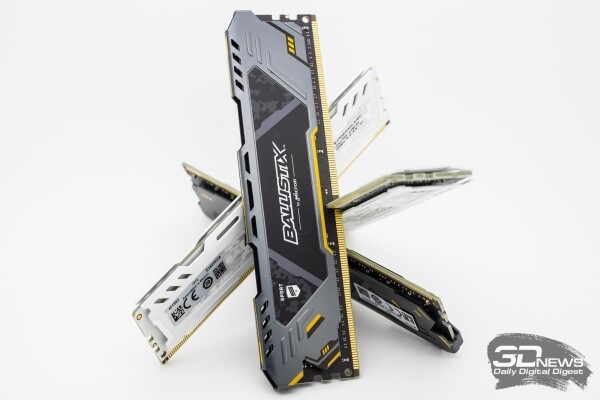
However, the current situation is such that addressing bottlenecks in computer configuration as they are discovered may not be the best strategy, especially when it comes to memory capacity. The good news is that the favorable window for purchasing RAM is about to close. Currently, DDR4 SDRAM modules have become so affordable that acquiring 32 GB is unlikely to severely impact the budget of an average enthusiast. However, the phase of cheap memory in the cyclical price changes is nearing its end, and within the next few months, the prices of DDR4 SDRAM modules will inevitably begin to rise. This means that purchasing a 32 GB kit now rather than a 16 GB one, with an eye toward the future, may be a very sensible decision. There is no doubt that the required memory capacities for current systems will continue to grow, but when the demand for additional memory arises sharply, purchasing it may prove to be significantly more expensive.
It is also pertinent to mention another argument in favor of purchasing 16 GB memory modules. The fact is that most of this memory available in stores consists of dual-rank, dual-sided sticks built on 8-bit chipsets. Due to the potential interleaving of memory banks, such modules are more performant than single-rank DDR4 SDRAM in 8 GB sticks. Therefore, by installing 32 GB of memory in your system, you will benefit not only in terms of capacity but also in performance, and this effect will be noticeable even if the tasks you are handling do not actually require significant amounts of RAM.
In other words, 32 GB memory kits should no longer be considered niche offerings of little interest to the majority. Under current conditions, such memory is capable of attracting a very broad audience of enthusiasts. It is precisely for this reason that reviews of 32 GB kits will increasingly appear on our site. For example, in this review, we invite you to explore such kits offered under the Crucial brand. A review of 8 GB Crucial Ballistix modules has already been published on 3DNews. , based on Micron Revision E chips. We concluded that this memory offers an excellent combination of price, overclocking potential, and performance.
Today we will analyze what users can expect if they wish to purchase similar memory in modules with double the capacity, and we will also visually demonstrate how dual-ranked DDR4 SDRAM modules are faster than single-ranked ones with the same chips. This analysis will help us answer the question of which memory subsystem option with a total volume of 32 GB is more preferable: 4 modules of 8 GB each or 2 modules of 16 GB.
Specifications and Package Contents
For testing 16 GB Crucial memory modules built on Micron Rev. E chips, we used two 32 GB kits from the Crucial Ballistix Sport series AT and Crucial Ballistix Sport LT White with part numbers BLS2K16G4D32AEST and BLS2K16G4D32AESC.
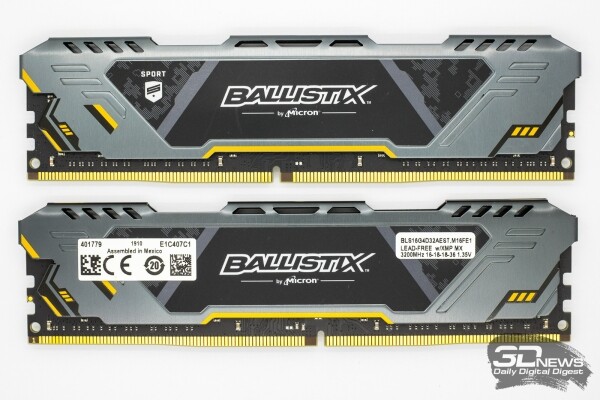
At first glance, the labeling of Crucial memory seems like a meaningless sequence of letters and numbers, but if you know how to decipher it, you can obtain quite detailed information about the characteristics of the kit. In order: BL stands for Ballistix; S indicates the Sport series; 2K means we have two-module kits; 16G – volume of one module in the kit; 4 denotes the type of memory (DDR4); D corresponds to unbuffered DIMM modules; 32 – the speed (DDR4-3200); A – the timing scheme (the closer to the beginning of the alphabet, the better, but the fastest option is designated by zero); E – operating voltage of 1.35 V; ST or SC – type of kit design (AT or LT White). Thus, from the labeling, it is clear that we indeed have those DDR4-3200 modules built on Micron Rev. E chips, which are known for their overclocking capabilities, but this time not in 8 GB, but in 16 GB configuration.
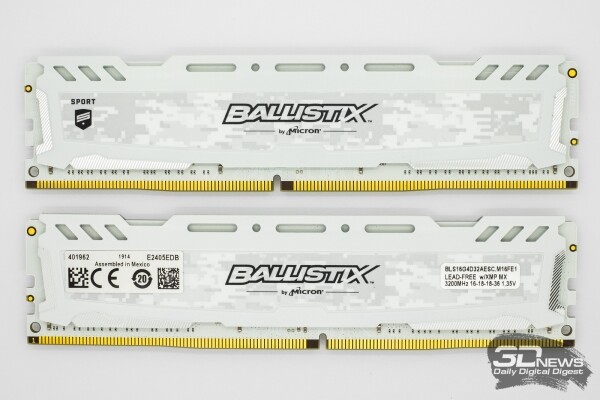
It is worth mentioning that the current lineup of Crucial memory for enthusiasts is undergoing some transformations, and the Sport AT and Sport LT series are being pushed to the background. Their ideological successors are the recently announced Ballistix and Ballistix Max modules and kits, which continue to be based on the same component base – 8-Gbit Micron Rev. E chips. Nevertheless, both the Ballistix Sport kits and the new Ballistix (Max) kits are currently available for purchase, and in terms of basic overclocking capabilities, they are roughly equivalent. The main difference lies in the different designs of the heat spreaders and the fact that the new Crucial memory series is bold enough to specify high frequencies in its specifications – up to DDR4-4400.
As for the Crucial Ballistix Sport AT BLS2K16G4D32AEST and Crucial Ballistix Sport LT White BLS2K16G4D32AESC kits, despite their external differences, they turned out to be completely identical in specifications. In both cases, the official specifications list the same parameters:
- memory size: a set of modules with a total of 32 GB (two 16 GB modules);
- operating frequency: DDR4-3200;
- timings: 16-18-18-36 (programmed in XMP);
- operating voltage: 1.35 V.
- high-performance heat spreaders;
- support for XMP 2.0;
- lifetime warranty.
The packaging is extremely simple: the buyer receives a blister packed with a pair of modules inside. No additional accessories are provided. However, there is a solid justification for this – the low price.
The popularity of the Crucial Ballistix kits is largely due to their affordability – while they offer very respectable specifications and overclocking capabilities. The kits BLS2K16G4D32AEST and BLS2K16G4D32AESC are no different from their counterparts in this regard. A 32 GB DDR4-3200 memory kit in this case will cost between 10,000 and 12,000 rubles, which is about twice as cheap as a similar set of modules would be if it were based on Samsung B-die chips. Similarly low prices can be found for memory based on SK Hynix CJR or AFR chips, but, as practice shows, their overclocking potential is noticeably worse.
Appearance
The Crucial Ballistix Sport AT and Crucial Ballistix Sport LT White modules with a capacity of 16 GB do not differ visually from the 8 GB options. Therefore, their design did not come as a surprise to us.
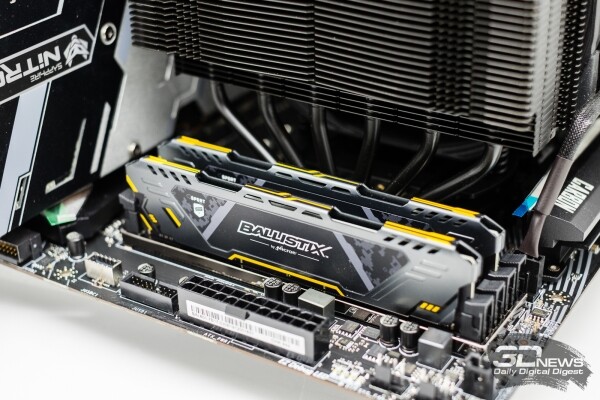
This memory is encased on both sides with aluminum heat spreaders of complex shapes, painted in white (for the Sport LT White) or gray (for the Sport AT). The configuration of the heat spreaders differs slightly, but the most important thing is that in both cases, they do not increase the dimensions of the modules. The height of the sticks in assembly is 35 mm, which means they can be easily installed in systems where memory modules are obstructed by bulky CPU coolers.
It is worth mentioning that the Sport LT modules can also be equipped with heat spreaders in other colors – red or gray. However, the uniqueness of the white version of Sport LT lies in the fact that not only the heat spreaders are painted white, but also the printed circuit board.
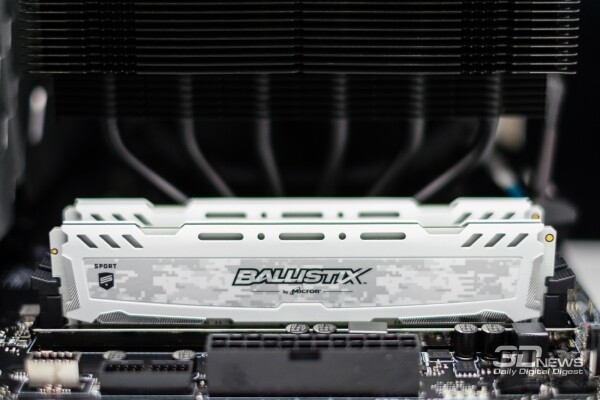
RGB lighting is not provided in the modules from the Ballistix Sport AT and Ballistix Sport LT White kits, and overall, this memory looks like a simple and unpretentious product in the world of overclocking DDR4 SDRAM. However, the first impression in this case is somewhat deceptive: in terms of practical properties, the examined Crucial Ballistix Sport kits easily outperform some pompously designed DDR4 SDRAM sticks.
Internal Structure and Operating Features
Upon closer examination, the Ballistix Sport AT and Ballistix Sport LT White memory sticks with a capacity of 16 GB turn out to be close analogs of the previously discussed 8 GB models. Simplistically, one could even say that the 16 GB modules represent a pair of 8 GB modules assembled on one printed circuit board. In fact, this means that the manufacturer uses a dual-rank architecture and places the usual 8-gigabit Micron Rev. E chips on both sides of the printed circuit board, rather than on one.
The unique design of the Ballistix Sport AT and Ballistix Sport LT White is enhanced by the layout of the printed circuit board, but in this case, it still adheres to the reference design of the B1 version approved by JEDEC. In other words, the overclocking capabilities of the BLS2K16G4D32AEST and BLS2K16G4D32AESC kits arise from the characteristics of the chips used, which, clearly, are not only good in themselves, but are also somehow selectively chosen by the manufacturer.
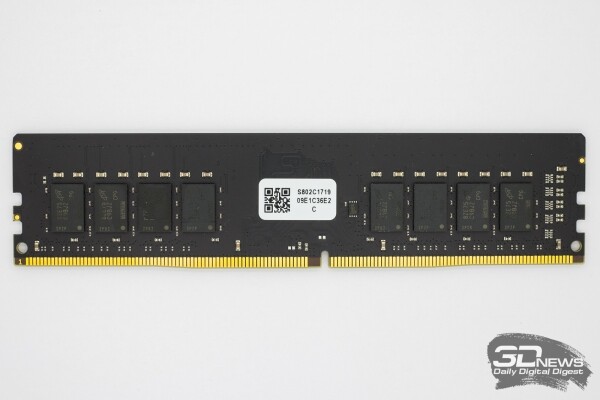
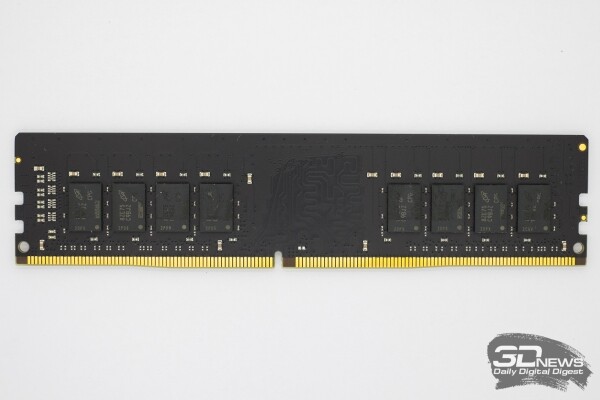
If the heat sinks are removed from the examined memory, it becomes clear that the Ballistix Sport AT and Ballistix Sport LT White are absolutely identical in internal construction. The only difference is that the manufacturer has painted the PCB of the white memory modules with white paint.
Everything else is the same: each of the BLS2K16G4D32AEST and BLS2K16G4D32AESC modules is built on a matrix of sixteen 8-gigabit chips mounted on both sides of the board. Moreover, the chips used in the DDR4-3200 series of Crucial Ballistix Sport LT White and Crucial Ballistix Sport AT kits are also identical. These are Micron CT40A1G8SA-62M:E chips, which we have already seen in the lower capacity kits BLS2K8G4D32AESCK and BLS2K8G4D32AESTK.
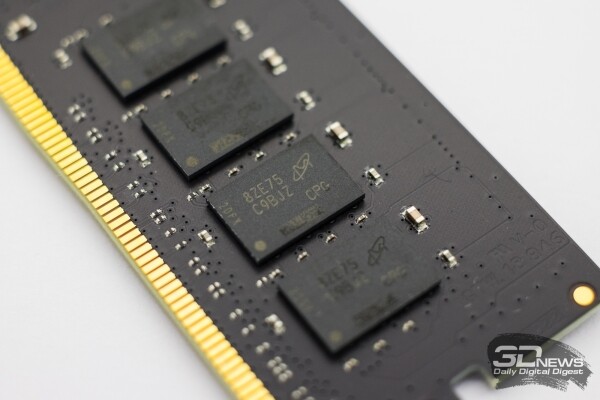
Formally, the applied chip type has a gradation of DDR4-3200 with timings of 22-22-22, but it should be noted that we are talking about 19nm semiconductor crystals from Micron Revision E. Such chips have proven themselves well among enthusiasts since memory modules based on them can exceed official specifications by one and a half to two times with increased voltage and proper cooling. This is partly what Crucial takes advantage of. The modules BLS2K16G4D32AEST and BLS2K16G4D32AESC discussed in this article promise significantly more aggressive timings even in their passport mode than defined by the specifications of the chips used, for which the DDR4-3200 mode is announced with a delay scheme of 16-18-18-36.
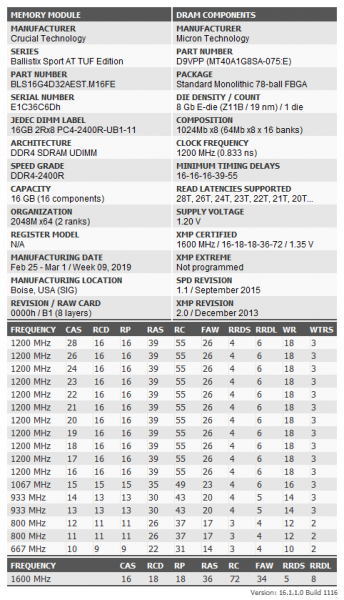 | 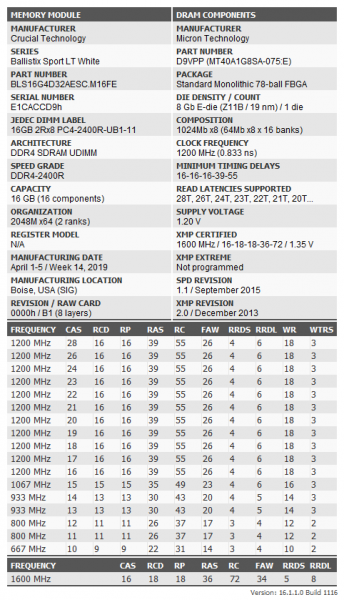 |
Such operational parameters are not only declared in the passport specifications but are also programmed in the XMP profile of the modules.
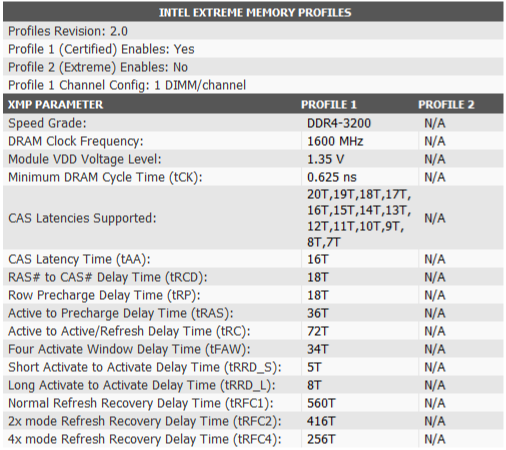
When automatically configuring via XMP for the BLS2K16G4D32AEST and BLS2K16G4D32AESC modules, a voltage of 1.35V is set, which exceeds the nominal 1.2V, but does not pose a hazard for their long-term operation.
In default mode, that is, when setting the memory subsystem according to the XMP profile, the performance level of the considered memory is as follows (measurements were made in systems with AMD Ryzen 9 3950X and Intel Core i9-9900KS processors).
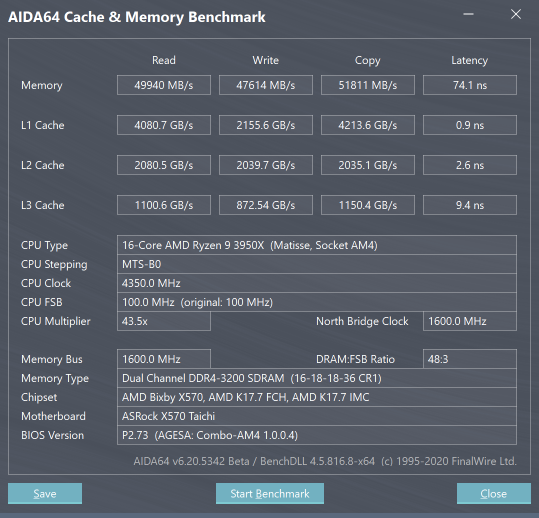 | 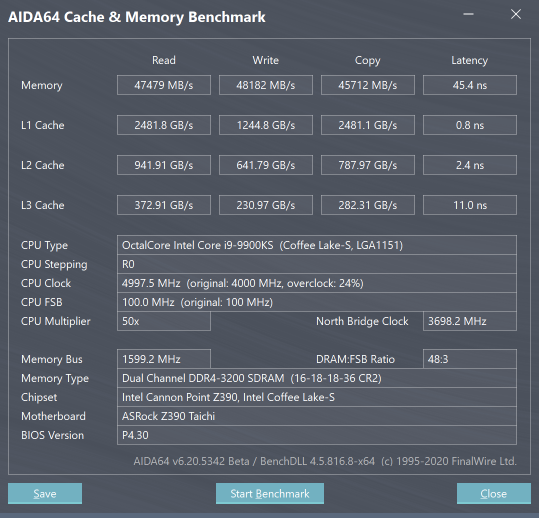 |
Considering the features of Micron Rev. E chips, the performance level can be considered quite decent. Yes, memory on Samsung B-die chips works faster, but the 16GB Ballistix Sport modules outperform the 8GB modules we tested earlier in practical throughput. In this case, the dual-rank design positively influences performance. This is especially noticeable on platforms with Intel processors.
At the same time, the design of the Crucial Ballistix Sport LT White and Crucial Ballistix Sport AT modules has its drawbacks. For instance, this memory lacks any hardware monitoring, making it impossible to control its temperature without additional technical means. In certain situations, this can become a serious issue since Micron Rev. E chips tend to heat up, and higher temperatures can reduce their stability.
Source: 3dnews.ru
