

I recently learned from a post on Habr But there's a reason to summarize. ICQ is still alive, but I'm no longer there, so I can tell the whole story of the format 'me and ICQ' from beginning to end. This post is for nostalgia’s sake, in my terms —

a tearjerker , but not only that. In a very limited way, I recreated the experience of twenty years ago, when at the turn of the century, ICQ was the number one messenger. I listened to those familiar sounds and sent a couple of messages to myself. I won’t say that nowadays ICQ is 'not great': after all, it has successfully outlived its competitors (AOL Instant Messenger, MSN Messenger, Yahoo Messenger). 15-20 years ago, ICQ implemented almost all the features of modern communication tools, but it just happened too early. That's what we'll talk about.I maintain a diary of a collector of old hardware in
Telegram. .

version of the site ICQ.com is dated April 1997, and back then, the domain belonged to a completely different organization — some association of manufacturers and users of measuring equipment. In December 1997 there's that very same ICQ in the recognizable style of 'early web primitivism'.
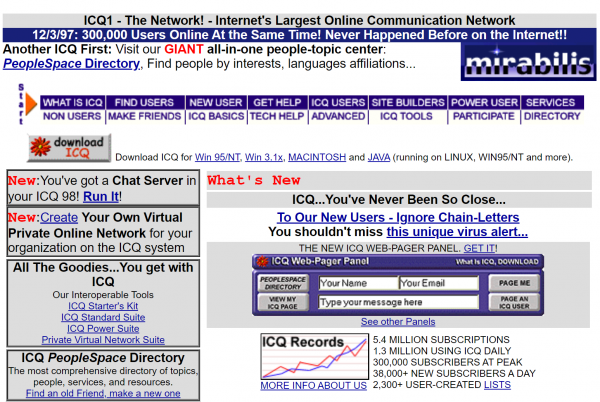
The program version for Windows 95/NT — v98a, which I definitely didn't experience. The website features complex instructions, with two distributions available — one includes a heavy DLL Mfc42, apparently necessary for running software compiled under Microsoft Visual Studio. This information is useful: my memories of that time are unreliable, especially regarding the correct dating of events. By 1999, I definitely had an ICQ account. At that time, I was studying in the USA, sporadically using ICQ; the main means of electronic communication back then were email and Fidonet. ICQ allows for real-time messaging, which requires regular access to the internet. I had it back then — unlimited dial-up for $30 a month, but those I wanted to chat with were only online at best once a week, sometimes from my mom's workplace, sometimes from school, or from early internet cafés. The unavailability of the internet for the masses and the time difference got in the way, but when everything aligned — it was awesome. The first experiences of network interaction — chatting in ICQ or in 'Krovatka', streaming radio broadcasts — was the future, now become a harsh reality. Just before you were mailing an envelope with a handwritten letter that would take two weeks to reach the recipient. And immediately, you are communicating with someone thousands of kilometers away as if they were sitting in the next house.
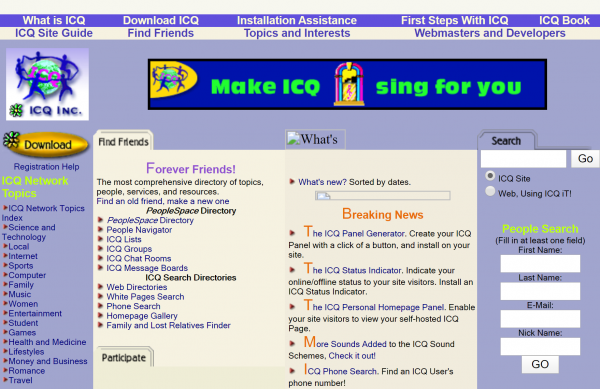
At the beginning of 1999, the ICQ site looks . There are attempts to build an internet around a simple service featuring poets: hosting web pages, games, and some 'singing boards'. Service description: ICQ is a revolutionary, user-friendly Internet tool that informs you about which of your friends are online and allows you to connect with them at any time. No more need to search for your acquaintances and colleagues every time you need to communicate with them.
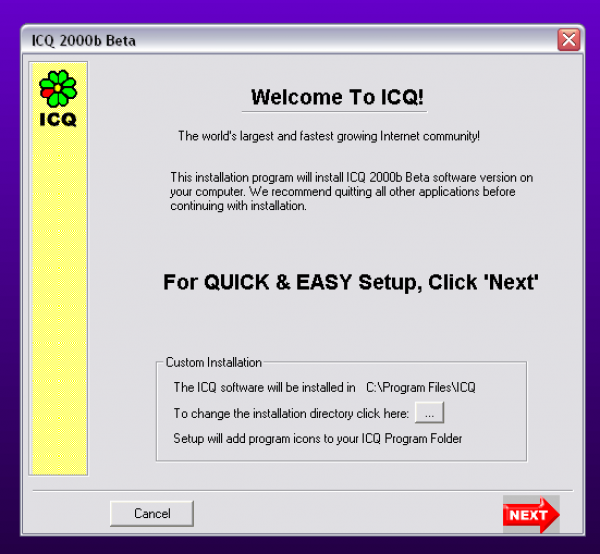
In other words, ICQ has a contact list where you can add people. For each contact, you can check if they are online and chat with them. The contact list will soon be transferred to a server, simplifying access to accounts from different computers. ICQ is not the pioneer of real-time online communication, but it has managed to package the service in a way that is understandable and convenient for the average user. So successfully that in 1998, the Israeli startup Mirabilis was acquired by America Online, then a giant in the online business. AOL grew during the dot-com boom, so much so that in 2000 it absorbed the traditional media conglomerate Time Warner for $165 billion. They paid a more modest yet still staggering sum for ICQ at the time: $287 million upfront and another $120 million shortly after.
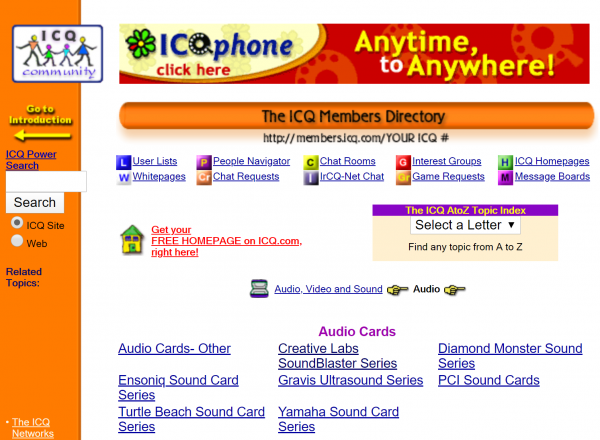
Year 2000. Dormitory, ten-megabit local network, and an inconsistent internet connection. ICQ is the primary means of communication, alongside strange discussions in text files shared on students' computers. Hacking someone's ICQ is a common occurrence: communication with the server is unencrypted, and passwords can be easily intercepted by tech-savvy neighbors. The ICQ user directory is a precursor to social networking, allowing you to find a random person and chat. To facilitate this, a feature labeled 'Available to Chat' appears in the client. One computer is shared among four people, so accounts need to be carefully managed to avoid breaking anything.
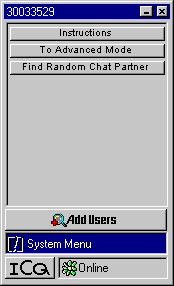
Year 2001, first job. ICQ serves as a corporate messenger, a precursor to Slack or Discord, but without chat rooms; all communication is strictly one-on-one. If you want to include someone in a message, you need to copy it and resend it. The contact list consists of colleagues and management. Management summons you for discussions via direct messages, and colleagues talk about outings (it's crucial to not mix up what to send to whom).
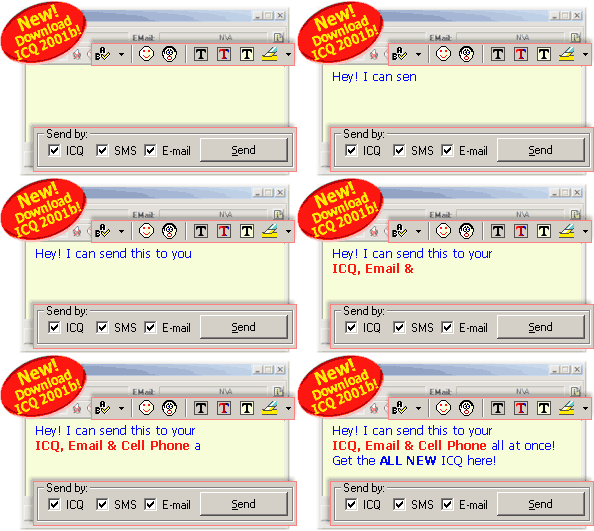
The history is concise: breaks for chats, discussing work matters, sharing music discs, and inviting friends to watch the latest episode of 'Masya.' The client software is official, but alternatives are periodically reviewed, such as Trillian or early versions of Miranda IM.
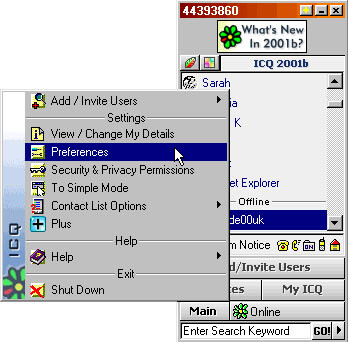
2003. A rental apartment, dial-up again, but sometimes mobile communication is used via GPRS. The first attempts at chatting through mobile networks were usually done with a mobile phone and a pocket computer running Windows Mobile or Palm OS. The experience is inspiring but impractical: being constantly connected is expensive and difficult, and the battery life of the devices is not designed for round-the-clock connectivity. After version 2001b, ICQ 2003 and ICQ Lite were released — I use the latter but am gradually switching to the alternative client Miranda IM. There are two reasons: the feature-packed official ICQ has become bloated (which they attempted to resolve with the Lite version), and there are now advertising banners in the client. I fought against them not only because I dislike ads but also because of the limited bandwidth of the modem connection. ICQ, as a company, in turn, fought against ad-free alternative clients by periodically changing the protocol.
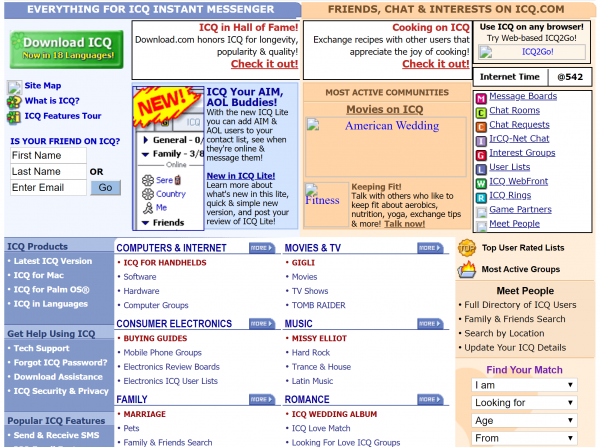
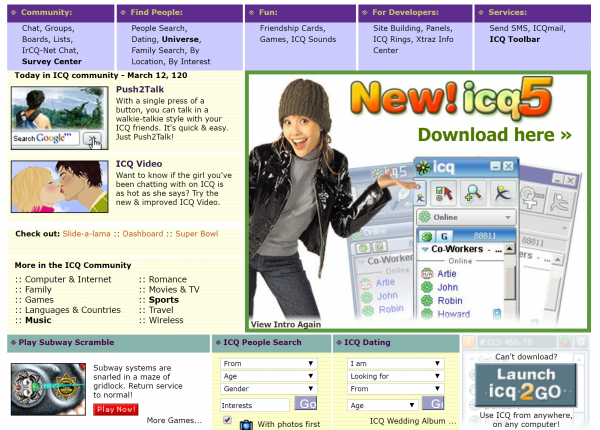
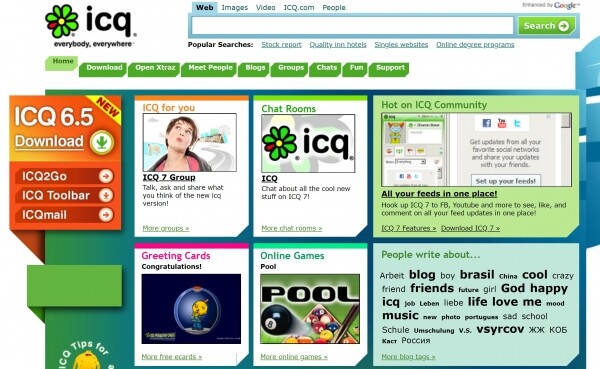
Until 2005-2006, all online communication happened on ICQ. Communication with colleagues, personal life, deep conversations, buying and selling. The ICQ website of 2005, in the latest trend, starts with an Adobe Flash video. ICQ 5 was the last official client I used: it was installed just in case there were problems with the alternative software. I also use the alternative client because of its multi-platform capabilities. In the mid-2000s, competitors to ICQ began to appear in droves. Some of the communication shifted to Google Talk, as it not only saved message history on the server but also integrated into the GMail interface. While exploring the features of the official ICQ client, I realize that the switch was not made because ICQ lacked anything. Nor was it due to the integration of Google’s chat with other company services. Rather, the reason was that Google Talk was a new phenomenon, while ICQ had become somewhat outdated. ICQ, in its attempts to monetize everything, seemed like a bloated monster, while GTalk appeared as a light and convenient service "just for business."
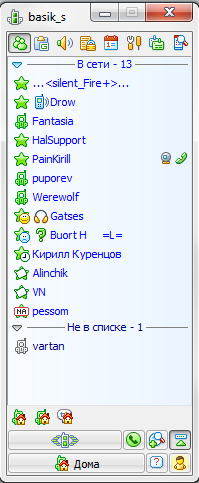
The alternative messenger QIP underwent similar stages of development in the second half of the decade. Initially, it was a convenient substitute for the official ICQ client with a very similar interface, but gradually it became feature-rich (with its own messaging protocol, photo hosting, enforced integration with the browser).
Monetizing software and users is normal, but in the case of ICQ and QIP, I stubbornly refused to monetize. Later, a similar story happened with Skype: it was actively used for voice communication, but over time it became bulky and inconvenient compared to its competitors, without offering any unique features. By 2008, I had completely switched to a messenger. , an open-source project, ad-free, convenient and minimalist, allowing you to connect users from ICQ, Google Talk, Facebook messengers, Vkontakte, etc. "in one window".
In 2010, I added a new contact to ICQ for the last time — my future wife. However, we hardly communicate via "asik". In general, the early 2010s saw a kind of IM wasteland: I don't remember preferring any one chat service. My attention was roughly equally divided among ICQ (increasingly rarely), Skype, Google Talk, SMS, messages on Facebook, and VK. It could be assumed that in the end, platforms would win out — where users simultaneously receive a plethora of services — including email, social media, shopping, and "stories", and God knows what else. It seemed that the "chat" had become a harsh reality, and that nothing new could be invented there.
It seemed! In 2013-2014, I finally found myself in a "always online" situation. At the end of the 2000s, device batteries didn't allow for that, and later, cellular coverage was unreliable. By the mid-2010s, smartphones could work for a day without disconnecting data, and cellular networks improved with the widespread rollout of 4G base stations. The concept of being constantly connected to the internet finally became a reality for most people, at least in cities — 18 years after the emergence of ICQ, a service originally best suited for such scenarios. However, in terms of user numbers and consumer attention, the winners were neither ICQ, nor Facebook with Google, but independent services like WhatsApp (later became part of Facebook), Telegram, and similar platforms. They benefited from a high-quality mobile application (rather than a side addon to a desktop version), the idea of "channels" in Telegram, group communication, effortless sharing of images, videos, and music, as well as audio and video calls. All of this was already present in ICQ (except for channels) back in 2003, albeit in a limited form! The most successful technologies are those that emerge at the right time. All the others eventually find their way into my "Antiquities" section.
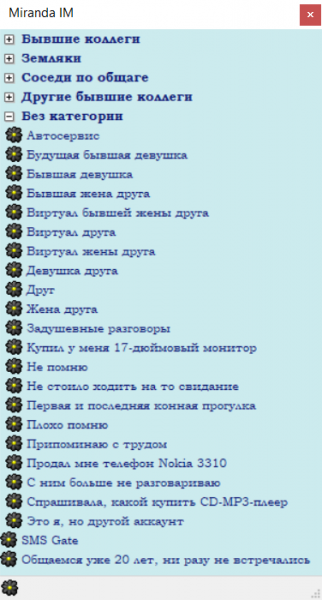
The most important artifact from my "ICQ era" is the archive of the Miranda IM messenger, or more precisely, a portable distribution of the program with a message database. I wrote about it in software from 2002: this kind of monument to the past was squeezed into the software distribution collection. Later, I found another copy of "Miranda" from 2005, meaning I have an archive of about 4 years of conversations in ICQ during the messenger's "golden" period. I cannot read these logs for long due to an overwhelming facepalm. Now, in March 2020, the main topic has become the coronavirus, and it’s said that touching your face with your hands is not recommended. So I won't. The screenshot above is the very Miranda IM from the archive. It still runs even on Windows 10, although it looks a bit strange on a 4K display and has encoding issues. To preserve the privacy of my contacts, I renamed them based on my memory, resulting in what I ended up with. This is a snapshot of my online life from about 15 years ago.
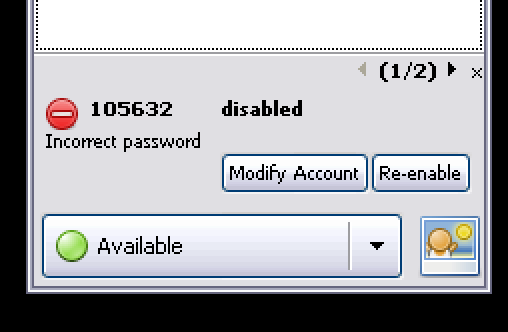
And here is the end of the story. In 2018, I set up a retro laptop I'm installing Windows XP, a couple of retro games, and the WinAMP player. At the same time, I'm setting up Pidgin, which I haven't used in a long time, adding my two ICQ accounts, not knowing it would be the last time I log into them. Out of 70 contacts, only one is online, and it seems he forgot he has the client running somewhere, as he doesn't respond. In March 2020, Pidgin can no longer connect — the server returns the message 'incorrect password', even though the password is definitely correct. The same thing happens when trying to log into my account on the ICQ website. 'Password recovery' also fails — neither email nor mobile phone is specified in the credentials. The era of ICQ in this household has come to an end.
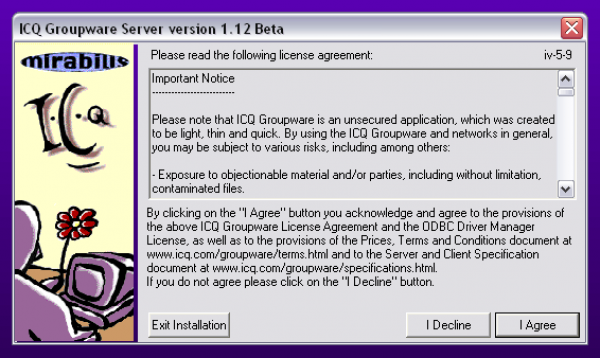
Even with an account, old ICQ clients will not work, just like old email programs or browsers. This software depends on changes in the network service and will at least break on encrypted communications — it didn't exist in the early 2000s, and now it is a necessary requirement for any data transmission on the internet. You can take a retro computer and install ICQ 2001b, but you won't get beyond the screen for entering UIN and password. However, there is an alternative: ICQ Groupware Server, an early (1999) attempt by the company to move the messenger into the corporate space, likely happened too early as well. The server allows you to create your personal network based on the ICQ protocol and issue yourself a cool four-digit number!
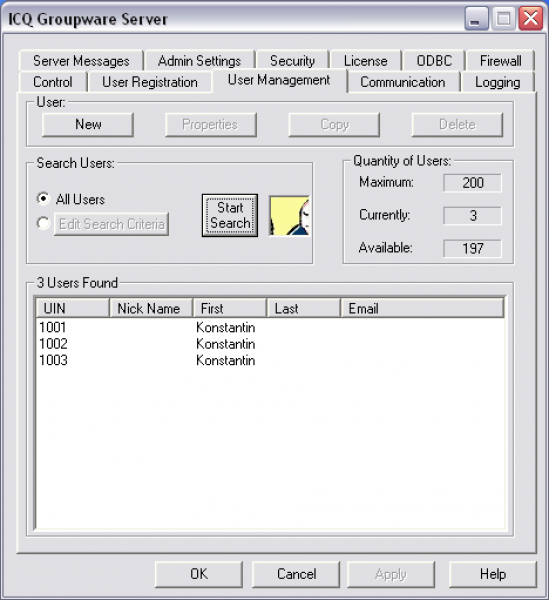
‘User’ versions of ICQ do not work with the Groupware Server (or I couldn't get it to work); you need a special corporate client. Theoretical compatibility exists with Linux servers and regular clients. , a domestic development and the result of reverse engineering the proprietary protocol. Fortunately, the archive of the early ICQ ftp server has been preserved in the web archive, so I didn't have to search for official distributions in the dark corners of the internet. Here is useful information about this software's operation.
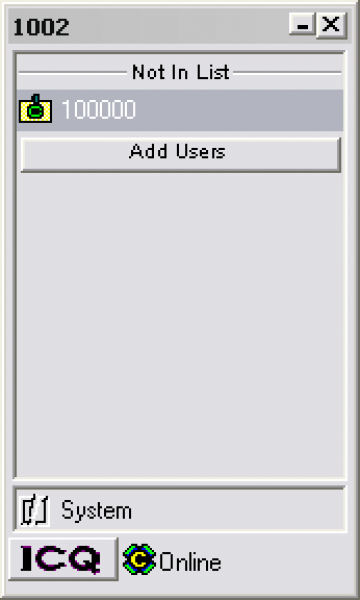
The client interface is very similar to the regular ICQ version 99b. This is the very beginning of ICQ's life, complete minimalism, both in functionality and design. I launched the server on that same ThinkPad T43 running Windows XP, although it would be more appropriate to use Windows NT4. The client software was installed on running Windows 98.
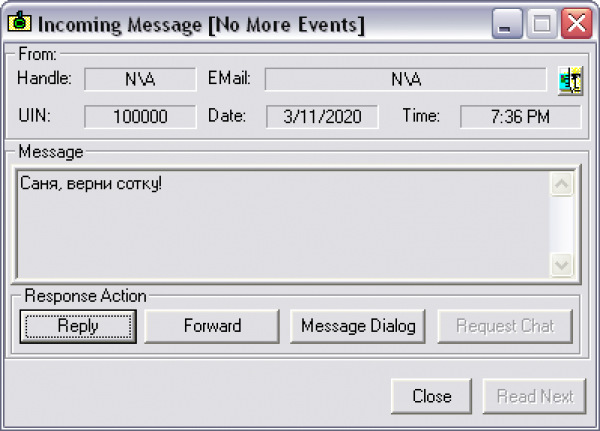
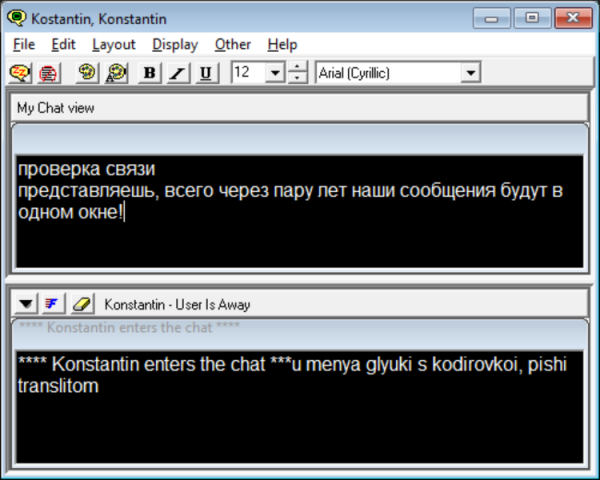
It works! What surprised me the most was the absence of a chat mode in this client: messages are sent and received like emails — you have to click Reply to enter text. The 'chat' feature is also present in this version, but separately: there, it seems, a direct connection happens between clients, allowing you to enter text in real-time — in different windows for the sender and recipient. This is the dawn of instant communication.
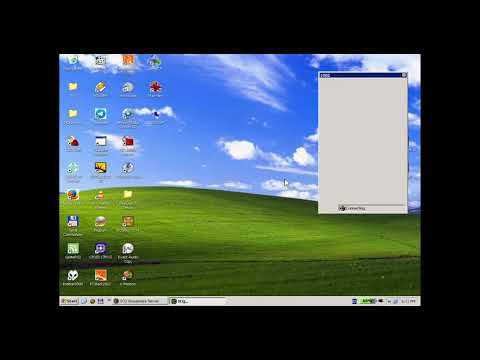
I will conclude this text with a video demonstration. It was necessary to do this, not so much for the video itself, but for the accompanying sounds of the client at work. Once standard background noises of our existence, they are now part of history. It's not that ICQ has changed, and I no longer have an account there. We have changed too. This is normal, but for some reason, I like to occasionally summon such ghosts from the past, historical software on ancient hardware. And reminisce.
Source: habr.com
