


A few years ago, a new specialty emerged in IT: DevOps engineer. This role quickly became one of the most sought-after on the market. Ironically, the popularity of DevOps is partly due to the fact that companies hiring these specialists often confuse them with representatives of other professions.
This article examines the nuances of the DevOps profession, the current market situation, and future prospects. We delved into this complex topic with the help of the Dean at the online university GeekUniversity, Dmitry Burkovsky.
So, what is DevOps?
The term itself stands for Development Operations. It's not so much a profession as it is an approach to organizing work in a medium or large company when developing a product or service. The reason is that multiple departments within the same company are involved in the preparation process, and their actions are not always well-coordinated.
For example, developers often do not know about the issues users encounter while working with the released program or service. Technical support is fully aware of user problems but may not be in the loop about what’s happening 'inside' the software. This is where a DevOps engineer steps in to help coordinate the development process, promote automation, and enhance transparency.
The DevOps concept merges people, processes, and tools.
What should a DevOps engineer know and be able to do?
According to one of the most prominent advocates of the DevOps concept, Joe Sanchez, a professional in this field should have a good understanding of the concept itself, experience in administering both Windows and Linux systems, familiarity with code written in various programming languages, and experience with Chef, Puppet, and Ansible. Clearly, to analyze code, one needs to know several programming languages, not just theoretically, but also have development experience. Additionally, experience in testing finished software products and services is highly desirable.
However, this level of experience and knowledge is not found in every IT professional. Here is a list of the minimum essential knowledge and experience needed for a competent DevOps professional:
- GNU/Linux, Windows OS.
- At least 1 programming language (Python, Go, Ruby).
- Scripting language for command line — bash for Linux and PowerShell for Windows.
- Version control system — Git.
- Configuration management systems (Ansible, Puppet, Chef).
- At least one of the platforms for container orchestration (Kubernetes, Docker Swarm, Apache Mesos, Amazon EC2 Container Service, Microsoft Azure Container Service).
- Ability to work with cloud providers (e.g., AWS, GCP, Azure, etc.) using Terraform, know how to deploy applications to the cloud.
- Ability to set up a CI/CD pipeline (Jenkins, GitLab), ELK stack, monitoring systems (Zabbix, Prometheus).
Here is a list of skills most often listed by DevOps specialists on Habr Career.
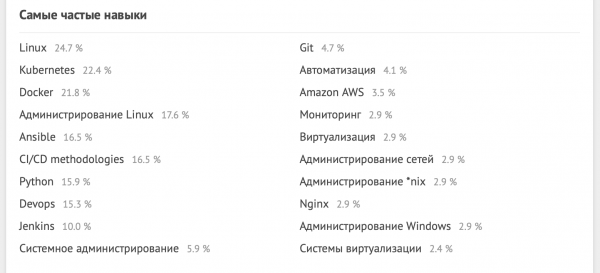
Furthermore, a DevOps specialist must understand the needs and requirements of the business, see its role in the development process, and be able to build the process taking into account the client's interests.
What about the entry barrier?
The list of knowledge and experience was not submitted in vain. It now becomes easier to understand who can become a DevOps specialist. It turns out that it's easiest for representatives of other IT specialties, especially system administrators and developers, to transition into this profession. Both can quickly gain the missing amount of experience and knowledge. Half of the required set they already possess, and often more than half.
Great DevOps engineers can also come from testers. They know how things work, are aware of the flaws and shortcomings of software and hardware. One could say that a tester who knows programming languages and can write programs is nearly a DevOps engineer.
However, a representative of a non-technical specialty, who has never dealt with either development or system administration, will find it difficult. Of course, nothing is impossible, but still, beginners need to realistically assess their capabilities. It will take a considerable amount of time to acquire the necessary 'baggage'.
Where can a DevOps specialist work?
In a large company whose work is directly or indirectly related to application development and hardware administration. There is a significant shortage of DevOps engineers in companies that provide a large number of services to end consumers. These include banks, telecom operators, major internet providers, etc. Among the companies that actively hire DevOps engineers are Google, Facebook, Amazon, Adobe.
DevOps is being adopted by startups and small businesses, but for many of these companies, hiring DevOps engineers is more of a trend than a real necessity. Of course, there are exceptions, but they are not many. Small businesses often need someone who can handle multiple roles, a jack-of-all-trades. A good CTO can manage all of this. The fact is that speed of operation is crucial for small businesses, while process optimization is critical for medium and large companies.
Here are some job openings (you can keep track of new ones on Habr Career at ):
DevOps Salary in Russia and Around the World
In Russia, the average salary for a DevOps engineer is about 132,000 rubles per month. This estimate comes from the salary calculator of the Habr Career service, based on 170 surveys for the second half of 2020. Yes, the sample size isn’t very large, but it serves well as a 'general average.'
Salaries can reach up to 250,000 rubles, with others around 80,000 and slightly lower. It all depends on the company, the qualifications, and of course, the specialist themselves.
Regarding other countries, salary statistics are also known. The specialists at Stack Overflow did a great job analyzing surveys from about 90,000 people—not only DevOps but also representatives from technical fields in general. It turned out that Engineering Managers and DevOps professionals earn the highest salaries.
A DevOps engineer earns about $71,000 per year. According to data from Ziprecruiter.com, professionals in this field earn from $86,000 annually. Meanwhile, Payscale.com shows even more attractive numbers—the average salary for a DevOps specialist exceeds $91,000. This is for a junior specialist, while a senior can earn $135,000.
In conclusion, it’s worth noting that the demand for DevOps is gradually increasing; the demand for specialists at any level exceeds supply. So, if there's a desire—it's worth trying your hand in this field. However, one must remember that merely having the desire is not enough. Ongoing development, learning, and working is essential.
Source: habr.com
