

Intel's management likes to repeat that with the transition to 7nm technology, the usual cadence of process changes will return — once every two or two and a half years. The first 7nm product will be released at the end of 2021, but by 2022 the company will be ready to offer a full range of 7nm products.
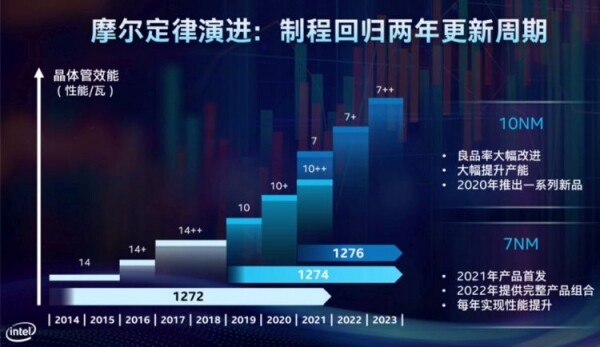
Statements about this at an event in China featuring the local Intel management. While discussing advancements in mastering new lithographic technologies, the company also highlighted the increase in the yield of quality 10nm products, the expansion of production volumes, and the variety of offerings. It should not be forgotten that this year Intel will introduce nine new 10nm products, with only five new items explicitly mentioned: the budget Jasper Lake processors, Ice Lake-SP server processors, Tiger Lake mobile processors, the entry-level DG1 discrete graphics solution, and components for the Snow Ridge family of base stations.
A part of the slide from the Chinese event dedicated to the 7nm process contains already known points. The first 7nm product at the end of 2021 is expected to be Ponte Vecchio — a compute accelerator based on a GPU. It will feature a multi-chip layout using EMIB and Foveros, support for HBM2 memory, and the CXL interface. Last year, Intel representatives promised that the second product would be a central 7nm processor for server applications.
Apparently, the Granite Rapids server processors will be launched in 2022. They will share the Eagle Stream platform and the LGA 4677 socket with the 10nm Sapphire Rapids processors, which will debut a year earlier. The latter will provide support for not only DDR5 and HBM2 but also for the PCI Express 5.0 interface, as well as CXL. Therefore, all these capabilities will also be available to the 7nm Granite Rapids processors.
Intel's desktop processors will not switch to 7nm technology anytime soon: 2022 seems to be an optimistic date in this regard. There is not much known about their possible characteristics, aside from the LGA 1700 socket design and the Meteor Lake codename. These processors are expected to use the Golden Cove architecture, which will prioritize increasing performance in single-threaded applications. There will also be new instructions introduced to accelerate artificial intelligence systems.
Currently, our understanding of Intel's 7nm offerings is limited to these three products. Certainly, consumer-grade graphics processors will accompany them in 2022, as attempts will be made this year to re-enter the discrete graphics segment with the entry-level DG1 product. Additionally, low-power Atom-class processors are set to transition to a yet-unnamed new architecture by 2023, likely adopting the 7nm process as well.
Source: 3dnews.ru
