

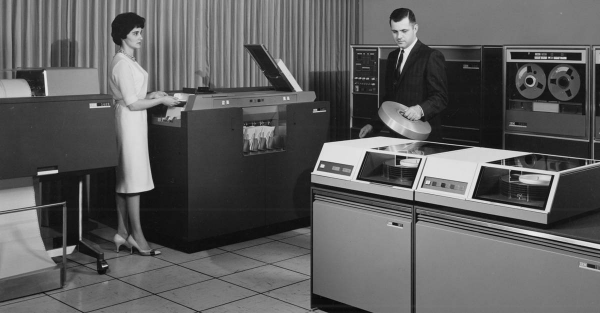
What has been will be;
and what has been done will be done again,
and there is nothing new under the sun.
The Book of Ecclesiastes, 1:9
The eternal wisdom expressed in the epigraph is applicable to virtually any industry, including the rapidly changing IT sector. It turns out that many innovations currently being discussed are based on inventions made several decades ago that were either successfully (or not so successfully) used in consumer devices or in the B2B sector. This also applies to what might seem like a trendy field, such as mobile gadgets and portable information carriers, which we will discuss in detail in today’s material.
There’s no need to look far for examples. Take mobile phones, for instance. If you think the first "smart" device that completely lacked a keyboard was the iPhone, released in 2007, you are deeply mistaken. The idea of creating a true smartphone, merging a communication device and a PDA into a single unit, did not belong to Apple, but to IBM. In fact, the first such device was unveiled to the public on November 23, 1992, at the COMDEX telecommunications exhibition held in Las Vegas, and this marvel of technology entered mass production in 1994.
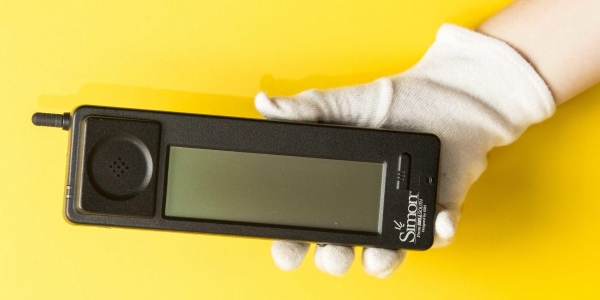
The IBM Simon personal communicator — the world's first smartphone with a touchscreen.
The IBM Simon Personal Communicator was the first mobile phone that essentially had no keyboard; information was input solely via the touchscreen. The device combined the functionality of a personal organizer, allowed users to send and receive faxes, and worked with email. If needed, the IBM Simon could be connected to a personal computer for data exchange or used as a modem with a performance of 2400 bps. Interestingly, text input was implemented in a rather clever way: the owner could choose between a miniature QWERTY keyboard, which was not particularly convenient given the 4.7-inch display size and 160×293 pixel resolution, and an intelligent assistant called PredictaKey. The latter displayed only the next 6 characters that, according to the predictive algorithm, were most likely to be used.
The best epithet to describe the IBM Simon is "ahead of its time," which ultimately defined the complete failure of the device in the market. On one hand, at that time there were no technologies that could make the communicator truly convenient: few would enjoy carrying a device measuring 200×64×38 mm and weighing 623 grams (over 1 kg with the charging station), with a battery life of just 1 hour in talk mode and 12 hours in standby. On the other hand, the price: $899 with a contract from the BellSouth mobile operator, IBM's official partner in the US, and over $1000 without it. Let's not forget the option (or rather the necessity) to purchase a larger capacity battery for "only" $78.
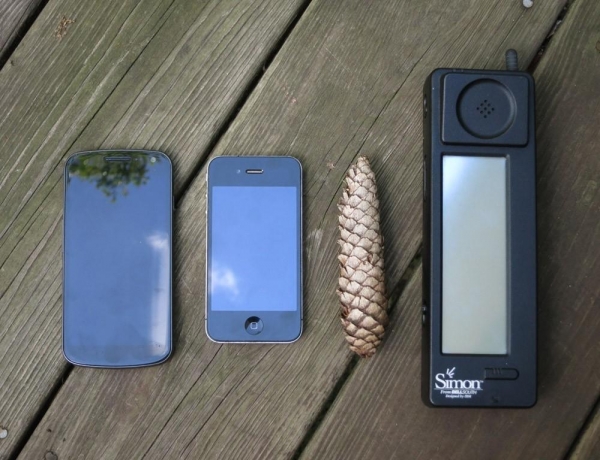
A visual comparison of the IBM Simon, modern smartphones, and a pine cone.
External information storage is not that straightforward either. According to historical accounts, the creation of the first such device can again be attributed to IBM. On October 11, 1962, the company announced the revolutionary IBM 1311 data storage system. A key feature of this innovation was the use of removable cartridges, each containing six 14-inch magnetic disks. Although this removable storage weighed 4.5 kilograms, it still represented an important achievement, as at least the cartridges could be replaced as they filled up and transferred between units, each of which was the size of an imposing chest of drawers.
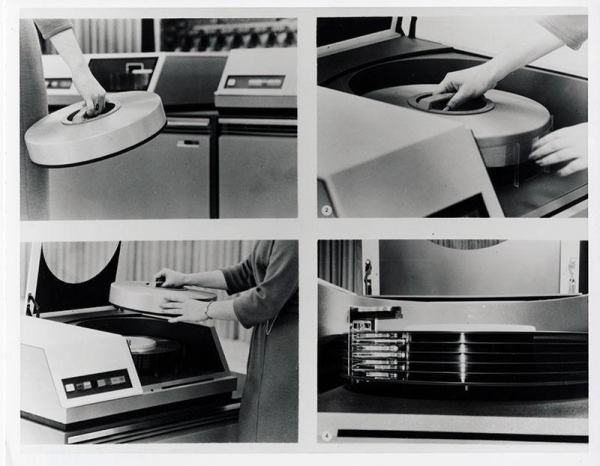
IBM 1311 - Data Storage with Removable Hard Disks
However, this mobility came at the cost of performance and capacity. Firstly, to prevent data damage, the outer sides of the 1st and 6th disks were stripped of magnetic layers, and they concurrently served a protective function. Since only 10 surfaces were now used for recording, the total capacity of the removable disk was 2.6 megabytes, which was still quite a lot at the time: one cartridge successfully replaced 1/5 of a standard magnetic tape reel or 25,000 punch cards, while providing random access to data.
Secondly, the price paid for mobility was a decrease in performance: the spindle speed had to be reduced to 1500 RPM, resulting in an average access time to a sector increasing to 250 milliseconds. In comparison, the predecessor of this device, the IBM 1301, had a spindle speed of 1800 RPM and a sector access time of 180 ms. Nevertheless, it was precisely because of its use of removable hard disks that the IBM 1311 became quite popular in corporate environments, as this design ultimately allowed for a significant reduction in the cost of storing individual pieces of information, enabling a decrease in the number of installations needed and the area required for their placement. As a result, the device became one of the longest-lived in the computer hardware market and was only discontinued in 1975.
The successor to the IBM 1311, designated 3340, was the result of the development of ideas laid down by the corporation's engineers in the design of the previous model. The new data storage system featured completely sealed cartridges, which mitigated the impact of environmental factors on the magnetic plates, enhancing their reliability, while also significantly improving the aerodynamics within the cassettes. The picture was completed by a microcontroller responsible for moving the magnetic heads, the presence of which allowed for a significant increase in their positioning accuracy.
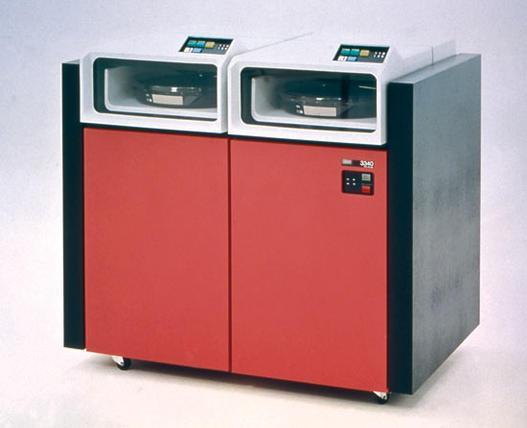
IBM 3340, nicknamed Winchester
As a result, the capacity of each cartridge increased to 30 megabytes, and the access time to a sector decreased exactly tenfold—to 25 milliseconds. At the same time, the data transfer speed reached a record 885 kilobytes per second for that time. Interestingly, it was the IBM 3340 that introduced the jargon term 'Winchester.' The device was designed for simultaneous operation with two removable drives, which earned it an additional designation of '30-30.' The same designation was shared by the world-famous Winchester rifle, the only difference being that in the first case it referred to two disks of 30 MB each, while in the second case it referred to the bullet caliber (0.3 inches) and the weight of the powder in the cartridge (30 grains, or about 1.94 grams).
Floppy Disk — the prototype of modern external storage devices
Although the IBM 1311 cartridges can be considered the great-great-grandfathers of modern external hard drives, these devices were still incredibly far from the consumer market. However, to continue the genealogy of mobile data storage, we must first determine the selection criteria. Clearly, punch cards will be left out, as they are a technology from the 'pre-disk' era. Likewise, magnetic tape drives are unlikely to be considered: although a reel technically has the characteristic of mobility, its performance is incomparable even to the earliest hard drives for the simple reason that magnetic tape provides only sequential access to recorded data. Thus, floppy disks are the closest to hard drives in terms of consumer properties. Indeed, floppy disks are quite compact, and like hard drives, they can withstand multiple rewrites and operate in random access mode. This is where we'll start.
If you expect to see those three legendary letters again, you are absolutely right. It was in the laboratories of IBM that Alan Shugart's research team sought a worthy replacement for magnetic tape, which was excellent for archiving data but fell short compared to hard drives in everyday tasks. A suitable solution was proposed by senior engineer David Noble, who joined the team and designed a removable magnetic disk with a protective casing in 1967, which could be operated with a special disk drive. Four years later, IBM introduced the world's first floppy disk, which had a capacity of 80 kilobytes and a diameter of 8 inches, and by 1972, the second generation of floppy disks emerged, with a capacity of 128 kilobytes.
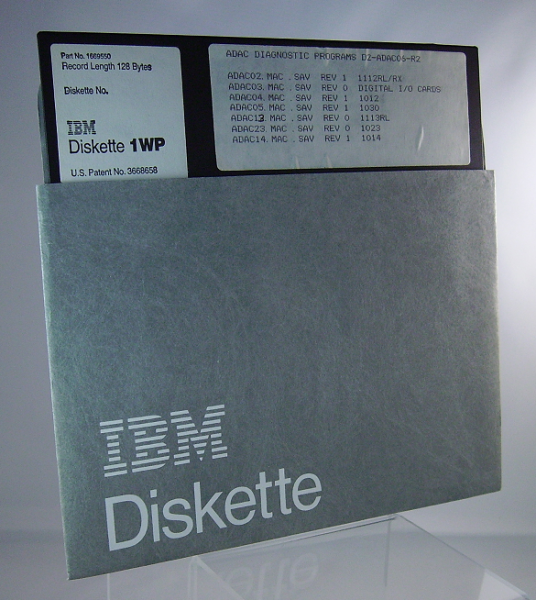
IBM 8-inch floppy disk with a capacity of 128 kilobytes
Riding the wave of success, in 1973 Alan Shugart decided to leave the corporation and establish his own firm, named Shugart Associates. The new enterprise focused on further improving floppy disk drives: in 1976, the company launched compact 5.25-inch floppy disks and original drives equipped with an updated controller and interface. The price of the Shugart SA-400 mini-floppy at the start of sales was $390 for the drive itself and $45 for a set of ten disks. Throughout the company's history, the SA-400 became its most successful product: the shipping rate of new devices reached 4,000 units per day, and gradually the 5.25-inch floppy disks displaced their bulky 8-inch counterparts from the market.
However, Alan Shugart's company couldn't dominate the market for long: by 1981, Sony took over the baton, introducing an even more compact diskette with a diameter of just 90 mm, or 3.5 inches. The first PC to feature an integrated drive for the new format was the HP-150, released by Hewlett-Packard in 1984.
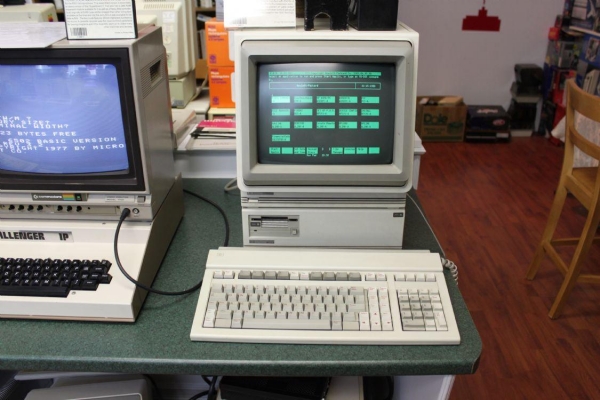
The first personal computer with a 3.5-inch drive, Hewlett-Packard HP-150
Sony's diskette was so successful that it quickly pushed aside all alternative solutions available on the market, and the form factor itself lasted for nearly 30 years: mass production of 3.5-inch diskettes ended only in 2010. The popularity of the new product was due to several factors:
- the rigid plastic case and sliding metal shutter provided reliable protection for the disk itself;
- thanks to the presence of a metal hub with a positioning hole, there was no longer a need to punch a hole directly in the magnetic disk, which also positively affected its preservation;
- the sliding switch implemented write protection (previously, to block the possibility of rewriting, one had to tape over the control notch on the diskette).
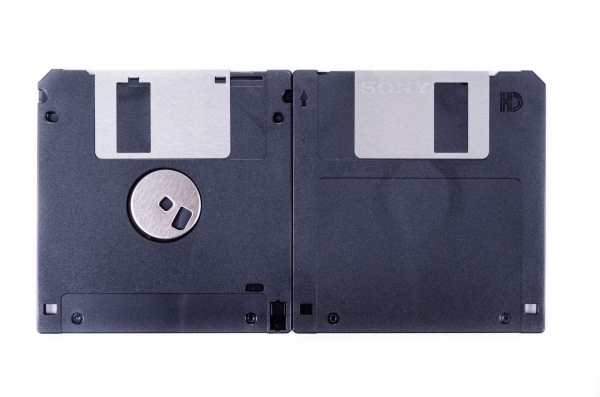
Timeless classic — 3.5-inch Sony diskette
Along with their compactness, 3.5-inch floppy disks also had a significantly higher capacity compared to their predecessors. The most advanced 5.25-inch high-density disks, introduced in 1984, could hold 1200 kilobytes of data. Although the early 3.5-inch samples had a capacity of 720 KB and were thus identical in this regard to 5-inch disks of quadruple density, high-density disks with 1.44 MB capacity appeared in 1987, and by 1991, extended-density disks capable of storing 2.88 MB of data were available.
Some companies attempted to create even smaller disks (for example, Amstrad developed 3-inch disks used in the ZX Spectrum +3, while Canon produced 2-inch specialized disks for recording and storing composite video), but these never gained traction. Instead, external devices closer in ideology to modern external storage devices began to emerge on the market.
The Bernoulli box from Iomega and the ominous 'click of death'
No matter how you look at it, the capacity of floppy disks was too small for storing sufficiently large amounts of information: by modern standards, they can be compared to entry-level flash drives. So what can be considered the equivalent of an external hard drive or solid-state drive? The products from Iomega are the best fit for this role.
Their first device, introduced in 1982, was the so-called Bernoulli Box. Despite its large capacity for the time (the first drives had capacities of 5, 10, and 20 MB), the original device was not popular due to its, frankly, gigantic size: Iomega's 'disks' measured 21 by 27.5 cm, which is identical to an A4 sheet of paper.
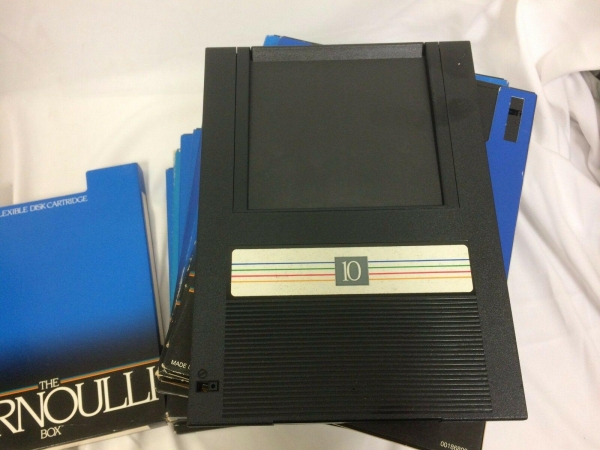
Here is how the original cartridges for the Bernoulli Box looked.
The company's devices gained popularity starting with the Bernoulli Box II. The size of the drives was significantly reduced: they were already 14 cm long and 13.6 cm wide (comparable to standard 5.25-inch floppy disks, not counting the thickness of 0.9 cm), while boasting a much more impressive capacity: from 20 MB for entry-level models to 230 MB for disks released in 1993. These devices were available in two formats: as internal modules for PCs (thanks to their reduced size, they could be installed in place of 5.25-inch floppy disk drives) and external storage systems connected to the computer via SCSI interface.
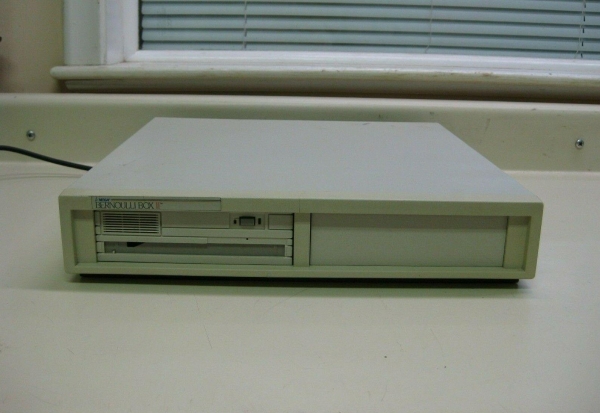
Bernoulli Box II
The direct descendants of the Bernoulli box were Iomega ZIP drives, introduced by the company in 1994. Their popularization was largely aided by partnerships with Dell and Apple, which began to install ZIP drives in their computers. The first model, ZIP-100, used drives with a capacity of 100,663,296 bytes (about 96 MB), boasted a data transfer speed of around 1 MB/s, and had a random access time of no more than 28 milliseconds, with external drives connectable to the PC via LPT or SCSI interfaces. Shortly thereafter, the ZIP-250 appeared with a capacity of 250,640,384 bytes (239 MB), and at the end of the series came the ZIP-750, which had backwards compatibility with the ZIP-250 drives and supported working with ZIP-100 in legacy mode (from outdated drives, information could only be read). Interestingly, the external flagships even gained support for USB 2.0 and FireWire.
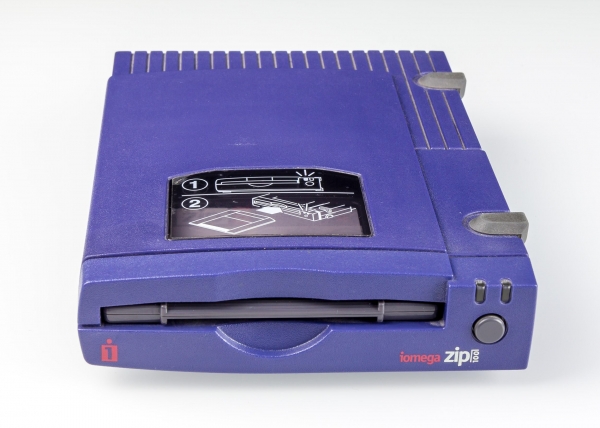
External Iomega ZIP-100 Drive
With the advent of CD-R/RW, Iomega's inventions naturally faded into obscurity — device sales declined almost fourfold by 2003, and by 2007 they had completely ceased (although manufacturing finally ended in 2010). Things might have turned out differently if ZIP hadn't faced certain reliability issues.
The key point is that the impressive performance of devices for those years was achieved thanks to a record RPM: the floppy disk spun at a speed of 3000 revolutions per minute! You may have guessed why the first devices were called nothing other than Bernoulli boxes: the high rotational speed of the magnetic plate accelerated the airflow between the read/write head and its surface, causing air pressure to drop, and as a result, the disk got closer to the sensor (Bernoulli's principle in action). Theoretically, this feature was supposed to make the device more reliable; however, in practice, consumers encountered an unpleasant phenomenon known as Clicks of Death. Any even the smallest burr on the magnetic plate, moving at high speed, could irreparably damage the read/write head, after which the drive parked the actuator and attempted to read again, accompanied by characteristic clicks. This malfunction was 'contagious': if a user did not immediately realize and inserted another floppy disk into the damaged device, it would also become unusable after a couple of read attempts, as the read/write head with distorted geometry would damage the surface of the floppy disk itself. At the same time, a disk with burrs could instantly 'kill' another reader. Therefore, those who worked with Iomega products had to check the integrity of the disks carefully, and later models even featured relevant warning labels.
Magneto-Optical Discs: Retro HAMR
Finally, while we're on the topic of portable storage devices, we cannot overlook such a technological marvel as magneto-optical discs (MO). The first devices of this class appeared as early as the early 1980s; however, they did not gain widespread adoption until 1988, when NeXT introduced its first PC called NeXT Computer, which was equipped with a magneto-optical drive produced by Canon and supported the use of 256 MB disks.
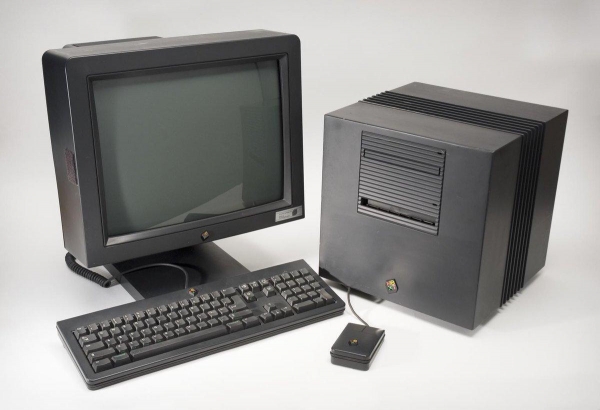
NeXT Computer — the first PC equipped with a magneto-optical drive
The very existence of magneto-optical disks further confirms the validity of the epigraph: although the technology of thermal-assisted magnetic recording (HAMR) has only been actively discussed in recent years, this approach was successfully used in magneto-optics over 30 years ago! The recording principle for magneto-optical disks is similar to HAMR, with some nuances. The disks themselves were made of ferromagnetic materials—alliages capable of retaining magnetization at temperatures below the Curie point (approximately 150 degrees Celsius) without the influence of an external magnetic field. During recording, the surface of the disk was preheated by a laser to the Curie point temperature, after which the magnetic head, located on the opposite side of the disk, altered the magnetization of the corresponding area.
The key difference of this approach from HAMR was that data reading was also accomplished using a low-power laser: the polarized laser beam passed through the disk plate, reflected off the substrate, and then, after going through the optical system of the reader, reached the sensor, which recorded changes in the laser's polarization plane. Here, one can observe the practical application of the Kerr effect (a quadratic electro-optic effect), which is characterized by the change in the refractive index of the optical material proportional to the square of the electromagnetic field strength.

The principle of reading and writing information on magneto-optical disks
The first magneto-optical disks did not support rewriting and were designated by the acronym WORM (Write Once, Read Many), but later models appeared that supported multiple writes. Rewriting was performed in three passes: first, the information was erased from the disk, then the writing occurred, followed by an integrity check of the data. This approach ensured guaranteed writing quality, making magneto-optical disks even more reliable than CD and DVD disks. Unlike floppy disks, magneto-optical media were practically immune to demagnetization: according to manufacturers' estimates, the data storage time on rewritable magneto-optical disks is at least 50 years.
By 1989, dual-sided 5.25-inch drives with a capacity of 650 MB appeared on the market, offering read speeds of up to 1 MB/s and random access times between 50 to 100 ms. At the decline of MO's popularity, models capable of holding up to 9.1 GB of data were available. However, the most widely used were compact 90-mm disks with capacities ranging from 128 to 640 MB.
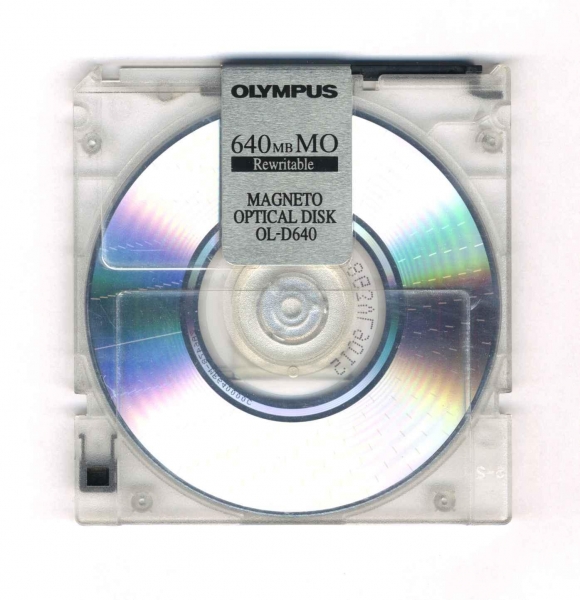
Compact magneto-optical disk with a capacity of 640 MB manufactured by Olympus
By 1994, the unit cost of 1 MB of data stored on such a drive ranged from 27 to 50 cents depending on the manufacturer, which, along with high performance and reliability, made them a competitive solution. An additional advantage of magneto-optical devices over ZIP drives was the support for a wide range of interfaces, including ATAPI, LPT, USB, SCSI, and IEEE-1394a.
Despite all the advantages, magneto-optics had several drawbacks. For instance, drives from different brands (and many large companies, including Sony, Fujitsu, Hitachi, Maxell, Mitsubishi, Olympus, Nikon, Sanyo, and others, produced MO media) were often incompatible with each other due to formatting differences. Furthermore, high power consumption and the need for additional cooling systems limited the use of such drives in laptops. Lastly, the triplicate cycle significantly increased write times, and this issue was only resolved by 1997 with the introduction of the LIMDOW technology (Light Intensity Modulated Direct Overwrite), which combined the first two stages into one by incorporating magnets within the disk cartridge that erased the information. As a result, magneto-optics gradually lost relevance even in the field of long-term data storage, giving way to classic LTO tape drives.
I always feel like something is missing...
Everything mentioned above clearly illustrates the simple fact that no matter how brilliant an invention may be, it must also be timely. The IBM Simon was doomed to fail because, at the time of its release, people did not have a need for absolute mobility. Magneto-optical disks became a decent alternative to HDDs, but they remained the domain of professionals and enthusiasts, as the average consumer prioritized speed, convenience, and, of course, affordability, for which they were willing to sacrifice reliability. ZIP drives, despite their advantages, failed to become a true mainstream option because people were not particularly interested in scrutinizing each disk under a magnifying glass to look for imperfections.
This is why natural selection eventually clearly divided the market into two parallel directions: removable storage media (CD, DVD, Blu-Ray), flash drives (for small data storage), and external hard drives (for large data volumes). Among the latter, compact 2.5-inch models in individual enclosures became the unspoken standard, largely thanks to laptops. Their popularity is also attributed to their cost-effectiveness: while classic 3.5-inch HDDs in external cases could hardly be called 'portable' and necessitated an additional power source (meaning you had to carry around an adapter), the only thing 2.5-inch drives typically required was an extra USB port, and the more recent, energy-efficient models often didn’t even need that.
Interestingly, the emergence of miniature HDDs is credited to PrairieTek — a small company founded by Terry Johnson in 1986. Just three years after its establishment, PrairieTek introduced the world's first 2.5-inch hard drive with a capacity of 20 MB, named the PT-220. It was 30% more compact compared to desktop solutions, with a height of just 25 mm, making it the optimal choice for use in laptops. Unfortunately, even as pioneers in the miniature HDD market, PrairieTek failed to capture the market due to a fatal strategic misstep. After setting up production of the PT-220, they focused on further miniaturization, soon releasing the PT-120 model, which, with the same capacity and speed characteristics, had a thickness of only 17 mm.
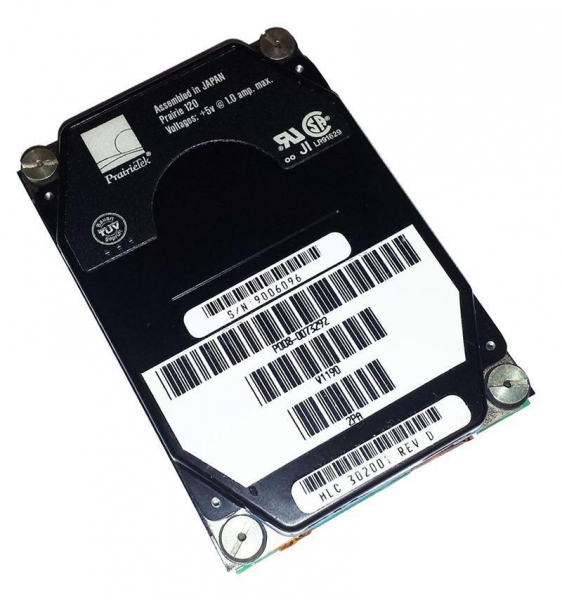
2.5-inch second-generation hard drive PrairieTek PT-120
The miscalculation was that while the engineers at PrairieTek fought for every millimeter, competitors like JVC and Conner Peripherals were increasing the capacity of their hard drives, a decisive factor in this unequal contest. In an attempt to catch up, PrairieTek entered an arms race, preparing the PT-240 model, which could hold 42.8 MB of data and featured record-low power consumption for the time — just 1.5 W. But unfortunately, this did not save the company from bankruptcy, and by 1991, it ceased to exist.
The story of PrairieTek is another clear illustration of how technological advancements, no matter how significant they may seem, can go unappreciated by the market due to their untimeliness. In the early 90s, consumers were not yet spoiled by ultrabooks and ultra-thin smartphones, so there was no acute demand for such drives. One might recall the first GridPad tablet released by GRiD Systems Corporation in 1989: this 'portable' device weighed over 2 kg and was 3.6 cm thick!
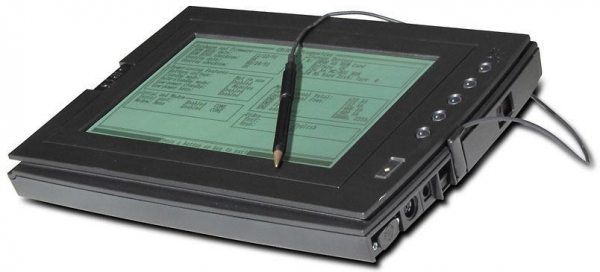
GridPad — the world's first tablet
In those times, such a 'little one' was considered quite compact and convenient: the end user simply saw nothing better. At the same time, the issue of disk space was much sharper. The GridPad, for instance, didn't have a hard drive at all; information storage was based on RAM chips, with the charge maintained by built-in batteries. Against the backdrop of such devices, the later-released Toshiba T100X (DynaPad) seemed like a true marvel simply because it came with a full-fledged hard drive with a capacity of 40 MB. The fact that the 'mobile' device was 4 centimeters thick hardly bothered anyone.
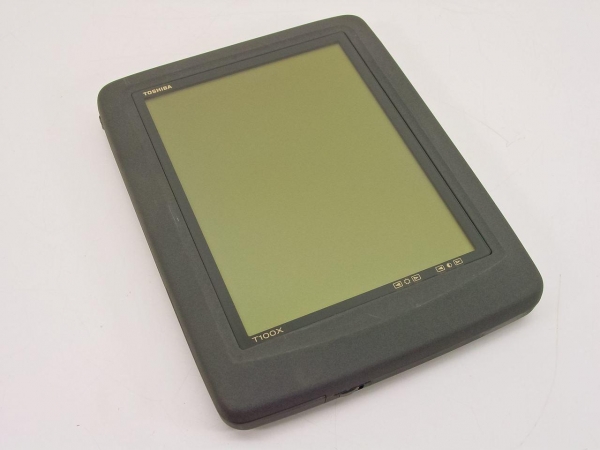
The Toshiba T100X tablet, better known in Japan as the DynaPad
But, as is known, appetite comes with eating. Every year, user demands grew, making it increasingly difficult to satisfy them. As the capacity and performance of storage devices increased, more people began to think that mobile devices could be more compact, and having a portable drive capable of holding all necessary files would be just right. In other words, there was a market demand for fundamentally different devices in terms of convenience and ergonomics, which needed to be met, and the competition among IT companies continued with renewed strength.
It’s worth revisiting today’s epigraph. The era of solid-state drives began long before the 2000s: the first prototype of flash memory was created by engineer Fumio Masuoka at Toshiba back in 1984, and the first commercial product based on it, Digipro FlashDisk, hit the market in 1988. This technological marvel could hold 16 megabytes of data, and its price was $5,000.
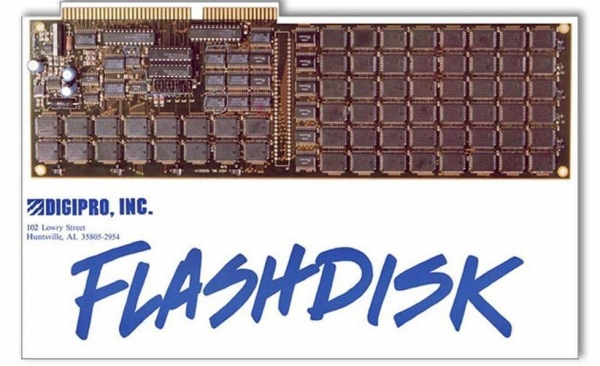
Digipro FlashDisk — the first commercial SSD
This new trend was supported by Digital Equipment Corporation, which introduced 5.25-inch devices of the EZ5x series in the early 90s, supporting SCSI-1 and SCSI-2 interfaces. The Israeli company M-Systems also joined in, announcing a family of solid-state drives called Fast Flash Disk (or FFD) in 1990, which somewhat resembled modern ones: these SSDs had a 3.5-inch format and could hold from 16 to 896 megabytes of data. The first model, named FFD-350, was released in 1995.
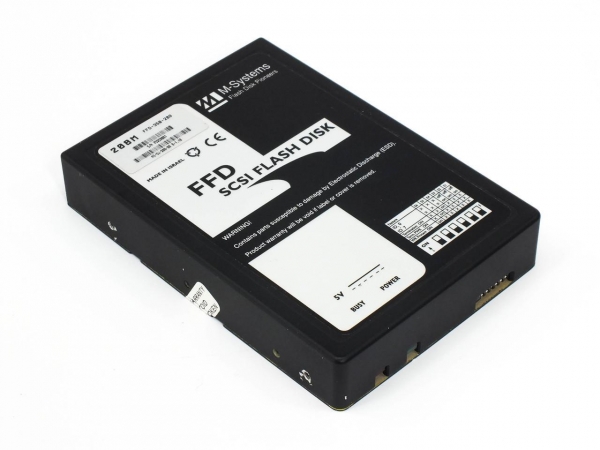
M-Systems FFD-350 with 208 MB — the prototype of modern SSDs
Unlike traditional hard drives, SSDs were much more compact, offered higher performance, and, most importantly, were resistant to shocks and strong vibrations. This potentially made them almost ideal candidates for portable storage devices, if not for one drawback: the high prices per unit of storage, which rendered such solutions practically unsuitable for the consumer market. They were popular in corporate environments, used in aviation for creating 'black boxes,' and installed in supercomputers at research centers, but the idea of creating a retail product at that time was out of the question: no one would have bought them even if any corporation dared to sell such drives at cost.
However, market changes didn't take long to occur. The development of the consumer segment of removable SSD drives was significantly influenced by digital photography, as there was an acute shortage of compact and energy-efficient storage media in that field. Just consider this.
The world's first digital camera appeared (again recalling the words of Ecclesiastes) back in December 1975: it was invented by Steven Sasson, an engineer at Eastman Kodak Company. The prototype consisted of several dozen printed circuit boards, an optical block borrowed from the Kodak Super 8, and a tape recorder (photographs were recorded on ordinary audio cassettes). It used 16 nickel-cadmium batteries as a power source, and all of this weighed 3.6 kg.

The first prototype of a digital camera created by Eastman Kodak Company
The resolution of the CCD matrix for this little device was only 0.01 megapixels, allowing for images of 125×80 pixels, with each photo taking 23 seconds to capture. Given such 'impressive' specifications, this device lagged behind traditional film SLR cameras in every respect, making the creation of a commercial product based on it impossible. However, it was later recognized as one of the most important milestones in the history of photography, and Steve was officially inducted into the Consumer Electronics Hall of Fame.
After 6 years, Sony took over the initiative from Kodak, announcing the lensless video camera Mavica on August 25, 1981 (the name is an abbreviation for Magnetic Video Camera).
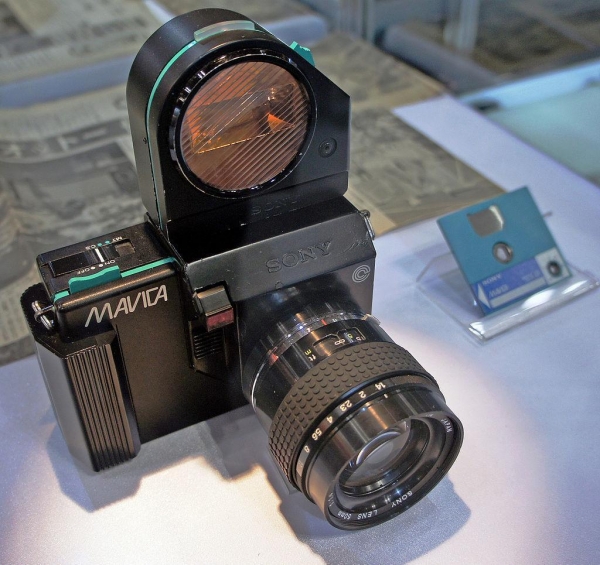
Prototype digital camera Sony Mavica
The camera from the Japanese giant looked much more interesting: the prototype used a CCD matrix sized 10 by 12 mm and boasted a maximum resolution of 570 x 490 pixels, with recording on compact 2-inch Mavipack disks, which could hold between 25 and 50 images, depending on the shooting mode. The frame was made up of two television fields, each recorded as composite video, with the ability to capture both fields simultaneously or just one. In the latter case, the frame resolution halved, but the photo weighed half as much.
Initially, Sony planned to begin mass production of the Mavica in 1983, with a retail price of $650. In practice, the first industrial samples appeared only in 1984, and the commercial launch of the Mavica MVC-A7AF and Pro Mavica MVC-2000 happened in 1986, with the cameras costing nearly an order of magnitude more than originally planned.
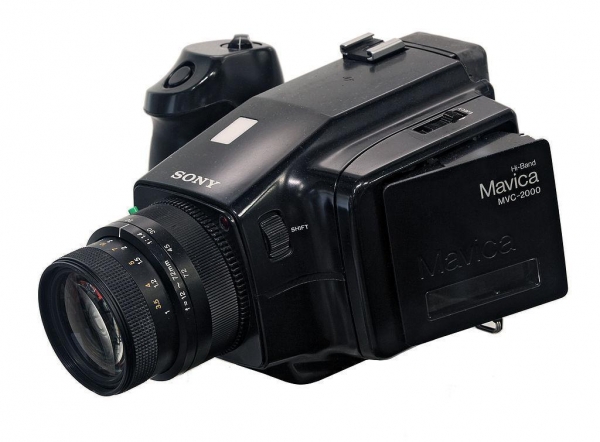
Digital camera Sony Pro Mavica MVC-2000
Despite their exorbitant price and innovation, it would be inaccurate to describe the early Mavicas as the ideal solution for professional use, although in certain situations, such cameras proved to be nearly perfect. For instance, CNN reporters used the Sony Pro Mavica MVC-5000 while covering the events of June 4th at Tiananmen Square. The enhanced model featured two independent CCD sensors, one producing a luminance video signal and the other a chrominance signal. This approach allowed for the omission of a Bayer color filter and increased the horizontal resolution to 500 TV lines. However, the main advantage of the camera was its support for direct connection to the PSC-6 module, which enabled the transmission of captured images via radio directly to the newsroom. This capability allowed CNN to be the first to publish coverage from the scene, and Sony later received a special Emmy Award for its contribution to the development of digital news photo transmission.
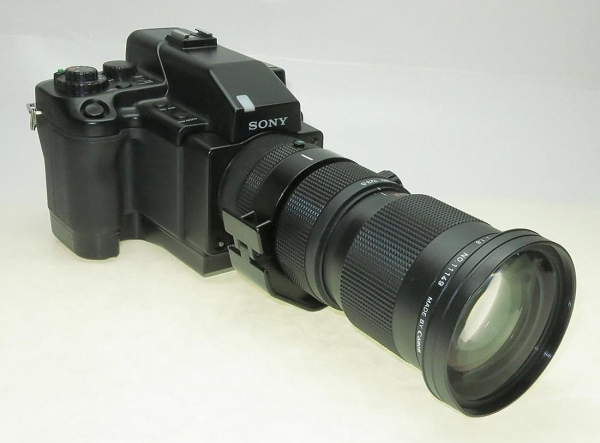
The Sony Pro Mavica MVC-5000 is the very camera that earned Sony an Emmy Award.
But what if a photographer faces a long trip far from civilization? In that case, they could take one of the remarkable Kodak DCS 100 cameras, which debuted in May 1991. This monstrous hybrid combined the small-format Nikon F3 HP film SLR with a DCS Digital Film Back digital attachment equipped with a winder, connecting to an external Digital Storage Unit (which had to be carried on a shoulder strap) via a cable.
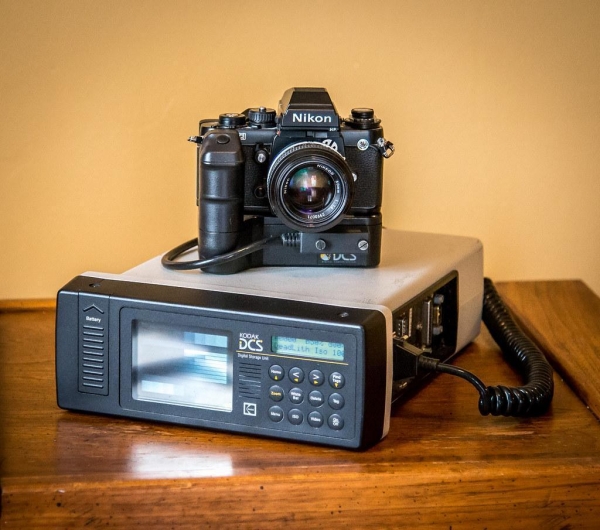
The Kodak DCS 100 digital camera is the embodiment of 'compactness.'
Kodak offered two models, each with several variations: the color DCS DC3 and the black-and-white DCS DM3. All cameras in the series were equipped with sensors offering 1.3 megapixel resolution, but they differed in buffer size, which determined the maximum number of frames during continuous shooting. For example, variants with 8 MB could shoot at a speed of 2.5 frames per second in bursts of 6 frames, while more advanced 32 MB versions allowed for bursts of 24 frames. If this threshold was exceeded, the shooting speed dropped to 1 frame every 2 seconds until the buffer was completely cleared.
As for the DSU block, it was equipped with a 3.5-inch hard drive of 200 MB, capable of holding between 156 'raw' photos to 600 compressed using a hardware JPEG converter (which was purchased and installed separately), and an LCD screen for viewing images. The smart storage even allowed for adding brief descriptions to the photos, although this required connecting an external keyboard. Its weight with batteries was 3.5 kg, while the total weight of the kit reached 5 kg.
Despite the questionable convenience and a price ranging from $20,000 to $25,000 (in the maximum configuration), about 1,000 such devices were sold over the next three years, attracting interest not only from journalists but also from medical institutions, police, and several industrial enterprises. In short, there was demand for such products, as well as an acute need for more compact storage devices. The appropriate solution was offered by SanDisk, which introduced the CompactFlash standard in 1994.
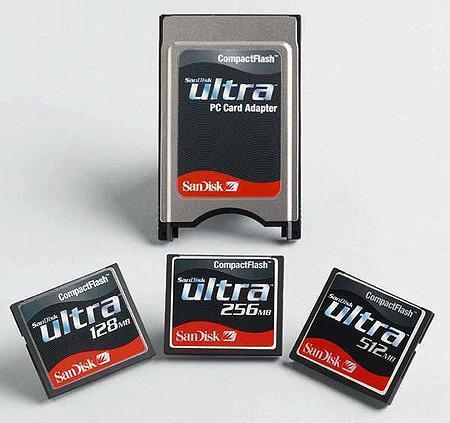
CompactFlash memory cards released by SanDisk and a PCMCIA adapter for connecting them to PCs.
The new format was so successful that it is still in use today, and the CompactFlash Association, established in 1995, currently has over 200 member companies, including Canon, Eastman Kodak Company, Hewlett-Packard, Hitachi Global Systems Technologies, Lexar Media, Renesas Technology, Socket Communications, and many others.
CompactFlash memory cards boasted dimensions of 42 mm by 36 mm with a thickness of 3.3 mm. The physical interface of the storage devices essentially represented a trimmed-down PCMCIA (50 pins instead of 68), allowing such a card to be easily connected to a PCMCIA Type II expansion card slot using a passive adapter. Again, through a passive adapter, CompactFlash could exchange data with peripheral devices via IDE (ATA), and special active adapters allowed operation with serial interfaces (USB, FireWire, SATA).
Despite their relatively small capacity (the first CompactFlash could only hold 2 MB of data), memory cards of this type were in demand in professional environments due to their compactness, cost-effectiveness (such a storage device consumed about 5% of the power compared to standard 2.5-inch HDDs, which allowed for extended battery life in portable devices), and versatility, achieved through support for a variety of interfaces and the ability to operate from a power source of 3.3 or 5 volts. Most importantly, they boasted impressive resistance to overloads exceeding 2000 g, a nearly unattainable benchmark for traditional hard drives.
The fact is that creating truly shock-resistant hard drives is technically impossible due to their design characteristics. When dropped, any object experiences kinetic forces in the hundreds or even thousands of g (the standard acceleration of free fall, which is 9.8 m/s²) in less than 1 millisecond, which can lead to a number of rather unpleasant consequences for traditional HDDs, including:
- slipping and misalignment of the magnetic disks;
- the emergence of play in the bearings and their premature wear;
- the heads slapping against the surface of the magnetic disks.
The most dangerous situation for a hard drive is the last one mentioned. When the impact energy is directed perpendicularly or at a slight angle to the horizontal plane of the HDD, the magnetic heads first shift from their original position and then drop sharply towards the platter surface, grazing its edge, resulting in surface damage to the magnetic disk. Moreover, it is not only the spot where the impact occurred that suffers (which, by the way, can be quite extensive if data was being read or written at the moment of the fall), but also the areas where microscopic fragments of the magnetic coating have scattered: being magnetized, they do not shift under the influence of centrifugal force towards the periphery, remaining on the surface of the magnetic disk and hindering normal read/write operations, leading to further damage to both the platter and the write head. If the impact is strong enough, it can even cause the sensor to detach, completely disabling the drive.
In light of all the above, new drives became truly indispensable for photojournalists: it was far better to carry a dozen or so unassuming cards than to lug around a device the size of a VCR that would almost certainly fail with the slightest strong impact. However, for the retail consumer, memory cards were still too expensive. This is why Sony's 'cube' Mavica MVC-FD, which saved photos onto standard 3.5-inch floppy disks formatted in DOS FAT12, dominated the 'point-and-shoot' market, ensuring compatibility with almost any PC of that time.
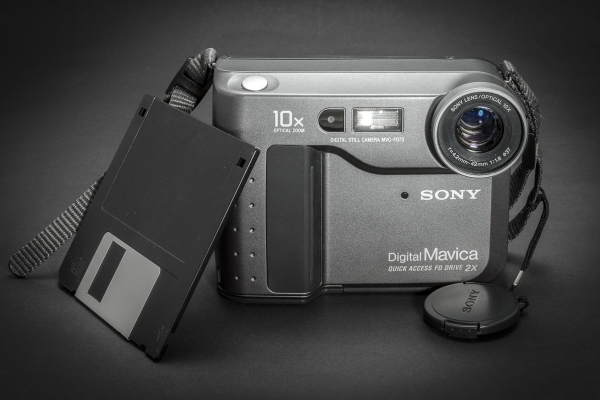
Amateur digital camera Sony Mavica MVC-FD73
And this continued until the end of the decade, until IBM intervened. However, we will discuss this in the next material.
What unusual devices have you encountered? Perhaps you had the chance to shoot with a Mavica, witness the agony of the Iomega ZIP, or use the Toshiba T100X? Share your stories in the comments.
Source: habr.com
