

Data protection implies the availability of — copies from which they can be restored. For most companies and organizations, data backup is one of the top priorities. About half of companies treat their data as a strategic asset, and the value of stored data is continuously increasing. It is used to enhance customer service, support ongoing operations, conduct research and development, and is involved in automation systems, the Internet of Things, artificial intelligence, and more. Therefore, the task of protecting data from hardware failures, human errors, viruses, and cyberattacks is becoming extremely relevant.
There is a growing trend of cybercrime. Last year, over 70% of companies were subjected to cyberattacks. The compromise of customer personal data and confidential files can have serious consequences and lead to substantial losses.
At the same time, a culture of data management is emerging, understanding that data is a valuable resource through which a company can generate additional profit or reduce costs, along with a desire to ensure reliable protection of its data.
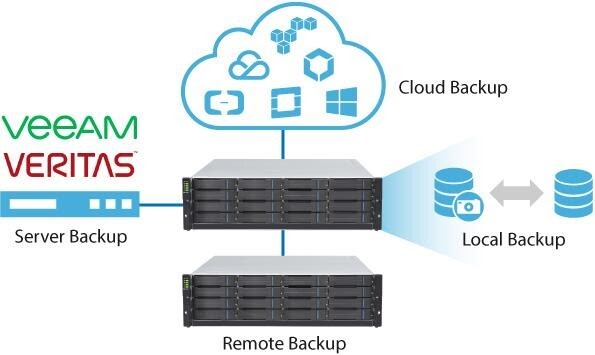
There are several options for backing up: local or remote storage of backups on one's own premises, cloud storage, or backups with hosting providers.
Store and protect
Survey results show that about a quarter of respondents perform data backups monthly, the same amount weekly, and more than a quarter daily. This is quite justified: as a result of such foresight, nearly 70% of organizations avoided downtime last year due to data loss. They are aided by evolving software tools and services.
According to According to IDC, the global data protection replication software market's sales are expected to grow annually by 4.7% from 2018 to 2022, reaching $8.7 billion. Analysts at DecisionDatabases.com in their report () concluded that in the next five years, the average annual growth rate of the global data backup software market will be 7.6%, and by 2024, its volume will reach $2.456 billion, compared to $1.836 billion in 2019.

In October 2019, Gartner presented the 'magic quadrant' for data center IT systems backup and recovery software. The leading vendors of this software included Commvault, Veeam, Veritas, Dell EMC, and IBM.
At the same time, the popularity of cloud backup is increasing: sales of such products and services are expected to grow more than twice as fast as the data protection software market overall. According to Gartner's forecast, by this year, up to 20% of enterprises will use cloud backup.
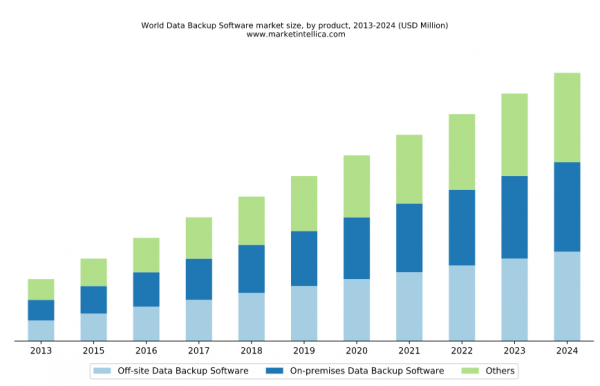
According to Marketintellica forecasts, the global software market for creating and storing backups on-premises and off-site will steadily grow in the near future.
According to IKS Consulting, in Russia, the 'cloud backup as a service' (BaaS) segment . According to from 2019, companies increasingly rely on cloud backup: over 48% of respondents use it, while about 27% prefer to combine cloud and local backup.
Requirements for backup systems
Meanwhile, the requirements for backup and data recovery software are changing. To better address data protection tasks and optimize costs, companies are willing to acquire simpler, more flexible, and cost-effective solutions, say Gartner analysts. Traditional data protection methods do not always meet new demands.
Backup and data recovery systems should provide simple deployment and administration, convenient management of the backup and recovery process, and rapid data restoration. Modern solutions often implement data replication functions, allow for operational automation, ensure integration with clouds, include built-in archiving functions, and support hardware snapshots.
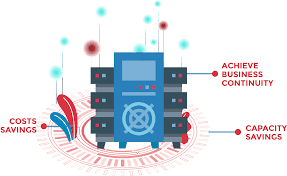
According to Gartner's forecast, in the next two years, up to 40% of companies will switch to new backup solutions, replacing their existing software, while many will use multiple products or services simultaneously to optimally protect various systems. What are the shortcomings of the previous backup and data recovery solutions?
All in One
Analysts believe that as a result of this transition, companies will gain more flexible, scalable, simple, and efficient systems, often consisting of unified software for data management and storage. Enhanced backup and recovery products include effective data management tools, allowing for data transfers to the most efficient storage locations (including automatically), and provide management, protection, and recovery capabilities.
With the growth of data variety and volume, comprehensive protection and management of data becomes a crucial requirement: files, databases, data from virtual and cloud environments, applications, as well as access to different types of data in primary, secondary, and cloud storage.
Comprehensive data management solutions provide unified management across the entire IT infrastructure: backup, recovery, archiving, and snapshot management. However, administrators must clearly understand where, how long, and what data is being stored, as well as the policies applied to it. Rapid recovery of applications, virtual machines, and workloads from local or cloud data storage minimizes downtime, while automation helps reduce errors due to human factors.
Large organizations with a combination of legacy, traditional, and modern applications often choose backup systems that support a wide range of operating systems, applications, hypervisors, and relational databases, offering high scalability (up to several petabytes and thousands of clients), while also allowing integration with a variety of data storage systems, public, private, and hybrid clouds, as well as tape drives.
Typically, these are platforms with a traditional three-tier architecture consisting of agents, media servers, and management servers. They can combine backup and recovery, archiving, disaster recovery (DR), and cloud backup functions, optimizing performance using artificial intelligence and machine learning algorithms.
As noted by Forrester, centralized management of data sources, policies, reliable data recovery capabilities, and security are the most important characteristics of backup solutions.
Modern solutions can perform backups of virtual machines at any frequency based on snapshots with virtually no performance degradation in operational environments. They eliminate the gap between the Recovery Point Objective (RPO) and Recovery Time Objective (RTO), ensuring data availability at all times and guaranteeing business continuity.
Growth of data volumes
Meanwhile, there continues to be exponential growth in the volume of data created globally, and this trend is expected to persist in the coming years. According to IDC, the volume of data created annually is projected to increase from 33 zettabytes in 2018 to 175 zettabytes by 2025. The average annual growth rate will exceed 27%. This growth is also influenced by the increasing number of internet users. Last year, 53% of the world's population used the internet. The number of internet users is growing annually by 15-20%. New and emerging technologies such as 5G, UHD video, analytics, IoT, artificial intelligence, and AR/VR are leading to the generation of ever-larger volumes of data. Sources of data growth also include entertainment content and video from surveillance camera systems. For example, the market for video storage from surveillance cameras is projected to grow at 22.4% annually, reaching 18.28 billion dollars this year.
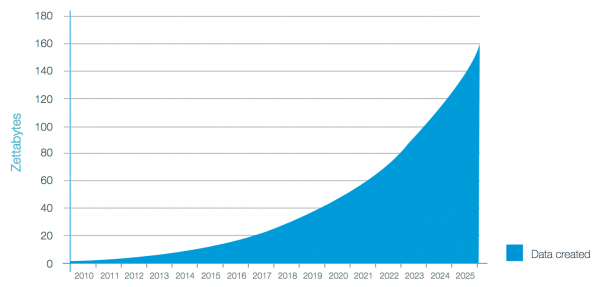
Exponential growth of created data volumes.
Over the past two to three years, the volume of corporate data has increased by about an order of magnitude. Consequently, the task of backup has become more complex. Data storage capacities reach hundreds of terabytes and continue to grow as data accumulates. The loss of even a portion of this data can impact not only business processes but also affect brand reputation or customer loyalty. Therefore, creating and storing backups significantly influences the entire business.
Navigating the offerings of vendors providing various backup solutions can be challenging. There are different options for creating and storing backups, but the most popular include local backup systems and cloud services. Cloud backup or utilizing a provider's data center ensures data protection and minimizes risks related to software failures, hardware malfunctions, and employee errors.
Migration to the cloud
Data can be accumulated and stored in private data centers, but this requires ensuring fault tolerance, clustering, and scalability of capacity, as well as having qualified specialists for storage system administration. In these circumstances, outsourcing all such issues to a provider is highly relevant. For example, when hosting databases in a provider's data center or in the cloud, one can place the responsibility for storage, data backup, and the functioning of databases on professionals. The provider will bear financial responsibility under the service level agreement. Furthermore, this allows for quickly deploying standard configurations to solve specific tasks, as well as ensuring a high degree of availability through resource redundancy and backup.
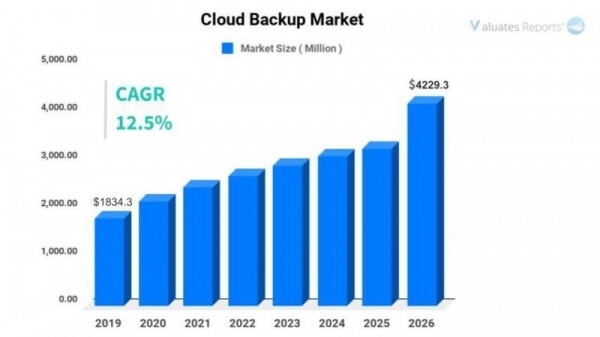
In 2019, the volume was $1,834.3 million, and it is expected to reach $4,229.3 million by the end of 2026, with an average annual growth rate of 12.5%.
An increasing amount of data will not be stored in corporate networks or on end devices, but in the cloud. According to IDC, the share of data in public clouds is expected to rise to 42% by 2025. Moreover, organizations are transitioning to multi-cloud infrastructures and hybrid clouds, a trend already embraced by 90% of European companies.
Cloud backup represents a data backup strategy that involves sending a copy of data over a network to a server outside the client's premises. Typically, this is a service provider's server that charges the client based on allocated capacity, bandwidth, or number of users.
The widespread adoption of cloud technologies and the need to manage large volumes of data are driving the popularity of cloud backup solutions. Additionally, cloud backup solutions are associated with benefits such as easy management and monitoring, real-time backup and recovery, straightforward integration of cloud backup with other enterprise applications, data deduplication, and support for various clients.
Key players in this market include Acronis, Asigra, Barracuda Networks, Carbonite, Code42 Software, Datto, Druva Software, Efolder, IBM, Iron Mountain, and Microsoft.
Multi-cloud environments
Data storage system providers are doing everything possible to ensure their products work efficiently in a multi-cloud environment. The goal is to simplify data usage and move it where it is needed, ensuring that storage is as efficient as possible. For example, they implement next-generation distributed file systems that support a unified namespace, providing access to data across different cloud environments and offering consistent strategies and management policies across clouds and on-premises. The ultimate aim is to manage, protect, and utilize data effectively, no matter where it resides.
Monitoring is yet another challenge of multi-cloud storage. Monitoring tools are needed to track performance in a multi-cloud environment. An independent monitoring tool designed for multiple clouds will provide an overall picture.
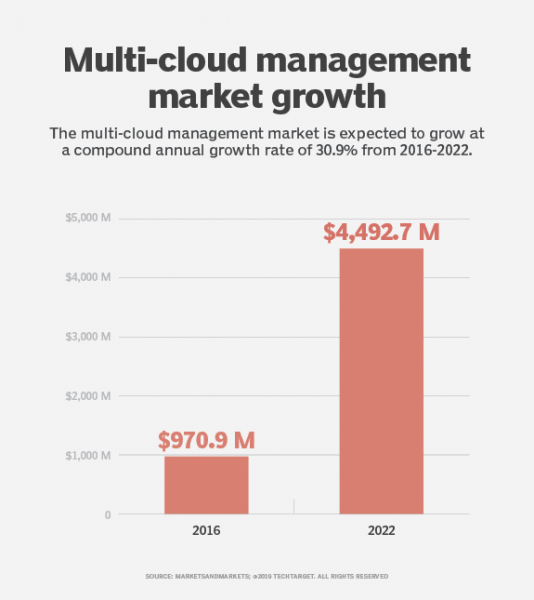
Forecast for the growth of the global market for multi-cloud management systems.
Combining edge and multi-cloud storage is also a complex task. For these systems to work effectively together, it is necessary to understand the volumes and types of data, where and how this data will be collected, transmitted, and stored. Planning the process also requires knowing how long each type of data should be kept, where, when, and how much data will need to be transferred between different systems and cloud platforms, and how backups and protection are handled.
All of this will help administrators minimize the complexities associated with combining edge and multi-cloud storage.
Data at the edge
Another trend is edge computing. According to Gartner analysts, in the coming years, about half of all corporate data will be processed outside traditional data centers or cloud environments: an increasingly significant share is being hosted at the edge — for storage and local analytics. IDC forecasts that in the EMEA region, the share of ‘edge’ data will nearly double — from 11% to 21% of the total volume. The reasons are the proliferation of the Internet of Things, and the shift of analytics and data processing closer to their source.
Edge infrastructure — data centers of various scales and form factors — offers ample opportunities for data processing and storage, providing low latency. Consequently, changes in the balance of data volumes housed in the core of the network/data center, at the edge, and on end devices are anticipated.
The transition from cloud and centralized computing to edge computing has already begun. Such systems are becoming increasingly in demand. The costs and complexities of creating a centralized architecture for processing large volumes of data are excessively high; such a system can become poorly manageable compared to distributing data processing at the edge or at an appropriate level of the network. Moreover, at the edge, data can be aggregated or depersonalized before being sent to the cloud.
Data abroad
Some companies prefer to store data abroad, viewing this option as a reliable protection against unauthorized access and an important risk reduction factor. Data stored abroad guarantees the protection of valuable information. Equipment located overseas is not under Russian jurisdiction. Additionally, with encryption, data center employees may not have any access to your data. Modern foreign data centers utilize highly reliable equipment, ensuring high reliability metrics at the data center level as a whole.
Using foreign data centers can also offer a number of other advantages. Clients are protected from risks associated with force majeure or unfair competition. Utilizing such facilities for data storage and processing minimizes these risks. For instance, in the event of server confiscation in Russia, a company can preserve a copy of its systems and data in foreign data centers.
Typically, the IT infrastructure of foreign data centers adheres to quality standards, high levels of security, and data storage control. They employ the latest IT solutions, firewalls, encryption technologies for communication channels, and DDoS attack protection measures. The power supply for data centers is also implemented with a high level of reliability (up to TIER III and IV).
Backup in relevant for any business in the Russian Federation that does not handle user personal data, the storage and processing of which, according to law No. 152-FZ "On Personal Data", must be carried out on the territory of Russia. These requirements can be met by deploying two sites: a primary one in Russia, where the initial data processing occurs, and a foreign site where backup copies are stored.
Foreign sites are often used as backup data centers. This achieves maximum security and reliability while minimizing risks. In some cases, they are convenient for storing data and connecting to European clients, providing better response times for European users. Such data centers have direct access to European traffic exchange points. For example, we offer our clients four data placement points in Europe — Zurich (Switzerland), Frankfurt (Germany), London (United Kingdom), and Amsterdam (Netherlands).
What should be considered when choosing a data center?
By using commercial data center services, businesses gain a convenient cost structure, more flexible services that can be scaled in real-time, and only pay for the resources consumed (pay-per-use). External data center services also reduce risks associated with future uncertainties, easily adapt IT to new technological trends, and focus on core business processes instead of maintaining IT infrastructure.
Providers take into account the best practices and international standards in constructing and operating their sites, which impose high requirements on the engineering and IT systems of data centers, such as ISO 27001:2013 Information Security Management, ISO 50001:2011 Energy Management System, ISO 22301:2012 Business Continuity Management System, as well as European standards EN 50600-x, and the PCI DSS standard concerning the security of processing and storing data from plastic cards of international payment systems.
As a result, the customer receives a fault-tolerant service that ensures reliable data storage and the continuity of business processes.
Source: habr.com
