

Hello!
My name is Anton Datsenko, and I am responsible for the development of corporate solutions and services in the Beeline Business division. Today, I will tell you how we use reservation technologies and load balancers in MultiSIM, for which clients such products are more important than they may seem at first glance, and a bit about networks in general.
I should clarify right away that this post will specifically address B2B clients. Because for regular subscribers, communication reservation means a smartphone with two SIM cards.
But if we’re being serious, the approaches here are somewhat similar. The importance of reserving the communication channel should be discussed in the same context as the importance of data backup. If you don't have a backup, that’s generally bad (but temporary). If you have a backup, it's already much better. And if you not only make backups but also check how well everything restores from them, that’s really good.
A stable network is, without a doubt, a guarantee of normal operation for most businesses, including small and medium-sized enterprises. This is because so much depends on the network—such as the functionality of online stores, working with databases in brick-and-mortar shops, and the operation of online cash registers and pin pads. In summary, if there’s no network, you won’t be able to make a proper payment for goods, you won’t be able to issue a receipt at the online cash register, and more.
What is a load balancer and why is it needed
A load balancer (also known as a traffic aggregator) is similar to a router that has from 2 to 4 SIM cards (depending on the model required by the customer). With the help of partners, we install equipment at corporate clients' sites and configure the connections. This can be either a direct connection through the load balancer via LTE networks or through a device with redundancy. There’s also an option with a VPN tunnel, but I’ll discuss that separately in the next post.
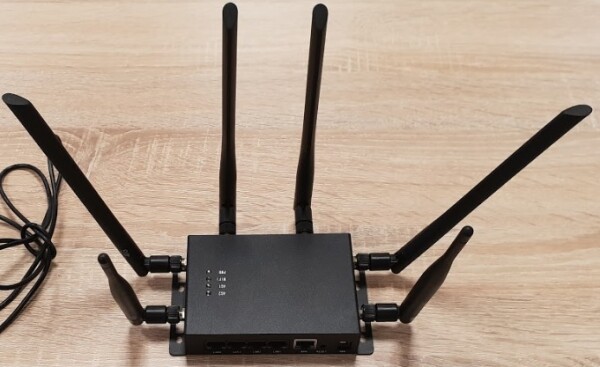
Here are two SIM cards
So, each load balancer aggregates the bandwidth of the channels provided by the SIM cards and works with the aggregation server. The server is located in our network, at the junction of our network and the partner's network, allowing us to obtain a working channel. Visually, this is a router, most often Mikrotik (yes, indeed), running a custom firmware which we based on OpenWrt and significantly revised.
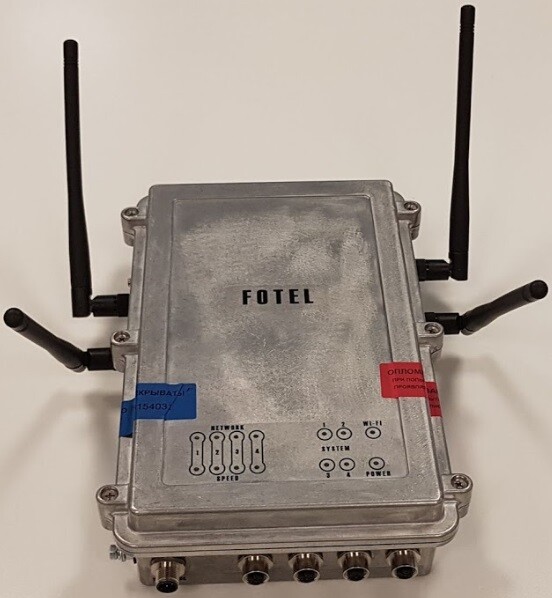
And here we have 4
More than 10 years ago, media companies in the USA started thinking about the necessity of such devices. Television there is more developed than here, with a particular focus on live broadcasts and direct connections from the scene. The quality of image and sound is important, as it is also a component of competitive advantage. Therefore, there are several companies with special patents on technologies regarding how to correctly segment a high-quality video frame into pieces, transmit it through a cellular network, and then reassemble an excellent picture from these pieces at the studio, instead of ending up with a mess, to show to the viewers. All of this, importantly, is done with minimal delay.
They use special devices equipped with a variety of SIM cards, allowing for a high-quality video stream to be transmitted from the event to the studio.
Our television market is structured a bit differently, which is why such a solution has not been adopted here, as it has turned out to be both expensive and not in high demand.
However, for businesses, load balancers with 2-4 SIM cards have come in handy.
Who benefits
It's great if your company has excellent network administrators and everything is fine with the provider. But there are situations where redundancy saves the usual workflow.
The majority of clients who actively use our product are companies with issues related to wired communication channels. There are many reasons for this — it could be a monopolistic provider in a business center, or the store might be located in a building that doesn't have a wired connection but in a small extension to it, which lacks that connection. For example, a small covered market within walking distance from residential buildings. And pulling a line from the main fiber optic network to such an extension is either complicated or unprofitable.
There are also clients with mobile offices or seasonal businesses, including event organizers. Our MultiSIM balancer (think of it as a router with SIM cards and special software) is a small box that can be quickly taken along, connected on-site, and everything will work. For instance, there is an insurance company that frequently needs to set up their offices in new locations. While that new client service office gets fully integrated into the network with all the documentation, it could take a week. However, if a MultiSIM balancer is used, it can simply be dropped off with the first shipment of office furniture and printer supplies, after which it can be plugged in and immediately provide a working network with secure access to corporate resources.
Once the office is connected to a regular wired network, the balancer can simply be removed and stored until the next such occasion, or kept as a backup in case of a network failure.
Banks. The vast majority of ATMs are connected to the network via mobile communication; inside such an ATM, there is a dongle with a SIM card that ensures communication. This usually provides sufficient connectivity since the traffic exchange of processing data is minimal, and no one is going to download torrents from ATMs, unless out of curiosity. Additionally, connecting an ATM through a mobile network makes it a bit more portable: within a shopping center, for example, it can be quickly moved from place to place, relying only on the availability of a nearby power outlet, rather than a network cable.
Where there are advantages, there will also be disadvantages. The main one is that the dongle has only one SIM card. Therefore, if this operator encounters problems, the ATM temporarily goes out of service and cannot communicate with the bank. Banks do not appreciate this, firstly, due to the loss of money (every hour of an ATM outage is a significant financial loss), and secondly, such downtimes negatively affect customer loyalty. You might rush to an ATM at a shopping center to withdraw money, and it just hangs.
We now understand that there is a high probability that this could be a network issue, but for the average person expecting crisp cash in just a minute, the source of the problem will always be the bank itself. If the ATM of a specific bank is not working = it's a stupid bank, that's how it always is. The load balancer will switch the network to the second SIM if necessary. A situation where two different operators go down simultaneously in a city is much rarer than temporary failures with one.
Additionally, let's not forget about setting up situational centers and operational headquarters for emergency services and government bodies. It is critical for them to deploy a secure network to fully access all their internal databases from any location, whether it is a field or a swamp. Currently, the process of deploying such a network looks like this:
- emergency services arrive on site and unload;
- install USB modems with operators' SIM cards;
- search for a fixed point of presence from the operators (they have contacts for such cases);
- connect the channel (either directly to the internet or straight to their network);
- overlay their special equipment on top of all this;
- deploy the network.
It may seem that there aren’t too many steps. However, the process can take a couple of days. With the load balancer, everything is done in 5 minutes. You pull it out, turn it on, and that’s it. There’s no need to worry about balance (we keep our finger on the pulse ourselves, regardless of which operators' SIM cards the client uses), plus the device doesn’t need to be kept in ideal conditions—it can even be thrown on the roof of a mobile trailer where it has better reception—IP67 protection allows for that.
Features of Redundancy
Devices that provide redundancy generally operate on a similar principle to the load balancer, but with a couple of differences. First, there are always only two SIM cards here. Second, they work alternately, meaning only one is active at a time; there’s no channel bonding done.
The client-side setup is just as simple — a router is installed with a special Python script uploaded, operating as an LTE modem, automatically switching from the first SIM card to the second as needed (the script does this based on certain trigger events). An additional benefit is not just its operation as a pure LTE modem, but also capability via cable. In other words, if you have access through a wired network, you can plug a cable into the router and work through it. If something goes wrong with the cable connection, the LTE channel will activate. This provides a form of redundancy for the cable signal if desired.
Here we did everything ourselves, without involving partners or third-party contractors.
A key feature of working with redundancy is VPN only. Yes, we build the entire network through a VPN tunnel. All SIM cards installed in such devices are in a single VPN network, so if you take one out and insert it into a regular smartphone, it won't work. The redundancy device creates a tunnel through the VPN network to our gateway, where clients connect. Essentially, for the end client, there is no difference, except for the size of the end non-fragmented packet.
At the same time, we keep the same IP and corresponding settings for each specific client. It operates via cable, switches to SIMs, and if you decide to move the device somewhere — the IP remains the same.
There are two more useful features for corporate clients.
First, Wi-Fi. The device functions as a limited network router, a sort of point between the operator and the client, and can also work as a typical client router according to a predefined set of rules. Nothing prevents you from adding Wi-Fi on top of this so that corporate clients can provide their employees with fast Wi-Fi. I would like to note that in this scenario we are specifically talking about a corporate working network, not public Wi-Fi with SMS authorization like in cafes and other places.
Secondly, there is a built-in SIP gateway. The router has a small PBX that can work with our cloud PBX, allowing clients to connect analog phones directly to the router. At the end of this year, we plan to launch a full-fledged service that includes multisim redundancy + Wi-Fi + cloud PBX, which is currently in testing. There is a plan to provide this service in the format of two entities — either immediately with our cloud PBX or with the PBX that the client already has.
Suppose a client has their own IP VPN network without internet access and their own PBX on Asterisk. They provide us with their settings, and we configure everything so that the client receives a router with two subscriber lines, Wi-Fi, and IP VPN access.
How to connect
Here on these pages.
.
.
For now, we are conducting active load testing. I will report on the results separately. If you have any questions about how our MultiSIM works, feel free to ask in the comments, and I will respond.
Source: habr.com
