

Have you ever wondered how letters with fines from the traffic police or bills from Rostelecom are printed? To send a letter, you need to print it, buy an envelope and stamps, and spend time going to the post office. And what if there are a hundred thousand such letters? Or a million?
For mass production of mailings, there is hybrid mail — here we print, pack, and send correspondence that cannot be delivered electronically. The client only needs to provide the recipient's information and upload the text in digital form, and we'll take care of the rest.
Currently, hybrid mail services are used by government and private companies that send thousands of mailings daily. Among them are the traffic police, Rostelecom, and Sberbank.
Most of the work in the shops is automated — letters are printed using industrial printers with huge rolls and automatically packed on special lines.
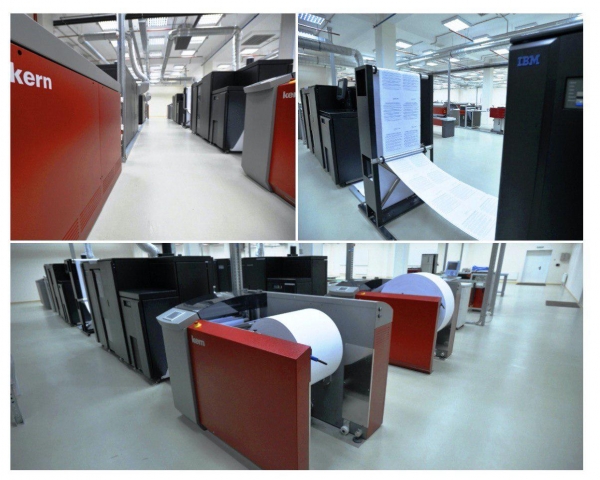
The cost of the service remains the same as for self-sending. For regular letters without tracking, it is 27 rubles 60 kopecks; for registered letters — 64 rubles 80 kopecks.
There are printing facilities in all regions of Russia, so many letters do not go through the regional transport stage and are delivered faster.
How hybrid printing works
The work of hybrid mail is supported by 55 printing shops, four of which are large facilities in Moscow, St. Petersburg, Kazan, and Novosibirsk. At these facilities, we can print up to 4 million letters a day.
The client — an individual or organization — provides us with a letter in electronic form. Legal entities upload an archive of PDF files to their personal account on otpravka.pochta.ru or send data via API through integration with the electronic postal system (EPS).
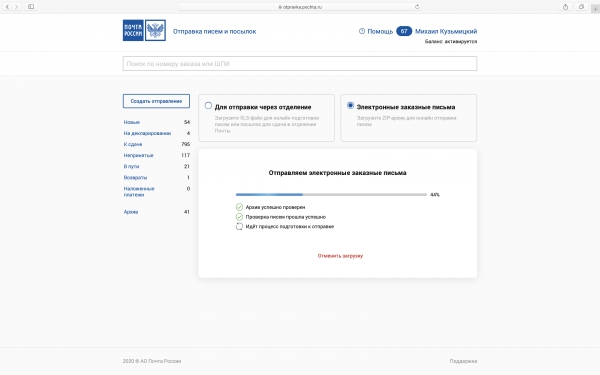
Individuals upload their letters through their personal account on .
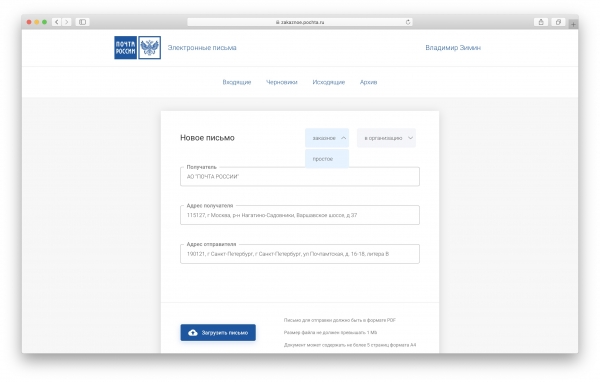
The sent files go into the EPS information system, are processed, and passed on — to the automated hybrid mail management system.
Received PDF letters are sorted into JSON — a simple and understandable format for processing, automatically converted into text, and prepared for printing and packaging in envelopes: we set boundaries, check fonts and sealing areas, and verify the recipient's address and zip code to ensure the letter goes where it needs to.
Each shipment has a specific set of data, similar to a transaction at a bank:
- information about the recipient and sender
- shipment rate
- weight
- printing parameters for each sheet: single-sided, double-sided, paper type, density
- envelope information: size, number of windows
Using this data, we calculate how to efficiently use space on the sheet. To save space, different text layouts can be utilized or the types of envelopes can be varied — with one or two windows or none, preparing envelopes with printed addresses.
The machine can print letters on one or both sides of the paper, fold them into envelopes in various ways — Z, C, or house shape. The address block can be printed on one side of the sheet, while the actual information is on the other. Currently, a person sets the layout data for the machine, but we plan to enhance this part of the work — the data will be sent to the equipment through an automated hybrid printing management system.
The print file sent to the printer after preparation consists of a large PDF or AFP, which "glues" up to 500 letters together.
Small workshops use sheet-fed printers that can print up to two thousand shipments a day.
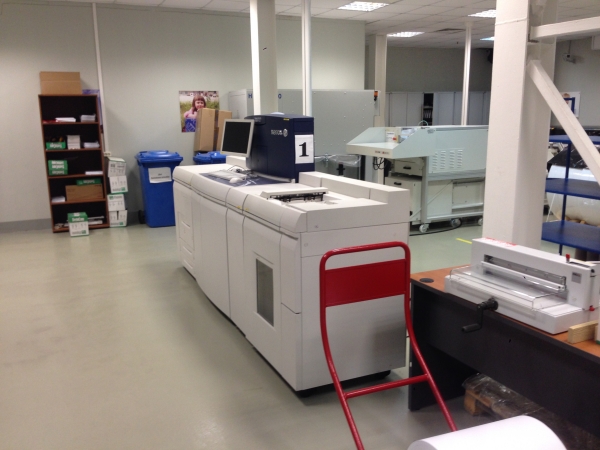
Sheet-fed printer
Printing in large workshops is automated and occurs in three stages
The first machine receives the file and prints many letters on a roll.


A person removes the roll from the roll printer and puts it on a cutter, where the ribbon is divided into A4 sheets.

In the next stage, the envelope machine folds the sheets in a specific way for packing and inserts them into envelopes. This device can read a special barcode (dataMatrix), which indicates which envelope a specific sheet should go into. The machine can pack no more than 5 printed A4 sheets into one envelope — hence the limitation on the size of electronic registered letters.

Finished letters are collected by workshop staff into boxes, loaded onto carts, and sent to the post office.
How to use hybrid mail services for your tasks
If you need to send a large number of letters, you can delegate the preparation, printing, packaging, and sending functions to the Post Office. Each sheet costs money for the sender, and these expenses can be easily optimized.
The cost of the service consists of two parts: the printing fee and the mailing fee. The price of printing depends on the order volume, number of colors, packaging method, and other parameters. The mailing expenses are in line with standard rates. An SLA has been agreed upon for each order — the timeframe in which the letters must reach the postal office. Notifications on the screen and emails about approaching deadlines help us track the time.
Distributed Printing
We strive to further reduce delivery times and transport load. To accomplish this, we are working on creating distributed printing technology that will allow us to automatically send print jobs so that letters appear on paper as close as possible to the recipient.
For example, a person violates traffic rules in Moscow but is registered in Khabarovsk. They will receive a fine from the Moscow branch of the traffic police. Our task is to deliver the letter to Khabarovsk with minimal movement. Instead of printing it in Moscow and sending it to another city by plane or train, we materialize the shipment at the center closest to the recipient and deliver it with minimal logistics costs.
To receive letters even faster and to eliminate paper correspondence, enable electronic letter delivery in your personal account. .
Source: habr.com
