


Many of the early Internet providers, especially AOL, were not ready to offer unlimited access in the mid-90s. This situation persisted until an unexpected rule-breaker emerged: AT&T.
Recently, the Internet has been actively discussed in terms of its 'bottlenecks.' This is quite logical, with a 12-year-old cable modem. Despite the repeated doubts raised by officials and the public, during the COVID-19 pandemic. However, the real issue is access. Rural areas are notorious for their terrible Internet access, with users having to deal with slow DSL or due to the failure to implement legislation that would have filled this gap in a timely manner. But today, I'd like to take a step back and discuss the time when the Internet faced problems from providers. In this article, we'll talk about the difficulties the Internet encountered when dial-up access first gained widespread popularity. 'Keep trying to dial in; sooner or later you'll get connected.'

Let's think about this advertisement: one person visits a friend to see if he's ready to join a baseball game, but actually admits that he can't go himself. Why did he even come? This advertisement is based on a logical fallacy.
The day AOL opened the gates of the Internet
Real Internet users have long harbored suspicions about America Online due to the model it created. This was not the 'real' Internet — the company did not require users to use something like or a terminal; it provided a friendly interface while keeping control for itself. Given the culture of technical savvy that created the Internet, such a model was an easy target.
Decades later, major social networks will resemble AOL greatly, but providers will be completely different. And much of this is due to the pivotal decision made by AOL on December 1, 1996. On that day, the company first offered unlimited access to its service for a flat fee.
Previously, the company offered various plans, the most popular of which were 20 hours per month and $3 for each additional hour.
A month before the new plan was introduced, AOL announced that for $19.99 a month, people could stay online as long as they wanted. Additionally, the company would enhance access technology so that users could operate through a standard web browser instead of the service's built-in web browser. As columnist Chicago Tribune James Coats, this change would also enable support for Windows 95, allowing the company to "transform into a fully functional 32-bit internet service provider with a flat fee of $20 a month." (Users could finally escape the horror of using web-surfing applications designed for Windows 3.1 in Windows 95!)
However, this decision turned into a pendulum swinging back and forth. Within a few months of the plan's introduction, accessing the AOL network was nearly impossible — the lines were always busy. Some people tried to solve the problem by purchasing a separate phone line so that it would remain constantly busy, and they wouldn't have to redial. Repeated redials were a torture. The user was next to an expansive digital ocean, but connecting to it was a challenge.
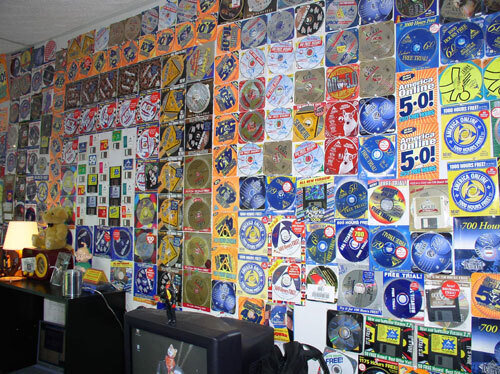
The problem was exacerbated by the fact that in the mid-1990s, AOL flooded users with a massive quantity of disks. (Photo: )
At the time, the significance of this change for AOL's business model went largely unnoticed. Overnight, the world's largest internet provider opened up access to the entire internet, departing from the 'carrot' scheme that most online services were adhering to at the time.
Until this moment, such online services as AOL, along with its predecessors like and , had pricing models based on the volume of services used; over time they became less, not more expensive. Notably, companies inherited their pricing strategy from electronic bulletin boards and digital access platforms, such as , which charged extra monthly payments also included hourly ones. Such a model isn't particularly consumer-friendly and posed a barrier to the enticing level of Internet accessibility that we have today.
Of course, there were other bottlenecks. Modems were slow on both sides of the equation—in the mid-1990s, the most common modems were still running at 2400 and 9600 baud, and speeds were artificially limited by the quality of the connections on the other end of the line. You might have had a 28.8 kilobit modem, but if the online provider could only supply 9600 baud, you were out of luck.
Probably the most significant barrier to constant access was the business model. Early Internet providers simply didn't know whether giving us more Internet access made sense, and whether the business model would hold up without hourly charges. They also faced infrastructure issues: if you offered unlimited Internet to everyone, you'd better have the infrastructure to handle all those requests.
In his 2016 book Shane Greenstein explains why Internet access prices were a serious issue. No one knew exactly what would be the winning argument for the internet age. Here's how Greenstein describes the two philosophical camps in the provider world:
Two viewpoints emerged. One of them emphasized user complaints about losing control. Users noticed that surfing the World Wide Web was hypnotic. It was difficult for users to keep track of time while online. Moreover, tracking online time was nearly impossible if multiple users were present in one household. Providers sympathetic to such user complaints believed that an acceptable solution would be unlimited usage for a fixed monthly fee. Increasing the price would cover the additional costs of unlimited access, but the question of how much to raise it remained open. Such pricing plans are usually referred to as "flat rate" or "unlimited".
The opposing viewpoint contrasted with the first. Specifically, it was believed that user complaints were temporary, and new users needed to be 'trained' to monitor their own usage. Supporters of this perspective cited examples of mobile phones and electronic bulletin boards. At the same time, cellular technology was developing, and per-minute billing did not deter users. It seems that one enterprising company offering electronic bulletin board services — AOL, even thrived thanks to such billing. Providers adhering to this viewpoint expressed confidence that payment based on usage would prevail and advocated for exploring new combinations that better suited the traditional surfing model of technically inexperienced users.
This led to a rather sad state of affairs, and it was unclear which model would yield greater profit. The side that solved this Gordian knot changed everything. Ironically, it was AT&T.
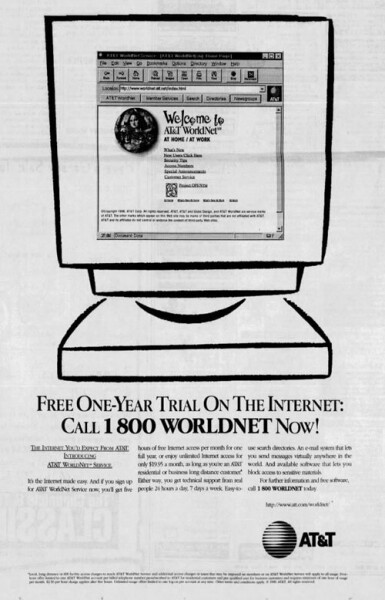
One of the old ads for AT&T WorldNet — the first Internet provider to offer unlimited access for a fixed fee. (Taken from )
How AT&T Made Unlimited Access the De Facto Standard for Mainstream Internet
Those familiar with AT&T's history know that this company was not typically seen as a barrier breaker.
Rather, it tended to maintain the status quo. It is enough to learn about the history of the TTY system, , striving to find a way to communicate with friends, effectively invented the acoustic coupler (a gadget that literally allows you to place a phone on a microphone and speaker) to bypass the 'Ma Bell' restriction that prevented third-party devices from connecting to its phone lines.
But at the beginning of 1996, when AT&T launched the WorldNet service, much changed. The RJ11 phone jack, used in virtually all modems of the early 1990s, emerged as a result of a court ruling preventing AT&T from restricting the use of third-party peripherals. Thanks to this, we got answering machines, cordless phones, and… modems.
By 1996, the company found itself in a peculiar position, becoming a rule-breaker in the then-nascent Internet industry. It was large enough for people who had never used provider services to finally consider trying them, and due to its flat-rate pricing, the company attracted active users — $19.95 for unlimited access if you subscribed to the company's long-distance service, and $24.95 if you did not. To make the offer more appealing, of free Internet access per month for the first year of usage. (Interestingly, it also offered speeds of 28.8 kbps — quite high at that time.)
The problem, according to Greenstein, was the bet on scale. With such a low price for Internet access, the company was essentially counting on tens of millions of people connecting to WorldNet — and if it couldn't guarantee that, nothing would work. 'AT&T took calculated risks by choosing to create a service model that couldn't be profitable unless widely used across many cities in the U.S.'
AT&T was not the first company with a flat rate — I personally used an Internet provider that offered unlimited dial-up access as far back as 1994. I had to use it because my excessive enthusiasm for long-distance calls to BBSs ultimately reflected on my parents' phone bills. But AT&T was large enough to launch a nationwide flat-rate Internet service provider that wouldn't struggle against its smaller regional competitors.
In this article noted that at one point, AT&T wanted to create its own 'walled garden,' similar to what AOL or Microsoft did with its MSN. However, around 1995, the company decided to simply provide people with a pipe to the Internet using open standards.
Markoff wrote: 'If AT&T builds an attractive and affordable portal to the Internet, will customers follow? And if they do, will anything remain unchanged in the communications industry?'
Of course, the answer to the second question was negative. But not only because of AT&T, even though it gained a massive number of users by deciding to charge a flat fee for unlimited Internet. In reality, this industry was permanently changed reaction to AT&T's entry into the market, which set a new standard for Internet access.
The bar of expectations was raised. Now, to avoid falling behind, every provider in the country had to offer unlimited access services priced competitively with WorldNet.
As Greenstein notes in , this had a devastating impact on the still-young Internet services industry: AOL and MSN became the only sufficiently large services capable of setting such a price. (Notably, CompuServe responded at the same flat rate of $19.95 as WorldNet.) But AT&T : about a decade ago, the Federal Communications Commission decided to allow the company's data transmission lines not to comply with the pricing rules applicable to local voice calls.
AOL, which had a large business centered around content existing in its own system, initially tried to play on both sides, of its service that ran over the AT&T connection.
But soon it too had to come to terms with the new standard — the requirement for flat fees for dial-up Internet access. However, this decision brought a whole slew of problems.
60.3%
Such was the call drop rate at AOL according to , performed by the Internet analytics firm Inverse. This figure was almost twice as high as that of the second company on the list of failures, and likely resulted from poor optimization of the dial-up network equipment. For comparison: the drop rate for CompuServe (which turned out to be the best company in the study) was 6.5 percent.
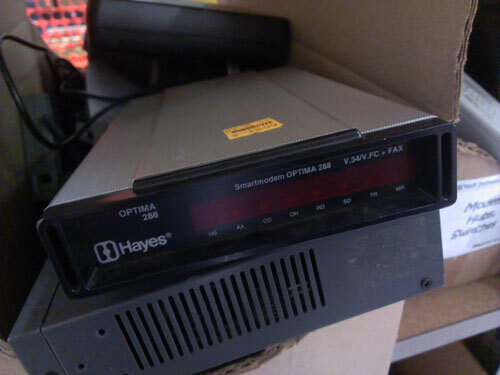
A 28.8 kbps modem, highly valued by home Internet users in the mid-1990s. ()
Taming the busy signals: why attempts to go online became such a nightmare in 1997
In the last few weeks, I've often heard one question—can the Internet handle the increased load? The same question was asked in early 1997 when more and more people began spending hours online.
It turned out that the answer was negative, not because the increased interest made accessing websites difficult. It was harder to access the phone lines.
(Individual websites were stress-tested due to the tragic events of September 11, 2001, from the interest in important news, as well as the destruction of a significant part of the infrastructure of one of the world's largest cities.)
AOL's infrastructure, already under stress from the service's popularity, simply wasn't built to handle the additional load. In January 1997, less than a month after providing unlimited access, lawyers from across the country began to pressure the company. AOL was forced to promise refunds to customers and limit advertising until it could resolve the infrastructure problem.
According to , AOL approximately doubled the number of modems available to subscribers, but for anyone who used the phone system to access the data service and received a 'busy' signal, it was clear that the problem was more serious: the phone system wasn't built for that, and it was becoming quite evident.
In this article Sun It was said that the telephone network structure was not designed for 24/7 use of lines, which dial-up modems encouraged. This strain on the telephone network led the Bell companies to attempt (unsuccessfully) to introduce an additional usage fee. The Federal Communications Commission (FCC) was not pleased, so the only real solution to this bottleneck would be a new technology that would take over those phone lines, which eventually happened.
'We use ordinary telephone networks because they already exist,' wrote author Michael J. Horowitz. 'They are slow and unreliable for data transmission, and there are no insurmountable reasons why the needs of Internet users should conflict with the interests of those making voice calls.'

This meant that for at least several years we had to rely on a completely unstable system, which adversely affected not only AOL users but everyone else as well. It is unknown whether Todd Rundgren, who wrote the infamous song about the anger and frustration of a person unable to connect to their Internet provider, was an AOL user or a user of another service: "".
According to Greenstein, providers tried to invent alternative business models to encourage users to connect to the Internet less frequently, attempting to charge lower fees or pushing particularly aggressive users towards choosing other services by withdrawing unlimited access. However, after the Pandora's box was opened, it became clear that unlimited access had already become the standard.
"Once the market as a whole transitioned to this model, providers could not find a large number of enthusiasts for its alternatives," writes Greenstein. "Competitive forces were aligned with user preferences — unlimited access."
AT&T's WorldNet was also not immune to the problems caused by unlimited internet service. By March 1998, just two years after the service was launched, for each hour used beyond the monthly 150 hours. 150 hours is still a fairly reasonable number, averaging about five hours a day. You can use them up if instead of watching "Friends" you spend every evening online, but that's definitely less than the promises of "unlimited" internet.
As for AOL, it seems to have come to the best solution in this uncomfortable competitive situation: after spending hundreds of millions of dollars upgrading its infrastructure, , effectively doubling the capacity of its dial-up services in one fell swoop. According to Greenstein, around the same time, the company sold its dial-up equipment and handed it over to contractors so that busy signals became someone else's problem.
In hindsight, the decision was almost genius.
Today it seems obvious, that we were somehow doomed to obtain unlimited access to the Internet.
Ultimately, one can imagine that college students in dorms with T1 lines were extremely frustrated by the technology beyond their campuses. The inequality was so apparent that it could not possibly be sustained forever. To be productive members of society, we need unrestricted access through these wires.
(Mark my words: a decent number of people who attended college in the 90s and early 2000s likely extended their stay in educational institutions simply because they needed access to the rare high-speed Internet of those times. Getting a second degree? Gladly, as long as the download speed was good!)
The Internet in dormitories was probably amazing, but dial-up modems clearly could not provide such speeds at home. However, the shortcomings of dial-up access eventually led to the development of more advanced technologies; DSL (which utilized existing phone lines for high-speed data transmission) and cable Internet (which used the lines that required time to connect) ) helped most users get closer to Internet speeds that were once only achievable on college campuses.
While writing this article, I pondered: what would the world look like if an infection like COVID-19 appeared when we were mostly online via dial-up, as such diseases seem to crop up once every hundred years. Would we be able to work remotely as conveniently as we do today? Would busy signals have hindered economic development? If AOL had hidden dial-up numbers from its users, as they suspected, would that have led to riots?
Would we even be able to order goods to our homes?
I don't have answers to these questions, but I know that when it comes to the Internet, from a connectivity perspective, if we had to stay home, today would be the most suitable time for it.
I can't imagine what it would be like if the busy signal added to all the pressure we currently feel during the lockdown.
Source: habr.com
